From Bashkim TRENOVA
Part Twenty-Five
– NAZIBOLSHEVISM – LITERATURE AND THE ARTS –
FOREWORD
Memorie.al / Historians, political philosophers, intellectuals of different schools or different positions have devoted thousands and thousands of pages, entire volumes, studies and articles to the comparison between Nazism and Communism. Generally, in their publications and studies, they focus on the police control of society by these dictatorships, the role of the dictatorial state hierarchy and the head of state as suppressors of free thought, the omnipresent place of official propaganda in society, the mass massacres and the network of concentration camps, the activity of the police, the NKVD in the USSR (later the KGB) and the Gestapo in the Third Reich. In his book *“Le Passé d’une illusion”* (The Past of an Illusion), François Furet notes that Nazism and Communism share the same opposition to liberal democracy and what they call “capitalist bourgeoisie”. Both ideologies claim to be socialist and use the image of socialism. Communist countries called themselves “socialist”. “Nazism” is a shortening of National Socialism.
Continued from the previous issue
THEATRE
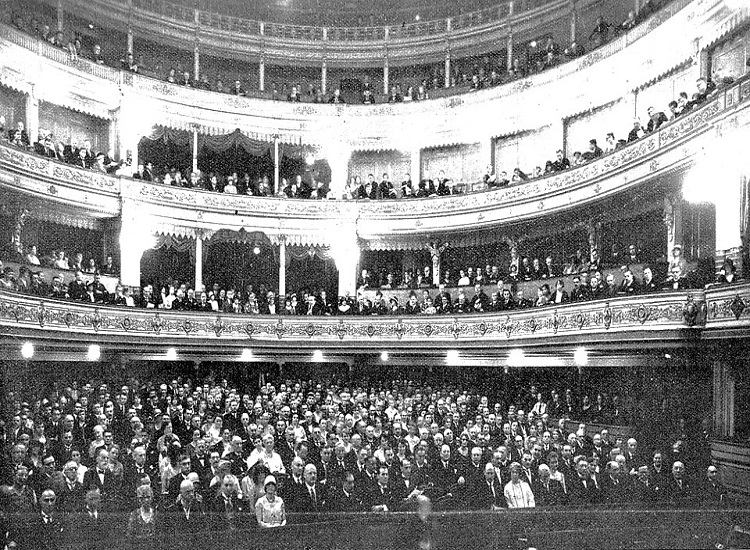
Like the macabre Nazi orcs, Nazi politics and ideology, the Nazi Thing Theatre ultimately turns out to be just a failed attempt. It did not find strong public support; the public soon grew bored with it and abandoned it. The content of the spectacle, its length, the mass scenes, the supposedly patriotic spirit, the deification, the mysticism, could not cover up its mediocrity for long. Neither the working groups of around forty writers assembled by Goebbels, nor the creation of competitions and special prizes, would be able to breathe life into the Thing Theatre, which was ultimately doomed to death.
Besides the Thing Theatre, in the Germany of the Third Reich there also existed another type of theatre: puppet theatre. Upon coming to power, the Nazis invested in using puppets, or in other words marionettes, for propaganda and ideological purposes, emphasising historical values and compliance with the regime, service to it. Such is, for example, the play ‘Wölfe’ (‘Wolves’) by the Nazi playwright Hans Rehberg, which deals with the attack of a British ship by a German submarine during World War II.
The Nazis’ interest in puppet theatre and the role of this theatre is encountered as early as 1933. From that year, the state organisation ‘Kraft durch Freude’ (‘Strength through Joy’) organised various activities, trips, variety shows, concerts, etc. Performing within the framework of this organisation offered professional puppet theatres great and stable financial opportunities. From 1937 onwards, 37 puppet theatre stages, under contract with the ‘Kraft durch Freude’ organisation, developed their activity in schools across the country, in various clubs, and later in military hospitals.
In 1938, aiming to use puppets as productively as possible in their service, the Nazis created the National Marionette Institute. “Puppets thus found themselves on the front line of ideological and political education.” Puppet theatre was used especially in the youth organisations of the National Socialist Party (NSDAP) to deepen their political education. Starting from 1939, the emphasis of the plays performed by puppet theatres was placed on supporting the troops.
During World War II, we also see puppet theatre in a very limited, perhaps even isolated, but nonetheless completely opposite role. There are no specific, in-depth studies in this direction. It is known that in 1943, Hanus Hachenburg, a 13-year-old Czech Jew in the Theresienstadt concentration camp, secretly wrote a puppet play – ‘Hledáme strašidlo’ (‘We Need a Ghost’). The play tells the story of a king, Analfabet I (Illiterate I), who demands that everyone think absolutely like him. His guard arrests all persons over the age of 60 in the kingdom and collects their bones to fabricate a ghost.
This puppet play conveys talent, irony and black humour. It was published in manuscript form in the magazine *Vedem*, an underground magazine of the children of Barracks No. 1 of the Theresienstadt camp. In this camp, “the SS had sent the elite of Europe’s Jewish intellectuals and artists and ordered the production of propaganda works. This strategy had the external effect of favouring underground creations. Thus, a group of young Czechoslovaks published the magazine ‘Vedem’, which they copied and distributed secretly.”
In a general overview of the theatre of the years of Hitlerite power and occupations, the theatres in Nazi concentration camps cannot be omitted. To this day, this theatre has not been analysed or documented in its entirety, in the appropriate depth, but only in a good part, with a few articles or thesis defences that make theoretical generalisations and draw general conclusions. Even the occasional rare interview with survivors of Nazi camps conveys impressions and data on the activity of theatres in these camps.
Documents on Nazi camp theatre that have survived to our days are very few. Among them, some photographs taken on 1 February 1941 in Thorn, at Stalag XX A, can be singled out, testifying to the sufferings in the camp, the spiritual state of the prisoners or deportees. On the same date, a delegation of the International Red Cross made a visit to the camp. At the end of it, in a report where the camp theatre is also mentioned, among other things it is written: “We read a great sadness on the faces of these actors… and moreover the traces that the camp has left on their bodies, in their daily lives.”
In the aforementioned photographs, one can also see actors dressed in short robes, their legs covered with sores, reminding you of their true status as prisoners of war, who work in the camp like everyone else until exhaustion, until death. In these camps, scattered throughout Europe, the prisoners and internees, women and men, whether belonging to the world of theatre or not, secretly chose the stage or dramaturgical style to express them. They did this starting with the spectacle ‘Cikus Conzentrazani’, performed in August 1933 at the Kazet Théâtre, and continuing until ‘Zebra’, in the first days that followed their newly won freedom in 1945.
Speaking of theatre in Nazi concentration camps, the French dramaturge, director and researcher of theatre in Nazi camps, Claire Audhuy, writes: “We divide these examples into two groups, summarising, on the one hand, the official theatrical creations and, on the other hand, those that saw the light clandestinely.” Under the difficult living conditions in concentration camps, in Stalags or Stammlager (camps for soldiers and non-commissioned officers who were prisoners of war), as well as in Oflags (camps for officer prisoners of war), there were several theatrical initiatives. Each Oflag had its own theatre approved by the Nazi camp administration.
The performances of this theatre, performed by the prisoners, humiliate the prisoners, demoralise them, depersonalise them, allow them no space for hope, however small, and shackle their spirit and attention just like their freedom. The Nazis used the existence of this type of theatre also to present it to the outside world as evidence of “cultured life” in the concentration camps. In short, it can be said that this type of theatre served as a forced instrument in the service of Nazism and its propaganda in all its breadth.
Another type of theatre is that created also by prisoners, performed for prisoners, secretly. Their art must be seen as an expression of resistance, of survival even in the extra‑life conditions of the concentration camps, as a powerful tool to keep morale and hope high, not to surrender, not to capitulate. “It was a kind of powerful battery for our energy…! For our imprisoned and poisoned souls it was a disinfectant medicine, far superior to all those possessed by Nazi medicine.”
Thus writes the Polish writer and screenwriter Marian Brandys, a former prisoner of war in the Nazi camp Woldenberg II-C, where Polish officers who had resisted the Nazi invasion were interned. The Oflag, or Camp XVII-A, was a prisoner‑of‑war camp for officers (Offizierslager) in Edelbach, Austria. According to the historian and specialist of Oflag XVIIA, Andreas Kusternig: “the theatre and dance stages also served to bring a little joy of life into the daily grind and to make the spectators’ eyes shine.”
In Camp XVII A in Edelbach, in Barracks 18, amateur troupes staged several plays such as Labiche’s comedy ‘Les Trente sept Sous de Monsieur Montaudoin’ (‘The Thirty Seven Cents of Mr. Montaudoin’), ‘Sud’ (‘South’) by Paluel‑Marmont, ‘Cigalon’ by Marcel Pagnol, etc. Karel Švenk, a Czech actor, director, composer and writer, is one of the well‑known names of theatre in Nazi concentration camps. He was deported by the Nazis in December 1941 to the Theresienstadt concentration camp, then to Auschwitz and Meuselwitz. Karel Švenk died during an exhausting, deadly death march, about two weeks before the end of the war. It is not known whether he died from overexertion or from blows by the camp guards.
Karel Švenk is known above all for his secret camp anthem ‘Vsechno jde!’ (‘Everything Goes!’), known as the ‘Terezín March’. In Terezín he wrote the comedy ‘Der letzte Radfahrer’ (‘The Last Cyclist’). The comedy was never staged. It has been preserved, partially. Some conceptions of the set and costumes of the spectacle have also been preserved. ‘Der letzte Radfahrer’ tells the story of a group of patients in a psychiatric hospital who manage to leave the hospital and put the world under their control. Since they did not like their hospital’s cycling doctor, they made all cyclists responsible for all the world’s problems.
The leader of the madmen extends the persecution to all those who have a cyclist in the family, or who had one many generations ago, as well as to those who have any connection whatsoever with cyclists. The victims of the madmen are sent to an island where they die of starvation. The anti‑hero of the play is the merchant Borivoj Abeles, who, to impress his girlfriend, decides to buy a bicycle at the most inopportune time. He also labelled the “last cyclist”, soon falls into the claws of the madmen’s police. Nevertheless, Abeles manages to escape the madmen and punish them.
In the secret theatre, the imprisoned audience was not to applaud; they had to avoid any suspicious noise. It was clear that the discovery of unauthorised theatre activities would without doubt face severe punishment, even death. Everyone: authors, actors, spectators risked their lives to attend a theatre. In truth, at that time in the concentration camps, ghettos or Nazi political prisons, risking life was a constant companion, part of the prisoner’s day. Death lurked at every step. Even a little food, a letter, a cigarette, a simple meeting between husband and wife, father and child, could mean death.
Therefore, acting in this theatre or watching it was no exception to the risk. But theatre, despite everything, made the actors and spectators laugh. Laughter in this hell was a tool for survival. Laughter in the camp allowed one to overcome, even for a few moments, the pain and the inexplicable absurdity of a tyranny, the terror, the demonic madness of a dictatorship. It proved that you are still a being of this world, a living being. And that was no small thing!
The theatre of the concentration camps, its great art, is one of humanity’s great achievements in the chambers of death and pre‑death, of madness and mass barbarism. Under the conditions of a tyrannical system and hundreds of thousands of executioners who served it, this theatre appears as a loyal ally of survival, of the unimaginable efforts to help and continue the breathing of the human being, defying the asphyxiation of the fire of the arsonists of the continent, of its values, of man himself as its greatest value.
Theatre in Russia has a tradition. Classical theatre is represented by works known worldwide such as: ‘Борис Годунов’ (‘Boris Godunov’) by Alexander Pushkin, ‘Ревизор’ (‘The Inspector General’) by Nikolai Gogol, etc. After the October Revolution, a veritable frenzy of theatre is observed. Konstantin Rudnitsky, a renowned theatre historian and critic, relates that in a ‘Вестник Театра’ (Theatre Bulletin) of 1919 it was written: “The future historian will discover how, through one of the bloodiest and most brutal revolutions of all time, Russia was making theatre.”
The communists in power used theatre, the art of the stage in general, to replace the Church and religion with a new church and a new religion, to preach and shape the “New Man” with an engine heart, a revolutionary human‑machine, charged with the “sacred mission” to propagate a brilliant future, to support the sending of soldiers to the front and the dekulakisation of the countryside, the “proletarianisation” of the intelligentsia and the ruin of the aristocracy. The policy of the Soviet authorities towards theatre, consistently, despite some opportunistic adjustments, was inspired by an extreme militant thought and stance.
Communist theatre was theorised, written, staged and produced by persons directly or indirectly linked to the Communist Party, its mass organisations or its sections. It was generally labelled as “proletarian”, “workers’”, “revolutionary” or “agitprop theatre”. For the communists, workers had been excluded from theatre for centuries. They had no voice in theatre, they did not speak. Others spoke for them. The “bourgeois” stages in Europe and the “noble” stages in Tsarist Russia left this class in oblivion.
This does not mean that peasants or workers were absent from bourgeois or aristocratic stages. They were present, but not as factors or as political actors, not as a social class conscious of the oppression, of the exploitation it suffered and of its duty to put an end to this oppression and exploitation through revolution. Thus, theatre had to be revolutionised. For the Bolsheviks, a political theatre was needed.
According to the decisions of the party in power, theatre in Bolshevik Russia should have nothing in common with bourgeois theatre. In the new “proletarian” theatre, the actor should not simply be the embodiment of a character but, above all, a leader of an idea, of a political logic, a political affirmation. In Russia at that time, steps and concrete actions were undertaken to transfer dramatic art outside the narrow confines of the atmosphere of a hall, to place it in a square or public space.
Practices of this nature were justified by their authors with the aim of giving the masses the opportunity to participate in the spectacle, merging spectator and actor into one. During the years 1917 and 1920, the communists sought to also make a revolution in theatre. According to them, this type of revolution would give the proletariat the right not only to appear on stage, but also to be authors, directors, actors. In fact, Lenin and later Stalin saw in the proletariat only a “pretext class” in the service of their authoritarian and dictatorial policy.
As expressed by the Soviet authorities after the October Revolution, charged with the “educational” role of theatre: “A theatre must be created where the masses participate in dramatic creation. The centre of physical and military education, mandatory for all, must work to prepare the masses for this purpose…! The author will make the canvas of the play, the director will arrange the entire staging. At the moment when the crowd must participate, the spectators will have been trained to sing with the actors, to bring the play to life, they will be carried away, like the artist, by the desire to create.”
The Bolshevik power very quickly understood the strength and role of a “proletarian” political theatre. Faced with an overwhelmingly illiterate population, the stage was valued by the Bolsheviks as a means of propaganda and “education”, i.e., as a kind of opium, as a tool to master the thought of the masses, to disorient them by manipulating human emotions and reality. For the implementation of the communist policy for theatre, appropriate mechanisms were also created, such as Proletkult, which appeared as a Messiah of an entirely workers’ or revolutionary, non‑professional theatre. The forms in which this theatre appeared are manifold: theatre at the front, agitprop groups, auto‑active theatre, the so‑called “intsenirovki” (massive actions of the masses in open space), workers’ youth theatre (TRAM), etc.
In Moscow, the country’s new capital, theatres were created representing its various peoples. The most famous among them was the Jewish theatre G.O.S.E.T. In various Soviet republics, a series of theatres were also opened, such as the Rustaveli Theatre in Tbilisi, the Berezil Theatre in Kyiv. It can be said that Soviet theatre was performed everywhere and in forty‑five different languages. Every soviet, every people’s commissariat, every committee, every self‑respecting section… feels called upon to create a stage according to its own idea”.
Communist theatre, born from October in the bosom of Proletkult, pretended to be revolutionary and proletarian. In truth, it was a theatre of agitation and propaganda in the service of the “dictatorship of the proletariat” established by the Bolshevik power, i.e., a political theatre. It deals, above all, with heroic themes, presents various moments of the revolution, exalting the victory of the proletariat, presenting it as the class in power and trumpeting the bright future of the people in the communist paradise. A partisan of the hegemony of the proletariat in the arts, decisively opposed to professional theatre, which was labelled “bourgeois”, this theatre defended amateurism against professionalism.
The objective of proletarian theatre was not to form “good professional artists”, to stage plays that artistically reflect a concrete reality, but the implementation of a “correct” theatrical line, the declamation of revolutionary slogans, of a programmed unbridled enthusiasm, of the victory of socialism in each and every field, the creation of the illusion that the proletarian, but also the kolkhoz peasant, are the central figures, the heart of every spectacle. This was the Party line and it was followed with iron discipline. Theatre could not have life if it deviated from this line, even unconsciously, even as a pale, completely invisible brush on a distant horizon. The desires and needs of the public were generally alien to it.
In practice, playwrights and theatre in Bolshevik Russia have as their duty the sanctification of the revolution and of any historical event related to it. Embellishment, turning events and communist leaders into symbols, magnifying them, mythologising them are also part of this duty. In its service are also the staging of “progressive” tsars, generals, marshals, admirals, great Russian captains who, surprisingly, centuries ago, expressed themselves in a political language that matched the present! This reality is reflected in a series of pseudo‑historical and deceptive theatrical plays.
The centralised system of publishing and staging plays has prompted many dramatists to choose as the subject of their work the “sanctification” or “iconisation” of Lenin and Stalin, turning them into symbols of the revolution. This phenomenon appears, for example, in the play ‘Человек с ружьём’ (‘The Man with a Gun’) by Nikolai Pogodin, which begins a particular cycle known as the “Leniniana”, a cycle that lasted until 1989. The play shows how a simple soldier named Shadrin participates in the October Revolution. The climax is his meeting with Lenin.
The author thus seeks to show the unity of Leninism with popular aspirations. Another play by the same author, titled ‘Кремлёвские куранты’ (‘The Kremlin Chimes’), sets events in 1920, at a time when famine is wreaking havoc in Russia. It shows Lenin planning the electrification of the country, his meeting with an elderly Jewish clockmaker who undertakes to repair the clock in Red Square, its release of the sounds of the Internationale. This play was performed in more than 50 theatres in Russia.
Another play by Pogodin is ‘Третья патетическая’ (‘The Third Pathetic’). In it, with a tragic spirit, Lenin’s death is shown, but also faith in the future. This play actually knows four versions. The initial version brings Stalin to the fore, the second Lenin, and the third places both on the same plane. In the version presented after the 20th Congress of the Communist Party of the USSR, which condemned the cult of personality, the role of Stalin’s character is reduced. “Lenin”, faithful to the testament he left, condemns Stalin for disregarding the collegial opinion of his comrades, for his authoritarianism./ Memorie.al