By Bashkim Trenova
Part twenty-four
– NAZIBOLSHEVISM – LITERATURE AND THE ARTS –
PREFACE
Memorie.al/ Historians, political philosophers, intellectuals of different schools or different positions have dedicated thousands and thousands of pages, entire volumes, studies and articles to the comparison between Nazism and Communism. Generally, in their publications and studies, they focus on the police control of society by these dictatorships, the role of the dictatorial state hierarchy and the head of state as suppressors of free thought, the all-pervasive place of official propaganda in society, the mass massacres and the network of concentration camps, the activity of the police, the NKVD in the USSR (later the KGB) and the Gestapo in the Third Reich. In his book “Le Passé d’une illusion” (The Past of an Illusion), François Furet notes that Nazism and Communism share the same opposition to liberal democracy and what they call “capitalist bourgeoisie.” Both ideologies claim to be socialist and use the image of socialism. Communist countries called themselves “socialist.” “Nazism” is an abbreviation of National Socialism.
Continued from the previous issue
THEATRE
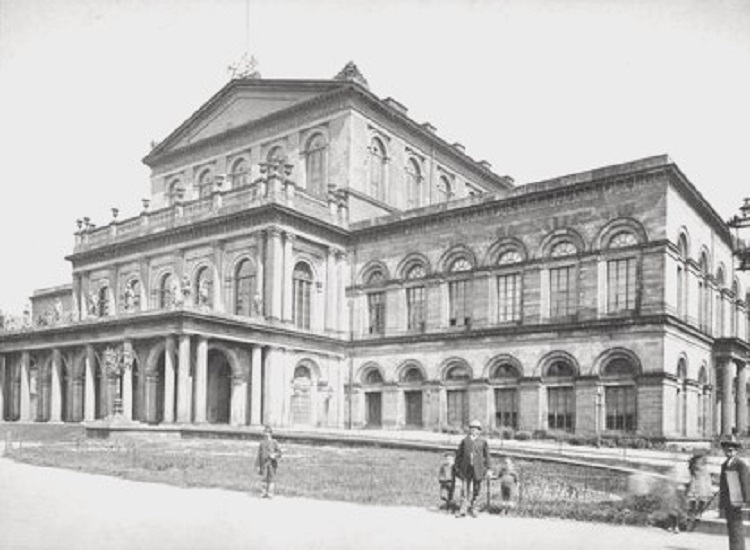
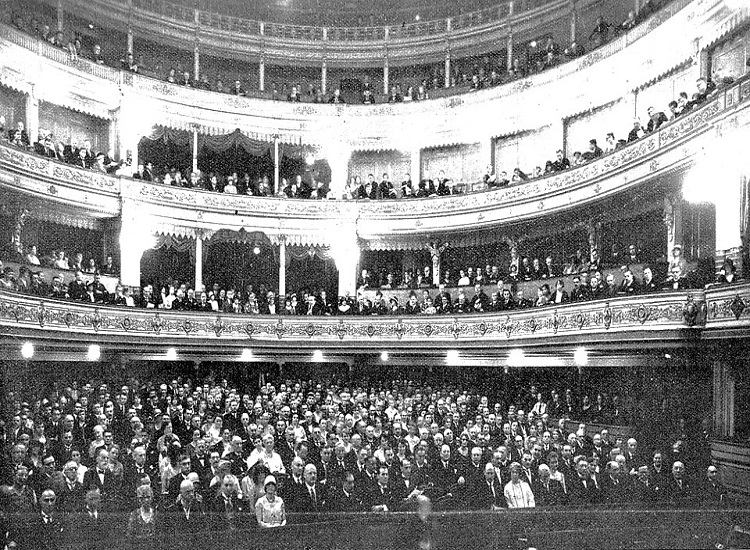
In the 1920s, the German theatre scene also held a leading place in Europe. All cities of the country, whether large or small, had their monumental buildings where various plays by local and foreign playwrights were performed. This reality was supported by a past or a heritage dating back to before the unification of Germany. Many principalities or kingdoms that later formed a unified Germany had “Hoftheater” (court theatres), then state theatres (Staatstheater), regional theatres (Landestheater), municipal theatres (Stadttheater, as they were known at the time). Alongside them, there were also a considerable number of private theatres, especially in Berlin.
In 1929, Germany had over 160 permanent theatres. This number also includes 76 opera stages. Berlin alone had 44 theatre halls. And, since about 20 halls had been closed since the First World War, there was even talk of a “theatre crisis.” The theatre world of Weimar Germany included over 25,000 artists and technicians, not including a significant number of writers who dedicated all or part of their creativity to dramatic art. No other country approached such figures at that time. The Weimar Republic, in fact, marks a golden period for German culture in general and, in particular, for the German stage. This does not mean that during this republic, art in general, including dramaturgy or theatre, should be evaluated only positively.
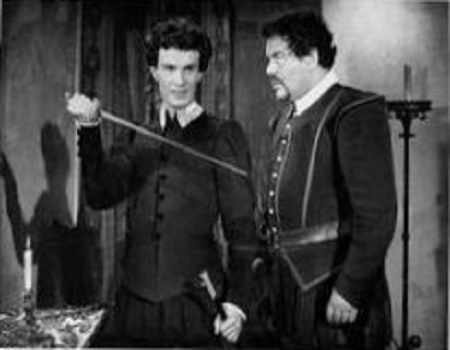
Even before the Nazis came to power, Dietrich Eckart, Hitler’s mentor, was described by him as “the man who dedicated his life to the awakening of his people, of our people, through poetry, thought and finally through action.” (1). He emerged as a nationalist playwright, defending extremist and antisemitic ideas. During the First World War, he wrote Lorenzaccio, giving the portrait of a prince, a leader, who seeks to establish order and give pride to his country. He describes this character as Führer. The country lacked such a man at that time. Later, Eckart would meet Hitler in 1919, and he found in him his “Führer,” the leader just as he had portrayed him in Lorenzaccio.
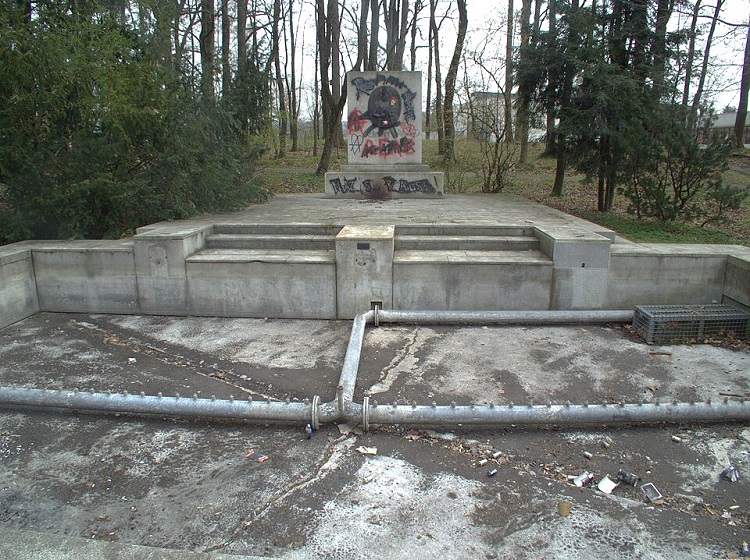
In 1934, Hitler, now Chancellor, would travel to Neumarkt to personally inaugurate a monument in Eckart’s memory. With the Nazis coming to power, a radical change in theatrical life in Germany is also observed. They placed the programmes of theatre halls under their full control. These programmes were Nazified, while theatre troupes were “Aryanized.” Playwrights declared “undesirable” by the regime, such as Erwin Piscator, Georg Kaiser, Max Reinhardt, were forced to leave the stage and Germany. A number of actors left the country to escape internment. Others, who remained, such as Hans Otto, were killed by the Nazis. The dramatist, lyric poet, storyteller, filmmaker, art theorist and director Bertolt Brecht also left Germany.
His plays: Furcht und Elend des Dritten Reiches (Fear and Misery of the Third Reich) and Der aufhaltsame Aufstieg des Arturo Ui (The Resistible Rise of Arturo Ui) were banned from being staged and were burned. The first play, Furcht und Elend des Dritten Reiches, portrays German society from the Nazi seizure of power to the brink of the Second World War, the deep entrenchment of Nazism in all spheres of life. Brecht presents in this play the daily life of Germans under Nazi terror. In one scene, a group of revolutionaries meet a former comrade who has returned from a concentration camp. “But how could he return alive from the death camps? Did he talk? Did he denounce us?” These questions are asked, these doubts circulate in the revolutionaries’ minds about their comrade returned from the camp. One scene of this play presents the story of a German couple. Their child denounces the father to the Gestapo for making some criticisms of the regime. This scene clearly expresses the climate of suspicion, the policy of denunciation, the paranoia and indoctrination that prevailed under the Third Reich. Their child, a member of the Nazi youth, might he not have spoken, might he not be an informer, their denouncer? These questions cross the parents’ minds. Furcht und Elend des Dritten Reiches thus treats a terrorized society, contemporary German society that has lost its control and the trust of its inhabitants, of its children.
The second play, Der aufhaltsame Aufstieg des Arturo Ui, clearly refers to Hitler, placing him within American gangster circles and giving him traits of Al Capone as well. The play transfers Hitler’s journey into politics, the 1929 crisis, what is known as the “Night of the Long Knives” in 1934, as well as the annexation of Austria in 1938, into the midst of the Chicago gangsters. Brecht wrote Arturo Ui while in exile in the USA. He chose the comparison with Al Capone’s gangsters to address the American public. In Der aufhaltsame Aufstieg des Arturo Ui, the characters of Goebbels, Göring, von Hindenburg, von Papen, etc., are easily recognised. Chicago represents Germany and the city of Cicero symbolizes Austria. This play, as its author himself described it, is “a historical farce.”
Theatre, more than any other sector of cultural life, was under the attention or “care” of the Nazi administration. As Dominique Pélassy, Doctor of Political Science, researcher at the CNRS (National Centre for Scientific Research) and author of many works, writes: “In the new Reich, theatre is the king of the arts.” In a speech given on May 8, 1933, before the directors of German theatres, Goebbels declared: “We, National Socialists, will reunite the people and the stage, we will make theatre with 50,000 and with 100,000, we will place one German after another under the charm of dramatic art and will enthuse them more and more with the great works of our popular life. We wish to create the German man not according to the model of a past nationalism, simply through the power of national sentiment, but, as National Socialism demands, by filling him with a national will.”
The Nazi regime undertook the construction of roofless theatres, amphitheatres of colossal dimensions, called Thingstätten, suitable for staging gigantic troupes formed of amateur and professional actors. Nazi Germany began, from the summer of 1933, the construction of 400 such theatres throughout the country. This policy was accompanied by the creation of many plays that sang the regime’s praises, the so-called Thingspiele (Thing plays). The Nazis aimed, in this way, through massive spectacles, to form, in these theatrical spaces, a community according to the model of their ideology. Perhaps for this service, Thingstätten are also known as “churches of the Third Reich.” The massive open-air theatres built by the Third Reich offer more than just a framework for propagandistic speeches. They are an inseparable part of the project to transform, to deform the human personality by the dictatorship.
The following years would best demonstrate that the “holy place” Thing would serve as a loudspeaker for “poeticized” political discussions, for noisy slogans, as a powerful racist, militarist and revanchist voice. All of this is carried and transmitted through a merciless war between Judeo-Bolshevik Satanism and the Aryan community. The challenger in this battle for life or death is the spirit of the German people, personified in the choruses present on stage. With the final victory of the “saviour”, the audience is cleansed and man, as a result of his connection with the broken cross, melts into one in the Racial People’s Community! For Nazi dramaturgy, facts and the laws of history are not interesting, but impulses are. The Nazi playwright is not a historian, but a follower of myths, of holy mysteries.
He takes it upon himself to be messianic. He wants, above all, to smuggle the Nazi theory of racial superiority as an absolute truth. “The National Socialist spectacle is not based on play, it is a vision: priority is given not to the actors, nor to the directors… but to the spirit of God, the far-sighted leader.” He is tasked with giving his contribution to the creation of the “new man”, to the unification of society, to the creation of the people’s community, to the rhythmically repeated idea that a new order will emerge from chaos. In reality, the drama of Nazi dramaturgy lies in its thematic poverty, concentrated on the Hitlerian seizure of power, on its justification by exalting Nazi “heroes” and their deeds, in general on National Socialist fictions, antiquity. The directors are different, but the axis of realisation remains always the same.
For the above, a brief look can be cast at the play Neurode by Kurt Heynicke, a radio play broadcast in 1932 and rewritten in 1934, after the Nazis came to power, according to their requirements for theatre. The author stages the life of miners near ‘Neurode’ at a time when the mine where they worked had to be closed because it was dangerous and unproductive. The miners do not accept its closure and, driven by German blood, are ready to die in the depths of the galleries as heroes of labour, as sons of the earth, just like soldiers at the front. The “solution” comes from a stranger who saves the mine and, consequently, the miners, by pouring a sum of money for this purpose. The “saviour” is, not by chance, in a black shirt, the shirt of the Nazi uniform.
The spectacle closes with the words of the consortium’s delegate, accompanied by the first coryphaeus and the chorus. Delegate: “I don’t understand anything! Everything I see, what is happening here, is unheard of. One utters the word: Faith! And that word turns into strength! Another utters the word: Homeland – and everyone submits to sacrifices, freely and joyfully. I don’t understand anything! The world has changed!” More or less the same thing is repeated by the First Coryphaeus: “The world has changed. Great things have happened here. A community has formed. A new feeling has been instilled in people.” Towards the end of the spectacle, the chorus is heard: “People, you are our faith. People, you are our victory.” Thus the mass, treated in Neurode, undergoes a significant change. It resembles a calm, waveless sea.
Likewise, chaos turns into order, into a new, eternal order, without opposing individualities, without protagonists and antagonists, but identical people who embody the rhythmic German spirit, the unity of life. Schlageter is another play that continues the same refrain. It was written by Hans Jost and staged for the first time on April 20, 1933, at the Staatstheater in Berlin, on the occasion of Hitler’s birthday anniversary. In the daily press, the play was hailed as “a national event.” It was broadcast on radio the same day. In the following months, it was broadcast no less than 14 times. Even these figures testify to the role that theatre had as a constituent instrument of Nazi propaganda. In this play, in four acts, the author settles accounts with the Weimar Republic and expresses his loyalty to Hitler.
Schlageter, a play in four acts, stages the entry of French troops into the Ruhr, the weak resistance of German officials towards them, and the German youths who participated in the First World War. A minister’s son opposes his social-democratic father, who, although imprisoned in his Marxist ideas, having lived through the hell of the war front, concedes him right. The central idea that Schlageter seeks to convey can be summed up in the General’s line: “Yes! … and I hear new columns marching by…! With a regular, rhythmic step… we are starting to march… Germany is awakening…”
The play Deutsche Passion (German Passion) by Richard Euringer, staged in 1935, can be seen as typical regarding the stage play of the beginning of the Thing movement, for the scale of rites, for the political spirit as well as for sacrifice, for the cult. The play plays with the ritual of death and resurrection. This ritual is not linked to God. It is dedicated to the death and rebirth of a nation. The plot is: An unknown soldier comes from the battlefields of the First World War and seeks to radically change German society, destroyed by misery and unemployment. To accomplish this task, he must fight against the evil spirit and win over it. This is evidenced by the reaction of the massive crowd in front of the tribune where the Unknown Soldier stands. A chorus responds unanimously to his demands. This chorus, which refers to Antiquity, symbolizes the new “community” of a people, while the Unknown Soldier is clearly Adolf Hitler.
It is known that the XI Olympic Games of 1936 took place in Berlin from August 1 to 16, 1936. Hitler exploited them to turn them into a kind of celebration of the “united body of Germany.” In fact, as writer and filmmaker Jérôme Prieur put it: “Beyond the rain of medals, beyond the first place which sanctifies, without question, the sporting superiority of the German competitors, the great success of the 1936 Olympics, besides serving as an international showcase for Nazism, is that it united Germany around its leader, around its regime.” It is the same refrain repeated by the German theatre of the time.
Within the cultural programme that would accompany the Olympic Games, the staging of the play Das Frankenburger Würfelspiel (The Dice Game of Frankenburg) by Eberhard Wolfgang Möller, commissioned by Goebbels, took place. Earlier, in 1934, he had written the anti-Semitic comedy Rothschild siegt bei Waterloo (Rothschild Wins at Waterloo). Speculating, falsifying historical reality, this play shows how Nathan Rothschild bet on the victory of the British at Waterloo in 1815. This dubious banker, after following the battle from the heights of a hill, returns to London and quickly, before the official announcement of victory over Napoleon Bonaparte, carries out profitable financial transactions on the Stock Exchange.
The play Das Frankenburger Würfelspiel, which was performed on the opening day of the Olympic Games and then three more times during their course, on August 5, 6 and 14, deals with the popular revolt of peasants in Upper Austria in the 17th century. More concretely, it treats the revolt of the peasants of Frankenburg, their rejection of the Catholic Counter-Reformation and, consequently, their massacre by the church authorities represented by Emperor Ferdinand II. An extraordinary judicial process was organized to punish these crimes. During its course, after the appearance on stage of divine justice, embodied by a character with a black shield, the fate of the oppressed is also decided.
With no connection to the Olympic Games and the principles of Olympism, nor to sport in general, the play’s task is to demonstrate the determination of a united and victorious people, the legacy they have left over the centuries. This play is, in a way, an anachronistic projection of examples from the past onto the present. Möller extends the action over 10 scenes, alternating the acting of professional actors (judges, prosecutors, the emperor, and the accused) with oratorios and lyrical pieces performed by a massive amateur chorus, accompanied by orchestral music. At the opening ceremony of the Olympic Games, the chorus consisted of 1,200 amateur actors. It appears as a kind of renewal, a reference to ancient Greek theatre, or to ancient Greek tragedy. As part of the spectacle, it appears as an expression of public opinion and, at the same time, as a superior, external power that observes and which, as such, is completely different from the other elements.
It sings hymns to the heroism of the people through scene VII, which shows the heroism of the fighting peasants condemned to be hanged. One of the play’s characters, the ‘Innkeeper of Baumgarting,’ declaims towards the end: “No, if God saw the crown of thorns that bloodies the brow of his people; his fury would be terrible…” At the end of the spectacle, as the stage empties, the voices of the chorus are heard from the heights of the sky; the fog dissipates and gives way to the German spirit, like the glorious return of Christ to finally establish the kingdom of God on earth! The drama is resolved by “supreme justice”, embodied in the character who personifies the “Last Judgement”, as well as by the heroism of the people, of the peasants in this case. “Dramaturgy thus played with the spectators’ experience in the relationship between the people and the messianic figure of divine justice, which could be attached to Hitler.”
Another piece of Thingtheater is Die Schlacht der Weißen Schiffe (The Battle of the White Ships) by Hans Schulz-Dornburg, staged in 1938. In short, this play, through its main character Jürgen Wullenwever, conveys the idea that the end of one Empire must be answered by the creation of a new Northern Empire. The author and director of this play stage a kind of “mayor’s march”, a kind of parade or March, from which the entire city population is excluded. Meanwhile, the army of fighters, just returned to the city after a victorious battle, confronts the organizers of this “march.” The swift actions of the fighters, rhythmically accompanied by fanfares, make a mockery of the ceremony organized by the mayor, now ridiculed by the people and driven away into darkness.
One of the main characters, in the role of the admiral, a loyal friend of Wullenwever, filled with hatred, declares: “What was he? A man? – With his hands on his belly, white as a happy woman’s – white and fat… should I hate him already? What are these? White hands with colorful rings – O Blubeard, you are ten times more a man compared to him! I shudder with terror.” The antagonism between the heroic and fear is conveyed on stage also with the play of lights, in the contrast between illumination and semi-darkness. The idea that this play conveys, especially to German youth, is the denigration and hatred of the opponent as well as contempt for women.
For the staging of Die Schlacht der Weißen Schiffe, besides 18 actors, a large number of extras were mobilized: 800 amateurs form the mass that must present the united people. Among them, 250 are members of the SA (Sturmabteilung – paramilitary organization) and the National Socialist Women’s Organization (NS-Frauendschaft), 400 young people belonging to the Nazi and People’s Youth organization (Jungvolk), of which 300 form the chorus and perform the songs, 100 play the fanfares and wind instruments, and finally, 150 members of the Federation of German Girls (Bund Deutscher Mädel) also for the chorus.
For the Nazi ideologues, theatre was a tool, an instrument in the service of their expansionist and hegemonic appetites. In 1943, four years after Nazi Germany unleashed the Second World War, a prominent figure of German theatre, the sworn National Socialist Heinz Kindermann, defined the role of German theatre during the world conflict with these words: “Wherever German culture has already taken hold or where the old land of German culture has been newly cultivated, not only German factories and schools have been built, but also German theatres. German actors, directors and set designers go to The Hague, to Krakow and to Ukraine, from Oslo to Athens. Everywhere, German theatre presents German culture, German customs and the German language alongside the advanced posts of German labour and military force…” / Memorie.al
To be continued in the next issue