
From Mërgim KORÇA
Part One
Memorie.al / The impetus that leads us to view the historical period encompassing the years 1939–1945 with a broad, fundamental, generalising and thoroughly scientific perspective requires that we illuminate and then also rely on historical facts that have not only been left in oblivion but have also been deliberately distorted by the historians of the dictatorship period. Therefore, we are obliged to begin our analysis by first defining the basic, genuinely scientific criteria regarding the use of linguistic terms without deforming their meaning, without subsequently allowing for erroneous interpretations (inclined by the impetus of political ideology), which in turn inevitably lead to completely wrong conclusions.
Let us list some examples of defining linguistic terms: COLLABORATION – In principle, cooperation, i.e. working together, aimed at achieving a contribution through a collective activity.
COLLABORATION – Viewed from a generalising philosophical perspective, it defines how the powerless (in any field – economic, political, military, etc.) are primarily inclined towards collaborationism, because they seek support and help.
COLLABORATION IN THE INTEREST OF THE HOMELAND – When cooperation is carried out with the aim of protecting national interests, disregarding personal ones, and generally not only trampling them but also putting at stake even the extremely positive past of the person themselves.
TREASONOUS COLLABORATION – When one collaborates with a foreign state for the sake of purely personal or group interests, inclined to support that undeserving foreign regime, and the leaders of this regime are distinguished by a feeling of unparalleled self-centredness (egoism of this nature), which pushes them to extreme limits, stepping even over the corpses of their former loyal supporters!
POLITICAL OPPORTUNISM – Consequently, as far as political collaborationism is concerned (whether it is in the interest of the homeland or not), it is precisely the incompetent who, unable to “pull the hair out of the porridge” (get themselves out of a difficult situation), referring to collaboration post facta (after events have unfolded), want to arrogate the right to themselves – having remained completely INDIFFERENT and opportunistic throughout the course of events – to pass judgement with a thumbs up or thumbs down (like the two‑time Nobel Prize winner Professor Linus Pauling – although considered pro‑Soviet, and thus not at all in support of this analysis – note M.K.)!
Proceeding from these considerations, we enter the topic by starting with a little history, in order to illuminate and necessarily clarify some important moments, so that the subsequent judgement may be seen as guided by sound and fundamental logic. It is our honour that we, Albanians as a nation, have inherited a name held in very high esteem throughout the currents of history. This is an undeniable truth. However, the great number of centuries during which political‑social storms and hurricanes tried to wipe our nation from the face of the earth – even though they did not succeed – confronted us with extremely difficult challenges to overcome.
Our very geographical position, inextricably conditioned thereafter by political developments as a consequence of the migrations of Slavic peoples across Eastern Europe during the 7th century, as a result of their fierce pressure for survival, created circumstances and situations that only a native of those lands – dead at that time and reborn today, in the 21st century – could clarify for us. Only he, by digging and scraping the now frozen and hardened surface of that lava of nomadic migrations that has now become autochthonous, would be able to shed accurate light on the truths of historical developments.
But even if, hypothetically, light could be shed on those already fossilised historical sequences, no concrete benefit would come to us. This is because during much more recent developments, specifically from the mid‑19th century onwards, the leaders of our people have been faced with the need to make decisions and take stances, under certain circumstances, in the interest of our nation – decisions and stances that contemporary historians of the communist dictatorship period have condemned from completely non‑scientific and utterly party‑conformist positions.
The misfortune then, that that savage and bloody dictatorship lasted nearly half a century, made it possible for the slanders, lies and distortions of those conformist historians – complying with the claims and fantasies of the paranoid communist dictator – to become ingrained and take their place in school textbooks even to this day! And it is precisely around one of these tangible and very present considerations, even in our own days, that I wish to focus during this analysis and shed light on the damage they have caused and continue to cause.
I will begin – just to mention it – by recalling a topic I have treated relatively extensively at the 5th Symposium held in Orosh, Mirdita, by THE ALBANIAN RIGHT IN DEFENCE OF ETHNIC ALBANIA, focusing on Chapter XXII of the Canon of the Mountains entitled: VRASA. On this occasion I wish to present to the reader a statement by the Japanese scholar Professor Kazuhiko Yamamoto, who, being a specialist in the field of customary law worldwide, affirms that the Canon of the Mountains is, in his view, the oldest legal code! I repeat the oldest legal code! Moreover, for its rigour of legal treatment, he considers it a precursor of the Justinian Code that laid the foundations of Roman law!
Why did I begin by shedding this light on the Canon of our Mountains? Because during the 47 years of the communist dictatorship, not only our jurists and historians, but also our most prominent writers of Socialist Realism, denigrated, scorned, desecrated and burned our Canon of the Mountains on the pyre! The question naturally arises: why was it done this way? To confirm the egoism of the dictator and his party, who wanted to instil the idea that every good thing in Albania was founded after the communists took state power! And this stance, first and foremost towards the Canon of the Mountains – which is nothing other than a jewel and, in the full sense of the word, THE HONOUR OF OUR NATION – was thus taken.
Yes, that honour which our neighbouring nations would dream so much of having themselves – our Socialist Realist historians and literati reduced it to such a level that today, when two or three drug traffickers or other wrongdoers kill each other, the newspapers write irresponsibly, following the mentality violently installed by the Communist Party of Albania, in capital letters: THE CANON HAS ACTED ONCE AGAIN! Whereas the answer to this extreme ignorance of historical truth, and consequently of the Canon of the Mountains itself, is: Those who do not know it must learn it, and the distorting historians of historical truths must also accept that, sooner or later, historical facts as well as distorted or denied truths, COME OUT INTO THE OPEN!
The Canon of the Mountains was operative when there was no rule‑of‑law state. Today it is merely a museum relic – but this valuable relic testifies how our nation, precisely in the absence of a rule‑of‑law state, was governed by rules and laws of civil and criminal law which other nations either lacked entirely or had codes that were in their infancy compared to ours!
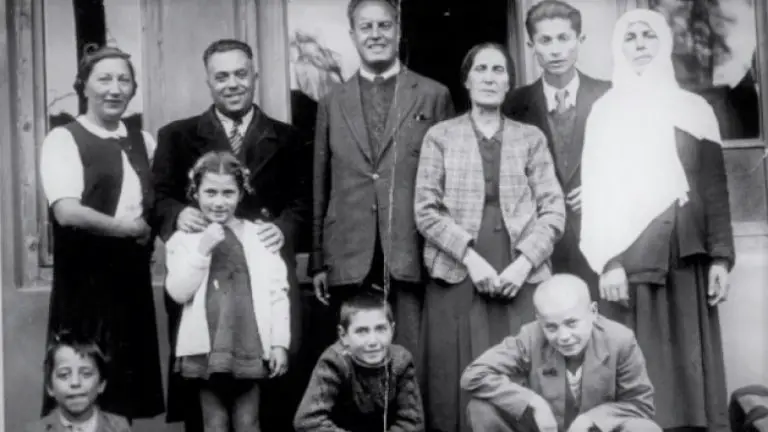
We continue with another extremely sensitive issue: the Habré (Jewish) problem in Albania and the concealment of the genocide against them. By way of illustration, in Israel they have institutionalised a high honorary title called “RIGHTEOUS AMONG THE NATIONS”. This title of honour has been given to non‑Jews who hid and saved Jews persecuted by the Germans during World War II, and their names are written on the wall of Yad Vashem, this honour being accompanied by a personalised medal.
Allow me now to make a swift comparative analysis. In Albania, 69 such honorary titles have been distributed by the State of Israel. If we take this number, in relation to population, as 100.00 units for Albania, let me list the other countries in order with their respective relative figures compared to Albania:
1 – Albania …………………………… 100.00
2 – Denmark …………………………. 16.63
3 – North Macedonia ………………… 9.80
4 – Slovenia …………………………… 6.53
5 – Romania ………………………….. 6.52
6 – Bulgaria ………………………….. 5.90
7 – Montenegro ………………………. 3.53
The sum total of the converted indicators of all six countries together reaches 48.91% compared to Albania! Setting aside Denmark from this list for a moment for calculation accuracy, Albania’s factor in saving the lives of Jews sheltered on its territory takes on an even more expressive picture in Albania’s favour, where the latter has an indicator of 100% while the other five Balkan countries together reach only 32.28%!
Now, removing Denmark from the abstraction circle and looking once more at the full comparative picture, it strikes the eye how Albania at the top, followed by Denmark, have much higher units of Jewish rescue than other peoples. Naturally, any observer, even moderately attentive, notices how in the Balkan Peninsula not only does Albania stand out four‑fold clearly from other peoples in the direction of saving Jews, but the Danes as a people also stand out well above the Balkan average in this direction! Naturally, two questions require answers:
1 – What did Denmark and Albania have in common in their stances?
In Denmark, the German occupier – as in Albania the Italian one – left the state structure untouched; in short, both countries had their own parliaments and governments. On the other hand, a memorandum was signed between Denmark and Germany recognising the Danish government with full powers, and the Germans agreed not to interfere in the country’s internal affairs. Let us not forget that the same was the position of the German government towards our country, immediately after the capitulation of Italy, with all its objectively relatively positive consequences for Albania itself.
2 – How is it possible that Denmark barely reaches 16.68%, compared to Albania, as regards the level of Jewish rescue during the German occupation?
This second question requires long and historically well‑documented explanations in a fundamental way. Within the framework of this analysis, we will answer necessarily within the limits set, so that at least the uninformed and those fed by communist propaganda – but essentially honest people – may learn the truths and then, if they wish, delve deeper and equip themselves with other facts and historical truths in this direction, and thereafter judge for themselves, without any external influence.
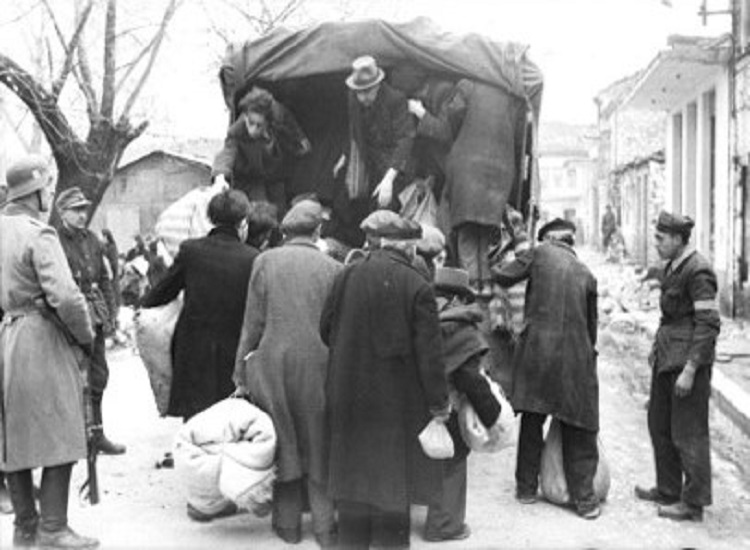
Denmark was under the pressure of the German army’s presence on its territory at a time when in Albania there was no German soldier’s foot until 8 September 1943, the day Italy capitulated. How did events unfold regarding the Jews? The Danish government protected and camouflaged the identities of the Jews – but of the Danish Jews! Whereas the Jews who had flocked to Denmark from Germany, Norway, Sweden and other states, being without the protection of the Danish government, were for the most part discovered according to name lists and ended up in extermination camps. While in Albania, the opposite happened. Regarding this fact, I will bring a personal testimony of my own.
I remember it well as if it were yesterday. My father had just returned from an inspection of schools in Kosovo. As soon as he arrived, he called the family friend and Prime Minister of Albania, Mustafa Merlika Kruja, informing him that he had just returned from Kosovo. Not an hour had passed when the doorbell rang and the Prime Minister appeared. As soon as he entered, he asked my father what he had to tell him about the Jews in Kosovo and the risk of their being detected by the Germans. I want to specify that this must have been before the end of the school year, and from the dress of my father and Mustafa Kruja, it was April or at most May 1942.
Since my father had no large‑scale information beyond the case of a Jewish professor, a friend of the Albanologist Norbert Jockl, Mustafa Kruja then briefly explained how the day before, the German Consul General had requested an audience and had presented him with a list of over 320 Jewish families residing in Kosovo, with all their home addresses, asking the Prime Minister for clarifications about them. Mustafa Kruja had taken the list and told him he would take immediate action to clarify this information. In fact, at that time there was no German soldier’s foot in Kosovo and this circumstance made it easier for the Prime Minister to save those Jews from possible eventual massacre.
He immediately called the Minister of the Interior, Dr. Mark Gjomarkaj, instructing him to notify immediately also Engjëll Çoba, then Secretary General of the Prime Minister’s Office, and to come straight to the Prime Minister’s office, where he himself headed together with my father. After a few days I learned that Engjëll Çoba, at the head of a group of prefects and deputy prefects, had headed for Kosovo followed by many buses of the S.A.T.A. company, and there, based on the name lists with all the exact addresses, they had provided the Jews with Albanian passports, where the so‑called David was renamed Daut in the documents, and Moses renamed Mahmut, and so on, then put them on buses and sent them urgently to Albania.
Meanwhile, the German Consul General was informed that his information had been inaccurate and apparently not updated by his informants. Within this context, I have the right to insist that the researchers of history find the origin of Prime Minister Mustafa Kruja’s order regarding pro‑Jewish actions, because in the archives there will be, without the slightest doubt, subsequent orders regarding the problem in question. Why am I so convinced? Because regarding that event, the former King’s Lieutenant in Albania, Mr. Francesco Jacomoni, on pages 288–289 of his book *“La politica dell’Italia in Albania”* (The Policy of Italy in Albania), published by Cappelli editore on 31 May 1965, states textually: “A demonstration by Mustafa Kruja of what his ‘manliness’ was, i.e., the ability to face situations with courage as well as generosity, I had a short time after he had taken over the Presidency of the Council of Ministers. The German Consul General appeared before him and presented a verbal note in which the Nazi government demanded the surrender of more than three hundred Jewish families who, refugees from Yugoslavia had found shelter in Albania…!
In fact, there was no German soldier’s foot that could identify them… we agreed (… They would be provided with Albanian passports with false names…)! Rome was not officially notified about these developments, but privately the Director General of Reserved Affairs, Minister Plenipotentiary Vidau, was informed. He was a man of great heart, and thanks to him we were able, through our representations abroad, to provide German, Bohemian, Polish, Hungarian and Romanian Jews with Albanian passports. They were given the opportunity to avoid racial persecution by heading to Albania.”
With the capitulation of Italy, Albania was also trampled by the foot of the German army. As a constitutional form of government, our country was governed by the High Council of the Regency, composed of four Councillors (unlike Denmark, where the head of state was the King), and then as executive apparatus successive governments. Subsequently, the High Council of the Regency firmly maintained the position of Mustafa Kruja’s Government towards the Jews, and thus until the day the last German soldier’s foot left Albanian territory. No one molested the Jews sheltered in Albania; they all survived!
Even with what has been presented here, I believe that no balanced and honest person can any longer doubt the fact that it was the extremely humane, decisive and courageous stance of the government led by Mustafa Kruja, followed then by subsequent governments during the Regency period, that managed to manoeuvre among the waves of those particular historical circumstances and succeeded in creating the conditions for the consolidation after the war of the saying: Only in Albania did the sheltered Jews emerge from World War II in greater number than they entered! We cannot fail to mention also a very meaningful stance of a member of the High Council of the Regency (during the time of the Germans), co‑signatory of the Declaration of Independence and distinguished patriot, Lef Nosi.
Even though he held that very high post, he took into his own home in Elbasan, sheltered and kept there, saving the life of the Jew Professor Mark Menahem, who in Macedonia (while being transported by train to Nazi death camps, had jumped from the train and entered Albania)! Anyone can trace this fact because Professor Mark Menahem made this event public after 1991. And for information, since Lef Nosi was a distinguished patriot and a genuine intellectual, he could end nowhere else but before the firing squad, together with another member of the Regency, Father Anton Harapi, and former Prime Minister Maliq Bushati!
And I take the liberty of posing a purely rhetorical question: Could the Jews have been saved in Albania on such a massive scale if the people had not had the support of the respective governments, starting from the one led by Mustafa Merlika Kruja and then subsequently all the other governments under the jurisdiction of the Regency? It was first and foremost the humane and then courageous positioning of all those governments that conditioned the alignment of the Albanian people, so honoured among the names on the Yad Vashem wall!
Thus far, two of the major distortions that indoctrinated historians and conformist writers have inflicted upon historical truths have been identified: the denigration and slander of the Canon of the Mountains – which, in the best‑case scenario, has been considered only the shame of our nation – and on the other hand, the problem of the rescue of the Jews, a fact that cannot be denied because it is contemporary, but the decisive factor in that avoidance of Nazi genocide against the Jews was undoubtedly the governments of that period of World War II, whose action was not only left in oblivion but continued to be denigrated as “collaborationist governments”, until the shining truth of those historical facts was covered by the slanders repeated even to this day!
But facts are stubborn, and the truth indeed tarries but a time comes and it comes out into the open! One day, quite unexpectedly – when Kosovo had not yet even been able to declare its independence – a decision was made (which, for the time it was made, because facts had been hidden in the motherland Albania for decades, appeared in the eyes of Albanians as very compromising for Kosovo and Kosovars) whereby one of the main streets of Pristina, precisely the one in front of the Parliament building, was baptised with a name honoured by Kosovars and called “Mustafa Kruja Street”. Likewise, streets with the same name have been named in Peja and Gjakova.
Thus, Kosovo, with responsibility and courage, based on publicly known but hidden, distorted and even denigrated facts by the dictatorship’s historians within the borders of the “motherland” Albania, highly values the figure of the former Albanian Prime Minister! Some not‑well‑informed researcher might think that this honour was given to Mustafa Kruja for his merit regarding the saving of the Jews who had flocked to Kosovo.
Gentlemen, the honour attributed to Mustafa Kruja is not directly related to that event but to the extremely patriotic stance maintained by Mustafa Kruja, related also to his actions in that direction towards Kosovo, which he had summarised with his full mouth – (I believe for a near and provisional future) – and officially and publicly expressed: “Better a half‑independent Albania with Kosovo, than independent without Kosovo! Together with Kosovo, independence is not late and in the end it comes!” /Memorie.al