Part Three
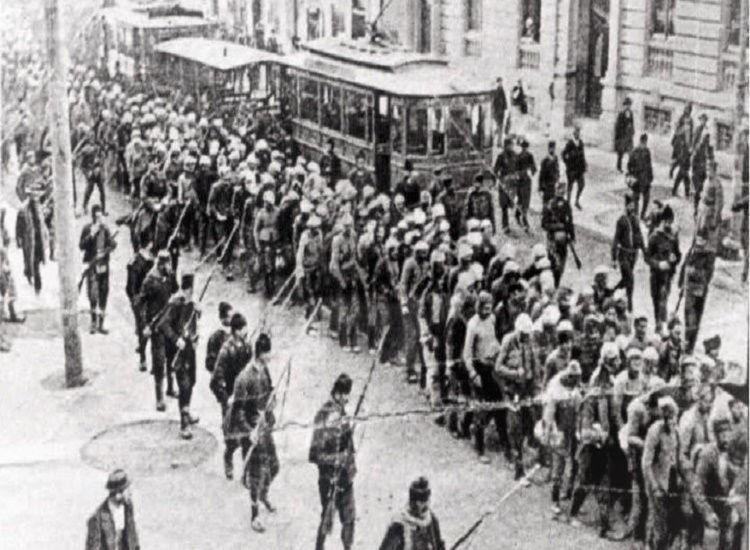
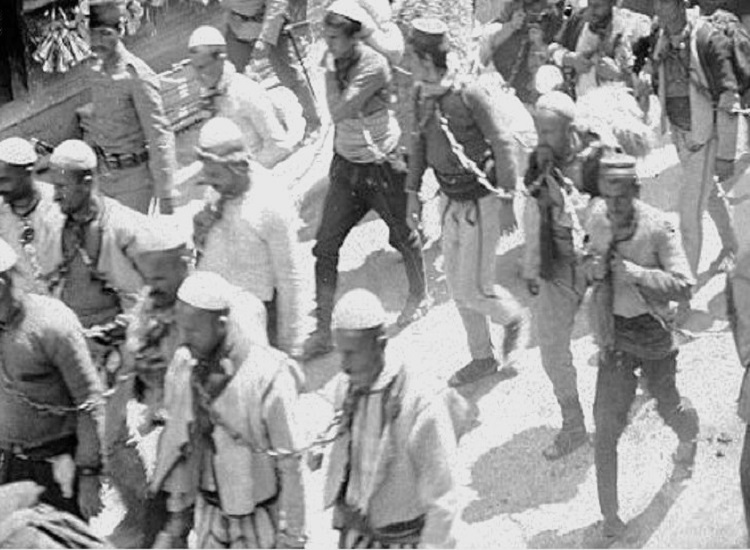
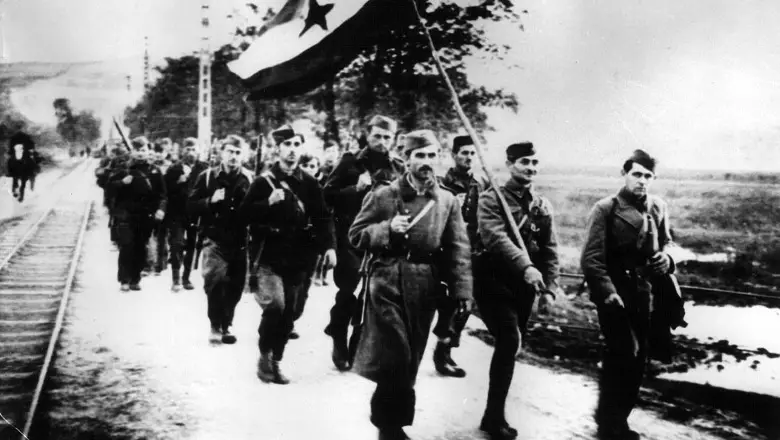
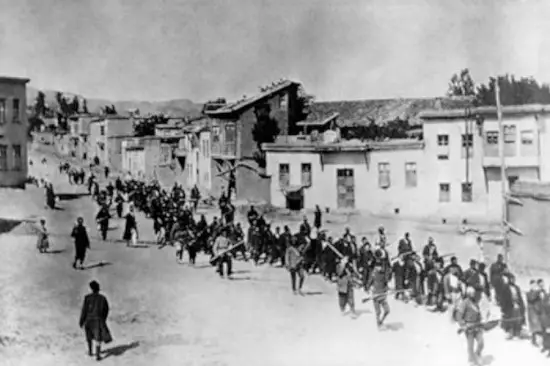
Memorie.al / The Operational Staff of “Kosmet,” ordered by the General Staff of the National Liberation Army of Yugoslavia, with the aim of dismantling the nucleus of Albanian resistance in Kosovo, during the months of March-April 1945, forcibly mobilizes Albanians to send them to the so-called second front of the “Adriatic” in northwestern Yugoslavia. The scriptwriters of the Tivar Massacre, for the sending of the Albanian conscripts to the northwestern parts of Yugoslavia, had chosen the route: Prizren – Kukës – Shkodër – Tivar – Dubrovnik – Rijeka. For this front, they mobilized Albanians from Vushtrria, Besiana (formerly Podujeva), Prishtina, Kaçanik, Ferizaj, Gjilan, Lipjan, Shtimje, Theranda, Burim, Peja, Gjakova, Rahovec, Sharri, and Prizren.
Continues from the previous issue
The journey (Prizren – Kukës – Shkodër – Tivar), the ease with which the Yugoslav forces passed through Albanian territory undisturbed…!
The Testimony of Azem Hajdini, survivor of the Tivar Massacre
However, we all knew very well that this was only a fabrication serving as a basis for a massacre of even greater proportions. After a few moments of deathly silence, one of our comrades stood up, whom we later learned was a young man from the village of Kozhicë. After consulting with his friends, he turned to the officers with a request and an appeal to put an end to these killings, mistreatments, and barbaric behaviors. But before he could properly present himself, the Montenegrin soldiers fell upon him, and with their rifles and bayonets, they chopped him up like a cabbage.
Pressed and shocked by this terrible pathological scene, we no longer knew what to do, what to say, or how to act. Confused and with our eyes wide open, we only stared ahead and waited for what the next moment and minute would bring. When no one else stood up or made a sound, the officers began to threaten that they would liquidate us all, one by one. Our continued silence began to be met with their fury.
They ordered that 80 people be separated from the middle of the column. They tied their hands and sent them behind a building. Then we only heard the gunfire and the screams and cries of those being massacred. Among the comrades I knew, who were shot among these 80, was also Abdyl Bislimi from Kryshevci of Drenica.
Upon the conclusion of this cruel act, since we were in a column of four, stretching 5-6 kilometers in length, and the possibility for mass extermination was smaller, they ordered us to stand up and remain in place with our hands tied above our heads.
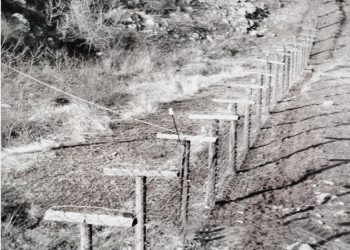
Shortly after, they ordered us to walk towards a large three-story building, with an area of approximately 300 square meters and a fenced yard. The building was surrounded on three sides by rocky hills, while the yard had high walls with an iron fence, topped with sharp points, which created very favorable conditions for the liquidation of all of us, regardless of whether we were in the yard or inside the building. At the entrance to the yard of the building, 10-15 soldiers were placed on both sides of the entrance, prepared with iron bars in their hands.
Each of us who entered through that passage received blows to the head, chest, or back with iron bars, and woe to the one who couldn’t withstand the hits, because there was always the possibility of collapsing on the spot. Anyone who fell from the blows was mercilessly trampled by the crowd passing through that entrance, with no one able to help them. It was impossible to pass through that narrow entrance without receiving blows. During this act alone, here at the entrance to the yard, about 100 or 150 people lay fallen.
Most of them were dead. About 1,000 of us, who were at the front of the column, bleeding and exhausted, were herded like cattle into that building. After the building was completely filled, according to an estimate, over 2,200-2,500 remained in the yard, while on the wide road, 7-8 meters wide and 80-100 meters long, about 1,000-1,100 people remained surrounded, but now not lined up, but huddled together. This was done because in this manner, their liquidation would be easier.
Upon the completion of this action, the soldiers seized Milazim Haxhiu from the village of Tërnavc, on the pretext that he was one of those who had attempted to take the revolver from the Montenegrin officer who was wounded as we described earlier. Even though he denied the accusations, a full chamber of the revolver was emptied into his body before our very eyes.
Even though we knew that the merciless executioners were preparing a ruthless massacre against us, the 17-year-old young man Ibrahim Koca from the village of Polac in Drenica, together with 7 comrades, went to the command of the Staff, which was located in the yard and was giving orders: “*Udri, majku vam, šiptarsku, neka znaju da je ovde Crna Gora i da ćemo sve do jednog zaklati*…” [Beat them, mother of yours, let the Albanians know that this is Montenegro and that we will slaughter every single one of them], for two purposes:
a) – to appeal for the cessation of the ongoing massacre, the brutal behavior, the beatings at the entrance with iron bars, and
b) – to be allowed to help the wounded comrades who had been left at the entrance of the building from the blows they had suffered.
Before Ibrahim Koca could present these requests, upon the commander’s order, many soldiers rushed at him, stabbed him with their bayonets, lifted him high up, and then threw him against a rock to see the sight more easily. Then, in a single word, they cruelly cut off his nose, ears, and tore his arms to pieces.
After this animalistic act, the staff and the soldiers withdrew to the side, 100 to 150 meters away. After a signal was given with a heavy-caliber weapon, immediately gunfire was heard from all directions. The bursts of various weapons came towards us from every corner, yard, house, rock, windows, and attic openings of the houses. They fired with firearms, such as rifles, machine guns, hand grenades, revolvers, and everything else imaginable.
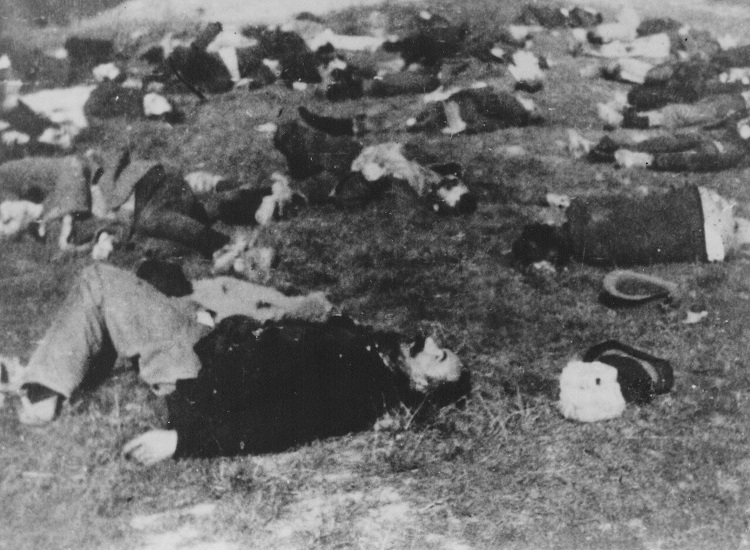
Thus, within one hour, not a single person from the crowd of people, approximately over 3,000 individuals who were situated in the yard and the square, remained standing, and the circle of the building, the yard, and the square had turned into a river of blood resembling a true cataclysm.
The Tivar Massacre, a conspiracy of Albanian communists to kill the right-wing “reactionary” forces
Books have been written about the Tivar Massacre, and recently writings have been published by many individuals, but it seems that the true purpose of it has still not been told. The Albanian communists in Albania and Kosovo remained silent about many massacres committed by the Serbo-Montenegrins during World War II.
Strong theses have been put forward by historians who characterize the Tivar Massacre as a plan to eliminate right-wing forces, a conspiracy between the Communist Party of Kosovo and the Communist Party of Albania, led by Enver Hoxha.
No massacre has dared to go unpunished, especially that of Tivar, unprecedented in human history. Tivar was a taboo subject at that time. But why did the communist leaders of Kosovo remain silent, why did Enver Hoxha and his communist company remain silent – this cannot be understood by sound logic, neither today or ever. The Bunjaj Resolution (1943-44) had as its aim the creation of Kosovo as a unit of the Yugoslav Federation.
But, in fact, at Bunjaj, a resolution was approved which stated: “…the final moment has arrived for the unification of the Albanian people of Kosovo with Albania…”. This resolution is written in the Albanian language and the Serbo-Croatian language. This resolution is evidence that the national liberation war of Kosovo was a war for unification with Albania.
This resolution was similar to the idea of the Albanian right-wing forces such as Balli Kombëtar, NDSH, etc., for the creation of an ethnic and democratic Albania. One month after the Bunjaj meeting, the Politburo of the CPY declared these decisions invalid, and thus Kosovo remained forcibly as part of Yugoslavia with a very weak autonomy.
In the letter of the Politburo of the CPY, sent to the Regional Committee of the CP of Kosovo, signed by Milovan Đilas, which rejected the decisions of Bunjaj, there is also the directive that the orientation for action in Kosovo was the discussion of Xhavit Nimani. Thus, Xhavit Nimani killed and terrorized for 45 years in Kosovo and today there are people who worship him just as they also worship Enver Hoxha, who in 1944 sent 2 brigades of the Albanian army to secure Kosovo as part of Yugoslavia.
The historian Prof. Dr. Zekeria Cana, in his books *”Diary of Captivity”* 1998-1999, writes that in the Tivar Massacre, no one from Gjakova was shot, because they were saved by Xhavit Nimani, who removed them from the line that was going to be executed.
This it informs us that the Albanian communists of Albania and Kosovo knew that this massacre was taking place. They did not react, thinking that with this macabre act, only the right-wing “reactionary” forces were being killed, with the aim that the Yugoslav communists and those of Albania could then breathe more easily./ Memorie.al
Prepared by Kreshnik MERSINLLARI