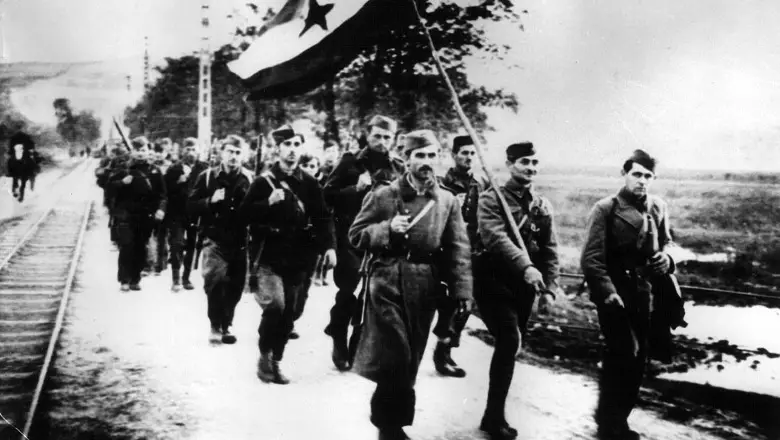
Memorie.al / The Operational Staff of “Kosmet,” ordered by the General Staff of the National Liberation Army of Yugoslavia, with the aim of dismantling the nucleus of Albanian resistance in Kosovo, during the months of March–April 1945, forcibly mobilized Albanians to send them to the so-called second front of the “Adriatic” in the north-west of Yugoslavia.** The scriptwriters of the Bar Massacre, for sending the mobilized Albanians to the far north-western parts of Yugoslavia, had chosen the route: Prizren – Kukës – Shkodër – Bar – Dubrovnik – Rijeka. For this front, they mobilized Albanians from Vushtrri, Besiana (formerly Podujeva), Prishtina, Kaçanik, Ferizaj, Gjilan, Lipjan, Shtime, Theranda, Burim, Peja, Gjakova, Rahovec, Sharri, and Prizren.
According to the memories of the elders who experienced this forced mobilization, the mobilized Albanians were first gathered in the district and municipal centers, and then, organized into military units commanded by Albanian officers, they traveled to the main mobilization center (the military barracks) in Prizren. After being processed, the mobilized Albanians would be disarmed, with the justification that they would receive weapons in Croatia and Slovenia!
The disarmament gave them a bad signal, and suspicion rightly arose about the preparation of some extermination scenario behind the scenes. This psychosis deepened even further when the Albanian officers were also disarmed, and the XXVII Brigade of the 46th Serbian Division, known for terrorizing the Albanian population in the preceding months, was put in charge of escorting them.
The Agreement between the Yugoslav NLA and the Albanian NLA: The 3rd and 5th Brigades from Albania, for the cleansing of Kosovo from resistance bands
In the second half of 1944, while the Allied forces (American-English-Russian) were advancing on all fronts against the Hitlerite army, the Supreme Staff of the Yugoslav National Liberation Army, taking advantage of the circumstances created, at the beginning of September of that year, downgraded the Main Staff of the NLAJ for “Kosovo and Metohija” to an Operational Staff, and on September 14, subordinated it to the Main Staff of the NLAJ for Serbia. And surprisingly, in the name of the Operational Staff of “Kosmet,” military preparations would supposedly begin for the liberation of Kosovo and other Albanian territories, or, in reality, the Supreme Staff of the NLAJ aimed to reconquer them.
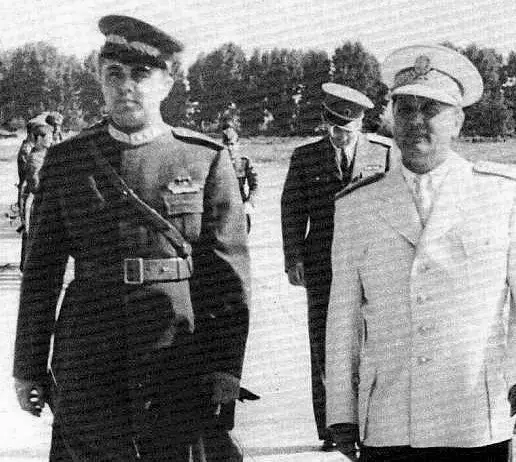
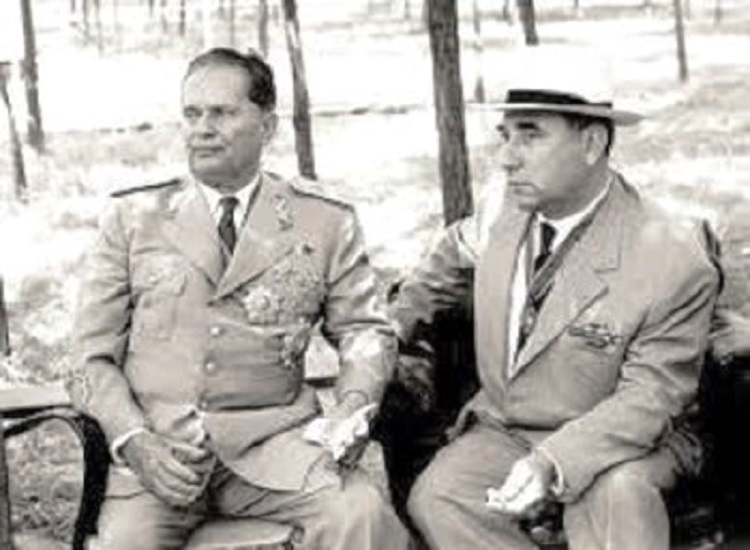
In the autumn of that year, the Supreme Staff of the NLAJ, led by Josip Broz Tito, in the name of internationalism, would make agreements with the Russian Red Army, then with the Bulgarian forces, and on September 2, 1944, also with the General Staff of the NLA of Albania, to conduct joint military operations against German forces in Yugoslavia…!
While the German army was retreating from many fronts of the war, the idea of the German Army Supreme Staff to strengthen the front line in the Balkans became unrealizable, and under these circumstances, the German Army Group “E,” which was deployed in Greece, received orders to withdraw from that region. The withdrawal would be made through Macedonia, Kosovo, and Sanjak, then on to Montenegro, Bosnia and Herzegovina, and heading north.
Army Group “E” surprisingly was not hindered (despite the propaganda made by the NLAJ strategists), but passed with very few losses to the north-west of Yugoslavia, while the fiercest fighting in Kosovo would allegedly be carried out by the Slavic-communist brigades “against the forces of the National Defense of Ethnic Albania and Albanian bands that are reigning in Kosovo.”
To argue this stance, we refer to the letter of Miladin Popović, which, on behalf of the Provincial Committee of the Communist Party of Yugoslavia, he sent to all political commissars in Kosovo. In the letter, among other things, Miladin Popović writes: “Although Kosovo-Metohija is without occupiers, we do not rule over the entire territory. The obstacle is the armed bands spreading chauvinism. Now we have the inalienable duty to cleanse Kosovo and Metohija of these bands.
The bands must be liquidated energetically and mercilessly. The lands of those who do not surrender within the specified deadline will be considered state property, and this (confiscation – my note S.B.) will be carried out by the headquarters (of the NLAJ, – my note S.B.). In the villages where resistance has been made, the organizers must be found and handed over to a military court, which will try them immediately and disarm the peasants…”!
According to the agreement between the NLAJ and the NLA of Albania, at the beginning of October 1944, the 3rd and 5th Brigades of the 1st Corps of the National Liberation Army of Albania would enter Kosovo. On October 17, 1944, the 2nd Bulgarian Army also set out for Kosovo, while there (Kosovo) and in the other ethnic Albanian territories in Macedonia and Montenegro, the units of the 13th Corps of the NLAJ (the 22nd, 24th, 25th, and 46th Serbian Divisions), the 41st Macedonian Division, the 9th Montenegrin Brigade, and all the NLAJ brigades for “Kosovo and Metohija” had completed their preparations for the offensive.
The military operations of these forces began the conquering offensive in three directions: 1. Kuršumlija – Përpallac – Podujevë – Prishtina; 2. Lebane – Medveđa – Prishtina; and 3. Bujanoc – Gjilan – Prishtina.
The establishment of military administration in Kosovo and the forced mobilization of Albanians in March 1945
The 3rd and 5th Brigades of the 1st Corps of the NLA of Albania helped establish the Yugoslav military administration. At the time when the Yugoslav forces were conducting the bloodiest operations in Drenica, on February 8, 1945, the supreme commander of the NLAJ, Josip Broz Tito, by special order no. 31, established military administration in Kosovo. For this decision, Tito, on February 7 in Belgrade, had a meeting with the Serbian military officers: Savo Drljević, Đuro Medenica, and Krsto Filipović, to whom he spoke about the role that the Military Administration should play in Kosovo.
With this order, all power in Kosovo would be transferred to a designated group of Serbo-Montenegrin military officers, who would exercise political, executive, and judicial power. On this occasion, changes followed throughout the structure of commanding cadres. At the head of the military government, respectively of the new Operational Staff, was appointed the former chief of the 1st Army, Colonel Savo Drljević, replacing Fadil Hoxha, who remained his deputy.
Chief of Staff was appointed Lieutenant Colonel Dušan Vukotić (until then deputy commander of the 46th Yugoslav Division), chief of the rear was appointed Stevo Dobrković (sent by the central staff of Serbia), while political commissar was appointed Lieutenant Colonel Đuro Medenica. On February 10, 1945, this command carried out a complete reorganization of the army, forming the Artillery Division, the Cavalry Division, the Communications Division, the operational group of brigades, the 46th Division, the 52nd Division, etc. This conquering military machinery in Kosovo, taking all measures for the “cleansing” of the territory from “remnants of fascism” and “counter-revolutionaries,” killed and massacred thousands of Albanians throughout Kosovo.
Especially after the establishment of the military regime in Kosovo, for the suppression and destruction of insurgent elements, the Operational Staff, ordered by the Supreme Staff of the NLAJ, began mobilizing Albanians to send them to the Trieste and Istria front (in north-west Yugoslavia), even though the mobilization of Albanians had begun as early as the end of December 1944 (with their sending to the Syrmia front, in northern Serbia). On March 11, 1945, in Gjakova, a demonstration of women was organized against the forced mobilization of their sons, brothers, and husbands.
The bloody journey of the echelons (groups)
The first killings occurred at midnight on March 26–27, during a rest break under the open sky in Kukës. The first echelon, consisting of 3,700 people, set out on March 24, 1945, and after 5–6 days arrived in Bar, where they were handed over to units of the 9th Yugoslav Division. During the journey, until they were delivered to the designated place, the mobilized were brutally mistreated by the Serbo-Montenegrin criminals.
The mobilized Albanians from Bar would then depart for Istria, where they would first stop for a few days to rest on Čiovo Island near Trogir. And during those days, while crossing on an old ship from the island to Trogir, about 65 people drowned, 29 of whom were from Kaçanik alone. The second echelon, composed of 4,700 people, set off two days later (on March 26), escorted by the forces of the XXVII Brigade, and on March 30, 1945, in Shkodër, they were handed over to the 10th Montenegrin Brigade.
During the four-day march on the route Prizren–Zhur–Kukës–Pukë–Shkodër, despite the great fatigue and exhaustion from the long road, the mobilized were mistreated and beaten, and in many places many of them were killed during rest breaks, while crossing rivers, or while attempting to quench their thirst at water sources. The first killings occurred at midnight on March 26–27, 1945, during a rest break under the open sky in Kukës. On this occasion, the most authoritative people among the mobilized were killed—they were the Albanian superiors of the military units who had commanded during the march from the municipal centers to the military barracks in Prizren.
On the evening of March 27, 1945, this echelon arrived in Fushë-Arrëz and, according to a well-prepared scenario, the Serbo-Montenegrin executioners, during the rest break (at midnight on March 27–28, 1945) while they were sleeping under the open sky, brutally killed about 120–140 people and threw their corpses into a ditch. After these ordeals, from Shkodër, under the escort of the Montenegrins, at midday on April 1, 1945, they arrived in Bar. On that fateful day, a mobilization of Serbo-Montenegrin soldiers was seen on the city streets, who were gazing with contempt at the long column of Albanians.
This column was stopped in the city center (by order), supposedly to rest, and meanwhile an incident occurred between the guard and four Albanians, who were prevented from drinking water from a fountain nearby. From this conflict, the ordered soldiers fired a volley of bullets into the bodies of the Albanians, killing several of them. The intentionally tense situation (to begin the prepared plot) forced the mass of Albanians to lie on the ground, while that space was targeted by rifles and machine guns that had been placed on every corner of the streets, windows and terraces of houses, and on the rocks of the surrounding hills.
During the months of March–April 1945, through the route Prizren–Kukës–Shkodër–Bar (to the Adriatic Front), 16,423 Albanians from Kosovo were sent, while about 4,600 others were sent from the Albanian territories of Macedonia. Meanwhile, in January 1945, about 18,500 Albanians were mobilized for the Northern Front (of Syrmia) within the “Kosmet” Brigades, and 5,000 others from Macedonia. From these figures, it appears that during the months of January–April 1945, about 44,523 Albanians from Kosovo and other ethnic territories were forcibly mobilized for the so-called fronts of “Syrmia” and the “Adriatic.”
Mobilization of the perpetrators of the crime to eliminate the crime
To cover up the traces of this cruel act, all Serbo-Montenegrin military units, citizens, and workers of this nationality were mobilized, and with trucks, wagons, carts, etc., throughout the night of April 1–2, they carried the corpses and the wounded (together!!!) and transported them towards Old Bar, to a place (abyss) among the coastal rocks. The corpses of the Albanians were first burned and then thrown into the abyss, while the rest would be buried…!!!
According to archival sources, it appears that in Bar, on April 1, 1945, about 1,700 Albanians were killed and massacred, although from the testimonies of witnesses who experienced this massacre, it appears that this number may be much larger. This tragic event for the Albanian people, although it occurred far from the opinion of the time, was clearly prepared by the head of the Yugoslav leadership, even though later Aleksandar Ranković and his associates would try to characterize this event as a “serious incident caused by the Albanians’ own fault”!
The barbarism of the NLAJ against the Albanian people
During these bloody operations, these forces committed the most heinous crimes known in the history of humanity against the Albanian population, and also confiscated, looted, burned, and mercilessly destroyed their properties. During this period, 47,300 Albanians were killed and massacred in the most brutal ways.
Thus, in:
– Gjilan: 7,854 people were killed.
– Prishtina: 3,675.
– Drenica: 4,820.
– Mitrovica: 1,970.
– Peja: 3,540.
– Ferizaj: 1,260.
– Podujeva: 1,670.
– Prizren: 1,200.
– Gjakova: 800.
– Rahovec: 750.
– Suhareka: 420.
– Dragash: 500.
– Presheva: 690.
– Skopje: 1,450.
– Tetova: 4,100.
– Gostivar: 715.
– Kërçova: 490.
– Sanjak (Novi Pazar): 1,410.
– Kumanova: 780.
– Tutin: 900.
– Bihor: 3,820.
– Plavë and Guci: 710.
– Ulcinj: 515.
– Bar and Dalmatia: 2,600 Albanians.In this situation, all the property of the murdered Albanians was confiscated, destroyed, or looted by Serbian colonists, who had returned according to the directives of the Political Bureau of the Central Committee of the Communist Party of Yugoslavia. / Memorie.al
Prepared by Kreshnik MERSINLLARI
To be continued in the next issue