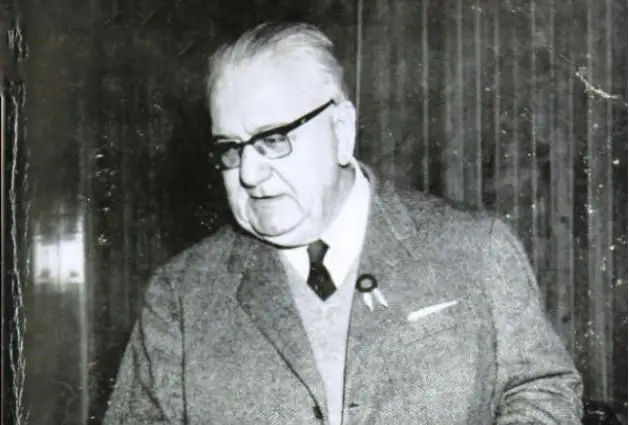

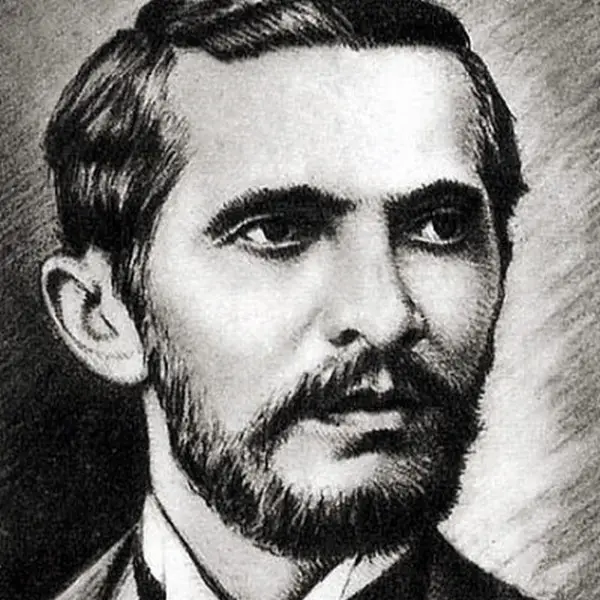
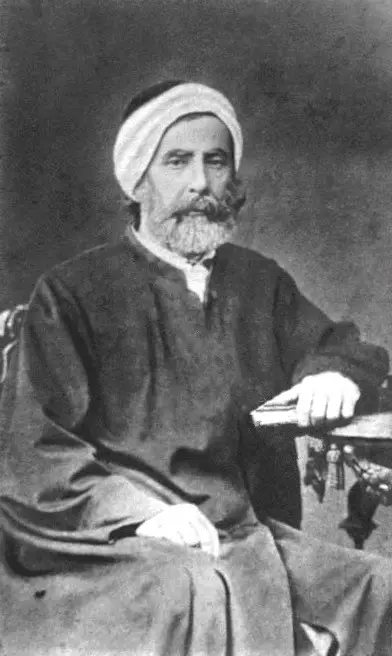
From ARSHIN XHEZO
Part One
Memorie.al / In 1986, when I was working at a newspaper, I received an unusual letter. It was sent by Vexhi Buharaja. It was a large envelope, clearly different from the others – those small, ordinary ones that you could immediately tell would contain some citizen’s complaint about housing or work – routine for any newspaper editorial office. Holding that envelope in my hand, I felt something special. Vexhi Buharaja was very well known to me: from the town, the neighbourhood, the alley. Moreover, our families, among the oldest in town, visited each other, and he himself was a friend of my father. But I, having left town early, right after high school, had met him very rarely, unlike my childhood friends who lived there.
I met him more often in my memories. As a child – nine or ten years old – my father would send me to his house to get or return books. They said his library was larger even than the town’s. The books I received were mostly in Persian, Arabic and Ottoman Turkish, and to me they seemed the same language and the same books, like the Qur’an. And that was the reason I was completely indifferent to them, not to say I didn’t even glance at them.
It is that megalomaniac and snobbish mentality, which unfortunately still exists today, that, views culture, literature and modern civilisation as a monopoly of the West. At the very least, it is forgotten that those who made Albania – the great Rilindas (national renaissance figures), Naim, Sami, or the founder of Independence, Ismail Qemali – had a culture completed from both sides of the globe.
Meanwhile, Fan Noli, the great orientalist, gave Albanian culture and literature masterpieces of the Orient through his masterful translations into Albanian. Had I had the mind at that time, with two teachers no less – one at home, the other five or six doors down our alley – at least one of these languages, today I would have it in my pocket.
One day he gave me the book Gjylistani dhe bostani (Gulistan and Bustan) by Saadi, an Albanian translation of it. It had just been published – he gave it for my father – and today I keep that book as a precious thing. There was another reason that envelope surprised me. Vexhi Buharaja and his family were declassed: that was the classic term for the enemy. It is true that in 1986 and later, that is, after Enver Hoxha’s death, a kind of “softening” of the regime was felt. But “at the top”, “below”, those who were in charge either felt this “softening” little or did not want it.
As for Vexhi Buharaja himself, seasoned by the “ups and downs” of politics, had every reason to be eternally suspicious, or not to trust anyone at all. What I took out of the envelope was another surprise. It was neither a letter nor an article, but an entire study, fully 25 pages: A Panoramic View of the Past of the “Muratçelepi” Neighbourhood (today “Çlirimi”), Berat. At the end: Vexhi Buharaja, Berat, and July 1979. The history of my neighbourhood! One third of the pages were taken up by references and explanations.
Of course, a scientist was writing. The paper was also unusual. Almost the size of today’s A4, but paper more than yellow, looking like it had been left in the sun for years. Given his conditions and possibilities, that should not have surprised you. Almost two years later, a friend of mine and his in Berat showed me the master’s manuscript of the translation of the Shahnameh, written with copying pencil, on thick paper – sheets of squared notebooks – like those used in the 1950s in the warehouses of construction enterprises, for example, for inventories or border – workers’ payrolls. The manuscript of the Panoramic View was typed on a typewriter – probably with the help of some comrade or friend.
Why did he send it to me?! To be published?
In the accompanying letter, which unfortunately I have not kept, I remember there were kind words about my father – who by then was no longer alive – and also some kind words about me, the son of my friend Mehmet Xhezo, which of course pleased me greatly – along with the greetings. He also said that, although, in his opinion, I knew the history of the neighbourhood because it was my neighbourhood, I am sending it to you … etc. etc. In truth, until then, I had the impression that I somehow knew the history of my neighbourhood, but after reading his Panoramic View … I realised I did not know it at all.
Why did he send it to me?! A 25‑page study could not be published in a daily newspaper with only four pages in total, and he knew that better than I did, just as he knew better the other reasons: political, which he and his family had suffered and were still suffering on their backs. I remember reading the accompanying letter two or three times and he was not asking for the study to be published in the newspaper. He was not asking for anything. But precisely because he was not asking for anything, the idea of publication would not leave me. Perhaps, accustomed early on to the return of manuscripts, to rejection of publication, to censorship, he had become used to not asking for anything.
Apparently, I was tormented by the idea that, deep down, despite cold logic, I also felt like the other rejectors. He was not asking for anything because he was not allowed even to ask; he was forbidden to ask. Vexhi Buharaja was a forbidden author and his name was in the drawers labelled “reserved” or “use prohibited.” It even seemed strange that his only publication, the masterful translation of Saadi Shirazi’s Gulistan and Bustan, had been allowed to be published in 1960. Apparently, the dilemma of whether to publish or not publish the history of the neighbourhood was also a hindrance and a feeling: I had done nothing for him.
We were waiting for him to leave, so we could know what we “lost” – this is a verse from a poem by Visar Zhiti about him. Even in February of this year, when my friend Shaban Sinani, enthusiastic about Vexhi Buharaja’s Panoramic View – he was seeing it for the first time – asked me to publish it as part of his book Berat-Beratinus-Buhara, I felt no sense of relief or discharge. It was not I who was publishing it, but someone else. Even if it was my friend. Your debt is not paid by anyone else. I am grateful to my friend, but, deep down, nothing changes. My relationship with the debt remains the same, and with it remain the hindrance and the feeling.
Apparently, I must console myself with childhood memories. It seems absurd, but it is true that only the very young and the old ask the question “why”, that is, the question that seeks causes, depth – whereas adults, paradoxically, the opposite: the question “how”, which seeks the surface. Later, I too learned to ask only the question “how”. But at that age, 7‑8 years old (it must have been the mid‑1950s), I was very surprised why on May 5th, on Martyrs’ Day, in front of the lapidary monument, the poem about Margarita Tutulani by Vexhi Buharaja, which we knew at home and in the neighbourhood, was not recited, but another one, which had been written in Tirana – I don’t know by whom. From our poem, which we recited by heart at home and in the neighbourhood, I remember only two stanzas:
“The sword turned white, the day turned black,
A body fell, a name arose,
Margarita fell a martyr,
A man emerged from a woman.
Mother, oh, stop your tears,
He has not died under the earth,
He is alive, oh, for God’s sake!
He is sparking fires above the clouds”…
Why was our poem not recited?!
Everyone in the neighbourhood and the town knew the answer to “why”, but no one answered. Vexhi Buharaja had “fallen into prison” and had acquired a bad biography. The formulation “fell into prison”, which was used more often in the neighbourhood, seemed completely meaningless, as if you had made the mistake or fault so innocently and unintentionally, as if at night you could fall into a pit that you hadn’t even noticed was at your feet. I believe this expression was used as a “middle ground”, or as a kind of euphemism to avoid any possible misunderstanding.
For example, the formulation “they put him in prison” could be taken anytime as if they put him in for no reason. But the other expression “he entered prison” could seem like the neighbourliness of someone who had spoken or raised his hand against the government. These were expressions similar to “when these came in”, or “these seem to be connected to the Russian”, where “these” meant the new rulers, but you only heard them in closed spaces and in a low voice, and the strange pronoun “these” seemed to refer to no one.
In difficult and delicate times, one had to be cautious, because your head could roll even for a word spoken…! Vexhi Buharaja “fell into prison” because, together with another intellectual, Todi Sotira, they selected several books by the world’s most prominent authors, which had been collected from the libraries of confiscated families and were to be destroyed. He was sentenced to political prison until 1948. The book and knowledge would become a metaphor for the calvary of his life. He served his sentence near the Maliq Swamp, where in those years the scholar Arshi Pipa, who later escaped, was also serving time, as well as the well‑known writer Mitrush Kuteli, whom one day they left for hours, stuck lengthwise and crosswise alive under the earth, under the bayonets of the guards.
What were Vexhi Buharaja’s crimes, hidden in the secret reserves for internal use? Late, many years later, the privilege my profession as a journalist gave me also gave me the key to open some reserve drawers, where I discovered not only why on Martyrs’ Day for Margarita Tutulani our poem was not recited, but the one from Tirana, but also that Vexhi Buharaja was a true poet, and had written poems also for other “Margaritas”, beautiful ones, in times of peace, and with just as much art, love and pain:
“With my tear‑filled eyes, I stood by her grave
At the door where life is smeared with tears, with blood, with bile,
I knocked so they wouldn’t refuse me to see her one more time,
Her whom I loved.”
As I could myself guess, one of the reasons why our poem for Margarita was not recited on Martyrs’ Day was that the poem for the other Margarita and other poems had been published in the newspaper Tomori, which was considered of the government, that is, of the occupier. This was not a cause, but a reason, because, simply, it was an extra‑literary criterion. Meanwhile, this was also confirmed by the fact that the poem for our Margarita was dedicated to a martyred girl with communist convictions and a leader of the National Liberation War, so ours was ideologically correct. Also, it had not been published in Tomori.
So, what was the real crime?
There have been writers who, even without making direct kinship with the sworn enemies of the country, have sung like crickets in the threshing floor about the stars, the moon, the lily, etc. These are the writers of “art for art”…! Now, it’s not just a matter of showing them their place, but also of erasing their traces…
Our writers must take example from Soviet literature…! Our writer will find in the faces of the leaders of this unprecedented war of the Albanian people, the synthesis of all the high virtues that our people preserve, and will make these an immortal example for future generations.
The offer to Albanian writers and artists was completely open, and each responded according to himself. In the book Gulistan and Bustan masterfully translated by Vexhi Buharaja, there is also a poem, titled “I am not a beggar”:
“– O Saadi, the world asks me, why you live in poverty
You have resources… that stop you from feeling misery.
You, with your royal verse, have made a noise like a king,
Why, then, are you crushed by endless sorrow and suffering?
So many kings praise you; so many treasures come to you,
Don’t you know that without treasures you will have tears and mourning?
– Many say the sparrowhawk lives better than the simurgh
He eats carrion every day, the latter – won’t approach filth in its breast.
This won’t happen to me, I won’t go to the sovereigns,
I won’t wander through gates like a begging dervish.
And if you ask for a needle, it’s as if you step on thorns,
Every begging from kings is shame and horror.”
Vexhi Buharaja knew the Russian language very well as well – he learned it in prison – and he could have lived like a king and not felt misery, even without writing direct flattering verses for the king (like the comrades), but simply by translating some verses of Soviet poets about Stalin and Lenin (like the comrades). Vexhi Buharaja is among the very rare Albanian poets and creators who wrote nothing about the time of the Party (like the comrades), nor about the Party and Enver Hoxha (like the comrades).
What did the secret reserves say about his works, and which are among the main ones?
Vexhi Buharaja, born a poet, wrote poetry from the age of 15. In his first published poems: I want to be a butterfly, The rain, On her grave, To the poet Lasgush Poradeci, To Margarita, or In front of Tomorri (with which he won first prize in a national competition), one feels a delicate and beautiful spirit, in a peaceful and humanist verse, influenced by romanticism and the literature of the National Renaissance, and mainly by Naim Frashëri or Lasgush Poradeci, to whom he sang. But, undoubtedly, the great Persian poets, the humanists Saadi Shirazi, Ferdowsi, etc., had a great influence on his creativity and his very formation.
Later, his love and passion became translations
Poet, philologist, orientalist, historian but also theologian (before graduating in language and literature at the University of Tirana, he had completed the General Madrasa in Tirana). Vexhi Buharaja was a polyglot. He knew very well English, German, French, Italian, Russian, but, undoubtedly, also Persian, Arabic and Ottoman Turkish, because they were his languages, a family inheritance: his father, grandfather, great‑grandfather, generations in a row, spoke and wrote Persian very beautifully – as in Bukhara, from which he got his surname.
In the early 1940s, Vexhi Buharaja’s name became known, and the minister of education at the time, the writer Ernest Koliqi, proposed a scholarship to Italy for oriental studies. He couldn’t go. Due to some family problems, he left Tirana as well and returned to his birthplace, Berat. As is known, his published works are: Gulistan and Bustan by Saadi Shirazi (1960), and Shahnameh by Ferdowsi (2001, 2010).
Vexhi Buharaja translated not a few poems and literature with religious inspiration, but most of his translations are secular literature, documents of Albanian historiography, etc. From Persian and Turkish he translated Dreams and The Four Seasons by Naim Frashëri, the drama Besa by Sami Frashëri, the works Cosmogony and Psychology by Hasan Tahsini, 12 documents of National Independence, Ismail Qemali’s correspondence, prose and poetry by the Turkish poet Tevfik Fikret, documents of Albanian historiography, etc. The translation of a large number of Turko‑Arabic inscriptions on mosques, etc., is another great contribution of his.
For me, – writes Lasgush Poradeci – two are the greatest in translations from Persian into Albanian: the great Fan Noli in America and the great Vexhi Buharaja in Berat (After Vexhi Buharaja, is oriental studies, at least, at the levels of tradition?). Meanwhile, what stands out by itself in his work are the studies, where his broad culture, deep knowledge of the country’s history and scientific rigour appear: A Panoramic View of the Past of the “Muratçelepi” Neighbourhood, The First Schools of the City of Berat, The Assembly of Sinja and its Memorandum, On Albanian Resistance against Ottoman Rule, The Life and Patriotic Work of Islam Vrioni, etc./ Memorie.al