
By GIORDANO BRUNO GUERRI
Memorie.al / “Albania, Ciano’s fief,” publishes unknown details. Here is what the Italian Minister writes in his diary three days before the invasion. Why the pages of the personal diary were censored: – In the months after the landing, it was not difficult to notice the progressive transformation of Jacomoni’s character, who was undoubtedly an excellent “navigator” through the “shallows” of the Albanian situation, quickly complicated by the war, and through the “torpedoes” that occasionally arrived from the Ministry of Foreign Affairs, where the Albanian cabinet was directed by Zenone Benini, a close friend of Ciano, a pleasant companion and lover of good pleasures.
Jacomoni maneuvered with style amidst these difficulties and, at the same time, patiently and unobtrusively, despite the awkwardness of some of his cabinet’s characters, built the figure of the Viceroy, indispensable in a country with a more or less monarchical tradition. The union was he, even if it was by Ciano’s “proxy.” He was the pillar and had long understood that his task was to protect the Albanians and their culture from the harsh attacks coming from Rome.
In 1940, Rome began sending, to balance Jacomoni’s activity (judged, especially after the outbreak of the war, as too weak), a rough and completely fascist character, Piero Parini, initially as the alter ego of the secretary of the Albanian Fascist Party, and later as General Secretary in the Viceroy’s office. They had set a guard over Jacomoni. But Parini did not understand at all what the Union meant to Jacomoni, according to the grand models of personal unions.
Naturally, the organization of the Albanian Fascist Party was modeled on the Italian one, without any visible result. But it wasn’t only the party that didn’t function, or that functioned as a mere semblance of the corresponding Italian bodies. Albanian autonomy effectively ceased to exist: the organs of the Italian state made laws in place of the corresponding Albanian organs, and within a few weeks, the Albanian state administration was destroyed, while the army and diplomacy were absorbed by the Italian ones.
The absorption of the diplomatic corps was not difficult, as there were few of them and they were more than satisfied to transition to the corresponding Italian roles. A transitional structure was created; the “Albanian structure,” from which several Italians long-resident in Albania immediately benefited, with or without merit, to stealthily enter the career. The most significant episode concerned the absorption of the gendarmerie by the Carabinieri corps, as the latter were dissatisfied that the surviving cadres of the Albanian gendarmerie wore uniforms and adorned themselves with ranks that were not usually obtained so easily. The same happened with the army.
A way out was found by replacing the Italian stars with Skanderbeg’s helmet on the Albanians’ uniforms. But not even two years passed before the government in Rome changed its mind: the Albanians, involved in a war they did not seek, were no longer satisfied with money and careers, but demanded and achieved the dissolution of the Albanian Fascist Party, the abolition of the department for Albania, and the re-establishment of the army. At the beginning of 1942, the war had already taken on a global character and things were not going so well for the Axis.
On January 9, 1942, Ciano published an article on Albania in the ‘Giornale d’Italia,’ full of praise for the principle of nationality: “If the complex organic structures of different nationalities are not taken into account, we nullify positive forces. Otherwise, it would be as if a farmer cut the roots of a tree, believing that in this way he would strengthen the trunk and branches.” In the first few days, some prominent Albanians had expressed the desire to have Ciano as regent; others had even offered him the crown: “Ciano was very pleased – recounts Ernest Koliqi, who made the offer – perhaps he caressed the idea of starting his own dynasty right in Tirana.”
Naturally, this did not continue, but even though he was not king in Tirana, Ciano behaved like one: in Rome, ‘Grand Duchy of Tuscany’ was often said to mean Albania, and the police chief, Bocchini, “absolutely and firmly” forbade his officials from dealing in any way with matters concerning him, because: “Albania is Ciano’s fief, and I do not want to have any problems with him.” The Italian Minister in Greece, Grazzi, recalls that Ciano “made frequent visits to Albania, received by the Viceroy’s office as a sovereign; there he set up and furnished, with money taken from state coffers, luxurious hunting reserves.”
Even the ancient name of the city of Saranda was changed to “Porto Edda.” Extraordinary sums were wasted in pursuit of a prestige policy, as suited Ciano. This is seen in the telegram sent to Jacomoni on February 3, 1940, in which he demands the reclamation of some marshy lands, while fertile land was left fallow: “To put ‘Italba’ into operation and begin the agricultural reclamation of Albania, which is also necessary for political purposes that cannot be overlooked, it is necessary to place at the disposal of ‘Italba’ itself a suitable quantity of land. And since it appears that in Albania there is the possibility of finding these lands, which will be fairly compensated, please get to work immediately on identifying the fallow lands that could serve this purpose and inform me of the further development of this matter, which has an urgent character. Keep me informed.” Much less than this telegram would have been enough to rightfully raise suspicions of illegal activities, fraud, and bribery.
But for all these, I have not found evidence (just as German agents did not find any, as we will see below), and it is difficult to raise accusations against Ciano. It must be considered that at the center of Ciano’s interests are power and the fact that he was rich by birth. But it is also true that he was particularly sensitive to requests for favors made by friends. Albanian oil – in which he was probably indirectly interested as a shareholder of the ANIC and AGIP companies – was sulphurous, thus requiring expensive refining, so it was not a profitable business. Moreover, very little was extracted.
Ciano’s entire policy in Albania, before and after April 7, 1939, seems to be influenced by a schoolboy memory of the Risorgimento: the desire to annex territories to the homeland and the adaptation of the social and political status of the new citizens are the most evident signs of this influence. From now on, Ciano could be called, by Mussolini’s flatterers, a great statesman who made Italy even greater.
He felt proud of the Albanian affair and did not hide it, giving himself, without any hesitation, the credit for the fact that he “gave Albania to Italy.” To understand how much he cherished his paternity of this story, it is enough to read the text of his speech in the Chamber of Deputies on April 21, 1939, where he rarely refers to Mussolini and his “unwavering will”: Ciano speaks willingly using the term “we.” But even more interesting and significant than the speech is the phone call he made immediately after to Ansaldo, to whom the speech had been transmitted telephonically.
Secret fund for Albanian affairs
Since the outright annexation that Ciano would have wanted was not possible, for fear of reactions from the Albanian world, the personal union was chosen instead of placing a prince of the House of Savoy at the head of the Albanian state, because such a move would have emphasized Albania’s dependence on Italy. What this dependence consisted of, Ciano shows on April 12, when he returns to Tirana to finalize the work of the Constituent Assembly. At that time, he had at his disposal a secret fund for Albanian affairs of 5 million lire and 380 thousand Albanian francs, and so he goes “to deliver packages of Albanian francs,” committing corruption and abuse of office.
Examples of corruption and maladministration were so numerous that they became the norm. Ciano, who was not opposed to these systems, has no problem admitting it: “We will give personal rewards, because personal gain often silences the noblest feelings…”; “A few decorations and a few posts were enough to carry out the operation of castrating Albania, without letting the patient scream.” Jacomoni did nothing but continue to keep alive what had already become tradition. Furthermore, the new Italo-Albanian relations were imported in such a way as to create as much confusion as possible:
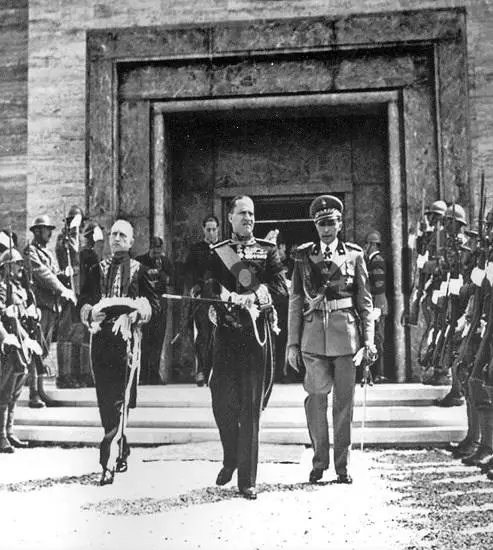
Jacomoni was appointed Viceroy of the King, thus practically the head of the Albanian state; but as a diplomat he still depended on the Italian Foreign Minister: it reached the point of absurdity when Jacomoni signed, in the name of Vittorio Emanuele III, agreements with the Albanian government, that is, with his own government. Specifically for Albania, a department was established within the Italian Ministry of Foreign Affairs, entrusted to Zenone Benini, Ciano’s childhood friend; then Piero Parini was sent to Tirana, as “assistant” to the secretary of the Albanian Fascist Party; he was a plenipotentiary minister, former director-general of Italians abroad, a superficial type like Starace, but somewhat more cultured and with good organizational skills. Ciano governed Albania through these three figures.
The Duce complains to the King
A significant contrast emerges between Mussolini and his son-in-law regarding the official titles to be given to Ciano for Albania. When, at the end of May, the King thought of giving Ciano the title of marquis on the occasion of the signing of the Pact of Steel, Mussolini changed his mind. Perhaps Mussolini did this because of his usual desire not to give too much glory to his subordinates, so as not to be overshadowed, but it is possible that other reasons prompted this decision. As he himself told Ciano, granting a new title of nobility (within 15 years of the granting of the first title to his father) would only damage his image in the eyes of the party’s rank and file.
Precisely after the Albanian enterprise, Ciano gained the greatest chances with Mussolini as the “dolphin” [heir apparent], so it was necessary not to distance him further from the party base, which – and the Duce knew well – did not harbor sympathy for the “first son-in-law.” The same considerations could apply to the matter of the Collar of the Annunziata. According to the diary – but I believe that this time Ciano did not write the truth – on August 6, Vittorio Emanuele III informs Mussolini that he intends to give Ciano the “Order of the Santissima Annunziata,” the highest royal honor, which automatically makes its holder a “cousin of the King.”
Ciano writes: “The Duce was initially hesitant, since ‘the collar could represent compromises that are better not to have,’ but now he is convinced that it is better for me to have it, so tomorrow he will write a letter to the King about it.” The statement is partly true; in a word, it is true that Mussolini – at a time when he was thinking more and more seriously about getting rid of the monarchy – was of the opinion that his potential successor should be kept free from the weight of a kinship that could politically be held against him in the not-too-distant future. But Ciano cannot resist; he desires the Collar even more than the title of marquis, and his “now he is convinced,” written in the diary, actually hides all the persuasive ability he exercised on Mussolini to obtain his approval and to stop his opposition, which was even more open than Ciano indicates.
D’Aroma gives a version of the event, according to which Ciano maneuvered with particular dexterity […] but Mussolini, once he understood the trick, immediately stopped everything, even though the high honor concerned precisely his son-in-law. We will even say that one morning in August; he called Galeazzo and, in a firm tone, ordered him not to accept the Collar. Galeazzo not only became very upset, but being stubborn and frivolous, he immediately set in motion all the support and those family and political levers that he already had in hand. Within a few days, in the context of not-good relations with family members, especially with his daughter Edda, Mussolini truly decided to write to the King.
Other documents I have found confirm the accuracy of D’Aroma’s version and the falsity of Ciano’s: It is not true, as Ciano wrote, that Mussolini had written to the King to give “authorization”; on the contrary, he wrote a rather explicit and detailed formal request, from which it also emerges that the King had not even expressed his desire to give Ciano the high honor.
Here is the text: “Your Majesty, upon returning to Rome, I was informed that on the occasion of the expansion of Italian territory, the serving Ministers of Foreign Affairs have been given the ‘Collar of the Annunziata.’ This happened after Libya, Rapallo, and Fiume. Given this custom, an exception for Count Ciano would have a certain meaning or would be interpreted in an unpleasant way. It is my duty to declare to Your Majesty that Count Ciano is owed all the internal preparatory work that made it possible for us to practically annex Albania, almost without a single shot being fired.”
Epilogue
It has been rightly written that the occupation of Albania has all the typical characteristics of a fascist enterprise: It is in contrast with certain legal and moral commitments, as well as with all previous political direction; it burdens Italy with enormous economic problems, which find her unprepared to solve them; it is presented to the domestic public opinion as an increase in Italian prestige, achieved thanks to the ability and persistence of the fascist regime; it is exploited by the fascist hierarchs for their personal enrichment. And just like other fascist enterprises – in Corfu, in Ethiopia, in Spain – it resulted in a profound upheaval throughout Europe.
Not simply because of the fact itself – which gave the impression of an abduction of the bride – but because Italy was once again acting as a disruptive element. Immediately afterward, Great Britain and France guaranteed Greece and Romania their help against any rash attack, just as they had done with Poland after the Nazi occupation of Bohemia; Roosevelt, for the first time, personally intervened in European affairs, asking Italy and Germany to promise not to attack other independent nations.
Thus, the coalition that would defeat the Axis was formed and consolidated. For all this, Ciano – who with the April events has lost a good part of his credibility abroad – is relatively unconcerned. He is still convinced that he can control the alliance with Germany, and even divert or abandon it. Six weeks after the capture of Tirana, he would sign the Pact of Steel, and not even three months later Ribbentrop would tell him that Germany intended to start the war.
Mussolini wiretaps his son-in-law’s phone calls
The phone call was intercepted and delivered to Mussolini; here is the text:
Ciano: (in a booming voice) – Ansaldo!
Ansaldo: (in a sweet tone) – Commander, Your Excellency!
Ciano: – How does it seem to you?
Ansaldo: – What, Your Excellency?
Ciano: – My speech, of course!
Ansaldo: – Ah, yes, Your Excellency. I haven’t read it yet. They are passing me the pages one by one, as soon as they decipher the transcript.
Ciano: – Well, how does it seem to you so far as you’ve read?
Ansaldo: – Marvelous!
Ciano: – Is that all?
Ansaldo: – Embroidered, enchanting! It will have worldwide resonance. The presentation of the facts is unwavering, luminous, magnificently logical.
Ciano: – Good! But make sure you highlight this entire well in your comments. You know what? Write a leading article instead. Keep in mind that the public received me truly exceptionally warmly. In all my life, I have never been as moved as I was today.
Ansaldo: – I believe it, Your Excellency. Do you want anything else?
Ciano: – Ansaldo!
Ansaldo: – At your command, Your Excellency!
Ciano: – Take special care not to remove any of the interventions from the text of the speech.
Ansaldo: – What do you mean, Your Excellency?
Ciano: – The applause, the cheers of the crowd. Do you understand me?
Ansaldo: – Don’t worry, Your Excellency!
Ciano: – Especially at the end of the speech. The final applause! Look, I really got a lot. Emphasize it in bold! Don’t spare the bold type! / Memorie.al