
By Bashkim Trenova
Part Twenty-Three
– NAZBOLSHEVISM – LITERATURE AND ARTS –
PREFACE
Memorie.al / Historians, political philosophers, intellectuals from various schools or positions, have dedicated thousands and thousands of pages, entire volumes, studies, and articles to the comparison between Nazism and Communism. Generally, in their publications and studies, they focus on the police control of society by these dictatorships, the role of the dictatorial state hierarchy and the head of state as suppressors of free thought, the omnipresent place of official propaganda in society, the mass massacres and the network of concentration camps, the activities of the police – the NKVD in the USSR (later the KGB) and the Gestapo in the Third Reich. In his book *“Le Passé d’une illusion”* (The Past of an Illusion), François Furet notes that Nazism and Communism share the same opposition to liberal democracy and to what they call “capitalist bourgeoisie.” Both ideologies claim to be socialist and use the image of socialism. Communist countries called themselves “socialist.” “Nazism” is an abbreviation of National Socialism.
Continued from the previous issue
FILM
Muraviov achieves a magnificent victory
‘Третий удар’ (‘The Third Strike’), made in 1948 by Igor Savchenko, is one of the first Soviet films after World War II which, dealing with the Red Army’s counteroffensive to liberate Crimea and Sevastopol, emphasizes Stalin’s supposed role in planning every detail of the strategy. *‘Падение Берлина’ (‘The Fall of Berlin’)* is also a propaganda film made in 1949 by Mikhail Chiaureli. The film was screened in 1950. Its hero, Alyosha, joins the ranks of the Red Army to serve his homeland and save Natasha, the woman he loved, who had been taken by the Nazis to Germany.
Thanks to his bravery and patriotism, Alyosha manages to meet Stalin, who directs military operations from his office in the Kremlin. The film reflects the development of military battles as a result of Stalin’s decisions and of the two young heroes, Alyosha and Natasha, until the final victory over Nazi Germany and the triumphant arrival of the Red Army in Berlin. After de-Stalinization, the film was banned from Soviet cinema screens, due to scenes depicting Stalin as a great theoretician and organizer of victory.
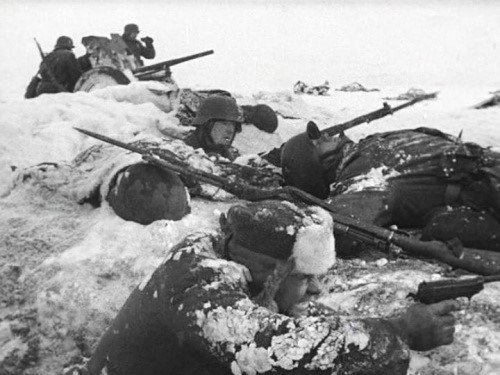
‘Сталинградская битва’ (‘The Battle of Stalingrad’) by Vladimir Petrov, is one of the major films of Soviet cinema dedicated to World War II, made in 1949. On screen, Stalin is seen analyzing the movements of the Wehrmacht troops and concluding that their goal is to take Stalingrad. For his part, Hitler believes the city is the key to final victory and orders his Nazi generals to capture it at all costs. Stalin plans the counteroffensive. The German army is surrounded.
Hitler orders his general Paulus to hold at all costs. Paulus refuses to surrender even when his soldiers are dying of starvation. The arrival of Soviet soldiers at his command post forces Paulus to surrender, along with the remaining troops. The Soviets organize a magnificent celebration in Red Square on the occasion of the victory at Stalingrad, while Stalin is shown looking at a map of Berlin.
‘Летят журавли’ (‘The Cranes Are Flying’) is a film by Mikhail Kalatozov from 1957. A year later, the film won the Palme d’Or at the Cannes Festival. This film was made after de-Stalinization, after the condemnation of the cult of personality, during the years when Nikita Khrushchev was at the head of the Communist Party of the Soviet Union and when a certain liberalization of literary and artistic life was observed in the country. “The Cranes Are Flying” and later ‘Баллада o солдате’ (‘Ballad of a Soldier’) by Grigory Chukhray, made in 1959, and ‘Иваново детство’ (‘Ivan’s Childhood’) from 1962, directed by Andrei Tarkovsky – these films present a different portrayal of World War II.
Whereas before the war was presented as an environment where the patriotic spirit of the hero on the battlefield erupted, these three films present it as a drama, as a tragedy of ordinary people. Later, with the arrival of Brezhnev at the head of the Communist Party of the Soviet Union, a period of stagnation and even regression in political and cultural life is observed. The country was led by a bureaucracy increasingly detached from the generation born after the 1917 revolution and from the youth born after the “Great Patriotic War.” Society and intellectuals, powerless and marginalized, submitted to the situation.
The public was disappointed, oversaturated with hypocritical communist propaganda of economic equality and social justice, with patriotic and conservative themes. Inevitably, cinema reflected this spiritual state. Among the cinematic productions of the first decade of the Brezhnev era, we can mention films dealing with the theme of war such as: ‘Сильный духом’ (‘Strong in Spirit’) made in 1967 by Viktor Georgiev; ‘Дневные звезды’ (‘Daytime Stars’) made by Igor Talankin in 1968; ‘Белорусский вокзал’ (‘Belorussky Station’) made by Andrei Smirnov in 1970; ‘Осень’ (‘Autumn’) made in 1974, also by Andrei Smirnov, and the film ‘Подранки’ (‘The Wounded’)by Nikolai Gubenko, made in 1976.
During this period, many films were shot dealing with the theme of espionage and counter-espionage during the war, such as: ‘Вавгусте 44-го’ (‘In August of 1944’), made by Mikhail Ptashuk in 2000; ‘Путь в Сатурн’ (‘Road to Saturn’) from 1967, made by Villen Azarov; ‘Мертвый сезон’ (‘Dead Season’) from 1968, made by Sava Kulish; ‘Щит и меч’ (‘Shield and Sword’) from 1968, made by Vladimir Basov; the 12-part television series ‘Семнадцать мгновений весны’ (‘Seventeen Moments of Spring’) from 1973, made by Tatiana Lioznova, etc.
Among the most successful and most popular films of this period is ‘Офицеры’ (‘Officers’) by director Vladimir Rogovoi, made in 1971. It follows the fates of two friends, Alexei Trofimov and Ivan Varavas, over many years. In the 1920s, the two young men served at a border post and fought against the nationalists of Central Asia. They would remember until the end of their lives the words of their commander: “Defending the homeland is a profession.” Both friends would participate in the Spanish Civil War and in World War II. They would meet again after the war, in peacetime, now both generals.
Besides figures from Russian history, heroes of the Revolution and the Civil War, and those of World War II, the Communist Party, through planning all the activities of life in the country, also imposed on Soviet cinema the “holy trinity”: the man of the people – a worker and peasant with unyielding will and somewhat naive; the “enemy of the people” – an external saboteur or a kulak opposing the regime; and the man of the Party – often a member of the secret service (NKVD, KGB) who shows the masses the right path and solves problems, no matter how dangerous or complicated. According to this scheme, Soviet films must always have a happy ending, with some event that unites the people and sings hymns to the work of the Party and its leader.
“Inspired” by the Party’s directives, cinema thus treats the Stakhanovite movement, exalts the great construction sites, plants, factories, kolkhozes, and kolkhoz workers, but to avoid the official accusation of “slander,” it remains alien to reality and the problems encountered in everyday life – pessimism, doubt, bad weather, mutilations, non-heroic death. Cinematographic art invents a false, abstract, and “academic” realism. Only enthusiasm, drive, only “The Party calls us!”, “Forward to new deeds!”, “For Stalin, hurrah!”
In 1924, according to the demands of the Bolsheviks in power, Yakov Protazanov made the film ‘Аэлита’ (‘Aelita’), dedicated to the new Russian-Soviet society. The film shows how the old bourgeois society has not abandoned its way of life, but now it must disguise itself by using folk clothing and gathering secretly. What draws the most attention in this film are the large construction sites that change the appearance of cities, the powerful machines opening roads, equality between engineers and workers – in short, communist ideology in action.
The film seeks to take this Soviet model beyond Earth, to Mars, with the creation of the “Union of Socialist Republics of Mars,” which must be linked to the USSR. The symbol of the Martian Republic is the hammer and sickle, just like in the Soviet Union. Protazanov, known for his earlier favorable positions toward Tsarism, thus supports the idea of a red revolution beyond the borders of the USSR – the early aspirations of the Russian tsars for new territories, which were also inherited by the new tsars of the Kremlin.
Great changes in Bolshevik Russia are also propagandized by Lev Kuleshov’s film, also from 1924, ‘Необычайные приключения мистера Веста в стране большевиков’ (‘The Extraordinary Adventures of Mr. West in the Land of the Bolsheviks’). This propaganda and humorous film presents an American, i.e., Mr. West, a representative of liberal capitalism, who, after visiting the land of the Soviets, extols the merits of communism and places a portrait of Lenin in his American office. This universalism and this ambition to export communism are symbolized in the film also through the “people’s radio” and its giant transmitter that covers the whole world.
‘Кружева’ (‘Laces’) is the first film made by the renowned director Sergei Yutkevich, in 1928. Through it, Soviet propaganda aims to show that freedom of expression lives everywhere in the country, in this case in a textile factory. “Laces” shows that there are also fake communists who, for personal reasons, harm the Proletarian Revolution. The main character is depicted in the film as a close associate of Trotsky, Stalin’s rival in the struggle for power, which was killed by Stalin’s agents a few years later in Mexico.
The film’s authors, and first of all its commissioners, convey the message that in Bolshevik Russia there is freedom of expression, but those who abuse it, who harm the communist model, must be removed from the factory, from the screen, must be radically punished. By eliminating the “traitors” through the screen, the film’s authors justify purges within the ranks of the Communist Party of the Soviet Union, but also outside it.
In 1929, Stalin plans the rapid industrialization of the country and the forced collectivization of agriculture. During the following years, the Soviet Union underwent a massive social and economic transformation. Phenomena and consequences of this include party loyalty turned into an obsession, its unification with patriotism and collective vigilance, the elimination of kulaks, the unmasking of “counterrevolutionaries,” “traitors,” and “saboteurs” who were hidden everywhere – in the Party ranks, but also among engineers, scientists, and artists.
In 1929, Dziga Vertov made the film ‘Человек с киноаппаратом’ (‘Man with a Movie Camera’), which shows how the country, cities, and villages have changed thanks to communism, how industrial and agricultural production has grown as a result of collective work, how the Soviet woman was emancipated, how society fights old customs. Stalin wanted a cinema closer to the spectator – that is, a propaganda that is as penetrative and direct as possible. This task is diligently carried out by Vertov’s film.
‘Генеральная линия’ (‘The General Line’), also known with the subtitle ‘Старое и Новое’ (‘Old and New’), is a Soviet film from 1929, made by Sergei Eisenstein and Grigori Alexandrov, in this same vein. The screen shows images of an ordinary village and a poor peasant woman, Marfa Lapkina, a resident. The kulaks, wealthy peasants, refuse to help the poor. Marfa sees communism as her only hope. With the support of young communists and party officials, she puts forward the idea of an agricultural cooperative – that is, a kolkhoz.
The establishment of the kolkhoz and its achievements in the life of the peasants are evident. The kulaks try to sabotage, but they fail in their efforts. Marfa’s cooperative even manages to buy a tractor and some other agricultural machinery. The year 1929 is extremely productive for Soviet cinema. ‘Обломок империи’ (‘A Fragment of an Empire’) by Fridrikh Ermler, is dedicated to the transformations achieved in Russia under communism. This film focuses on post-revolutionary St. Petersburg. The screen reveals a Russian soldier of World War I, who has lost his memory and rediscovers the city.
The city’s name has changed. The tsar’s statue has been replaced by Lenin’s. People seem happy. The city has a decent infrastructure and tall buildings, giving it a completely different appearance from pre-revolutionary times. In the factories, gender equality is noticeable. Care is taken for the workers’ health and well-being. The amnesiac soldier understands nothing of this reality. He cries out: “Who is the boss here?” He is explained that now the boss is the people – proletarians, peasants. Then the film calls for fighting everything that remains of Tsarist Russia and that could hinder the victory of communism and, consequently, the happiness of the people.
Even in the 1930s and beyond, cinema is a reflection of society – as the power wants to present it, as it wishes to see it: powerful, magnificent, strong, happy, united, and abundant. The hero always manages to convince the masses to embrace his ideas, to mobilize them.
This scheme is obeyed with blind obedience by the films ‘Богатая невеста’ (‘A Rich Bride’) from 1937, ‘Трактористы’ (‘Tractor Drivers’) from 1939, and ‘Кубанские казаки’ (‘The Kuban Cossacks’) from 1949, made by Ivan Pyriev; ‘Весёлые ребята’ (‘Happy Guys’) from 1934, ‘Цирк’ (‘Circus’) from 1936, made by Grigori Alexandrov; ‘Член правительства’ (‘Member of the Government’) from 1939 made by Alexander Zarkhi and Joseph Kheifits.
Most of the stories treated by Soviet cinema of this era end with a happy ending on all levels – professional, family, and sentimental as well. This cinema propagandizes a “Soviet dream” as realistic, in contrast to the illusory “American dream”! / Memorie.al