
By Merita Shkupi
Part Two
Memorie.al/ 43 years ago, on August 13, 1983, one of the most prominent fighters for freedom, democracy, and social emancipation – the publicist, writer, scholar, politician, and frontline activist against tyranny of every color and dimension, Musine Kokalari – closed her eyes forever. Forgotten by acquaintances, disregarded by society, and condemned by the brigand state, she died in the depths of misery, in a lost room, interned in Rrëshen in the 1980s, with no one by her side and with the inconsolable fear of losing over 1,000 pages of studies on the folkloric riches of Mirdita and the surrounding highlands.
Continued from the previous issue
In that writing of Musine Kokalari, an appeal was made to Albanian women to help the freedom fighters with all their strength and means. In the writing, among other things, it said: “…The Mountains are full of our sons. Some fight today. Some will fight tomorrow. All for Albania…”! Precisely the statement; “Some fight today. Some will fight tomorrow,” had not pleased Enver Hoxha. It was the first marker of his hatred for this young patriotic girl and top-tier intellectual.
In the book “Around the Hearth” (Rreth vatrës), Musine describes the brief dream of a girl from Gjirokastër. After the wedding, she is placed under the heel of her mother-in-law, father-in-law, and husband, of course. The young flower that wants light and sun to bloom begins to wither and fade beneath the black shroud of customs. With the instrument of art, she continues her fight for the emancipation of Albanian women in an unceasing effort against domestic violence.
Meanwhile, Musine Kokalari occupies herself with the newspaper and the program of her Social-Democratic Party. A program that also included the long and fervently desired solution to the Kosovo problem. A program that was destined to remain on paper due to the deeply anti-national investment of the pro-Slavic clique that had taken over the leadership of the anti-fascist war.
Hard times were coming. Musine’s brother, Muntazi, asked his sister to flee the country as soon as possible, as their lives were in great danger. In a farewell letter that Muntazi wrote to Makbule Xhomo (Vrioni), the wife of Feim Bej Leskoviku, he emphasizes, among other things:
“…I took this decision (to flee the country) because several trusted friends informed me that my life and that of my relatives are in danger from the bully of Gjirokastër, Enver Hoxha. He has ordered the red devils to act against us. This is understood simply as being for personal motives, because we have been opponents of the Nazi-fascist occupier and have worked simply for the good and progress of the nation.
As we have discussed on other occasions, the misfortune of our nation and of poor Albania is that it has fallen into the hands of a monstrous man, treacherous, vengeful, spiteful, cunning, megalomaniac, egotistical, who wants people beneath him, a gambler, a liar, and who, when he was abroad for studies, did not pass a single exam, spent his time in cabarets, casinos, etc., and dirtied the world with debts…”! Musine, unable even to imagine the terrifying degree of human degradation in the “red devils,” refused to emigrate, reasoning:
“Albanians have never taken up arms against women, brother. You know that peace is established by a woman with a white flag.” It was a fatal refusal for her future. First, the brothers who remained (those who had not meddled in politics) were arrested. They were executed by firing squad without trial and thrown into a mass grave with many others.
Throughout the country, the cries of “criminals to the noose!” resounded! Reshat Kokalari, her gray-haired father, who had left his career in Turkey to serve his country, could not understand what was happening. He did not want to accept the deep disappointment of his generation, which had been nourished by the dreams of the Frashëri brothers.
Old and ill, with a flock of women and children, he clung to the only thread he had left—Musine. Meanwhile, Musine Kokalari knew that her days were now numbered, yet she continued her activity. She recalled the drama they had once performed in Gjirokastër when they were schoolgirls; “The Sacrifice of Iphigenia.”
In 1945, all the opposition groups chose their representatives to present their party programs to the Anglo-American allies. The Social-Democratic Party did the same. A futile hope. Musine was already preparing her mother for the very bad end that awaited her in the near future.
She could not stand aside, because it was not enough merely to pray to God to stop the hand of the criminals who were burying people alive and turning the people into an amorphous herd that howled and screamed, inciting the wildest instincts of the mob. At the peak of terror, she did not retreat.
She could not just stand by and watch. When she was arrested, she embraced her father with a silent and manly embrace—a farewell embrace. Other scenes appeared on the streets—demonstrations of a brutal “enthusiasm.” Large crowds joined those emerging from the courtrooms, howling their favorite tune; “Traitors to the noose!”
Albanian soldiers came out of the sports fields embracing Yugoslav soldiers after brotherly football matches between new friends, shouting: “Long live Marshal Tito!”, “Enver – Tito”, etc. The newspapers wrote that Musine Kokalari and Suat Asllani had been placed with their backs against the wall in the face of the facts served up by the communists.
The torture did not weaken her. In her deposition, Musine admitted to the activity of the Social-Democratic Party, calling it a moral commitment, a commitment to achieve her ideal of democracy, and by no means the violent overthrow of their power. She was sentenced to 20 years. She endured 16 years of imprisonment only to experience another torture, no less severe: internment in Rrëshen.
Chance brought her to meet, in that small town, the daughters of Izet Osmani, interned because “their dead father had turned out to be alive,” and had even become a “dangerous spy.” A sort of legend that only the diabolical minds of Albanian Enverism could concoct. Even many years later, including the new period of democracy, those daughters could not find their father, while witnesses for the prosecution shamelessly claimed they had been forced to lie. They were precisely the ones who dared and were not afraid to approach Musine.
A graduate in literature from Italy, the first female writer in the country’s history, the courageous democratic politician, and at the same time the once-delicate girl who aroused the interest of all the young intellectuals of the time, tried to pull herself together. After all, her escaped brother had married and had two children.
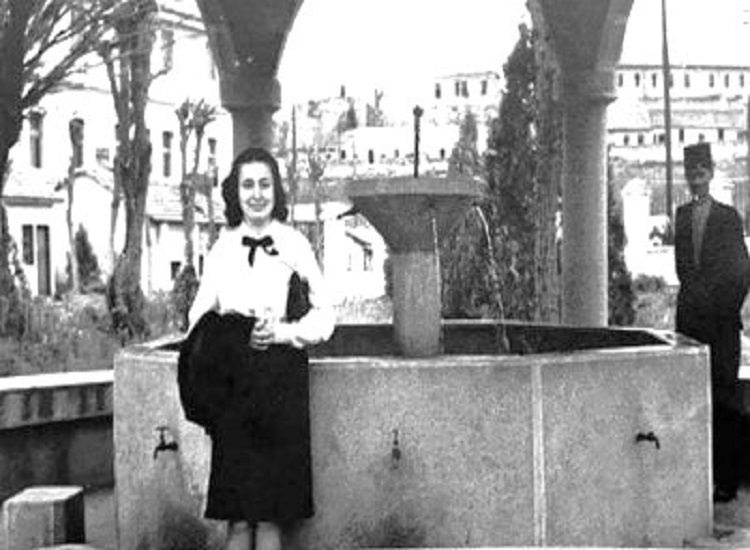
So the trunk of their life had not dried up. She, too, could very well set her life in order. She would return from work in construction, wash herself, and put on her white blouse and a coat she had bought in Rome, and walk, utterly indifferent to the stares of the spies who were everywhere. Although she now belonged to the most discriminated and oppressed stratum—that of the enemies of the class—paradoxically, as she walked the streets of Rrëshen, she looked very “luxurious” in that small town, where children went barefoot even in winter.
They called her “cariste” (for whatever idiotic motive), and when she went to the cinema, people moved away from her row as if she had leprosy. But she did not get angry. What fault did the poor people have? If someone spoke to her, the next day they would be called to the Internal Department and would have to account for every single thing – what they had talked about, how much, and how! Life, however, dragged on according to its own incorrigible laws.
The hard life, the great stress, the physical and spiritual suffering left their marks on the health of that graceful lady of yesteryear, who could never have imagined approaching such an end, so foreign to her youthful dreams. Musine fell ill with cancer, and finding no proper help, she wrote letters to the hospital directorates. No one answered. Someone finally found the time to inform her that her turn for the operation had not yet come. Two interned women constantly stood by her and helped her as much as they could.
But on the fatal day of August 13, 1983, when she passed away, they were not there. The door to her room, after the death was confirmed, was closed by the men of the Internal Department. They also took those 1,000 pages of valuable scholarly works, and no one knows in whose vaults they ended up. They robbed her even in death.
This was the last act of violence exercised by Enver Hoxha’s terrorist regime against his noble fellow citizen, against the one who dedicated her entire life to a noble cause – the emancipation of women and of all the Albanian people from brutal violence, both old and new, which turned Albania into a ghetto of Europe.
A Romani man carrying gravel with a dump truck agreed, after much pleading, to load her coffin onto his vehicle. Something eerily similar to the end of Mozart. She, too, was accompanied to the cemetery by only three people, loaded onto an old municipal cart. Bitter facts about which people later repent, just as those who disregarded the death of the great Viennese composer repented.
But have those Albanians who desecrated such a beautiful flower of their nation repented? The negative answer to this question is even heavier than the event itself. No, they have not repented. And apparently, they never will. / Memorie.al