
From ARSHI XHEZO
Part Two
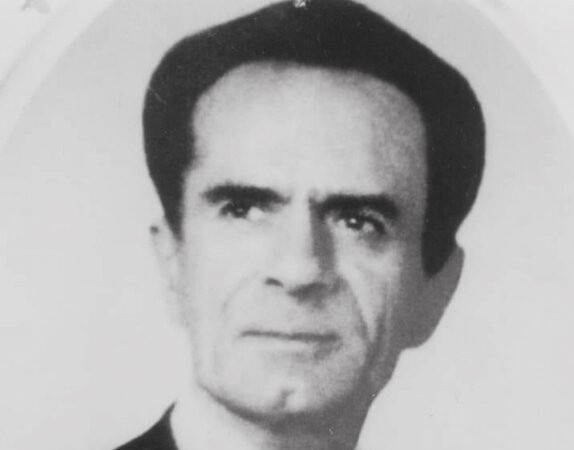
Memorie.al – In 1986, while I was working at the newspaper, I received an unusual letter. It was sent by Vexhi Buharaja. It was a large envelope, markedly different from the others – those small, ordinary ones you could instantly tell would contain some citizen’s complaint about housing or work – routine for any newspaper editorial office. Holding that envelope in my hand, I felt something special. Vexhi Buharaja was very well known to me: known to the town, to the neighborhood, to the alley. In fact, our families – among the oldest in town – visited each other, and he himself was a friend of my father. But I had left town early, right after high school, and had met him very rarely, unlike my childhood friends who still lived there.
There is another kind of work – invisible – that makes his creative personality particularly unique; in every study and translation of his; you will find a sea of notes or explanations. It was precisely this uniqueness that drew the attention of Prof. Eqrem Çabej, who, after reading the translation of Gulistan and Bustan, said that even the introductory study, the explanatory notes, and the encyclopedic glossary alone would merit Vexhi Buharaja a scientific degree. As soon as the door – or rather, the window – of contact with the world of his work was opened a crack (for him, the hindered one – never), he immediately drew the attention of foreign scholars.
One such scholar was Professor Franz Babinger of the University of Berlin, a distinguished linguist (considered the greatest orientalist of the 20th century), who was enthused by Vexhi Buharaja’s scientific competence. Later, Vexhi Buharaja would also correspond with Prof. Babinger. Vexhi Buharaja’s works – whether original creations or translations – are all about Albania and Albanian culture, not about the politics of the day. And he was fully aware that he would have to pay for this. He and his family.
Vexhi Buharaja was arrested, but also insulted…!
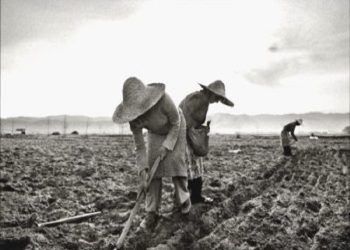
After prison, now with a “bad biography,” they assigned him to the most menial jobs. It was truly sad when, beyond the classroom window – we were in the first year of high school then – we saw him every day: now no longer in a suit and tie, nor in the fine clothes of a cleric, but with a pickaxe and shovel in his hands, and wiping away sweat from time to time, he was hauling gravel at the Gropa e Zhurrit, at the foot of the castle, right across from our classroom windows. We watched and said nothing, for another reason too. In our class were also Vexhi Buharaja’s daughter, Myzejen, and we instinctively felt that any word or gesture of ours would make her feel bad.
Sometime later, they removed him from Gropa e Zhurrit and supposedly eased his work, but in fact insulted him even more: they assigned him to one of the town’s barbershops, to wait for customers’ tickets.
Not only we, the younger ones, but everyone felt awkward approaching the table where the Professor sat when they entered the barbershop for a haircut or a shave. Vexhi Buharaja was no longer a poet, a translator, a scholar, or a theologian. The magic words – “declassed,” “tainted” – had stripped and dispossessed him of those things. Nevertheless, he knew how to preserve his inner freedom under any kind of clothing and any kind of obligation.
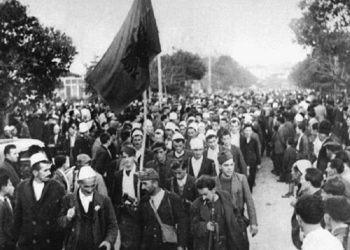
But the citizens of Berat also loved and honored the “tainted” Vexhi Buharaja all his life. Especially his death and burial, in July 1987, they turned into an extraordinary manifestation of respect. The whole town, thousands of people, old and young, took part in the procession and burial of the town’s great son, and the coffin with his body was not placed in the municipal vehicle. For nearly three kilometers, from Vexhi Buharaja’s house to the cemetery, the citizens carried it on their hands, raised high, on their fingertips.
It resembled a procession of love, pain, but also protest and grievance. If those dispossessed of books and religious clothing were few, those with a “bad biography” because they were stripped of property, land, vineyards, olive groves, shops, etc., in my neighborhood and town, were not few.
Apparently, dictatorships are maintained more easily and longer when the “stripping,” the dispossession, is total and threefold: dispossession of physical property, dispossession of intellectual property, and dispossession of religious faith – the strangest and most unpredictable. The entire neighborhood and our whole town were hindered and insulted – not just Vexhi Buharaja. You could understand this even from the panoramic view of an adolescent.
Those with bad biographies – or kulaks, who had been rich but no longer were – stood out in many ways. By their clothes, their attire. They must have been bought abroad – or at least in Tirana. Suits, ties, large, heavy overcoats, but you could tell they had been bought many years ago. They also stood out by their walk. Always to the side of the road, almost always alone, or with family members or relatives, and they made their way from Muratçelepiasi to the bazaar or vice versa with their heads bowed, barely speaking.
We knew that many of them had finished good schools, so we were not surprised that they were very polite. Many of their parents and relatives had gone to prison, and that seemed to explain everything. It was said that the Vrionas were the most numerous. Perhaps because they had been the richest. At the time, I had a vague idea, of course, about who spoke…
More than the word “declassed,” for them the daily vocabulary used the words “tainted” (*i prekur*) and “shadowed” (me hije): “he is tainted,” “his family is tainted.” Precisely the terrible word used for those sick with tuberculosis, or “veremi” as it was called in everyday language – a fatal disease after which your days were numbered. Who could have thought up that epithet? This was because there was no cure for it – more precisely, it hadn’t been invented yet in those years.
Even after the invention of penicillin, thanks to this antibiotic also in Albania (around 1955 when it arrived), and this disease began to be cured like all others – our “tainted” ones still found no remedy. In fact, from 1955 onward, their “illness” began to worsen; their “taint” was of a different kind – political.
Apparently, ironically, it was also called the “rich man’s disease,” because only the rich could afford to cure it with special foods and long holidays in climatic resorts. Switzerland and Vienna were mentioned, for example, or Voskopoja – depending on your pocket. This word, which also seemed deliberately invented, was a bitter mockery of the *zengjinë* (rich folks) of Berat, who, now fallen from grace, could not even afford Tomor or Shpirag, right at their doorstep.
Among other things, the disease was also contagious.
The Vrionas or other “tainted” ones passed it on to one another for several generations, leaving them without work and without education, and worst of all, in prisons or internment. The class struggle followed a genetic line, but the disease was also inherited by in-laws: “she married into the Vrionas… she gave (as bride) to the Dyrmos…!” Exceptions from the Party: either your wife or the Party (Sabri Godo, the writer, for example, chose his wife, but he alone knew how much he paid for it…).
There were plenty of “tainted” in our neighborhood, and in other neighborhoods of the city, as many as you like. Apart from the Vrionas, the Myfti family, the Protopapa family, the Dollani family, the Haznedar family, the Protoduari family, the Kokoshi family, the Lapardhaja, Stefa, Sterjo, Jaho, Dyrmo families, etc. Born after the Liberation, I myself remember the last of the dispossessed. For example, Nan Karaji, who had a shop in the square near the city’s post office, was a beverage merchant: wine and raki wholesale and retail.
When one day, to our surprise, we saw his shop closed. We heard that he had endured the first two extraordinary taxes – meaning he had paid the state cash on the nail. But the third tax broke him. Pyzja, the ready-made clothes and bridal trousseau merchant, had surrendered sooner – his pocket was smaller than Nan Karaji’s and others.
We had some strange enemies in town, which I never understood why they were enemies. For instance, Doctor Ymer Dishnica, the father of my friend Peri. They had put him in prison and interned him in Berat as an “enemy of the people” (!). He had graduated in France. The people loved him very much because, besides working at the hospital, he visited everyone at home, day or night. How could he be an enemy of the people, when the people loved and respected him so much?
There were other families, large and medium, whom the agrarian reform or the extraordinary taxes turned into “tainted,” kulaks, with bad biographies, etc. But this does not include those who self-declared as kulaks or bad biographies after the 1990s, whom the whole town knows. Some of them were also known as hafije, meaning spies and collaborators of the State Security, and even though their names appeared in the newspapers, they carried on…! It was a phenomenon that appeared in all communist Eastern countries after the overthrow of the dictatorships.
Katovica is not a myth!
The ordinary townspeople were not at all afraid of infection from the “tainted.” As if nothing had happened, the walks and visits continued as before. What was striking was the nobility and care of the “tainted” themselves to avoid meetings so as not to harm their friends and companions. Until high school, this virtue of my fellow citizens seemed to me the most natural thing in the world. Perhaps the fact that all parents, all families, in the alley, in the neighborhood, in the town, did the same thing had an influence.
What could be the reasons for this disregard for politics? Perhaps, until then, the early 1960s, the class struggle, as it was called, had not yet flared up so much. For us, and for the adults as well, the best-known, greatest, and most respected people in town were Doctor Dishnica, Doctor Thomo, Doctor Kondi, Doctor Haxhistasa, Doctor Lluka, Doctor Maksuti, Doctor Pandeli Çina, Doctor Afrim Çeçua, Doctor Zino Matathia, or learned men like Vexhi Buharaja – and the little ones had no idea what a first secretary or a seventh secretary was! These were the people who daily came to help people and provide remedies.
But perhaps this disregard for politics came from the fact that in our town, where the vast majority of the population still consisted of autochthonous, old families – 100, 200, 300 or more years old – knowing each other’s old biographies thoroughly through centuries of neighborliness, they made their assessment based on the old biographies and disregarded the new biographies, those made by politics. So it was confirmed once again: the old biography retains moisture longer than the new one, which is measured by one party or another, by one chair or another.
In the 1980s, I also came to know closely a patriot of mine, from the Vrionas family, Jusuf Vrioni, with whom I had the chance and fortune to work together for nearly ten years at the “8 Nëntori” Publishing House (later renamed “Encyclopedic”). A true intellectual, educated in France and traveled through Europe, an aristocrat and elegant in behavior and dress, and, of course, extremely capable and cultured – in him you could see the roots, the old biography. The 13-year prison sentence had not been able to cut those roots.
In the second year of high school, we were lucky to have a literature professor, but unfortunately only for a few months; because later he disappeared and we learned that he had been imprisoned for agitation and propaganda: 10 years. Luan Myftiu, from a well-known family of the town, also “tainted.” Tall, somewhat thin, neatly kept, he was particularly talented. He was cultured and knew literature well. Extremely polite and not at all pathetic, he spoke in a light, low, somewhat timid voice, and you – all eyes and ears – thought that only such a voice could speak about literature.
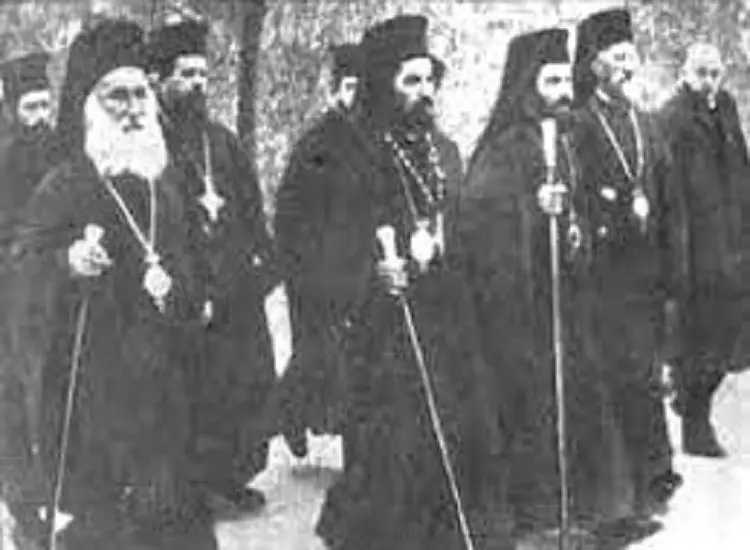
We also had quite a few “tainted” in our high school class. That Zefi, in his cell – later they shot him – had been forbidden to move his lips to say his prayers, and for any violation, i.e., lip movement, he was punished with five lashes of the whip on his back and legs. Since it was impossible to assign a guard to every Albanian to shut his mouth, it was thought that erasing God from memory could be achieved by closing or destroying all churches and mosques and dispossessing even the houses of God; by punishing clerics.
The stripping of faith and religious beliefs was the most Quixotic undertaking. This privacy, utterly intimate and sacred, is not recorded in any census or passport of civilized countries. On February 15, 1967, at 10:00 a.m., on all the doors of Shkodra’s churches and mosques, leaflets – as they were called – were placed, on which was written: “Enough of your deception! Go to work and earn your bread by the sweat of your brow!”
The initiative spread quickly throughout Albania, and within a short time, most churches and mosques were struck with pickaxes, while some of them were turned into warehouses, theaters, or cultural centers. At the same time, and perhaps even before the mutilation and alienation of churches and mosques was planned, the mutilation, alienation, insult, and humiliation of them was also planned: they were to change their clothes and shave their beards, all of them.
In fact, clerics were the last contingent left with beards and mustaches. It seems unbelievable, but immediately after the Liberation, according to an orientation that was never known where it came from, no one could wear beards or mustaches anymore. No government or party decision can be found in the archives. Newspapers and speeches began to call them bourgeois foreign displays, and that was enough for people to take measures themselves.
The satirical magazine “Hosteni” attacked with writings and caricatures anyone who dared to try them on. In fact, in some cases, quite a few actors from the Film Studio were ridiculed in the press, who, under the pretext that they had such roles, began to wear beards and mustaches. It was the only place in the world where you didn’t see a single one. To be completely accurate, there was one such person in Tirana. He was a man in his sixties. Tall, thin-bodied, with a noble appearance and an intellectual sparkle in his eyes, he was the only one who wore not only a mustache but also very long hair that hung down quite a bit behind, below his jacket collar.
It was the 1970s, and most of those who saw this man walking calmly through the streets of Tirana took him for a foreign tourist. He was not a tourist; he was the well-known and respected professor of agronomy, Abedin Çiçi, about whom it was said that he had been allowed to keep that long hair on Enver Hoxha’s personal orders. This rumor circulated everywhere, but no one knew the truth. There are some truths of that time that the youth of the post-1990s have every reason to take as fictions. Perhaps only the archives and the press of the time can convince them.
But what about the priests and imams? After all, as everywhere in the world, their beards and mustaches were institutional and professional. Our neighborhood mosque had just been closed. Sitting in one of the barbershop chairs waiting my turn, I heard the barber, addressing one of the imams seated in front of the mirror, with tears in his eyes and choked with emotion, saying:
– “For heaven’s sake, Hoxha Efendi, forgive me! My hands cannot bring themselves to remove your honor’s beard!”
Of course, in those years, we children did not judge such scenes – like the one in the barbershop – as “denial of the universal right to exercise freedom of religious faith, based on convention x, y, …,” etc., etc. On the contrary, those scenes seemed to us the cause for the “mockery” that would begin when the imam, now beardless and dressed “civilian,” would hurry from alley to alley to get home, followed by the laughter and whispers of some who could hardly wait for such occasions for their jokes.
And I, seeing him there in the barbershop before the barber, imagined what our imam would do from now on. Would he go to the cinema like everyone else? Would he bathe in the river in his underwear like everyone else? Would he eat ice cream while walking down the street? And Hafiz Rizai, what would they call him now – “Comrade Riza”? And Father Vangjeli, would they still call him “Pope”? Because Father Vangjeli, like Hafiz Rizai, had become “one of them.”
That was the fate of all the city’s clerics.
For military personnel, when for some offense or another they are sentenced to prison, according to law, before they are put in their cells, their military symbols is removed: their weapon, their cap, their belt, and their shoelaces. After that, they look completely without identity and ridiculous, with their hair deformed by the cap that had sat on their head for 30–40 years, and the completely white patch on their forehead. Likewise, the imams, priests, and dervishes appeared on the city streets after they removed their robes and their beards. You couldn’t even recognize them up close anymore.
The likable deacon of the “Goricë” neighborhood, Father Vangjel Xoxa, whose very black beard against his very white face created a rare contrast, after the “operation” shut him indoors for quite a long time. Then, inevitably, he had to go out to earn his daily bread. He started working as a carpenter in the city’s joinery, and my brother, who worked there, told how Father Vangjeli worked with great pride to meet his quota, even in the first days.
Famous people – writers, artists, scientists, etc. – for the public opinion that loves them, appear likable even in their outward appearance, even when they are not at all so. But Vexhi Buharaja was truly a likable man, so no change in appearance could damage his image. Tall, with a straight body and an elegant gait, as with the suit and tie he wore; dark-haired, with a black, well-kept beard – in those years he was a cleric – he immediately caught the eye. In the neighborhood, certainly, but also throughout the city. It is etched in my memory that when he left his house at the end of our alley, and it became known that he was going to the neighborhood mosque, the women and girls of the neighborhood would hurriedly open their gates and announce to each other: “Ladies, quickly, get dressed, let’s go to the mosque, because today Mr. Vexhi is going to preach!” / Memorie.al