By Eugen Shehu
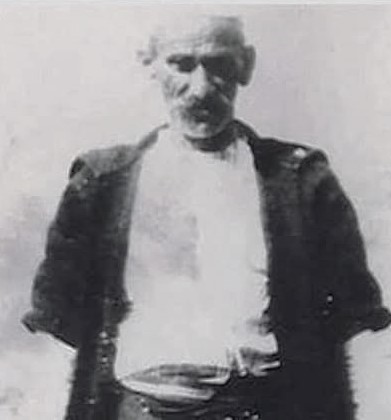
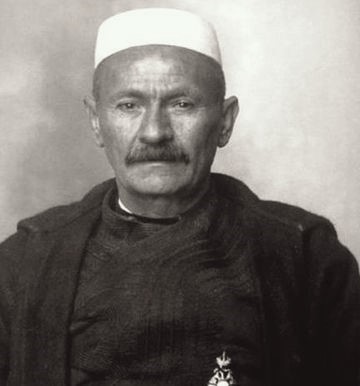
Memorie.al – Probably born in 1875, he roamed the roads of Lisivalle while Albanian men convened at the Albanian League of Prizren. But a strange connection would exist until the end of his life with this great assembly, with this epochal act of Albanian bravery in the face of its national disintegration. Perhaps the link between an event and the life of a child must be sought precisely in the fact that all the subsequent years of Suf Xhelili witnessed not only their physical passage but also their complete devotion to the independence of all Albanian lands. In this “devotion,” there is, among other things, the smoke and roar of war, the sweetness of the lullabies of Lisivalle, and the snow and hail from the Nine Mountains of Dibra.
Whenever anyone sits down to meditate on this man, I would advise them: go and see Sufa’s towers in Lisivalle.
If they are ruined, take a stone from them, and weigh history. If even the stones are no longer there, take a blade of grass from that place where the towers once stood. Even that will weigh more than a stone. You just have to feel this weight in your heart. More than physical kilograms, you will come to understand within yourself tonnes of pain.
But why pain? Because until some time ago, no one visited Suf Xhelili’s grave. Do not be surprised! Yes, yes, Suf Xhelili…! They say he was a clever commander; they say he spoke little; they say the attacks began when his rifle fired; they say that everyone in Dibra recognized the shot of his rifle. They say…! I only know this much: Suf Xhelili, this terror of the Serbo-Slavs!
Nermin Vlora Falaski has stated: “Albania has been defended over the centuries by her finest sons. We will mention only two of them, two distinguished men from Dibra, who even gave their lives for their homeland: Elez Isufi and Suf Xhelili, whom the people have preserved in folk tales and kept with love in the treasury of precious memories.”
“The continuity of their patriotic activity still cannot be fully woven together through documents. But their efforts emerge from the voice, from the heart of the people who have dedicated legendary songs to them.” (Nermin Vlora Falaski, “The Knight of Dibra”, p. 210).
Suf Xhelili, among other things, had great fortune in life. He is the nephew of the legendary Elez Isufi. In this blood relation, anatomy can hardly be decisive. Uncle and nephew, beyond anatomy, would be united by the pure sentiment of Albanianism. Even when it is said that they were anti-Serb until their last moment, one must understand that the instinct toward this “heresy” is, in the final analysis, the influence of a purified nationalism.
For as long as the feeling of territorial independence thrives, it is understood to be in complete opposition to the moral and physical endangerment of the homeland. Contemporaries remember Sufa with pride, especially in the Battle of Kolesjan, so widely discussed today for its epic dimensions both in Albania and in the former Yugoslavia.
Kolesjan, this natural Albanian fortress, would be above all a battlefield between Albanianism and the Slavic thirst for seizing territories, initiated perhaps five centuries earlier by the dreams of Tsar Dushan. Composure at the height of battle was his second nature.
No matter how complicated the situation, no matter how much death swirled around his positions, Sufa would always be on the brink of death but still conversing with life. To the shame of Albanian Military Art, it must be said that precisely this wise peasant from Dibra should have been studied in detail.
His combat actions and energies, adapted to the situation and human resources, remain a mystery before which all Albanian military personnel will bow with veneration. Especially in today’s conditions, when our military art is definitively separating itself from Leninist military theory, the Battle of Kolesjan should be ranked among the foremost for its method of organization according to the principles of popular warfare. Afterward, his rifle would fire wherever Serbian dreams “trespassed.”
And the shot was indeed a great thunderclap. It happened that Serbs were attacked in Manastir. They were broken and they said: “Aha, Sufa has attacked us.” But on that same day, fighting also took place on Mount Vrahiç. And again, many captured Serbs declared: “Suf Xhelili has attacked us…!” Former Serbian captain, Stavro Belishica, has written: “When we accompanied Elez Isufi from Great Dibra to Sllovë, we had received orders to act at the first opportunity that presented itself.”
“Sufa’s presence, the way he organized the tight defense around Elez with the highlanders, caused our aim to fail. We trembled before Sufa. He crushed us with his heavy gaze and imposed on us either his point of view or certain death.” (Xhelal Ndreu, “Unpublished Memoirs” – taken from Stavro Belishica, in 1941).
Sufa was not a monster. Of average height, wise, noble to the point of sacrifice for the national cause, he would climb almost alone to the dizzying heights of legend. And then? How is the Serbian terror of him explained?! The history of the Balkans is quite turbulent. In it are layered the traces of countless battles between nations, between people belonging to different tribes, between ethnicities.
In this stratification, at an almost tragic juncture, Albanians have always found themselves alongside the Slavs. And if Albanians are known as the most ancient peoples of the Balkans, it is known that many centuries after them, the Orthodox Slavs of Ukraine came up to the northern borders of the Balshaj principality. From here, the great conflict would be engendered, not to be extinguished even today in civilized Europe.
A line of brave and wise men would defend the nation, the language, and the lands of their Albanian forefathers, up to their sublime anguish. Among them is Sufa, undoubtedly peculiar in the hatred he bore for the Serbs. In this blood connection, and moreover the call of ancestral blood, the bravery and pride of the Nine Mountains of Dibra would grow. There is a moment in Sufa’s life that was so widely discussed by our historians “educated” with the teachings of the Slav-Albanian red Party.
A moment which would cause, for five decades, Sufa’s name to be at the forefront of gigantic anonymity in the national memory. His flirtation with Esat Pasha. It is known that the latter offered Suf Xhelili money, titles, ranks, and positions. But he never accepted. It is known that behind Esat were the ultra-reactionary and chauvinist Serbian circles.
But this “flirt” is thought to be one of those games of Dibran popular wisdom. The moment of Esat’s “cooperation” with Sufa would arouse surprise among some leaders of the Dibra gentry and nothing more. While their departure would not only free many patriots from anxiety but would definitively discredit the Serbian favorite, Esat, for whom Albania was merely property to be divided, even though our freedom and ethnicity were at stake. And Esat’s “separation” from Sufa was almost terrifying for the Serbs.
In a letter that the patriots of Dibra send to Elez Isufi, it is said: “Here, Dardha, Reçi, and Lura, are waiting for you or Suf Xhelili, and we beg you to come here as soon as possible. I could not write a separate letter to Suf Xhelili, as I did not have paper at hand. But we expect you to come as soon as possible or to send Suf Xhelili. For this matter, we beg you, as do the whole region and all the villages here. Your brothers: Dik Xhelili and Miftar Kaloshi.” (Elez Isufi, documents, p.132).
The Esadist forces were preparing for a brother-against-brother war, thus predetermining the fate of subsequent battles with the Serbs. But this war did not happen thanks to the immediate arrival of Suf Xhelili, his maturity, and his bravery in taking upon himself certain burdens that have never befallen a hero. Immediately after this, denouncing the Esat-Pashiq pact for the deployment of Serbian forces to Durrës, the Battle of Qafa e Trojakut would be organized.
Two thousand Serbian soldiers killed and over 1,000 captured would not only prevent the Serbs from reaching the Adriatic but would astonish the military art of the Belgrade headquarters, re-emerging a common dimension of it: that of fear when facing the men of Dibra led by Suf Xhelili. Afterward, together with his brave men, he would unfurl the humanism of our race.
All prisoners were kept fed and returned to their country, amazed by the great spirit of the warrior. Because he loved Dibra and all of Albania without the Serbs, because he inspired true democracy, Suf Xhelili was the first in Dibra to stand up for the defense of the first democratic state of Noli, which lasted a few months. In assemblies, in the men’s chambers, or in the forests and mountains of Dibra, he would express himself with great sympathy for Noli and for what he wanted to achieve.
His political vision, although clouded in different times and situations, would always be clearly in favor of the democracies of Western Europe. And it could not have been otherwise. A life tired by endless wars would want to fade away only by seeing the birth of this democracy.
The silent Serbian archives have not yet spoken. But it is known that a bullet from a treacherous hand found Suf Xhelili’s heart in the foggy December of 1924. Naturally, the bullet could never hit the songs, deeds, conversations, and legends about this man from Dibra who became the terror of his greedy neighbor. The friendships formed many years later between Enver Hoxha and the Yugoslavs would wound even the stones of Sufa’s grave. Nevertheless, he survived through his ideal, appearing fully in our days. /Memorie.al