

By Arshin Xhezo
Part One
Memorie.al / In the spring of 2005, the American-Jewish photographer Norman H. Gershman, director of the Islamic Foundation called “Besa,” came to Albania – and a few months later also went to Kosovo. Initially in Tirana, then also in other cities of Albania, Berat, Krujë, Shkodër, etc. – according to a list he had with him – Mr. Gershman sought out and photographed citizens, witnesses from families that had sheltered and saved Jews during World War II, or their descendants; but only Muslims, by religious faith, and with them he would later create a photographic exhibition and a special album. “The reason I have focused on Muslims in Albania,” said Mr. Gershman, “is that the world, outside this room, does not even know that Albanians are a Muslim country, that their ‘Besa,’ God, the friend, are sacred to them, and that is the reason they saved hundreds and thousands of Jews from certain death, all of them.”
Perhaps precisely for this reason – that the exhibition and album had to feature only photographs of Muslims – almost all those captured by his camera or lens hold a Quran in their hands, or honor according to the Islamic rite. (Apparently, it is an old habit of photographers, reminiscent of those from the former municipal offices, who would “arrange” you themselves, and before clicking the camera, never forgot to advise you: “Smile a bit?!”) The album-book or book-album, titled “Besa” from “Muslim Albania,” was published, with even more “Albanian Muslim” rescuers, and was first promoted on a tour in the United Kingdom.
A little later, the book “Besa” and “Muslim Albania” were written about in the major German newspaper “Die Welt.” (“During the German occupation, Albanian Muslims saved nearly 2000 Jews.” – Die Welt, 2011). Then, based on the book, a film was prepared, “Besa. The Promise,” the footage of which, with the rescuers of Jews – almost all the same Albanian Muslim citizens with the Quran in their hands or honoring the Islamic rite – was also shown on the well-known CNN network, a program which was later taken and broadcast by one of our own TV stations.
No one doubts Mr. Gershman’s good intention, and for that he should be thanked. But, while it is entirely within his right to work for the British Islamic Foundation, which, for its own motives, seeks to show the world “a model of Islam,” there is no reason to do so by distorting history with falsehoods or half-truths, which are even more harmful than lies.
Last year, a photojournalist, known worldwide for his photos and exhibitions on particular events and people, was surprised in Korçë by the fact that in this city of “Muslim Albania,” according to him, Muslims drank beer, but they also drank together with Christians and in the same place, at the Beer Festival. The journalist who interviewed him could have told him something everyone knows: that the Muslims of Albania are just as, and perhaps even more, skilled as drinkers than the Christians of this country; they drink beer, wine, raki, and whatever they can get their hands on.
It is more than true that in Albania there has been and is a normal, even model, Islam, and that hundreds and thousands of Jews were sheltered and saved by Muslim families during the war. It is also true that traditional institutions such as “Besa,” “Hospitality,” etc., played an extraordinary role in sheltering and saving Jews during the Nazi occupation.
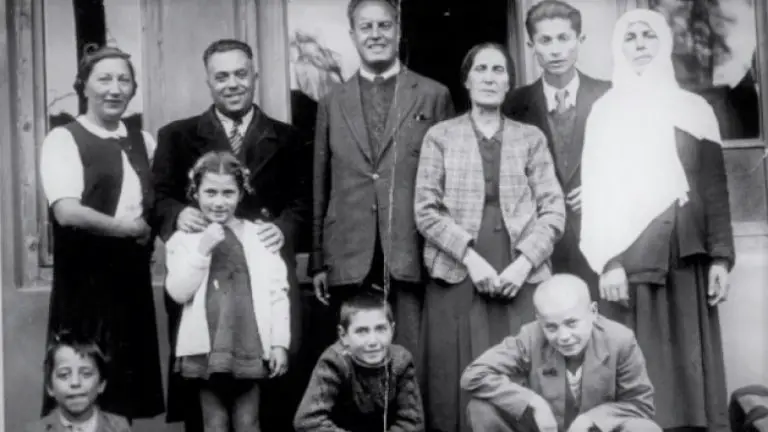
But there is abundant documentation in archives, the press, and books, and there are still living witnesses, confirming the great and beautiful truth: that the sheltering and saving of Jews is a deed not only of residents of the Muslim faith, nor only of those of Christian or Bektashi faith: it is a deed of all Albanians. And of an Albania that is neither solely “Muslim” nor solely “Christian,” but of an Albania which, in all periods of the Albanian state since 1912, by Constitution, has always declared itself and has been secular, has never had an official religion, but rather religious and ethnic coexistence, truly in harmony and a model for many.
Meanwhile, the sheltering and saving of Jews, just as it is not the merit of citizens of only one or the other religious faith, is also not exclusive to the institution of “Besa,” “Honor,” “Friend,” or “Hospitality.” Being impossible to explain the saving of Jews with all its factors – that is, explaining it only with “Besa” – this word becomes magical, mysterious, calling into doubt both the truth and the role that “Besa” or Albanian “Hospitality” truly played. But, in any case, without exaggeration, because hospitality, for example, “is not an exceptional quality of the Albanian.” There are many other peoples, even quite hospitable ones.
The bad thing is that, besides foreigners, these words are repeated as slogans, more so, unfortunately, even by us who, sometimes out of ignorance, sometimes out of an inferiority complex towards foreigners, applaud without thinking twice when we see exhibitions or films with “Muslim Albania,” “Muslim rescuers,” and other falsehoods, just because they are prepared and shown by foreigners, since they “propagate our image”…
Preserving and transmitting historical memory to generations, especially for events such as fascism, communism, or the Holocaust against the Jews, which brought great trauma to humanity, is not a matter of erudition or simply gathering facts. “Those who forget the past are condemned to repeat it,” writes Franz Kafka. But “how to preserve it?” – That, it seems, is the question.
Superficial, one-sided, partial treatment, with half-truths and without analysis of causes and effects, as is often happening even with the saving of Jews in Albania during World War II – attributing it only to Muslim believers or making it exclusive to the traditional institution of “Besa,” “Honor,” or “Friend” – that is, when it is not convincing, turns history into myth – the chance and long-awaited gift for today’s anti-Semites and neo-Nazis.
This is not the place to elaborate, because these issues have been and should be better dealt with, I believe, by specialists in the field, but for the case we are discussing, monopolizing the saving of Jews to Muslim believers, besides ignoring historical truth, also has an ethical, moral aspect. (How bad would those very Muslim families who sacrificed for the Jews feel, in front of their Christian neighbor, friend, or companion who made the same sacrifice?)
And, above all, this lack of responsibility, wittingly or unwittingly, provokes division among citizens, believers of different faiths. “The idea that our religion is the best, the purest, from an anthropological perspective is a myth,” writes Akbar Ahmed, an Islamic scholar at the American University in Washington. “Building bridges between religions is an imperative if we wish to survive in the 21st century.”
Muslims and Christians in Albania are “Siamese brothers,” historically, for centuries. They have done both the good and the ugly things together. And Albania itself, although it is neither “Muslim Albania” nor “Christian Albania,” and, geographically in Europe and with a European identity, still has not managed to become European by today’s standards, due to the responsibility of all, not of citizens of one faith or the other.
On this path of a common destiny, the explanation of the saving of Jews is, I believe, an explanation that is only realistic if all factors are analyzed, which are complementary and are fundamentally based on the survival and interests, first and foremost, national, vital, and economic, of all communities.
Some of them, I think, are:
1 – Early and long neighborliness. The Jews, like the Greeks, are the oldest neighbors of the Albanians. They came as early as the 2nd–1st centuries BC, and over two thousand years of neighborliness is at the foundation of this friendship, which is also reflected in the subsequent solidarity.
2 – The Jews came not as conquerors, but as immigrants, people in distress, and for this reason Albanians made room for them and came to their aid, just as later they did for Greek, Serbian, Macedonian, Vlach, etc., immigrants.
3 – In the years when the Jews immigrated to the Albanian lands, there were still free and fertile lands in the fauna and flora; likewise, there were local needs for labor, especially in those crafts specific to the newcomers. This, I believe, is also one of the main reasons from which earlier immigrants “benefited” and “benefit” everywhere in the world, because, as is known and seen more clearly today, due to intensive communication and globalization as a whole, the “hosts” themselves are increasingly “squeezed” in their territories and national wealth.
4 – The Jews found in our country a consolidated tradition of ethnic and religious coexistence, and with no trace of anti-Semitism.
5 – The hospitable locals were not fanatical in their faith and rituals, and they accepted “the different” as different, even in religious faith, together with their rituals and cult objects, which they protected and respected just like their own. The famous Emperor Constantine the Great, known as Constantine from Illyria, writes: “We desire with all our soul that all people worship and believe in whatever religion they wish.” (Michael Grant: “Constantine the Great from Illyria”, Bakus Publishing House, Tirana, 2004, p. 180)
6 – Albanians had customs and traditions such as the institution of “Besa,” “Honor,” “Friend,” etc., which encouraged in the Jewish newcomers, as well as in those from other communities, security of life, respect, and regard for them, their culture, and their religion. This is a valuable and recognized quality of the Albanian ethnotype.
7 – The Jews saved from the Nazis in the years 1943–1944, for Albanians, were not the “first experience” or “first test” of human solidarity and sacrifice for another in need and disaster. Just a few months earlier (after September 8, 1943, when fascist Italy capitulated), Albanians “forgot” the enemy that had invaded and killed them, and sheltered and saved about 20,000 Italian deserters who were left on the streets and in dire straits.
8 – Albanian anti-fascism and the National Liberation War not only encouraged the protection and salvation of Jews, but the salvation of the Jews itself became one of the manifestations, one of the beautiful aspects of Albanian anti-fascism.
In Albania, alongside Albanians, communities of Greeks, Macedonians, Vlachs, Roma, etc., have lived and still live, and, naturally, solidarity and sacrifice for them would be exactly the same as for the Jews, if they found themselves in their situation, regardless of ethnicity and religious faith.
Like individuals, states and nations are evaluated, especially, by the culture of consensus. / Memorie.al