By Agron Tufa
Part Two
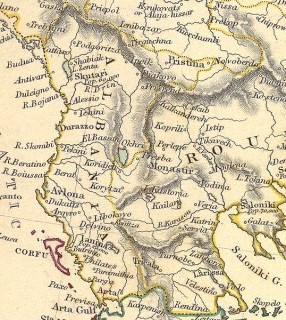
Memorie.al/ As a family, the Kastriots, the ancestors of Skanderbeg, appear in historical sources later than many of the Albanian noble families of his time, who are mentioned as minor feudal lords in the 1270s, some perhaps earlier. As was said, during the Middle Ages, Albanian nobles generally used the name of their early village as a surname. In fact, this practice continued up to the present day (Naim Frashëri, Faik Konica, Zef Jubani, Filip Shiroka, Ymer Prizreni, Isa Boletini, and many others). The Kastriots must have also used this practice. In Albania, there is only one village named Kastriot. It is located in the deep mountainous interior of Eastern Albania, 8 kilometers north of Peshkopi, in Lower Dibra, within the boundaries of the micro-region or provincial community of Qidhna, one of the nine “mountains” of the Dibra area.
Continues from the previous issue
As a resident of this settlement with the supposed name Kastri, the surname Kastri-ot emerged, just as, he added, happens with the inhabitants of many settlements in Southwestern Albania, such as Kaninjot, Suliot, Delvinjot, Borshiot, Sheperiot, etc. Naturally, this explanation has no basis, for at least two reasons: because near Shkodra there are no signs that there was ever a village called Kastri, and because in that region the linguistic phenomenon of naming inhabitants with the suffix – ot is encountered nowhere – a phenomenon mainly widespread in Southwestern Albania.
North of Shkodra there is a settlement called Kastrat, but its inhabitant is not and cannot be called kastriot. Moreover, the settlement Kastrat is located in the district of Malësia e Madhe, while Mazrek is in the district of Dukagjin. Consequently, both one district and the other are difficult to consider as the birthplace of the Kastriots, who had no connection whatsoever with them.
Athanas Gegaj also accepted the view of the two aforementioned medievalists, but he departed from Fan Noli, because he found in Mirdita a locality named Kastri (between Dibrit, Menella, Kashnjeti, and Vigu), from which, according to him, the Kastriots took their first surname. He then adds that he supports this claim on the fact that the Kastriots had ownership rights over the regions of Mirdita.
But this thesis is undocumented, hence dubious, to say the least – unacceptable, considering that the suffix –ot for inhabitants is not found in Mirdita either, and that Mirdita was in the possession not of the Kastriots, but of the Dukagjins, at least from the third quarter of the 14th century. Regarding the second surname, Athanas Gegaj sought it in a Mazrek, which, according to him, was located in the region of Has of Kruma.
But this thesis is also difficult to accept, considering that from a documentary point of view it is not proven that the Kastriots had ownership rights not only in Mirdita, but not even in Has of Kruma. In the dissertation on Skanderbeg, which Fan Noli published in 1947, he abandoned his 1921 view and came out with a new thesis, which seemed to him more substantiated.
He based the new thesis on two chronicle sources, of which one – the Ragusan chronicle of P. Lukari, published in 1605 – he had also read in his first work (1921), but had not paid it sufficient attention, while the other – a Bosnian codex of the 16th century, published by E. Fermenxhini in 1892 – he had not known in 1921.
Lukari in his “Chronicle” writes that; “Gjon Kastrioti was lord of Kruja” and that “his family came out from Kastrati, a village in the jurisdiction of Has in Albania, a little way from the Drin river.” (Giovanni Castriota signor di Crui, la qual famiglia usci da Castrati, villa nella guirisditione in Az in Albania, poco discoto dal fiume Drilon). Has is a region in Northeastern Albania, centered on Kruma, which some time ago became a separate district.
Fan Noli thinks that Lukari erred only on one point, because instead of saying Kastriot, he wrote Kastrat. But Noli is not right. In Has there is no village called Kastriot. In fact, there are no signs that there ever was a village with that name. Only in Kruma is there a neighborhood that bears the name Kastrat.
Moreover, Lukari’s information contains several inaccuracies, which resulted from the fact that, as a late author, he was perhaps relying on unreliable narrative sources. First of all, Gjon Kastrioti was never “lord of Kruja”. Likewise, the Kastrat neighborhood of Kruma is not located near the Drin River.
Furthermore, we are not sure that Lukari is referring to Has of Kruma, because in the register of the Turkish administration of 1572, this region was called Pashtrik and not Has. Finally, as was said, the inhabitant of the village Kastrat cannot be called Kastriot.
As the Ragusan chronicler himself says it, his account resembles the aforementioned legends that circulated in Albania, after Skanderbeg’s death, regarding the origin of the Kastriots. For all these reasons, we are compelled not to take Lukari’s account into consideration as a documentary source.
The impression that we are dealing with a legend is reinforced by the 17th-century Albanian writer and historian Frang Bardhi. Speaking about the origin of the Kastriots, in his work dedicated to Skanderbeg, published in Latin in 1636, he claims that he knows and accepts Lukari’s account of the Hasian origin of the Kastriots, because, according to him, the Ragusans knew well not only the Balkans but also the Mediterranean.
In support of Lukari’s account, he adds that in Kastrat of Has there lived a family that considered itself descended from the Hero, with well-known descendants, one of whom, Mustafa Kastrati, had converted to Islam, while the other, Gjon Kastrati, had remained Christian. Nevertheless, Frang Bardhi states that he did not have this information from documentary sources, but had heard it from fathers and grandfathers. The very surname Kastrat and not Kastriot of theirs indicates that we are still on the ground of family legends.
Regarding the origin of the Kastriots, the Bosnian codex published by E. Fermenxhini, which is thought to be earlier than the Ragusan chronicle of Lukari, is extremely laconic. It states that the Kastriots (in the original it is recorded in the Slavicized form: Castrioich – K.F.) were “from the village of Kastriot located in the Province Az of Epirus (de Castrioti in provincia Az in Epiro).” As can be seen, here the name of the village is correct.
Nevertheless, Noli, who in the meantime had read Jastrebov, was not sure whether the Kastriots had taken their surname from the name of the village Kastriot located in Dibra, or whether the Dibra village had taken its name from the Kastriot family. As a result of this uncertainty, he disregarded the origin of the Kastriots from the Dibra village and leaned toward the name of the Has region of Kruma, or as he calls it, the Highlands of Gjakova.
But even the Bosnian codex, which is thought to have been compiled around 1571, that is, more than a century after Skanderbeg’s death, is not without inaccuracies. This is evident, for example, when it says that the Dukagjins (whose name he also Slavicizes as: Dugaginovich), are from Upper Zenta (Montenegro – K.F.) in Epirus (de superiori Zenta in Epyro), when it is known that their domains were in the region of Mirdita, Lezhë, and Puka.
Prof. Aleks Buda partly departed from and partly aligned with both Athanas Gegaj and Noli. He accepted that the Kastriots’ origin was from Has of Kukës, from the village of Kastrat, which today constitutes a neighborhood of Kruma. At the same time, he thought that the name Kastriot of the village in the Bosnian codex, published by Fermenxhini, must have been Kastrat (as Lukari says), but the compiler of the act wrote it as Kastriot under the influence of analogy with the name of the Kastriot family.
Then he adds that the family name, which comes from Kastrati, took the form Kastriot and should be sought under Byzantine influence, which acted on the names of many Albanian family heads of the middle Ages. This view was also joined by the authors of the “History of Albania,” published by the University of Tirana in 1959 (Volume I), including the author of this work (Kristo Frashëri). But by now these arguments are not convincing.
The author of this work departed from this view as early as 1974 and put forward the thesis that the origin of the Kastriots should be sought in Lower Dibra, in the provincial community of Qidhna, within whose jurisdiction lays the village of Kastriot. The discussion must begin again from the information given by the Ragusan chronicle of Lukari and the Bosnian codex of Fermenxhini, although, being late, neither of them has documentary value.
As can be noticed, between them there is only one point of convergence: the name As or Az of the region, while the other two elements differ because, in one the village is called Kastrat, in the other Kastriot; likewise the region As or Az, in one it is said to be included in Arbëri (Albania), in the other in Epirus (Epiro). Regarding the point of convergence, historians who have used these two sources until now have thought that we are dealing with Has of Kruma.
Despite the fact that the other elements do not point to Has of Kruma, the very name As or Az of the region encountered in both chronicles cannot be ignored. The fact is that the two chronicles do not give us more geographical elements to identify where the region named Has was located, in whose jurisdiction, according to the Bosnian codex, lay the village of Kastriot, near which, according to the Ragusan chronicle, flowed the Drin river.
It is very possible that the two mentioned chronicles have in mind another region, which was called Has, although, as far as we know to date, in documentary sources of the 15th century, this toponym is not encountered either in Kruma or in any other corner of Albania.
Nevertheless, the fact that the name Has is encountered in the 17th century, in the village of Tren, in Lower Dibra, in the micro-region of Qidhna, on the eastern bank of the Drin river, near which (about 3 km) lies the village of Kastriot, is not without value.
According to memories collected quite some time ago from elderly men by a good connoisseur of the Dibra region, Azis Ndreu, the southern part of the Kastriot Field up to the Gjelagjosh stream, was once called Hasi i Thatë (Dry Has), but now it is called Fusha e Thatë (Dry Field), just as it is also reported in the aforementioned magazine “Albania” of Faik Konica (1903).
Here we are compelled to point out that the origin of the Kastriots from Has of Kruma creates a difficulty in another direction as well, which arises from the question: how could a man from distant Has become a feudal lord in a region foreign to him, and moreover, how is it explained that the Dibra people of the provincial community of Qidhna (or of the “mountain” of Qidhna, as the Dibra people call it) would accept to have over their heads a feudal lord from another region, foreign to them?!
In medieval centuries, in Albania, this could only happen if the Dibra region, or any other mountainous region (why not also lowland?), had been conquered by a centralized state, which had enough consolidated power to force the highlanders to submit to whatever feudal lord was appointed from above.
But Albania’s centuries-old history shows that Albanian highlanders, even when they were forced to accept foreign rulers, accepted them on the condition that they would be governed by their own local leaders.
In the best case, the appointment of a Kastriot scion from Has of Kruma in the Dibra region could have happened during the rule of Stefan Dušan. But Stefan Dušan, apart from there being no signs that he exercised absolute power in the deep mountainous areas, did not live long.
His death must have brought about, as everywhere else, also in Dibra, the expulsion of his feudal officials by the native population. Consequently, the fact that the Kastriots appear in Dibra immediately after the collapse of Stefan Dušan’s Serbian Empire indicates that they were local leaders caught up, as everywhere else here as well, in the process of their own feudalization. / Memorie.al