

By Dr. Hasan Bello*
Part One
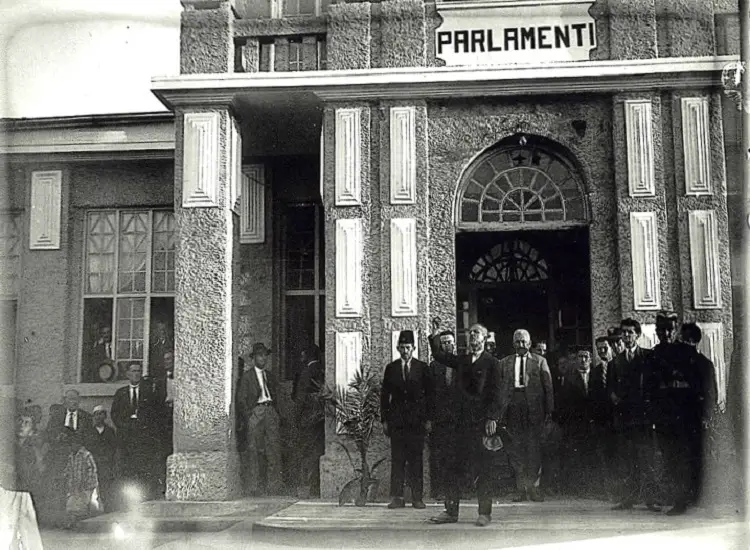
Memorie.al / This article is based on two reports drafted by the commissions of republican and monarchist deputies of the Albanian parliament. It aims to compare the fundamental arguments and counter-arguments that these two groups presented to the parliament’s leadership regarding the determination of the form of regime in the new statute of the Albanian state. What stands out is that they reflect a high degree of responsibility, intellectual level, and legal-constitutional preparation of the deputies. Regardless of how political developments unfolded, it must be emphasized that all representatives of the aforementioned groups were inclined toward finding the most suitable form of regime, one that would ensure stability, prosperity, and internal constitutional democracy for the Albanian state.
The Fundamental Arguments of the Republicans
In the introduction to their explanatory report, the republican commission presented historical reasons as their fundamental argument for the form of the Albanian state regime. According to them, monarchies were based on theocratic principles, the traditions of a royal family that had ruled in the past, or historical causes. Whereas in Albania there was no royal family with theocratic claims, nor any national dynasty with historical rights. The claims of Wied to the Albanian throne were rightly dismissed by this group with the argument that he had left Albania to participate in WWI under the flag of another nation.
This act had violated the decisions of the Conference of Ambassadors, which had decided, in agreement with the Great Powers, on the neutrality of the Albanian Principality. This argument constituted a strong legal precedent to oppose the claims of Wied and the supporters of the monarchist regime. According to this group, this had proven that the saviors of a nation always emerged from the bosom of the people and never came from outside.
Another argument was that in the contemporary period, the creation of new dynasties was not at all in fashion. On the contrary, a considerable number of old dynasties, with centuries-old roots, were disappearing. This argument, which linked the republican form of regime with the historical currents of civilization, shows that the Albanian political elite was under the ideological influence of the French Bourgeois Revolution of 1789. However, it was not a sustainable argument because states and nations like Britain, which was at the forefront of economic, industrial, scientific, and cultural development, although a monarchy, had not been hindered from being a model of parliamentarism.
Here it should not be forgotten that the vast majority of European states, and especially Albania’s neighbors, were monarchies. Nevertheless, this did not stop the supporters of the republic from asserting that Albania lacked a native dynasty, that the old traditions of the Albanian race and the historical situation freed our country from the burden of monarchy. They emphasized that the Albanian was a democrat at heart. According to them, this had also been noted in the books of foreign travel writers. They wrote that neither the long pre-Ottoman conquests nor the Ottoman Empire had been able to uproot from the Albanian’s spirit the eternal conviction he held toward the Eldership (Pleqësia).
This showed that a system of Eldership, i.e., a Republican system, was a system that sprang from the spirit and social life of the Albanian people. Whereas monarchy was in complete opposition to his nature. The social condition of Albania, according to the republicans, showed that the only state form that could suit the Albanian was the Republic. This group proposed an original form of leading the Republic, which consisted of its direction by four representatives (one Muslim, one Orthodox, one Catholic, and one Bektashi). They were to lead the Republic collectively, presiding over it on a rotating basis. This model had proved efficient in the years 1920-1924, when the country was led by the High Council. The Republic, according to them, was a system that also matched the religious composition of the Albanian state.
The election of a king could not be done without the intervention of the Great Powers. The republicans cited the example of Wied, whose rule had proved fatal. To these question marks was added the lack of a person who could possess the necessary abilities to be placed at the head of Albania. Nonetheless, the republicans adhered to the conviction that installing a king would cause dissatisfaction, both internally and externally. With the change in international circumstances, installing a foreign king, in their view, no longer aligned with the interests of Albanians. These interests set forth the immediate need for Albania to be governed as a republic.
Another argument was the limited financial capacity of the Albanian state. According to them, with an annual budget of 14 million gold francs, Albania could not maintain a royal court. Whereas the republic was considered a system with low financial cost, “it will be the garment that fits our body.” The argument put forward by the monarchists that “the king will be impartial and above all parties; in difficult times he becomes a peacemaking force and all parties gather around the king,” although seemingly reasonable, was rejected by the republicans by citing the history of the Balkan kingdoms. The republicans called for the form of the Albanian state regime to be sanctioned as soon as possible.
According to them, the world was facing various political entanglements, which would sooner or later intervene in our country as well. Therefore, the solution to this problem had to be made as quickly as possible. This would avoid the seeds of uprisings and fratricide among the Albanian people. To the fear of those who thought that a dictatorship might arise from the republic, they answered that such things were the product of historical circumstances and could arise from both great monarchies and small republics. This could be avoided by placing constitutional guarantees in the statute, which would cut off the path to dictatorship and guarantee the sovereignty of the people. This report bears the signature of the chairman of the republican commission, jurist and deputy Petro Poga.
The Fundamental Arguments of the Monarchist Deputies
In the introduction of the explanatory report of the monarchist commission, it was articulated that the state, as a product of historical events, as a manifestation of the strongest social needs, had as its primary duty: Ensuring internal and external tranquility. The development from every viewpoint of the people it encompassed within its bosom.
According to the monarchists, the Balkan, European, and world states had different political forms. But the best form was that which, in accordance with the level of development and civilization of a nation, secured stability for it; that form which, by avoiding political-social shocks and the infringement of the people’s liberty, ensured the gradual but rapid development of all the mental and spiritual faculties of that nation. These qualities of a state’s form were also needed by the Albanian people, who were taking their first steps towards civilization and political life.
According to the monarchists, the happiness, progress, and freedom of a people were not secured by adapting the most modern and most liberal form imagined in theory, but by applying that governmental system which best corresponded to the level of politico-social development. According to them, an ultra-liberal state form for an undeveloped people could have the opposite result. It could create premises to bring to power, under the mask of the people’s freedom and sovereignty, dictatorships and parliamentary oligarchies, which would suppress the most elementary rights of a nation.
This conclusion was the fruit of an analytical overview of the history of Albanian parliamentarism in the years 1920-1924. It was the logical conclusion of the political chaos produced by the fragility of parliamentary democracy in that period. Historically, state forms, according to the monarchists, were essentially divided from the viewpoint of sovereignty into two main categories: Absolute monarchies or empires in which sovereign power flowed from top to bottom, as a hereditary right granted by God to a royal family to rule and govern as Sovereign over a nation.
A concrete example, according to them, was the Ottoman Empire during the period of Abdul Hamid II and France during the Bourbon period. A special category of these forms were constitutional monarchies, in which royal families, as a result of pressure from the people, were forced to delegate a part of their power. This was regulated by means of statutes or constitutions. An example of this was Tsarist Russia after the creation of the Duma, the Austro-Hungarian Empire, etc., which were considered archaic forms and out of fashion.
The second category was republican or monarchist democracies, in which power flowed from bottom to top and sovereign power resided entirely in the people. While the people, according to the rights defined in the statute, delegated a part of this sovereignty to the king. The latter enjoyed certain prerogatives, which were hereditary. Another example was the aristocratic republics, in which sovereignty lay in the hands of a few families (Venice). But this form was also démodé. Therefore, the main forms of the contemporary period that rivaled each other were parliamentary monarchies and democratic republics.
In the judgment of the monarchists, from the viewpoint of popular sovereignty, these two forms had no difference from one another. The only difference was that while in one form the head of state was elected; in the other he was hereditary. According to them, the form of regime was not an indicator of the degree of emancipation and democratization of a society. They argued this with the case of the most civilized peoples of the world, such as the Belgians, the Dutch, the Scandinavians, who, although they were monarchies, were no less sovereign than the people of the Republic of Mexico.
According to the monarchists, between the French constitution and the British one there was no difference from the viewpoint of popular sovereignty. In fact, there were cases, such as the President of the USA, who, based on the constitution, enjoyed more rights than the King of Italy. To reinforce this view, the monarchists also referred to international experience. They acknowledged that after the end of WWI, the republican regime had become fashionable for many countries. But this, according to them, was the result of historical events or political developments, which often were not the product of the general will of the people to apply the republic. As an example, they took the USA, which was the most democratic and functional republic of the time.
According to this model, several republics in South America had also been founded. But apart from the USA, in which, as everywhere, the instinct of the Anglo-Saxon race had shown natural qualities for regulating with complete freedom according to the parliamentary system, in other states the republican form of regime had not given good results. On the contrary, in most cases, coups d’état and dictatorships of the heads of the republic had reigned there, who with their supporters had seized the direction of the country. The most negative model they cited was the Republic of Mexico.
Furthermore, this group examined the forms of regime of several continents: Australia, where even where the republic existed, it could not be said to have full sovereignty because it depended on the Kingdom of England. Asia was a real mish-mash of regimes, which were not distinguished by democratic and functional states; together with Africa, it was in most cases a colony of Western kingdoms. A certain exception here was Egypt, which had a civilization and historical heritage from the antiquity period. But even it was a monarchy.
The best model for the republicans was the European continent, or more precisely France. The latter, after long uprisings, starting with the Revolution of 1789, had shed endless blood. However, the change in the form of regime in France had changed nine times within 80 years: three times empire, three times monarchy, and three times republic. This showed that this state, known for its high degree of civilization, culture, and philosophy, had experimented periodically until it had evolutionarily found the most suitable form of regime. / Memorie.al
*Researcher – Institute of History, Tirana