By GEORGE FRED WILLIAMS
Part Two
Memorie.al / “Bah! Look at these barbarians!” has exclaimed every tyrant who has driven his victim into misfortune, when at last he found it impossible to make him a slave. The painful event of Albania has not been shown to the people of the United States of America. It has been buried in its own land of Byron and of the great states, which have resolved to wipe this heroic people from the face of the earth. In the dark halls of European diplomacy, for centuries on end, the fate of Albania has been trapped and tormented. Even now, with tears in its eyes and utterly weakened by the slavery and injustice of centuries, it extends its emaciated hands forward to beg for justice and liberty; but still in vain. Yes, the wages of sin is death, and the righteous care of God brings forward the fact that today’s evil condition of Europe flows directly from that very policy which it applied to Albania.
Continued from the previous issue
BLOOD FEUDS
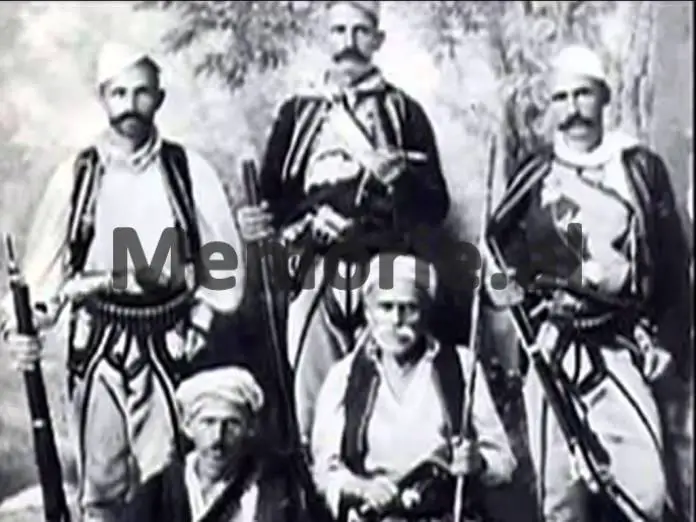
Blood feuds are a tradition of the Albanians, but regulated according to certain laws and customs of the country, which determine when, by whom, and how a blood feud is justified. In these cases, the government does not interfere; even if it does intervene, it will follow the custom of the country rather than the law. This “lex talionis”—the rule that grants the right to exact reciprocal retribution, or as it is said, an eye for an eye and a head for a head—has not only entered into laws over the centuries, but also into beliefs. It was judged that the spirit of the slain has no peace until the blood-avenger is killed.
In Albania, blood feud is not left to the family or heirs solely for murder, but also for matters of female honor. Feuds often extend all the way to bajraks (clans), tribes, and blood revenges have many times crossed villages and regions. Turkish laws in this country provided no justice whatsoever; indeed, they encouraged these customs, since they caused divisions, quarrels, and internal hostilities among Albanians—things that lightened Turkey’s burden for implementing more tyranny and slavery. With the coming into force of the criminal code, this custom will perhaps disappear with time, as in the case of Montenegro.
ALBANIAN WOMEN
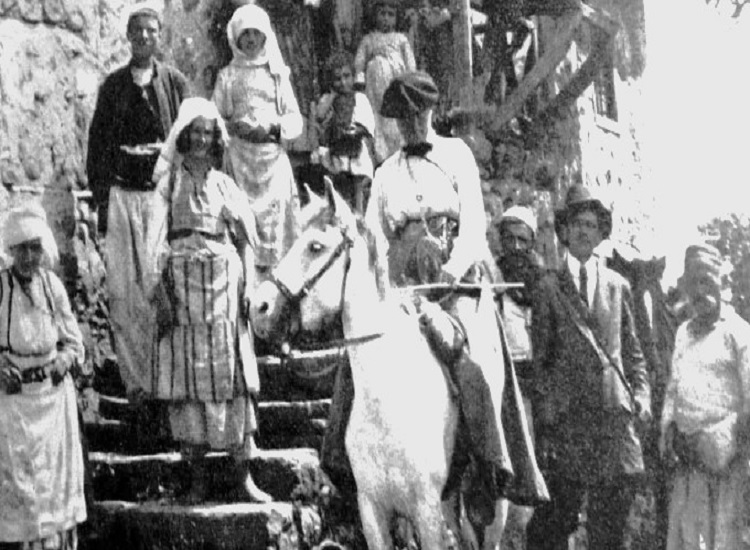
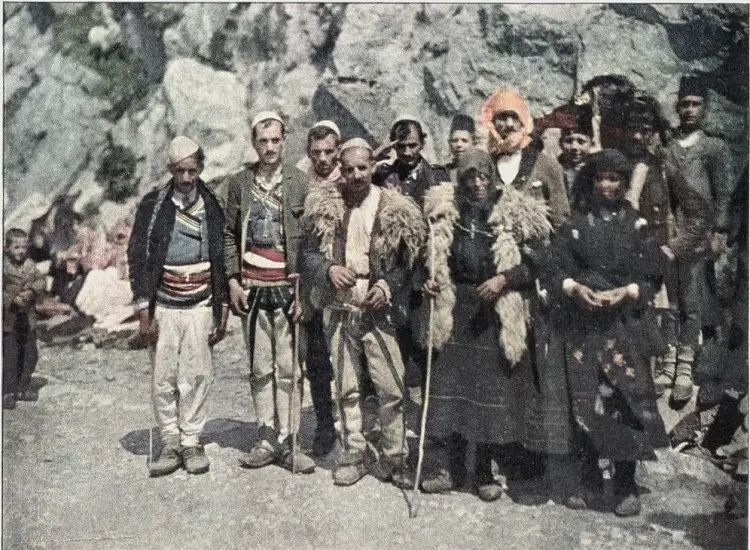
While, as in the other Balkan states, the woman does all the work, both in the field and in the home, she is viewed with more respect and holds a higher position than the woman of the East. A woman may travel from one side of Albania to the other without any suspicion; even a man who might happen to be with her is safe because of the woman. If an engaged girl leaves her fiancé, she burdens her family with a blood debt, which her fiancé has the right to exact.
Apart from those in the cities, the bride does not receive a dowry from her father; on the contrary, the groom pays a sum of money to the girl’s father; for widows, half that amount is paid. Among Albanian women, love and beauty do not play a significant role. What adds to the woman’s importance in the eyes of her husband is childbearing; as children increase, so does her status. Nowhere are there more virtuous women than in Albania.
A MIGHTY BREED
The blood of Albanians is the blood of manliness. The Albanian gave Turkey its best generals and ministers. Their brothers in Italy, the Tuscans, laid the true foundations of Rome’s greatness. Five Roman emperors were sons of Illyrian highlanders; they strengthened the Italian race. In the gorges and mountains of Attica, the Albanian language is still in use today. In Greece’s struggles for liberty, Albanianness appears in famous names. They mingle with others, but in that mingling they do not blend—that is, they do not intermix their blood and customs. The preservation of their own language and customs under the heel and tyranny of centuries shows the capabilities of a strong and indomitable race. We shall see how Europe used this key of the Balkans to keep closed the doors of mercy and light upon a people who are now praying for independence and freedom.
THE ENTANGLEMENTS OF THE GREAT POWERS
“My son, you do not know with how little mercy the world is governed.”
(Oxenstierna, Prime Minister of Sweden, 1612)
Albania, such a small and backward country, without any civilization whatsoever, why does it play such a great role in European politics? It is necessary to answer this question here, as the answer addresses the complex content of European diplomacy. The short answer is that Albania’s geographical situation presents political problems even broader than those posed by the other Balkan states.
Albania’s condition is a key factor of the Eastern Question, since this is the natural route of passage from the Adriatic to the East. Besides this, it is precisely the place for the outlet of Balkan commerce, and finally, it holds in its hands the command of the entrance to the Adriatic through the Strait of Otranto. Its ports, together with the Aegean port of Salonica and the Bosphorus, are the keys to the doors of Eastern Europe to the Mediterranean. To take hold of these keys, European diplomacy has worked for two whole centuries.
THE EXCLUSION OF RUSSIA FROM THE MEDITERRANEAN
Above all, the figure of Russia emerges clearly, whose main political goal has been to have free passage to the Mediterranean. For this purpose, it found it reasonable to destroy Turkey. In 1711, Peter the Great called upon the Slavic states of Serbia, Slovenia, Macedonia, Bosnia, Herzegovina, Croatia, and Montenegro to join him in a religious and racial war to liberate the Orthodox Christians and all the peoples speaking the Slavic language from the Ottoman yoke. From that time onward, Russia and Turkey have been in constant confrontation, and Russia has become the protector and helper of the Slavic states.
These conditions were presented to parliament by Sir Edward Grey (British Foreign Minister), a parliament which was the customary seat of European diplomacy in the past. It is worth noting that the states named by the Great Tsar, together with Hungary and Poland, formed a strong circle of Slavic peoples against Germanic Austria. The dream of uniting these peoples into a Slavic empire was a joy for Russia and Serbia, but a terror for the Germanic peoples and for all of Western Europe. Out of fear of this specter of a Slavic empire, the powers of Europe have remained united to prevent Russia and its Slavic allies from taking a position or creating any passage to the Mediterranean.
But the main fact concerning Albania is that the European powers supported Turkish rule in Europe and defended it against Russia for the sole reason that Turkey’s disappearance from the Adriatic to Constantinople would cause the division of these lands among neighboring states, and in this way, the great issue of the Slavs’ outlet to the Mediterranean would be opened. The Crimean War was fought by England and France to protect Turkey against Russia and ended with the Treaty of Paris, in which Turkey’s independence was guaranteed and secured. It was accepted to participate in the agreements of the European powers, while the Christian peoples of the East were left to the feeble mercy of the Sultan. It was before this war that Tsar Nicholas proposed that the Turkish Empire should not be recognized by Russia and England, but the latter did not accept this demand.
THE TREATY OF BERLIN
In 1878, Russia invaded Turkey and stopped at the gates of Constantinople. The Treaty of San Stefano was concluded between the two belligerents, by which Russia skillfully, for its own benefit and use, created a large Bulgarian state that on its southern side would extend to the Aegean Sea, including the port of Salonica. This caused the rapid convocation of the European powers, which produced the Treaty of Berlin. This treaty stopped the formation of the projected Bulgarian state and silenced Russia’s demands for a port on the Mediterranean.
Serbia, Romania, and Montenegro were declared independent states. A map of recent times would show that the treaty left a portion of the Balkans still under Turkish rule, stretching from the Adriatic to Constantinople and including the Bosphorus, Salonica, Macedonia, and Albania. The Slavic states of Bosnia and Herzegovina on the Adriatic were given to Austria. It was a determined insistence on Europe’s part not to allow any Slavic state an outlet to the Mediterranean. The slavery and bondage of wretched Albania were not discussed; this was the victim of the principle of this European diplomacy.
SERBIA’S DEMANDS ON THE ADRIATIC
The Balkan War of 1912 was not welcomed with good eyes by the European powers. Its history is known, but it has not been fully understood in the United States of America that the two most important things of this war were the taking of the port of Salonica and the ports of Albania. These were the natural outlets for Balkan commerce and the unloading points for future railways.
Even Austria was impatiently awaiting some opportunity to take the port of Salonica into its hands, but the Serbian state demanded above all a port for its commercial movement. It was closed off and isolated from the sea, and if the violation of foreign territories gave it the right, Serbia could shamelessly demand an outlet to the sea. The quarrel among the Balkan states themselves caused the six great powers of Europe to take the reins in hand, intervening to settle these disputes.
AUSTRIA AND ITALY AS RIVALS
At this time, another phase of turmoil in Albania must be mentioned. Austria and Italy command or control the Adriatic Sea, except for the Albanian coast. These two states have waited impatiently for years for the opportunity to seize the ports of this country. They have spent money maintaining agents and schools in Albania to increase their influence over this people. Both have waited the day when the “Sick Man of the East” would be buried on the other side of the Aegean. On two points, Austria and Italy were particularly in agreement: first, that neither of them should rule Albania, nor second, that no other power should establish itself in the Adriatic.
From a general diplomatic point of view, this was not very unreasonable. Why? If Austria had Albania under its rule, it would be only 74 km from the Italian coast, between Vlorë and Otranto. And if Italy became the ruler of Albania, it would turn the Adriatic into a gulf of Italy, making it *”il mare nostrum”*, as the Italians like to say. On the other hand, any naval power in possession of Albania would be a threat and menace to both Austria and Italy.
THE SLAVIC EMPIRE
The plan for a Slavic empire was nurtured more by Serbia under the created name of “Greater Serbia.” Even Montenegro has joined this plan; both being under the guardianship of Russia, their sworn protector. With such an empire, the Slavic provinces of Bosnia, Herzegovina, and Dalmatia, with Austria’s permission or opening, would make possible Montenegro’s and Serbia’s outlet to the Adriatic. These states became very enraged when, in 1908, Austro-Hungary extended its rule over Bosnia and Herzegovina and made them wholly its own.
When the six great powers had finished the London Conference on the Balkan division, they followed the same old principles of not allowing the Slavic states to touch the Mediterranean. Turkey had almost been withdrawn from the Balkans, and a great problem lay on the table of the European powers. They resolved this by giving the port of Salonica to Greece and creating the independent state of Albania. In this way, Serbia’s hopes were buried—Serbia which at this time has risen to its feet and trampled over Albania, while Montenegro has seized Shkodër.
ALBANIA AND THE WORLD WAR
In this plan of action, Austria and Italy were unquestionably the driving powers, and Crown Prince Franz Ferdinand of Austro-Hungary was seen as the guardian of their principle. Serbia, quite enraged since 1908, now became furious, and without doubt its demonstrations against Austro-Hungary were severe and threatening revenge. Europe’s lively goal of excluding Russia and its allies from the Mediterranean is also seen from the fact that when Austro-Hungary took Bosnia and Herzegovina, it nearly caused a European war, and the act of creating the independent Albanian state certainly ignited a general clash. The great anger against Austro-Hungary naturally turned towards the Crown Prince, and his assassination in Sarajevo worsened relations between Austro-Hungary and Serbia beyond measure. After this, events moved very quickly.
Austro-Hungary dictated an ultimatum to Serbia and, upon its rejection, declared war. Russia raised its voice, saying this was its affair, and within a few days, five of the great powers found themselves in continuous conflict. Had Europe fulfilled Serbia’s wishes for a pier in Albania, this terrible climate would not have come. The possession or rule over Albania was unquestionably the cause that provoked this war which is engulfing the European continent. This is the history of European diplomacy in the Balkans, however briefly it has been described. Therefore, the title “The Entanglements of the Great Powers” is particularly fitting.
THE GUILT OF EUROPEAN DIPLOMACY
If indeed the Slavic union is a menace to Western civilization, then surely the history of diplomacy changes when Russia has secured powerful allies in the West for the destruction of Germany—the greatest obstacle to its triumph. But if this union is merely an invented tale or an untrue justification, then European diplomacy must be called guilty of the crime it commits by keeping the Balkans under the weak yoke of Turkey. On one side or the other of these two forks, which are the answer to this problem, this kind of diplomacy must hang.
Even if it were true that the Slavic menace was a pretext and that the great powers only wanted to find a reason to keep Russia away from the Mediterranean, the sufferings and misfortunes of Albania hang upon their hands, because Albania suffered solely because of their fault. Indeed, with how little mercy the world is governed! But had Europe broken the Ottoman rule in Europe a century earlier, certainly the face of our civilization would be different. The Balkan states would already have a century of maturity in their freedom, and it is possible that on the path of peace, they would have been more advanced in wealth, education, commerce, and industry. / Memorie.al
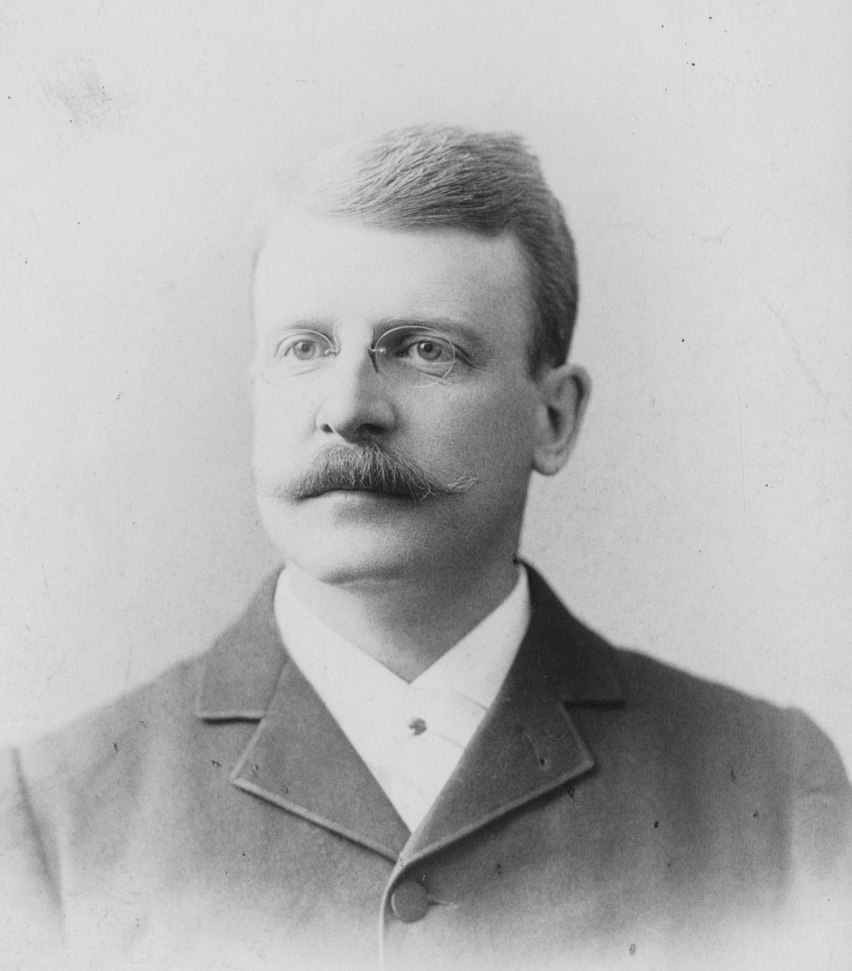
*George Fred Williams (1852-1937), American diplomat, former United States Ambassador to Greece and to Montenegro, in the years 1913-1914.