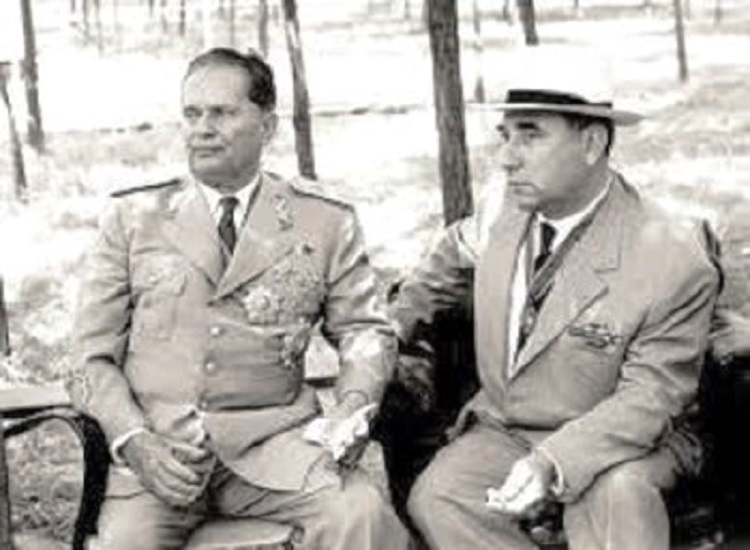
From Prof. Dr. Enver Bytyçi
Memorie.al / A document discovered in the archives by the master of memoiristic research, the well-known journalist Dashnor Kaloçi, published the transcript of the conversation between the former communist leader, Enver Hoxha, and the former Chargé d’Affaires of the Republic of Albania in Belgrade, Lik Seiti. The meeting bears the date of September 19, 1970. The document provides us with the picture of the relations between Yugoslavia and Albania of that time, and simultaneously focuses on the stances of the Albanian political leaders of Kosovo in comparison with one another. At the epicenter is the role and figure of Fadil Hoxha, who had held a conversation with the Albanian diplomat, and the latter had requested that this conversation be transmitted to Enver Hoxha. Also present was Ramiz Alia.
What stands out is related to a viewpoint, according to which “Kosovo should not seek Republic status within the Federation of Yugoslavia.” This viewpoint was given to our diplomat in Belgrade by Fadil Hoxha himself. Meanwhile, the former leader of communist Albania authorized Lik Seiti to orally give this response to Fadil Hoxha: “We consider your opinion of not accepting the creation of a second Albanian Republic to be correct. This is a correct and patriotic stance. The People’s Republic of Albania would fight an opposing stance with all its forces. We agree with your opinion that in the world there is only one People’s Republic of Albania”!
This is a determining moment in the search for the hypothesis: Did Enver Hoxha help or harm Kosovo even after 1948, during his governance?! Until I read the document in question, I had dilemmas as to whether Enver Hoxha only in the years 1941–1948, more precisely 1944–1948, was on the side of the Yugoslavs and Serbs and against Kosovo, or whether this stance extended later in time as well?! But I leaned more towards the truth that secret agreements with Tito existed throughout the entire time of Hoxha’s reign. I base this fact on the agreement with the secret service of Serbia and Yugoslavia for the return to Albania of those who had fled our country; on the mistreatment, even to the point of cruelty, of Albanian patriots who escaped from Yugoslavia (Kosovo) and their forceful return again into the hands of the Serbo-Yugoslav security; or on the fact that Hoxha’s Albanian government attempted to create a military coalition after 1968 for what was said to be “against a Russian aggression”! Even trade relations with Yugoslavia were among the most favored by the regime of the time.
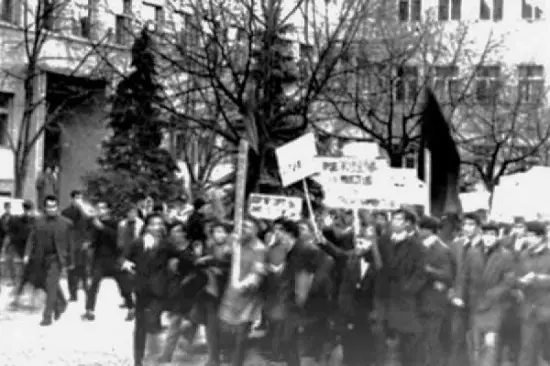
Nevertheless, the transcript of this conversation from 1970 definitively resolves the dilemma. Enver Hoxha was continuously against a Republic of Kosovo within the framework of the former Yugoslavia. He even states that a stance “in favor of a Republic of Kosovo” would be fought with all his forces! The viewpoint of the Albanian leader of Albania is not evasive. It is very precise and categorical. No to a Republic of Kosovo. This means that the demand of Albanians in the protests of 1968 for “Kosova Republic” was opposed not only by Belgrade, but also by official Tirana. Official Tirana thus favored Tito in his decision on the status of Kosovo, in line with the Serbian viewpoint.
Certainly, Fadil Hoxha tested Lik Seiti by presenting his opinion regarding Kosovo. He had instructions from Tito to conduct this test. Hoxha himself admits this in the conversation. Enver Hoxha, knowing that it was Tito who wanted to know the opinion of the Albanian leadership regarding the status of Kosovo under discussion, confirmed his loyal stance towards Tito. He received this opinion through the Chargé d’Affaires of Albania in Yugoslavia and even, without needing further explanations, decided: “Kosovo should not be a Republic within the Federation of Yugoslavia”!
This was enough for the Yugoslav leader to have no difficulty in making the decision—that is, for Kosovo to be an autonomous province of Yugoslavia and formally also of Serbia. He received the same answer as that of 1946, when Tito had told him that “Kosovo would join Albania after the war, but that it was the Serbs who would not accept this”! Once again, the obstacle was “the non-acceptance by Serbia of a Republic of Kosovo within the framework of the Yugoslav Federation”!
Thus, Enver Hoxha, for reasons unknown, continuously supported Tito in his “difficulties in convincing the Serbs”! He created the political conditions for him to maintain the balance of relations between the republics of the former Yugoslavia, by sacrificing Kosovo. The justification that “in the Balkans there cannot be two Albanian republics” was simply a pretext. After all, the Republic of Kosovo in Yugoslavia did not have the status of statehood. Kosovo would not be a member of the UN or any other international organization. As such, it neither threatened nor weakened the Republic of Albania. The opposite is true.
For this reason, it must be believed that Hoxha’s interest was the neutralization of any military threat coming from Yugoslavia. For this reason, official Tirana sacrificed the position of Albanians in the former Yugoslavia. Hoxha also feared small military provocations, as they could serve as an opportunity for the outbreak of internal Albanian grievances against him. Everything was thus linked to his power. In this sense, a Republic of Kosovo within the framework of Yugoslavia would give it the right to veto and develop close relations without any obstacle with the Republic of Albania. This relationship was seen as a danger to Enver Hoxha’s dictatorial regime.
Nevertheless, historians have often interpreted, according to their own tastes, the fact that after March–April 1981, Enver Hoxha and the Albanian government supported the demand of Albanians in Kosovo for a Republic. This support is interpreted by historians of the then regime and by those who want to justify the anti-Kosovo stances of the current regime as “patriotism” on the part of Enver Hoxha. Again, we are dealing with the illusion of deception. In 1981, the communist regime in Albania was at the peak of its economic, financial, and political crisis. China had already divorced its relations with Albania. The country was in total isolation.
The theory of “reliance on one’s own forces” was not working. Therefore, the regime took refuge in its last shelter—nationalism. This began with the celebrations of the 100th anniversary of the Albanian League of Prizren (June 1978) and was strengthened in the following years. But there was also another reason. It appears that within the leadership of the Party of Labor, there were disagreements regarding the stance towards Serbian violence against Albanians in Kosovo. According to Jens Reuter, during the year 1991, over 1,000 Albanians were killed in Kosovo, although the media had concealed this fact. Under these conditions, the former Prime Minister, Mehmet Shehu, wanted to radicalize actions against the Serbian massacres in Kosovo.
But Enver Hoxha was against it. Consequently, he needed to support the Albanians’ demand for “Kosova Republic,” with the aim of balancing the situation, until he eliminated his rival at the head of the government. Meanwhile, Hoxha was the main Albanian responsible for the Serbian massacres of 1944–1946 in Kosovo, when, according to figures, over 50,000 Albanians were killed and massacred. They were accused of being reactionaries because they were nationalists. Enver Hoxha did the same thing in Albania. Many of them fell victim to Serbian terror in the presence of the Albanian brigades and divisions sent there.
While the Massacre of Tivar (Bar) began in the presence of the Albanian authorities and ended with their knowledge. All of this followed the former Albanian dictator like a shadow. But not only that. All his successors, from Nano to Rama, followed the same political line of compromises and submission to Belgrade, severely damaging the interests of the Albanian nation and especially those of martyred Kosovo! What has occurred in the relations of the Communist Party (of Labor and Socialist) with Yugoslavia, and thus with Serbia, are the shameful black stains of our history. This is also proven by the conversation traced and published these days between Enver Hoxha and Lik Seiti! / Memorie.al