From Dritan Çoku
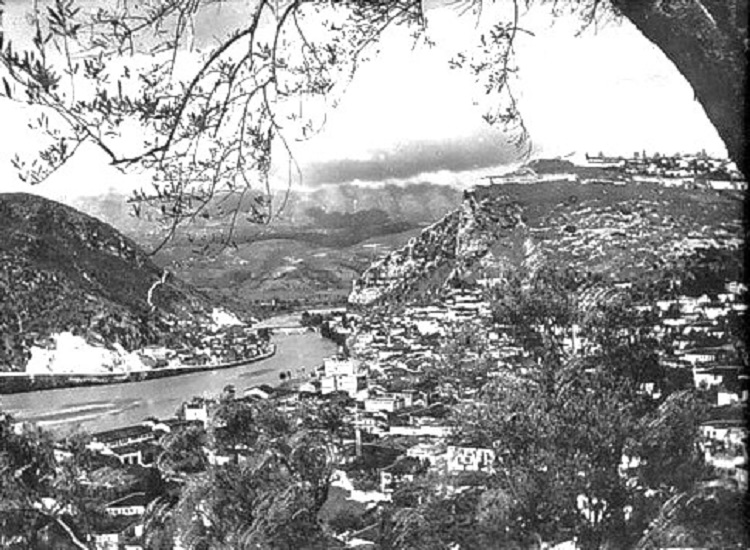
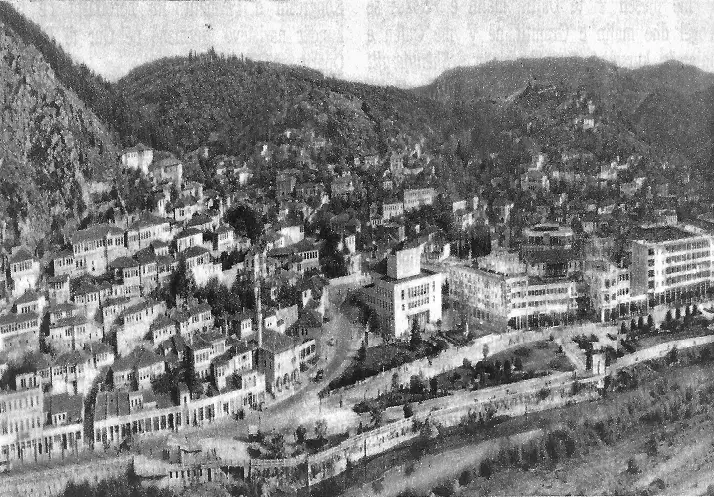
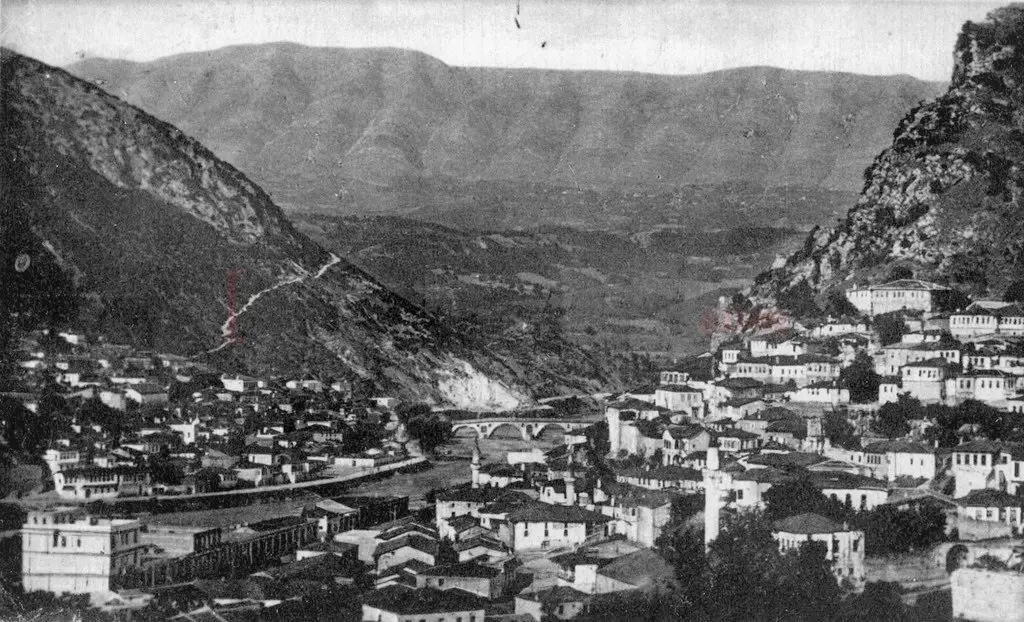
Memorie.al / The “Goricë” neighborhood in the historic city of Berat constitutes the only residential unit built on the left bank of the Osum River, thus separated from the rest of the city. The construction of this ensemble appears to have begun around the mid-16th century, based on the good development that this neighborhood had achieved around the third quarter of the 17th century. The neighborhood fulfilled all its needs in the craft-commercial center, because within the neighborhood there was no such unit. In earlier times, connection with this neighborhood was made by ferry, wooden bridge, and later by a stone bridge over the Osum River, or as it is called today, the “Bridge of Gorica.”
In the monthly magazine “Diturija” of Lumo Skëndo, we have an article titled “Old Berat” dated July 5, 1927, by Mr. Gjergj Haxhi Mihali. He recounts that from a book in the Church of St. George, we learn that Kurt Pasha, the Pasha of Berat, in the year 1777, had financed the construction of the Gorica Bridge over the Osum River and converted it into stone.
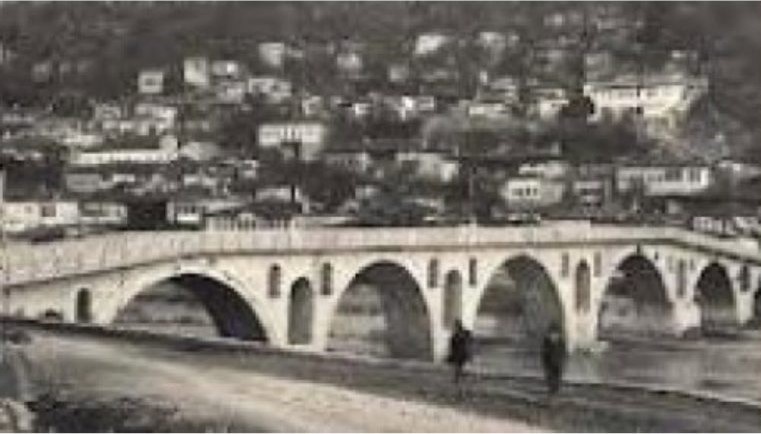
In 1918, at the end of World War I, the Austrians, before leaving Berat, placed dynamite on the bridge and destroyed its middle section. The Italians who came after them placed a suspended footbridge with steel cables near the destroyed arch, which served for the passage of people. (Koli Vesho, Berat, Museum City, Berat, 2012, p. 143)
An investment of 45,000 lire, with the contribution of Berat citizens who gave 10,000 lire, led to the reconstruction of the bridge in the “Goricë” neighborhood, which had been burned during the First World War, by the firm “Tamburlini” (Marela Guga, History of the Prefecture of Berat 1920-1939, typescript, p. 266). Various damages to it and the need for simultaneous two-way traffic on the bridge led to the widening of its width. This solution was realized by replacing the stone parapet of the bridge with a newly created parapet, inserting iron rails that project as cantilevers into the bridge’s body, encasing them in concrete, and creating a new parapet, which still stands today.
This widening created two mini-sidewalks on the bridge’s surface on both sides for pedestrian passage. In conclusion, we can say that at the entrance and exit of the bridge, we have the authentic original work, while two arches and the railings were reconstructed in 1923, and one abutment and two and a half arches that rest upon it are thought to have been reconstructed in 1938 (fig. 3, 6). (Genci Samimi, Dritan Çoku, The Life of a Monument, The Gorica Bridge in Berat, Why it should be planned for Restoration, “Gazeta Shqiptare” supplements “Milosao,” December 12, 2010)
In September 1944, the German army could not carry out their plan to destroy the bridge on the day they left Berat. But what was the architectural appearance of the curious bridge of Berat over the Osum River in the 16th–17th centuries? The construction of the curious bridge of Berat over the Osum River for the passage of people was described by the famous Ottoman traveler and chronicler Evliya Çelebi, in his work, SEYAHATNAME (Travels), in 10 volumes. He provides quite important and very valuable data for the Balkan Peninsula, Western Europe, Africa, Asia, etc.
In the 8th volume of his work, he describes the city of Berat in about 12 pages after his second visit made in 1672. He says: “In the city of Berat, down there, behind the coppersmiths’ market, on the Osum River, there is a large bridge that serves for the passage of travelers towards the ‘Dry Suburb.’ In total, it has nine wooden arches, but the foundations of the bridge rest on piers of strange stones, sunk in water. The upper part of the bridge is paved with oak material (planks).
It is something so curious that it can rarely be encountered. In Herzegovina, in the city of Koxha, which lies on a deep river and was built during the time of Sultan Suleiman, it consists of only a single wooden arch, whereas this one in Berat is equipped with nine arches (God protect it!).” (Vasfi Samimi, Berat 300 Years Ago, “Dita 2000,” Tirana, 2007, p. 38) Regarding the time of construction of this bridge, it is difficult to say anything precise, since to this day we have not come across any data.
Except for one thing that is certain: It was built when the need for communication between the two banks of the Osum arose, meaning it belongs to that time when settlement and construction began on the left bank of the river, in the neighborhood of Gorica. Reasoning thus, the construction of this structure, in chronological terms, can be placed, at the very least, in the second half of the 16th century. (Ferit Duka, Berat in the Ottoman Period (16th–18th Centuries), “Toena,” Tirana, 2001, p. 214) Moreover, as emerges from the cadastral register of 1583, in the second half of the 16th century, the neighborhood beyond the Osum, Gorica, already existed. (Ibid., p. 177)
The travel writer Evliya Çelebi informs us about the mountain of Gorica: “It is a large, high mountain, adorned with countless trees and forests. The timber and planks used for the repair and maintenance of the bridge are taken from here. Any person who dares to cut even a thin branch from this forest is punished and measures are taken against him by the court.” (Vasfi Samimi, Berat 300 Years Ago, “Dita 2000,” Tirana, 2007, p. 37)
The Christian population continued, as a century earlier, to perform certain maintenance duties. In 1688, Papa Jani, Staso Jani, Bane Dhimo, from the “Kala” (Castle) neighborhood of Berat, declared that they continued to be exempt from extraordinary obligations towards the service of preparing materials and expenses for the city bridge. (Petrika Thëngjilli, Albanians Between East and West (1506-1839), Religious Sphere 1, “Maluka” Sh.p.k, Tirana, 2002, p. 245)
As mentioned above, these sources show quite clearly and speak about the engineering work; it’s quite curious realization, and the rules for preservation, securing timber material, and its maintenance. From various sources, it appears that even in the 18th–19th centuries, wooden bridges were quite widespread, of which today we have no trace. (Valter Shtylla, *Some Old Stone Bridges in Our Country, “Monumentet” 11, 1976, “Mihal Duri,” Tirana, 1976, p. 223)
During the detailed study of the Gorica Bridge, we have carried out an in-depth analysis of historical sources from historiographical literature, descriptions that various travelers have made of this engineering work, the factual documentation of engravings and photos of how the Gorica Bridge was built and its architectural appearance. We have brought to light the initial state of the stone bridge, the reinforcements and reconstructions it has undergone during its life up to the present day.
Knowledge of the monument, its history, the continuity of its life, and the specific features of the monument’s existing reality, were the main reasons for the study and graphic presentation of the curious bridge of Berat over the Osum River with 9 wooden arches for the passage of people. It is understood that according to the width of the riverbed, the bridge was built with many arches.
From the perspective of the construction of the wooden arches and the visual aspect of the bridge, we think that the bridge in the center consisted of 3 large arches that created the horizontal part parallel to the river level, and on both sides with 3 arches each, where the arches gradually decreased in size to also provide the slope down to the side supports that led to the road level on both sides of the Osum. So, to this curious bridge with 9 wooden arches, an unusual thing for that time, one arch has been added on each side from where the gradual slope begins down to the lateral supports.
We offer this type of reasoning for the very fact that the Gorica Bridge that we inherit today, differing only in material as it is built of stone, has the same philosophy, or school of construction, in the manner of constructing the arches and the slope from both sides, a dominant type of bridge in Albania and the peninsula, the main aim of which is to load the arches as little as possible and reduce as much as possible the lateral thrust exerted on the piers. (Eqrem bej Vlora, Diary (From Berat to Tomor and Back), “KOÇI,” Tirana, 2003, p. 54)
As an example of this similarity with the Stone Bridge of Berat over the Osum River (1777), we also have the bridge over the Shkumbin River, also built by Kurt Pasha of Berat, as well as other bridges. The bridge-builder’s aim (perhaps inherited from the Byzantines) is, by weighing down the ends on both sides, to create arches that are loaded as little as possible. Often, therefore, the last stones of the arch also form the cobblestone pavement over which the road passes, which descends when the arch ends and ascends again when the next arch begins. (Johan Georg von Hahn, Albanian Studies, IDK, Tirana, p. 117).
The piers of the bridges also have openings on both sides, to provide a solution for a lighter construction, but also functioning as discharge windows during river floods. In the piers between the arches, in their lower part, just as Çelebi informs us… “that the foundations of the bridge rest on piers of strange stones, sunk in water…,” we think that the piers were treated as sharp cutwaters with a mass of large stones to open the river’s flow and to resist the currents of the Osum, which greatly impressed the chronicler at that time. So, the bridge in the 16th century had 9 arches, 8 piers, and 2 lateral supports.
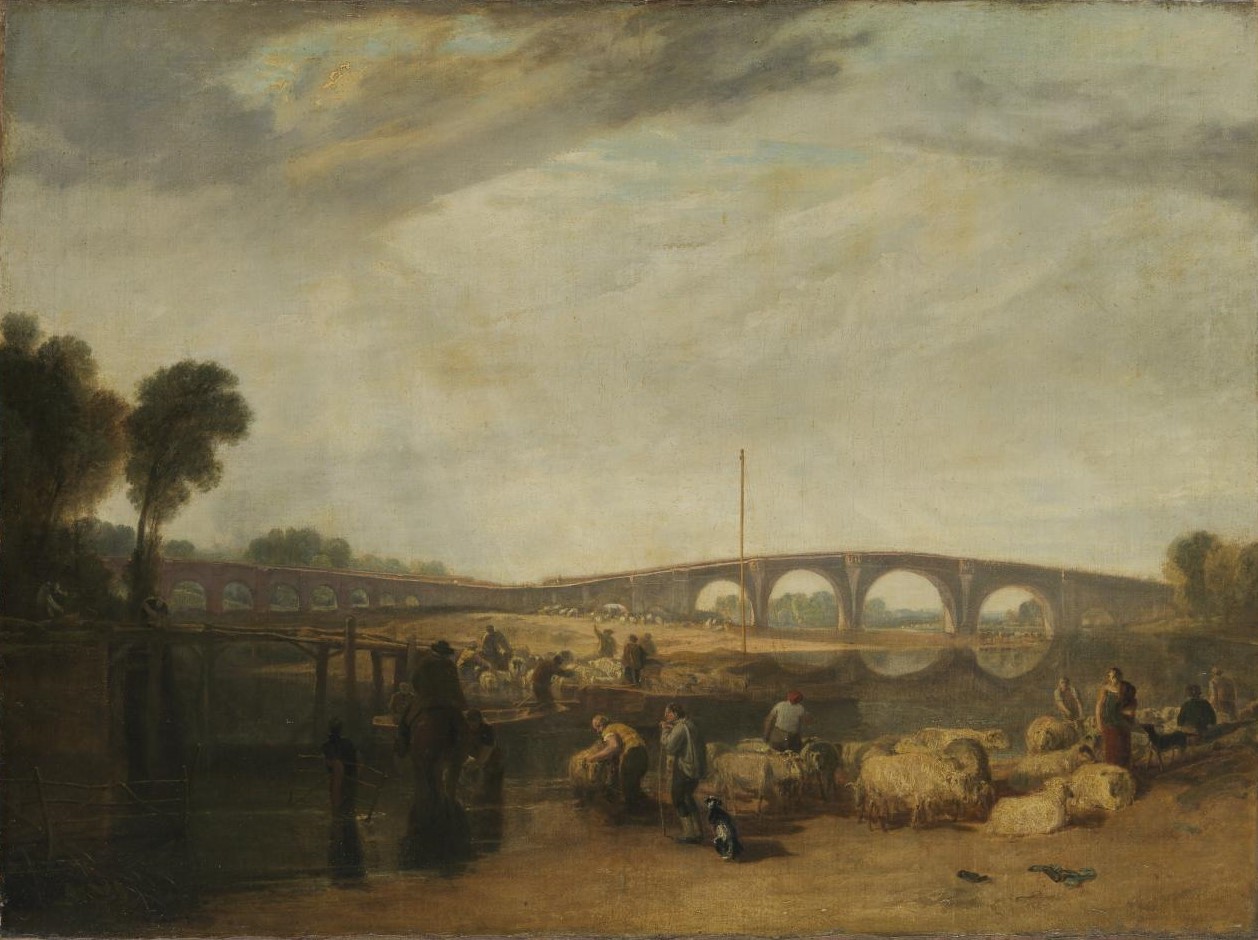
During our research into traces of wooden bridges even outside the Albanian space, we encounter two wooden bridges built in England, evidenced by visual art. The first, realized in a painting by Canaletto after 1750, depicts the bridge built along the River Thames at Walton-on-Thames in Surrey, England. The wooden bridge was completed in 1750 and stood until 1783, when it was dismantled and a brick one was built. The other evidence is an engraving showing the town and the Kew Bridge in Surrey.
The bridge had 11 arches; two at each end of the bridge were made of stone and connected to the 7 wooden arches. This bridge was completed on June 1, 1759, and resisted for 30 years, after which it was built entirely of stone. In the graphic realization of the curious bridge of Berat, from a visual perspective, I have relied precisely on these two works realized in England, because I think that the bridge built in Berat with nine wooden arches supported by stone piers (16th century) might have similarities in the manner of constructing the arches with wooden elements.
Life’s essential and necessary requirements for various needs, one of which is public constructions, meant that the masters—who in contemporary documents are recorded with the word “ustallarë” (master craftsmen) in the field of construction, including carpenters—whose professional activity, through the process of formation during their work, experience, etc., created a school in technique, construction method, and realization of these building works.
In conclusion, we think that the wooden bridge of the 16th century in Berat had that construction method according to the sketch presented in this study. With the above proposal for the graphic presentation of this engineering construction, we do not claim to have definitively solved and proven the problem of what the appearance and architectural construction of the 16th-century bridge over the Osum River in Berat was like, but we think at least to have put forward a hypothesis.
We hope that Albanian colleagues, both male and female, who deal with material culture, will in the future not only fill the void through more in-depth studies on architecture in Albania, which, unfortunately, in recent years have been neglected, but also for monuments that have specific features, by having a more complete knowledge of archives, testimonies of the time, and the latest studies. We are open and we desire that observations, from whomever they may come, be valuable for a more complete study of this architectural heritage in the future, especially when viewed within a broader framework. / Memorie.al