Part Two
Memorie.al / There are some key points in a country’s history about which it is thought that much is known, but in reality, there is still much to discover. One of these events is the Party of Labour of Albania’s Conference in Tirana in 1956. The historian Ana Lalaj returns once again to this moment, seen in the light of documentation supplemented by Albanian and foreign archives, and freed from any kind of prejudice.
Continued from the previous issue
Minutes of the conversation between the First Secretary of the Central Committee of the Party of Labour of Albania, Enver Hoxha, and the Ambassador of the Soviet Union to Albania, Leonid Krillov
Tirana, April 16, 1956
From the reports of Leonid I. Krillov
Secret
Copy No. 1
May 8, 1956
No. 168
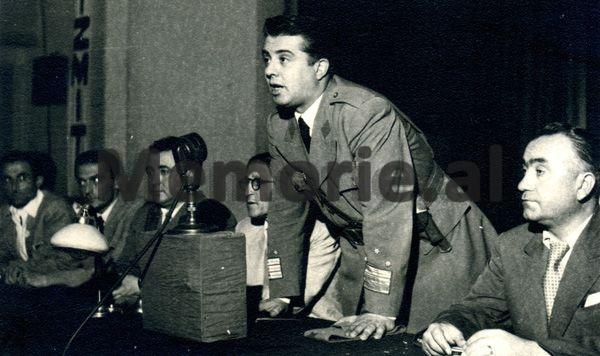
Today the First Secretary of the Central Committee of the PLA, Enver Hoxha, who has arrived in Tirana, confided to me his impressions of the city party conference. Last night, says Hoxha, I had to take the floor three times.
First I took the floor immediately after arriving and tried to calm the situation at the conference and to give calm answers to the issues rose, thereby showing that the conference had slipped from the right path.
This first speech of mine at the conference was generally well received. But after me a demagogue took the floor and said that Enver Hoxha spoke very correctly here, but let him tell us why the state spends 1 million lek on the treatment of each member of the Central Committee.
Then I could not contain myself, said Enver Hoxha, and from my seat I declared war on this demagogue for this slander, as a result of which he was forced to flee the podium. This was certainly a bit harsh on my part, but to give freedom to these demagogic attitudes, given also the general situation of the conference, was also impermissible.
All this caused the known breakdown in the work of the conference and after this the delegates began to make good critical assessments, both of the work of the city organizations and of the work of those of the center. After this, said Enver Hoxha, I took the floor for the third time and raised the question of who benefited from the direction the conference took at the beginning and who was to blame for it.
Now the conference is working quite normally and we are confident of its successful results. We do not consider these facts accidental, said Enver Hoxha. Inevitably, some group of people had prepared for the conference in their own way, trying to turn it against the Central Committee.
But neither the Central Committee nor the city party committee knew anything about this. This is a good lesson. In this regard, the activity of the Bureau of the City Committee and its secretaries also appears very antipathetic. We need to completely renew the leadership of the city party committee. Further, Enver Hoxha touched on some political issues raised in politics regarding the cult of personality and relations with Yugoslavia.
The thing is, said Enver Hoxha, that after receiving the text of Khrushchev’s secret report at the 20th Congress of the Communist Party of the Soviet Union, we could not make its content known to the people and we waited for a signal from the Central Committee of the CPSU, while in the German Democratic Republic, Hungary and Poland, the comrades acted in their own way and broadly agreed with all matters relating to the cult of personality, passing us on this point.
We also did this after the well-known article in Pravda, as the Chinese comrades did. Therefore, an opinion arose among some of our workers that we were keeping silent about the cult of personality issue, even though everyone knows that our party, as early as 1954, following the example of the CPSU, did the greatest work to eliminate the cult of personality in the conditions of Albania, and now only some reminiscences of the cult of personality can be spoken of.
At the conference, it was also asked why we are silent about the issue of Koçi Xoxe and about relations with Yugoslavia. But this issue is very delicate. The matter of Koçi Xoxe’s punishment is very clear to us.
Regarding his connection with Yugoslavia and our relations with Yugoslavia in general, we plan to raise this issue at our upcoming Third Congress of the Party of Labour of Albania, in the report of the Central Committee, in such a way: The friendly relations between the peoples of Yugoslavia and Albania were established and strengthened during the course of the common liberation struggle.
After the war ended, these relations were further strengthened and developed. Along with this, known mistakes were made by both sides, which could have been removed by the efforts of both parties. But when we uncovered the criminal activity of Koçi Xoxe, when after the criminal activity of Beria’s gang the anti-Yugoslav resolutions of the Comintern were published, all these facts took on a special light in our representation, and we unjustly linked the criminal activity of Koçi Xoxe with Yugoslavia.
We can say further that now, when everything is clear, we have no obstacle to the further development of social relations with Yugoslavia. But according to this thesis, said Enver Hoxha, we think that we should consult with the Central Committee of the CPSU before the congress.
Enver Hoxha, according to my impression from the conversation, takes seriously what happened at the Tirana Party Conference, but feels completely confident and does not show excessive nervousness. / Memorie.al
Ambassador of the Soviet Union to Albania
L. Krillov