
By Idriz Zeqiraj
Memorie.al / By decision of the Commission for Expulsion – Internment, attached to the Ministry of Interior, I was expelled from Tirana and interned in the village of Bilça, Berat. Berat was a classic zone for internment, because even a single policeman, placed on a bridge—the only passage connecting Berat and Skrapar with the rest of the country—controls every movement. There, during the time of the Kingdom, the communist Qemal Stafa had been interned, along with other opponents of Zog’s Monarchy. However, communism had massified internment, which began with a 5 (five)-year sentence and extended into decades; indeed, in the majority of cases, it lasted a lifetime, until oblivion!
The space for movement was limited to one kilometer. I worked uprooting trees, to open up new hilly lands. I lived in a ground-floor room, in half-darkness and full of dampness, with broken doors and windows. The mice from the drains played carefreely in my room. They called it a room, but it was a dilapidated place and resembled more a shelter for livestock. I covered my head with a blanket, a quilt, even in the summer heat, for fear of being scratched or bitten by the mice. The books of my library were their preferred “game,” since they were placed on the floor, in cardboard boxes.
A residential building was nearing completion. A room, without a kitchen, was planned for me; a room with a kitchen for the family of the former Rear Admiral of the Albanian Military Fleet, Teme Sejko; and two rooms and a kitchen for the former wartime leader of Shkodra, the former general, former “Hero of the People” of Albania, the highlander from Vuthaj – Sadik Bekteshi, who was interned with his family.
The course of events ruined the initial plan for populating this building. I was the first to be arrested and sentenced to a political prison. Then, the former director of the Political Directorate of the Press at the Ministry of Defense, Sadik Bekteshi, was sentenced to 25 years of hard labor, and later, we would meet in the “Leather Shop,” as the locals called Burrel Prison, because from there, hopes of freedom were utopia, illusions, and a common grave, “the size of a cherry pit,” inside the prison perimeter, awaited the handcuffed residents of this ill-famed prison.
Violence against the Sejko family, violence against Chameria
Politics punished the Sejko family even more severely. Teme Sejko was from Filat of Chameria, and his family had been persecuted and driven out by Greek government bands in 1945. Teme, a young, intelligent, and energetic boy, distinguished himself in military studies and patriotic loyalty, climbing the career ladder to become the first Rear Admiral of the Albanian Military Fleet. In the 1960s, in a show trial, typical of Stalinism, allegedly related to espionage with the 6th American Fleet, he was arrested in a group and executed with clubs and torture.
The family lived in Tirana. His wife was the sister of the only brother from Korça, a martyr of the war. She, with her two sons, Rajmond and Sokol, was interned in Berat. Her elderly parents, although they had no other children, went after their daughter to live together. The youngest son, Sokol, was accused of attempting to burn down the Textile Combine in Berat! A 16-year-old girl allegedly set fire to a bale of cotton in a corner of the corridor at the factory entrance. And, supposedly, she did this on Sokol’s orders! And, it is well known how “quickly” cotton burns!! A farce of a trial was organized.
The participation of the Sejko family in the trial was conditioned, only if the mother of the accused Sokol would disown her son in the courtroom! But she was an educated and dignified mother. “I want to hear the judicial process and if I am convinced of my son’s guilt, I will disown him without hesitation,” she told the authorities of this staged judicial process. This condition was not accepted by the court! Sokol was sentenced to death – firing squad, with the motivation: “sabotage of the socialist economy”!
The 21-year-old Sokol Sejko, in the courtroom, denied, entirely, the accusation made against him and denounced the Security (Sigurimi) and the Party for the staged trial, with the aim of extinguishing the Sejko family. And, he asked his family for a suit, to die beautifully. Two weeks after the sentence, Sokol was executed on the slopes of Ullishta of Berat. The person who had buried him, later lost his freedom, and showed his brother, Rajmond, the area of the burial, but not the exact grave, because the executed person had to be “lost-sealed,” even for eternity!
The suicide of the mother of the Sejko brothers
The mother’s heart could not bear the execution of her innocent son. During a sleepless winter night, she wrote several letters and threw them under the doors of several families interned in the city of Berat, denouncing the rigged trials and sentences for her husband Teme Sejko and her son Sokol. And, as the new day dawned, dressed in a suit, jacket, and trousers, she jumped headfirst from the balcony of the 5th floor of her apartment, ending her life.
That night, the eldest son, Rajmond, was a guest at his aunt’s house in Plug, Lushnje, where the family of the Cham Rexho Plaku, former commander of the partisan unit “Chameria,” sentenced and re-sentenced to political prison, was interned, and after more than two decades of suffering, died in prison. Rajmond Sejko traveled in the morning by the first bus on the Lushnje – Berat line. He got off hurriedly to get his work clothes and the bread bag. But, the Security officer, who was waiting for him, grabbed his arm, saying: “Rajmond, come with me, we have some work at the Internal Affairs Department (police).”
At the entrance of the police station, another official addressed him: “Rajmond Sejko, in the name of the people, you are under arrest”! The investigator’s first question for Rajmond was: “Why did your mother commit suicide”? This was shocking for Rajmond, who was learning of his mother’s death from the investigator. And he believed the news, because when getting off the bus, many citizens had looked at him with great curiosity, since they had learned about the suicide of Teme Sejko’s wife, namely, the mother of the brothers Rajmond and Sokol Sejko. It was early morning and a multitude of people were hurrying to their workplaces.
Inhuman treatment in the dungeon and meeting Rajmond Sejko
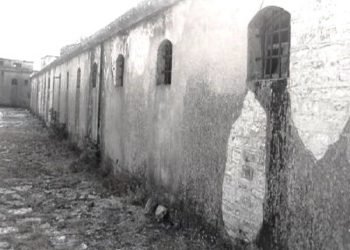
It was winter, very cold. They had stripped me of my overcoat, jacket, sweater, undershirt, and left me only in trousers and a shirt, without socks, on the concrete. The dungeon (cell) was underground, with excessive dampness, and they said it is the only prison that has survived the centuries, remaining in function “since the time of the Turks.” The dungeon reeked of urine and stale, layered tobacco dust. It was perpetual darkness.
A half, torn, and dirty blanket, which the policeman gave me in the late hours of the night and took back before dawn, could not cover, even remotely, my body. For seven months of investigation, no shower, no opportunity for cleaning or basic personal hygiene. Alone and very hungry, but more so, frozen.
After the sentence, in a dungeon, a cell, they put me together with Rajmond Sejko. We were waiting for the transfer to another prison, to serve the sentence. Rajmond was handsome, and they said he was a copy of his father in his youth. When he learned of my background, he opened up entirely and spoke freely to me about the tragedy of his family. “I feel sorry for my grandparents, how will they bear the loss of their daughter, my mother? They are old and sick. Mother was the only hope of their old age. Now I will suffer more for my living grandparents than for my terribly dead parents and brother,” Rajmond Sejko recounted painfully and mournfully.
The re-sentencing of Rajmond, in Spaç prison, while still serving his initial sentence, to raise his sentence quota to 18 years in prison, brings to mind the words of the younger brother, Sokol, addressed to the communist trial: “your goal is the extinction of the Sejko family.” Meanwhile, their uncle, Taho Sejko, worn down by the pressure and provocations of the State Security, committed suicide in Shkodra.
The forcible granting of citizenship to the Chams, a supreme national betrayal
In 1945, it was unbridled Greek nationalism that drove the Chams from their ancestral lands, under the pretext that they had collaborated with fascism against Greece, which is not true. In 1952, it was Enver Hoxha who, with a special decree, forcibly gave them Albanian citizenship and did not allow them to return to their hearths, to Chameria, Greece, even though the Greek government, now in a new composition, called for the collective return of all its citizens, who had been forcibly displaced, at the end of the Second World War. Their properties were also registered and their titles were preserved.
The forcible granting of Albanian citizenship to the bloodied and expelled Chams, from their lands, under the barrels of guns and bayonets, giving legitimacy to the Greek government to revoke their Greek citizenship, was and remains the supreme national betrayal of Enver Hoxha and his criminal party. And, this supreme betrayal remains forever a national crime and the highest peak of the serial betrayals of the Albanian communists, to the detriment of the Albanian cause. Ironically, the Albanian communists, wherever they were, clung, like dung to shoes, to the moldy and regressive Slavist-Stalinist ideology.
The pure friendship with Dr. Beniamin Çetta
In the chained auto-prison (prison transport van), we traveled to the “Kaush” prison of Tirana. “Kaush” were called the large rooms, with plank beds, attached one after another, three-story, climbed by ladders, on both sides of the room, with a walkway in the middle. There, prisoners from all over Albania were gathered, to be distributed to the 11 prison-camps of the country and the infernal Burrel prison, the latter destined for convicts from high political and military cadres, as well as the stoics, the steadfast, the disobedient, the incorrigibles.
This category, but also former high cadres, usually had to leave their bones inside the prison perimeter, in the “cherry pit,” in a mass grave, where the multitude of bodies has made impossible the identification of the corpses, an initiative attempted in the time of democracy. The number of prisoners in Burrel prison was limited, from 80 to 100 convicts, many of whom were re-sentenced, throughout the serving of their first sentence, with the sole aim: never to enjoy freedom!
There we found the cardiologist, a specialist in heart diseases, well-known not only in the district of Durrës, but also further in Albania, from Mirdita, Dr. Beniamin Çetta, the brother of our esteemed professor, Anton Çetta. He was sentenced with a large group of his Cham patients, indeed all with the cliché accusation of “agitation and propaganda against the party and people’s power,” being “rewarded” with a ten-year sentence each. They were, mostly, elderly men. And old age had increased their longing and heartbreak for their birthplace, the bountiful and divine Chameria.
Dr. Beniamin Çetta, even though he had passed 45 years, was still not married. He lived with his mother and aunt, both elderly and with health problems. And, the doctor was more worried about the two lonely old women, unable to take care of themselves, than about his own shackling. In the Tirana prison, we became friends with Dr. Beniamin. He was kind, sincere, very courteous, modest, and very humane. I asked him why he had delayed marriage.
“Being a bachelor, I had more opportunities to take care of Mother and Aunt and I do not want my bride to have this burden,” the doctor told me, not without regret. This reminds us of the holy book “The Bible,” where it is written that the Catholic religion does not forbid the marriage of priests, but by being celibate forever, priests have more time to devote themselves to religion, the church, God.
In 1990, Dr. Beniamin asked me to help him arrange a visit to Germany and to meet his older brother, Anton. By then, I had been granted asylum in Germany. I informed the Professor about his brother Beniamin’s request, who thanked me and promised that “we will see each other soon,” adding that I should not take any action regarding Beniamin without meeting him first. Professor Çetta came to Germany, met with me, we talked, and I informed him about Dr. Beni, as we called him in prison. However, he instructed me to tell Dr. Beni that “he must wait a while longer and I will arrange a visit for him to Kosovo, because the rest of the family wants to see him too.” And, so it was done. / Memorie.al