From ARSHIN XHEZO
Part Three
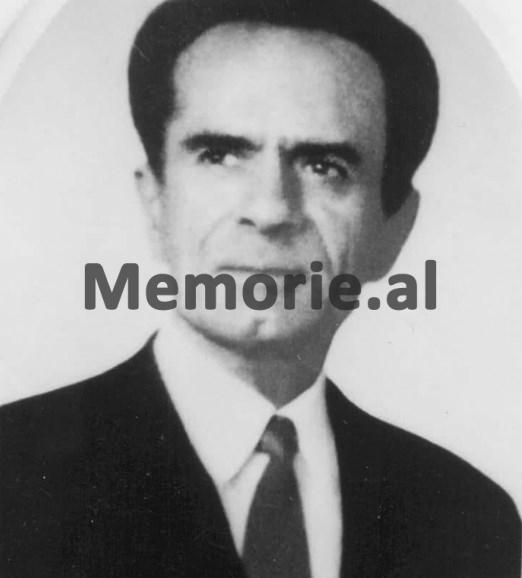
Memorie.al / In 1986, while working at the newspaper, I received an unusual letter. It was sent by Vexhi Buharaja. It was a large envelope, noticeably different from the others, the small, ordinary ones, which you could immediately tell would contain some citizen’s complaint about housing or work – routine for any newspaper editorial office. Holding that envelope, I felt a peculiar sensation. Vexhi Buharaja was very well known to me: from the city, the neighborhood, the alley. Moreover, our families, among the oldest in the city, visited each other, and he himself was a friend of my father. But I, having left the city early, right after high school, had met him very rarely, unlike my childhood friends who lived there.
Continued from the previous issue
At that time – as an 8 or 9-year-old child – I did not understand that this intimate calling of the neighborhood women and girls, simply by first name, without the surname, but also without the word mister or a religious title before the name, was affection stemming from him being a neighbor, one of us, or because the one who would go out and preach before the believers, that is, before them in the mosque, was not a theologian but a likeable man. But I have it well fixed in my memory: when Vexhi would “preach” (rrëfente vas), the women and girls of the neighborhood would fill the mafil tightly – a form of wide gallery on the second floor of the mosque, specifically for women and girls, who would watch through the wooden lattices.
Then what they whispered to each other, who know… Although Vexhi Buharaja himself writes in the history of our neighborhood that the boys and girls of the neighborhood, especially when in an alley, called each other brothers and sisters and could not marry each other…! What did Vexhi Buharaja “preach” or talk about when he climbed the stepped podium in the mosque? The truth is that we had no desire to go to the mosque and we did not go. However, a couple of times, out of curiosity, we went inside and listened for a few minutes to how Vexhi Buharaja, who had a reputation, “preached.”
We were surprised! We expected him to speak Turkish, but he spoke Albanian, and it seemed to us as if we were not in a mosque but at school. Because the “sermon” he told was like a subject of moral education, history, and literature. He spoke about why knowledge must be acquired, how to love the homeland, how to respect parents, why the Muslims and Christians of the city are brothers and must get along well with each other, etc., etc. School. Exactly like school, just add God, who was not present at school. Anyway, the war against the beards of priests and hodjas continued.
We no longer saw them entering the barbershops of the city, because we heard that, being ashamed, they would call barbers to their homes. In fact, only a few years later, in 1973-1974, after the 4th Plenum, which was called the anti-liberalism campaign – the campaign against beards and mustaches spread without distinction of religion, region, or idea, even to those civilians who, taking advantage of certain liberalism in artistic and cultural life, had also grown beards and mustaches. The state’s reaction was decisive and brutal.
Furthermore, in 1974, an experiment was even conducted with foreign tourists at Rinas Airport, who, according to the order, to enter Albania, had to first enter the airport barbershop and leave their beards and mustaches at customs…! This is not fiction. The experiment did not last long. The embassies accredited in Tirana and the foreign press reacted immediately, even with jokes, against the Albanian scandal, unheard of in the world.
But who would have thought, for goodness’ sake, to humiliate the respected clergy in this way? Wasn’t closing the churches and mosques, and filling the prisons with them, enough? What was this pathological war and hatred against beards and mustaches? The formulation “foreign manifestation” used in newspapers and speeches for beards was not at all convincing. Had they come to us from foreigners?! To appear more measured and objective, people began to seek the causes with facts and arguments more deeply; at the roots and in national tradition. Nothing, on the contrary, because Albanians, generation after generation – father, grandfather, great-grandfather – all with mustaches and beards, and they had not gotten them from foreigners. Look, if you will, at old photographs and family albums.
To be even more convincing, let us jump from our fathers to the Fathers of the Nation – famous and sung about. Our National Hero himself, Gjergj Kastrioti-Skanderbeg – first, a Christian, and, when it suited him, a Muslim – but in both cases, with mustache and beard, even larger than today’s. Our Renaissance figures, likewise: the trio of Frashëri brothers – Abdyl, Sami, and Naim – all three with large, beautiful beards; continuing with Jeronim De Rada and other Arbëresh in Italy, or Pashko Vasa in Lebanon, the great Fan Noli in America, Bajram Curri, Isa Boletini. All of them.
The terrible Pasha of Ioannina cannot be imagined without his beard like white mist, so much so that it seems the song was not raised for him, but for his beard. Shorn, shaved, the 80-plus-year-old man would have looked like a dead, ugly man who couldn’t scare even the village chickens, let alone stand up to a battalion of Turks, let alone face an entire empire for years. As for Vasilikia, the beautiful Greek woman, she would have to be an idiot to stay attached to such a head. It was another head, the head for which the song was raised:
“The head in Istanbul, the body in Ioannina,
They killed you, Ali Pasha, they laid you out…”!
If you placed that scoundrel’s head on the Arch of Shame in the middle of Istanbul for the whole world to see, and to tell everyone: look what head we have cut off, anyone would have the right to think that the Shame and the Arch were not for that head they saw, but for the heads of those who placed it there. So, each one mentioned the heads with large beards they knew of the Nation, but Ismail Qemali, the founder of Independence and the Albanian state, seemed to put a lid on the conversation: a beard and mustache larger and more beautiful than those of the Father of the Nation, you could not find as an argument.
There could be no doubt, also because it was Enver Hoxha himself who spoke with admiration about their bravery and wisdom. Meanwhile, in no case, and none of these great faces of the nation, were ever labeled or criticized for ideological limitations, bourgeois-revisionist influences, or anything of that nature. For centuries, beards and mustaches had become part of national tradition; at the same time, a symbol of manliness and of the man. Albanian boys could go to the army or get married, not simply when they turned 16 or 18, but when their mustache sprouted.
Meanwhile, all this deviation or overturning of tradition in the second half of the 20th century was happening in a Balkan country, moreover, in that Balkan country where beards and mustaches were signs and symbols of a man’s dignity, pride, and self-respect, and where even the slightest touching of the mustache by another, or worse, the curse “may your mustache fall out,” was considered unmanly and was paid for with one’s head. Tired of endless and fruitless discussions and speculations, people turned to find the cause of the shaving of beards and mustaches in politics and ideology.
On the contrary! In politics and ideology, not only was no support or argument found, but it was ascertained that the founders of the doctrine themselves wore beards and mustaches. Lenin and Stalin, of course, but before them, the theoreticians had even larger beards. Engels stood out for his beard and mustache from his youth, while Marx’s head, the “father of communism,” with its proverbial, giant beard, looked less like a head with a beard and more like a large pile of wool in which a face was placed.
So, what then could have been the reason or reasons for this strange order against beards and mustaches, and who, specifically, had given it? In fact, a well-founded suspicion circulated that all this might have been an initiative of Prime Minister Mehmet Shehu, and that Enver Hoxha either had not been informed about what was happening, or deliberately left the Prime Minister to see how far he would go.
The speculation was not baseless, if you recall that the Prime Minister was known for such initiatives. Moreover, not long before, in a village in Librazhd, during a rally, he had grabbed a cooperative chairman firmly by the hair from behind the neck and shouted at him: “With these beards and mustaches, you, you rednecks, want to bring capitalism to Albania!” “Let’s not rush,” said someone. “Your explanations seem a bit naive to me. They are just stories, folklore. The cause seems to me a bit deeper.”
Why is Mehmet Shehu particularly fierce in this campaign against beards and mustaches? Does the fact that the most ardent to appear is precisely Mehmet Shehu, who himself had a mustache as a young man; then in the Spanish War, also with a mustache, and also with a mustache in the National Liberation Anti-Fascist War, when he was commander of the 1st Shock Brigade, seem credible to you? Look at the war photographs. In all cases, you see him with a mustache; him and the vast majority of ex-partisans. Look at the post-war photos too. None.
Mehmet Shehu’s ferocity, he said, is explained by a revenge complex for a great insult. But the great general of war could not act out of character. The death Mehmet Shehu chose, the spectacular suicide in 1981, was his extraordinary revenge and challenge, after which Enver Hoxha never recovered and, as has been said, it hastened his death. Nevertheless, Enver Hoxha’s idea was well thought out and is the A-B-C of any ruler. Those he lined up had to be completely without identity: all the same, as is done with new recruits, who, before being lined up as soldiers, all have their heads shaved to zero, because it is known, a faceless crowd, “zero people”, are easier to rule.
This was done to everyone, and the poor priests and hodjas could not be an exception. Expropriation had to be total, and property, conviction, and religious faith were not to leave a mark even on people’s faces. Time showed that this grotesquerie, this big joke, turned into a boomerang, and that fundamentally the regime itself and those who ordered such madness were ridiculous and grotesque, but the cost was great.
Insult is worse than poverty
In the title of his study on the “Muratçelepias” neighborhood, Vexhi Buharaja does not set time limits. He says generally “Panoramic view of the neighborhood’s past.” Which past? It is known, as he himself writes, that the neighborhood is 300 years old. Meanwhile, the study covers only the first 200 years. What about the last 100 years? He has deliberately set aside the period of several decades of socialism, and, perhaps, to hide this fact, has he also avoided the kingdom period alongside it? It is not surprising. It is in the logic and constant of all his creativity. Vexhi Buharaja has excluded this period from his poetry, from his studies, translations, from everything. Could it be that for him the past of the neighborhood and city he wrote about was more beautiful than the future?
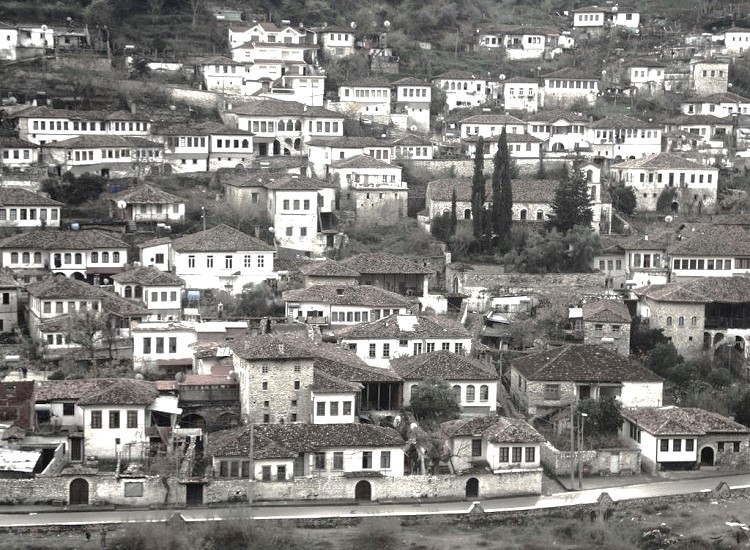
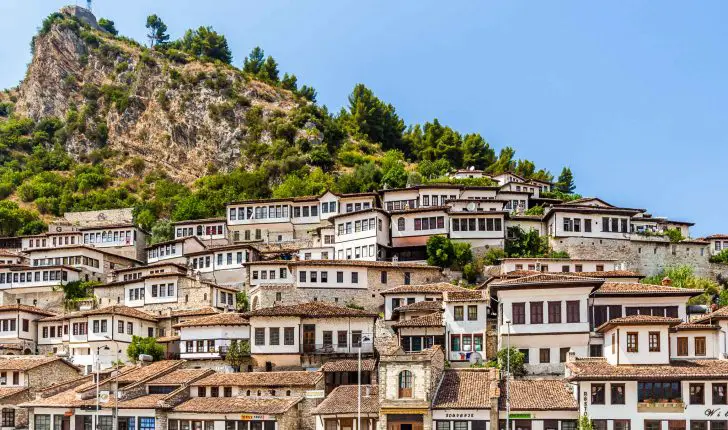
In the panoramic view… of Vexhi Buharaja, our neighborhood and our city have light. Even brighter and more beautiful are our neighborhood and city in the notes of the Turkish chronicler, Evliya Çelebi, 300 years ago: There are 500 houses, adorned and well-maintained, covered with beautiful tiles. The houses are two-story. They are built entirely of stone and are placed on a terrain that stretches over seven hills and streams. It is an adorned city. In Berat, there are 30 neighborhoods…! Ten are Christian, one Jewish neighborhood, and there are no neighborhoods for the Franks or the Gypsies.
There are altogether 30 pulpits for believers and there are 5 madrasas…! In the “Muratçelebi” neighborhood, there is the Hysen Pasha Mosque. It is a new and beautiful mosque. It is a hexagonal stone minaret, adorned, elegant, and beautiful, covered with a sky-colored dome, and with blood-red tiles. It is a mosque full of light, beauty, and finesse, so much so that no equal can be found in the science of architecture. It is a pure, sincere, and priceless mosque. There are five schools of knowledge.
Near a newly built road by Hysen Pasha, by the river, there is a place with 100 shops, arranged in order and harmony, where learned people gather…! Some people talk with each other and develop topics on religious, scientific knowledge, poetry, etc. Here there are many poets, orators…! They are people with knowledge deep as the sea, but as for religion, they do not pay much attention…! Here there are elegant, mature, and smart people.
If a man in the city sheds blood (kills) and flees, hiding in Mali i Thatë (Dry Mountain) to escape the hand of justice, he himself can never return to this city…! Around the city of Berat, there are 77 places of entertainment and promenades…! In the city of Berat, down there, behind the coppersmiths’ market, over the Osum River, there is a large bridge for the passage of travelers, opposite, in Dry Varosh. The bridge has altogether nine wooden arches, but the foundations of the bridge rest on legs of strange stones, submerged in water. The upper part of the bridge is paved with oak material. It is something strange and rarely encountered. In Herzegovina, in the city of Koxha (Foča), a bridge found over the deep river was built in the time of Sultan Suleiman, but it consists of only one wooden arch.
Whereas this one in Berat is equipped with nine beautiful arches (God preserve it!). The city of Berat, as a mountainous place, with clean air and water, has healthy boys and girls; it has educated, restrained people. All are beautiful, splendid, and, in general, are pleasure-loving and lovers. The boys walk around armed and swear by their weapons; they are lively and spirited, and for the smallest thing, they draw their swords and rush at you (God preserve us!). This people are a noble tribe of Albania…! They are brave warriors, stern, and fearless (God preserve us!).
Can time be tripped and stopped?
Vexhi Buharaja has in his personal archives thousands of pages of books, studies, translations from the world’s greatest authors, but in manuscript, unpublished. Accustomed only to leaving them in manuscript in his personal archives due to constant censorship, for him the words book, publication, publicity, first copy, autograph had faded, lost their meaning – and he himself – also hope. For the pleasure and emotion that the publication of a book brings to the author, various writers of the world have made the most diverse definitions: the greatest happiness, like the pleasure of giving birth to a child, etc.
The distinguished poet, publicist, philologist, researcher, orientalist, and translator Vexhi Buharaja was deprived of the sweat and the reward, but above all, of the greatest pleasure of life; the pleasure and joy of creation. And this is the greatest crime against him. Meanwhile, the manuscripts – ready-made works of this personality – are testimony and proof of crime. Today, still unpublished, they resemble the testimonies of an unpunished crime. Moreover, a double crime: against the author and against Albanian culture. Vexhi Buharaja has been left only to the patriots, the creators of Berat. Ahmet Kondo and Izedin Hima have written valuable books about him. Very good writings have been published by Agim Dishnica, Agim Mehqemeja, Ajet Nallbani, Simon Vrusho, and especially Bedri Telegrafi, who is also a family member.
But Vexhi Buharaja is not a local creator; much less a family one. The Albanian state and society are responsible for the distinguished orientalist, poet, researcher, and translator. The publication and re-publication of the Shah-Nameh in 2001 and 2010 by the Naimi publishing house and some studies by Shaban Sinani are the only undertakings from the center for this great personality of Albanian culture. But the Ministry of Culture and the state are not involved at all in this center. A series publishing the main works of Vexhi Buharaja would simply be an inaugural moment. / Memorie.al