By Aurenc Bebja
Part One
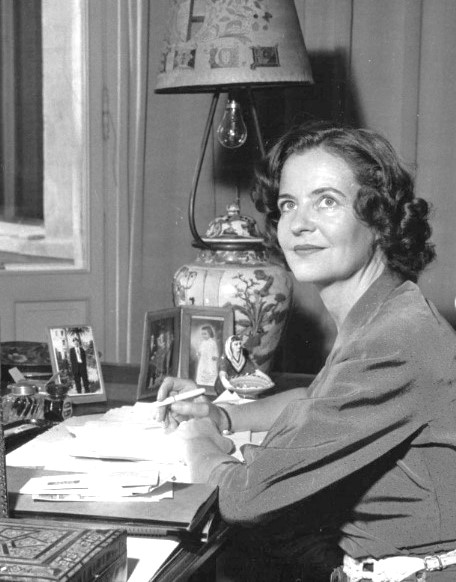
Memorie.al / The magazine “Les bonnes soirées” published, on September 18, 1960, on pages 6–8, an exclusive interview with Queen Geraldine of Albania, conducted at the time in Cannes, France, which Aurenc Bebja has brought to the Albanian public. Geraldine Apponyi, the beauty of Budapest, was forced to leave her kingdom and endure the horrors of exile. A large villa surrounded by palms and flowers. A villa that has the face of many others and where it seems that only the sweetness of life can find asylum. Despite this appearance, these bougainvilleas, whose purple foliage has the elegance of flowers, “La Pierre Grise” is not a villa like the others.
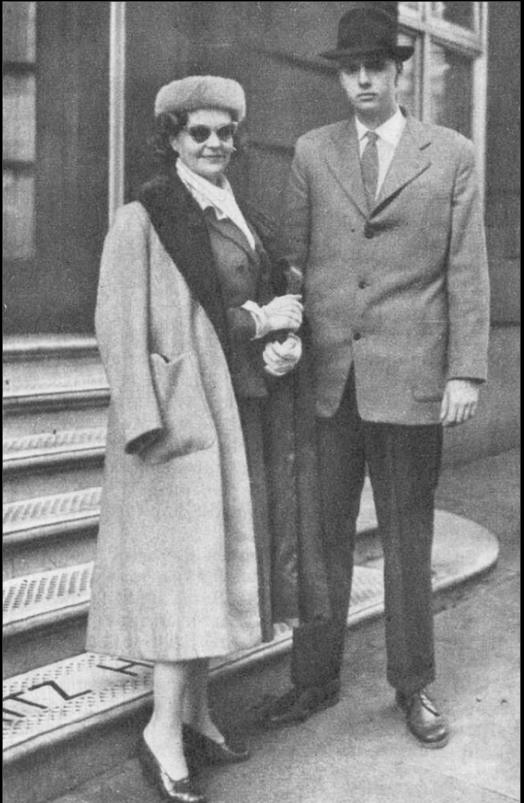
Its inhabitants have a history, because the unfortunate heroes of one of its tragic pages are part of the history of Europe. This large villa, created for happiness, shelters the former King Zog I of Albania, his wife Geraldine, and their only son, Leka.
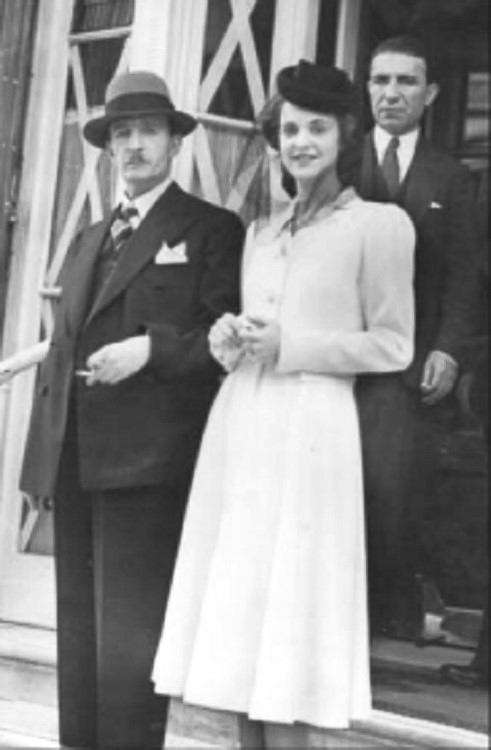
It is precisely in the garden of the city that a beautiful young blonde, tall, slender, welcomes me. She was wearing a light blue dress, with two rows of pearls around her neck, a magnificent diamond on her finger, and a blue flower on her white jacket. Her voice was clear, soft, without any accent. Her blue-gray eyes radiated gentleness and intelligence.
– I am happy to welcome you, madam.
I have before me Queen Geraldine, whose tragic fate had shaken all of Europe a few months before the great upheavals of the Second World War. April 1938: Europe is not yet on fire, but civil war brings bloody tears to Spain. Hitler has just annexed Austria, but life goes on. The crowds flock to the four-year-old five-cent pieces of Canada.
King Zog is to marry the beautiful Countess Geraldine Apponyi. The Apponyis are representatives of one of the oldest Hungarian families. Geraldine inherits Hungarian blood and a fiery character from her father. She is so beautiful that she has been called “the Beauty of Budapest.” She counts among her ancestors more than fifteen crowned heads. She is related to all the royal families. The Habsburgs, the Saxons, the Bulgarians, the Portuguese, the Romanians, the Greeks, and the Yugoslavs.
Her mother, married for the second time to the French colonel Girault, is of American origin. It is precisely this Anglo-Saxon ancestry that the young daughter undoubtedly owes her love of sport and her majestic stature. Geraldine, as a child, spent two years at the lycée in Nice. As a young girl, she already spoke four languages, to which Albanian has been added.
This King of Albania, born in 1895 and whom she is to marry, already has an extraordinary past. His country lived for five hundred years under Turkish domination, and Ahmet Zogu, the son and grandson of a Pasha, had sworn from childhood to make Albania independent. At the age of seven, he was sent as an “extraordinary ambassador” to the Turks. The child proved so determined that they kept him in Constantinople.
But when he returned to Albania, he returned to his beloved mountains and, at the head of his ever-growing supporters, fought on the peaks from which the fighters were almost invincible. But the Serbs, after the Turks, occupied his country. Step by step, Albania would nevertheless gain independence. In 1926, the republic was admitted to the League of Nations, then, in 1928, the Kingdom. Ahmet Zogu was proclaimed king under the name; Zog I.
From this country, the young Hungarian girl, the charming creature called Geraldine by Europe, would become queen. Located south of Yugoslavia, bordering the Adriatic, Albania has about one million inhabitants. It is a mountainous region with no trains and no roads, where the inhabitants devote themselves to agriculture and livestock. But Zogu and Geraldine have great plans.
They will clean, build, improve. Already, oil exploration has opened up great hopes. All the newspapers of the world have spoken of the magnificent wedding in Tirana. Now, twenty years later with me, still just as beautiful, still just as calm and alluring, Queen Geraldine recalls her memories.
Geraldine in Wonderland
– My wedding? It was above all a great celebration for all the Albanians whom I already loved with all my heart, a celebration that lasted three days and three nights. The streets were draped with red banners. The black eagles adorned all the balconies. Of course, Tirana housed many more people than usual that day. Everywhere there was a diverse, colorful mix. Everyone was wearing their best costume.
There was a grand ball at the Royal Court. The banquet hall was decorated with the letter “Z” wrought with weapons and with very ancient, embroidered costumes. People danced all over the country. All of Albania was like a book of colorful pictures. Every square, like every crossroads, was bursting with colors and songs. Then I remembered an image that had struck me in a magazine of that time.
The caption read: “Geraldine in Wonderland.” There were children in red blouses and black trousers, a rider in a green cloak, and two ladies in gold-embroidered dresses. A meeting between East and West.
A dress from the thousand and One Nights
My wedding dress?
Geraldine has a soft smile at this memory. Her outfit certainly came from Paris. Her long blue veil embroidered with diamonds, filled with bouquets of roses, looked like a silver foam. The dress was white, long, completely covered with pearls. Throughout Tirana and throughout the Albanian villages, the trees were in bloom.
The whole country had thus donned a white mantle, a festive mantle. Count Ciano, Mussolini’s son-in-law, had made a very remarkable arrival, standing in an open car surrounded by bicycles that disappeared under bouquets. One hundred and fifty young couples, paid for (their wedding) by the King, had joined together on the same day. They formed around the future queen a touching and enthusiastic court of love.
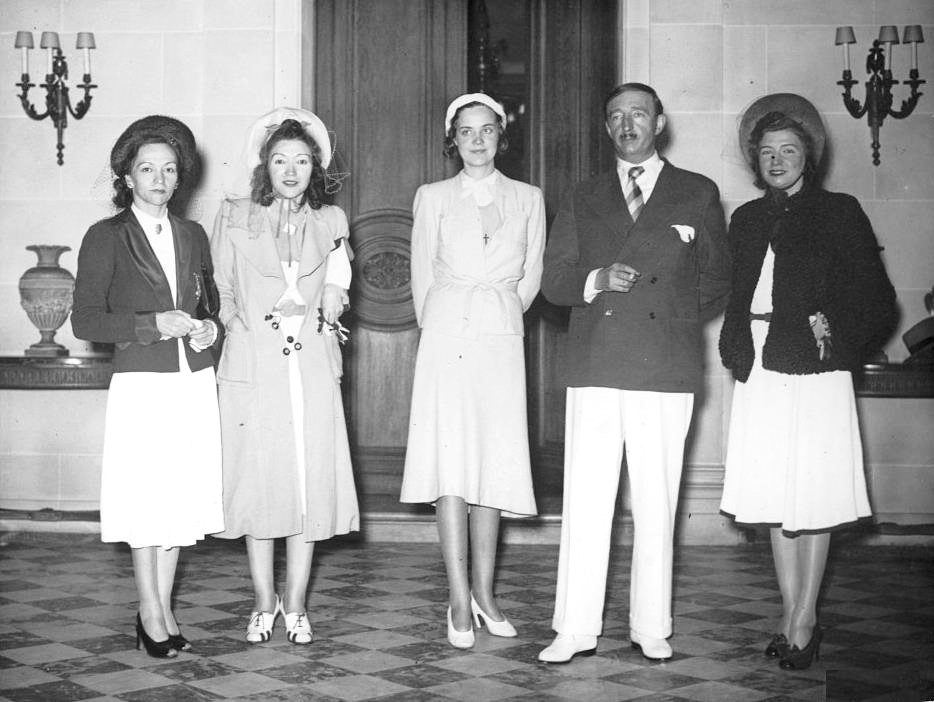
The powerful men of the day had sent precious gifts. Mussolini, a yacht rocking in the port of Durrës; Hitler, a long car that looked like a nickel carriage. Hungary had offered Geraldine, a perfect horsewoman, four white thoroughbred horses. In the images of the time, three young girls with brown curls emerge from a white hat. In full white uniform, they are Myzejen, Ruhija, and Maxhidja, colonels of the Albanian army regiments and the King’s younger sisters.
April of Joy
April 27, 1938. While Zogu, a Muslim, and Geraldine, a Catholic, had been united in a civil marriage, one hundred and one gunshots shook Tirana, and thus a rain of spring flowers fell from the trees that covered Albania with a festive carpet. In the villages, shepherds with large mustaches roast lambs before their doors amidst drippings of juice and flames. The people are happy. There is a brave king and the most beautiful queen in the world.
A queen who has just declared: “Above all, I want to take care of the women and children of my country.” The young couple set off for their honeymoon in their amazing, luxurious nickel-plated carriage. They had barely a year of happiness. A year in which they began to put their plans into action. In the euphoria of the moment, Albania believes in Italian friendship; moreover, it has signed a pact of alliance in Rome. The King wants to build a highway linking Durrës to Tirana. It will bear the Duce’s name.
Then a large concrete cathedral will be built, and finally the Royal Palace. Zogu and Geraldine’s house is truly a simple square house in the middle of a garden. The new residence will include twenty-five rooms and three large halls. There will be a cinema, a swimming pool, a winter garden, and – Geraldine is very interested in this – a labyrinth of roses.
Soon, the “Marconi” Company will inaugurate a radio station. New stamps will be issued. Zogu and Geraldine love each other. The Queen will soon have a child.
April of Misfortune
– Alas! Meanwhile, the storm is breaking. Hitler swallowed Austria in one gulp. Mussolini’s pride suffers from the fact of being unable to balance this lofty fact. He thinks that of all the nations surrounding him, Albania is the only one that cannot resist him.
Negotiations take place between the government of Rome and that of Tirana regarding the transformation into a protectorate of the Italo-Albanian treaty of 1927. Acceptance of the Italian conditions meant that Albania would have to renounce its independence. Zogu, supported by all his people, refused.
And on April 7, at dawn, Italy invaded Albania without warning. The Italian squadron violently bombed the main cities and landed its troops in Sarandë, Vlorë, Durrës, and Shëngjin. The entire coast was immediately occupied. Albania resisted with the energy of despair. But what can the highlanders’ rifles do against organized armies? King Zog tried to negotiate to avoid the massacres of a hopeless war.
Everything was in vain. On April 8, Italian troops entered Tirana. During this time, a young woman had given birth to a child, a son, in the simple house of Tirana, which she loved because it was the house of her affections. / Memorie.al