By Aurenc Bebja
Part Two
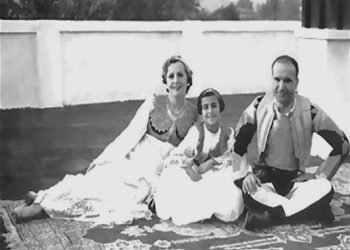
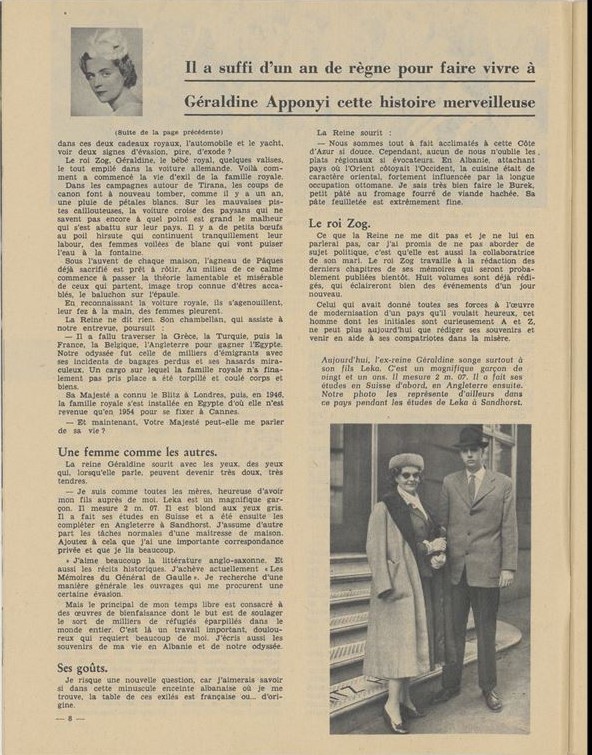
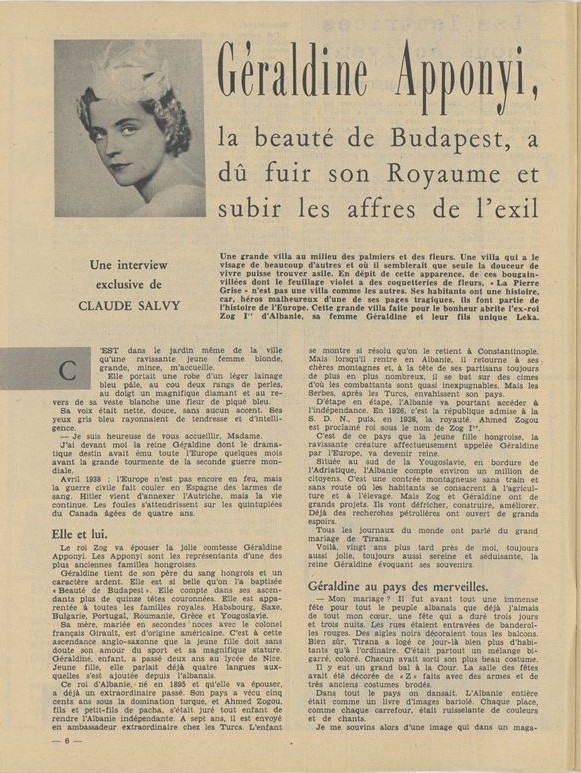
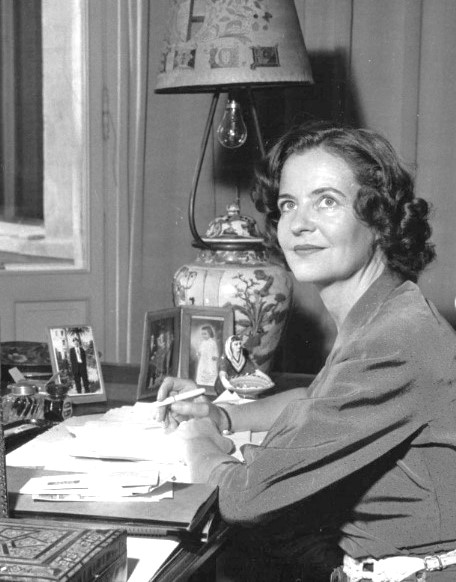
Memorie.al / The magazine “Les bonnes soirées” published, on September 18, 1960, on pages 6–8, the exclusive interview with Queen Geraldine of Albania, conducted at that time in Cannes, France, which Aurenc Bebja has brought to the Albanian public. Geraldine Apponyi, the beauty of Budapest, was forced to leave her kingdom and suffer the horrors of exile. A large villa surrounded by palms and flowers. A villa that looks like many others and where it seems that only the sweetness of life could find asylum. Despite this appearance, this bougainvillea, whose purple foliage has the elegance of flowers, “La Pierre Grise” is not a villa like the others.
Its inhabitants have a history, because the unfortunate heroes of one of its tragic pages are part of the history of Europe. This large villa, created for happiness, shelters ex-King Zog I of Albania, his wife Geraldine, and their only son, Leka.
Continued from the previous issue
– And now, can Your Majesty tell me about your life?
A woman like others
Queen Geraldine smiles with her eyes—eyes that, when she speaks, can become very gentle, very loving.
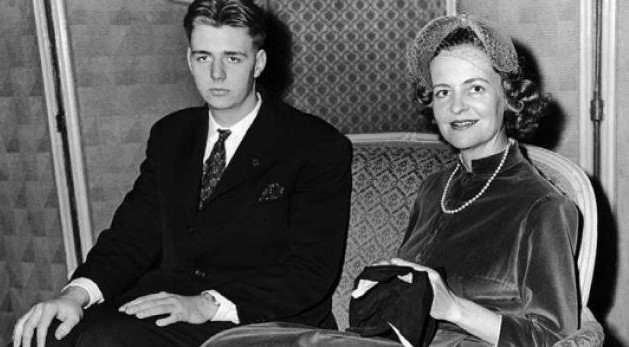
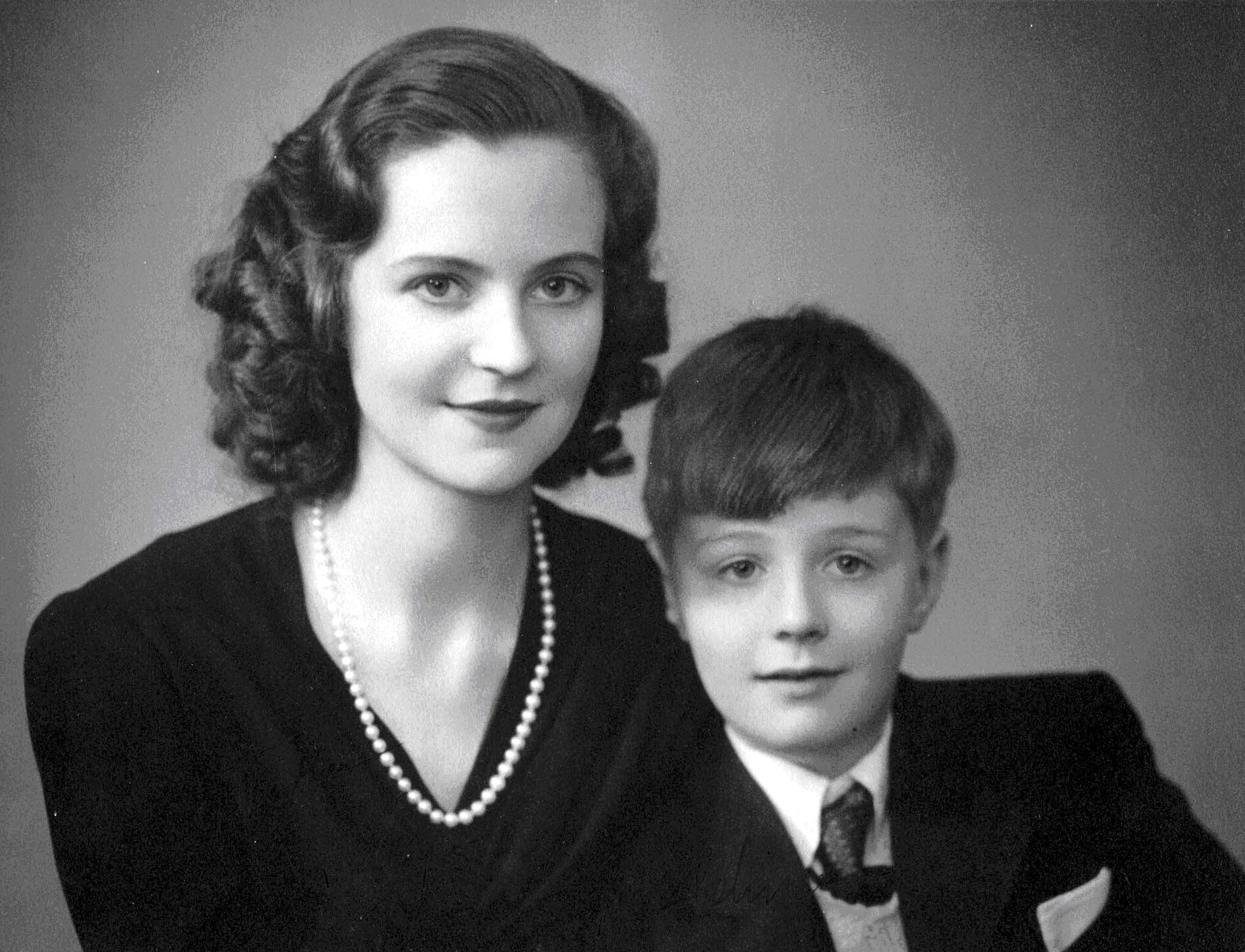
“I am like all mothers, happy to have my son with me. Leka is a handsome boy. He is 2.07 m tall. He is blonde with grey eyes. He studied in Switzerland and then finished his studies in England at Sandhurst.
I also take on the normal duties of a lady of the house. Add to that the fact that I have an important private correspondence and that I read a lot. I really like Anglo-Saxon literature. And also historical accounts.
Currently, I am finishing The Memoirs of General de Gaulle. In general, I look for books that give me a certain escape. But the greatest part of my free time is devoted to charitable organizations, whose purpose is to alleviate the condition of the thousands of refugees scattered throughout the world.
This is an important, painful work that demands a lot from me. I am also writing the memoirs of my life in Albania and our odyssey.”
Her tastes
I risk a new question, because I would like to know whether, in this small Albanian circle where I find myself, the table of these exiles is French or… of original origin? The Queen smiles: “We are completely acclimatized to this gentle Côte d’Azur. However, none of us forgets the regional dishes that are so tempting.
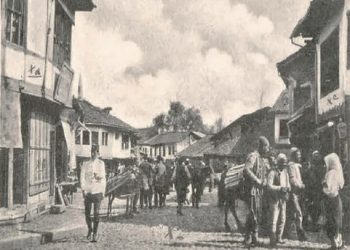
In Albania, a beloved country where the East embraces the West, the cuisine had an oriental character, strongly influenced by the long Ottoman occupation. I know very well how to make ‘Burek,’ the small cheese pastry filled with minced meat. Its dough is extremely thin.”
King Zog
What the Queen does not tell me—and she will not speak to me about it, because I have promised her that I will not open any political topic—is that she is also her husband’s collaborator. King Zog is working on the last chapters of his memoirs, which will most likely be published soon. Eight volumes have already been written, which will shed new light on many events.
He who had given all his strength to the work of modernizing a country that wanted to be happy, this man whose initials are curiously A and Z, can now only write his memoirs and come to the aid of his poor compatriots.
The dramatic birth of the crown prince
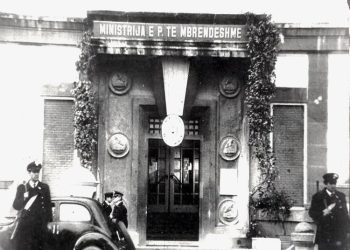
It is customary to fire cannons for the birth of a royal prince. In Tirana, the custom was respected. The ten cannons that surrounded the house fired for twenty-four hours. Alas! The Albanian cannons had barely fallen silent when the other cannons were heard – those of the enemy. Each shot would now resonate with pain in Geraldine’s heart. This was no longer the festive cannonade of holidays.
The Crown Prince of Albania was greeted by the artillery of the invader of his country. And immediately they had to flee, and, unfortunately, they had to flee in a car offered by Chancellor Hitler, the great friend of Mussolini. Should we see in these two royal gifts – the car and the yacht – two signs of departure, or even worse, of exodus? Geraldine Apponyi needed only one year of reign to bring this wonderful story to life.
King Zog, Geraldine, the royal infant, a few suitcases – all piled into the German car. Thus began the life of exile for the royal family. In the villages around Tirana, the cannon fire once again brings down a rain of white petals, as it had a year before. On the bad, stony roads, the car meets peasants who still do not know how great the misfortune that has befallen their country is.
There are small, rough-haired goats that continue plowing peacefully, women dressed in white who go to draw water from the spring. Under the awning of every house, the already sacrificed Easter lamb is ready to be roasted.
Amidst this calm, the lamentable and wretched train of those leaving begins to pass – a familiar image of gloomy beings, with bundles on their shoulders. Recognizing the royal carriage, they kneel, holding their felt hats in their hands, while the women weep. The Queen says nothing.
Her Chamberlain, present at our interview, continues: “We had to pass through Greece, Turkey, then France, Belgium, and England to reach Egypt. Our odyssey was that of thousands of emigrants, with the incidents of lost luggage and its wonderful chances.”
A cargo ship, which the royal family ultimately did not board, was later struck and sunk with troops and cargo. Her Majesty experienced the Blitz in London; then, in 1946, the royal family moved to Egypt, from where they did not return until 1954 to settle in Cannes. / Memorie.al