By PASKAL MILO
Part One
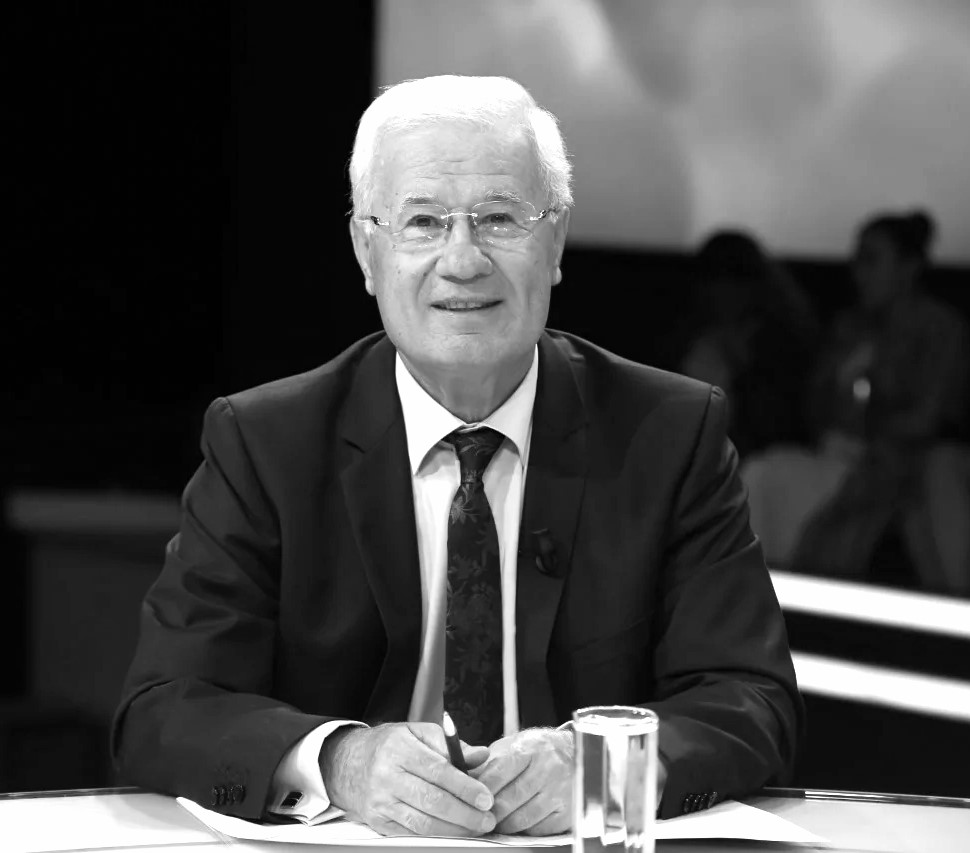
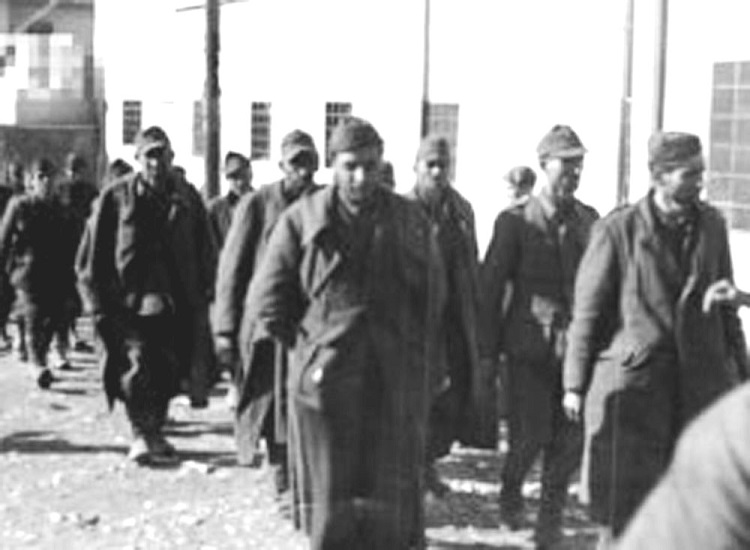
Memorie.al / The repatriation of prisoners of war were one of the most sensitive issues after the Second World War. Around 250 German and Austrian soldiers—prisoners or those who had switched sides during the fighting—remained in Albania, where the dictatorship of the proletariat was being installed. It would not be easy for them to return home; indeed, some of them never returned. They were imprisoned, shot without trial, secretly eliminated as agents…! Among those who remained in Albania there were also women. Their fate is described by the historian Paskal Milo in his newest work, titled “Albanian-German Crossroads,” published some time ago.
The historian has relied on previously unknown documents, extracted from the archives of the Ministry of Internal Affairs, which attest to the number of prisoners of war, the conditions in which they lived in Albania, how they were pursued by the State Security (Sigurimi), and who was the last German to leave Albania.
THE REPATRIATION OF GERMAN PRISONERS OF WAR
The heavy burden of reparations that defeated Germany bore on its shoulders during the war and which had to be paid in the grim and dubious peace restored afterward, was neither the only challenge nor even the first for this country. Over the span of 27 years in the first half of the 20th century, Germany had twice inflicted upon other nations, especially European ones, multi-million losses of human lives on the battlefronts and in concentration camps, endless horrors and suffering, irreversible mutilations, and biblical-scale destruction.
The temporary laurel wreaths of victories placed upon the hot heads of conservative and Nazi warmongering circles were paid for with rivers of German blood, but they placed the nation’s future under heavy economic, political, and moral mortgages. Hatred fell like a heavy curtain over the heads of Germany. Justice and revenge lived together for years. Trials like that of Nuremberg and many others did their job and punished the guilty and the major criminals, but not all those who deserved to be placed in the dock. When the war ended, each nation did what it could to heal its wounds. The victors applied the balm of hope for peace and a better life to their pains.
The Germans, under the heavy weight of moral responsibility for the crimes committed in their name, experienced contempt and humiliation. Not all of them deserved it, and not all were guilty. An entire people can never and should never be condemned. They must be given hope to rise again from the deep abyss into which the terrible adventure of the criminal minority had thrown them. But even among the Germans, the drama of the war and its defeat was not experienced in the same way. It would be hard to find a simple German family that did not have a member killed or maimed.
But there were many, many others whose fate was unknown, who wandered the roads of Europe, and hundreds of thousands who were prisoners in the victorious countries of the war. At the Yalta Conference, the Great Allied Powers reached a full agreement on the protection, maintenance, and repatriation of prisoners of war and civilian nationals of their respective countries. However, there was no special agreement regarding German prisoners of war either at Yalta or at Potsdam.
There, the matter was only briefly touched upon, more for their use as labor or for the disarmament of 400,000 of them who were in Norway. International laws and conventions for the treatment of prisoners of war were not lacking. But what was lacking in post-war Germany was a central governing authority to take responsibility for their care. The International Red Cross and the German Red Cross became involved from the beginning, and with some delay, so did the occupying authorities of the Great Allied Powers in Western Germany.
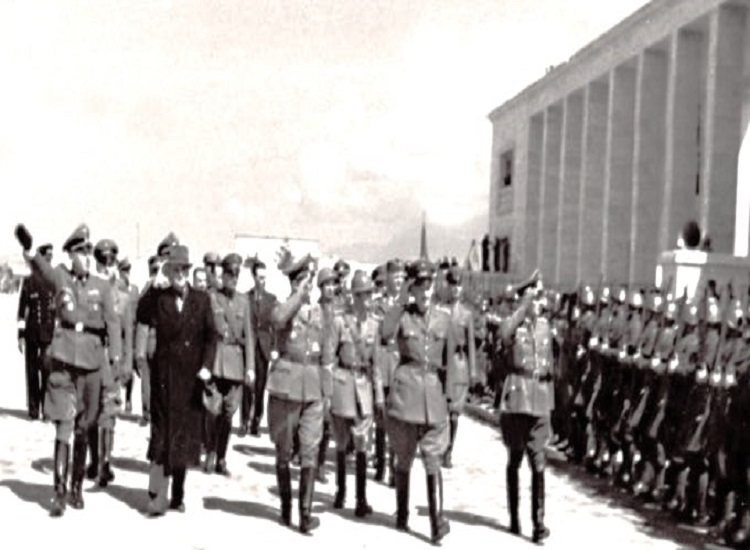
In Albania, at the end of the war, a number of prisoners from the Nazi army had remained, the majority of whom were Germans, but there were also those of Austrian, Czech, Polish, Slovenian, Armenian, etc., nationalities. About these people and their fate, nothing has been said or written. It has been a taboo subject and, in this last quarter-century, unknown to public opinion.
The author, in the context of this book, conducted special research in the diplomatic, military, and Ministry of Internal Affairs archives and found interesting documentary sources, most of which are being used for the first time. The number of prisoners of war in Albania was around 250, but over different years, differing figures have been given. The maximum figure appears in a report from 1947, which mentions 298 German prisoners. Of these, over 200 were Germans, 25 were Austrians, etc.
This number, with slight variations, remained almost the same from 1945 until 1950. In addition to them, about 50 German soldiers who had joined the partisan forces after July 1944 also remained in Tirana with a special status, awaiting repatriation. At the end of August 1945, 17 German partisans were allowed to leave Albania for repatriation, another 16 in October, and another 11 in November. In addition to them, 8 Austrian partisans, 2 Poles, and one Czech were also repatriated. By social composition, over 90 percent of the prisoners were workers, peasants, and artisans. Among them were several officers, students, and clerks, two priests, two painters, two doctors, several pharmacists, merchants, etc.
The vast majority had primary education, few had secondary education, and very few had higher education. They had been taken prisoner mainly after July 1944, across almost the entire territory of Albania, in Sarandë, Himarë, Vlorë, Fier, Elbasan, Librazhd, Peqin, Korçë, Tiranë, Pukë, Dibër, Kukës, etc. From a political standpoint, regarding their attitude toward the communist regime, the majority of prisoners were classified as “indifferent,” while there was a group that held a “not good” attitude, hostile to the new power. Another group of about 60 prisoners, classified as “anti-fascists,” had a “good” behavior, and among them were also members of the former German Communist Party.
The deployment of German prisoners changed over the years. The majority of them, about 150 people, were gathered immediately after the war in the Vlorë district, in Kallarat and Llakatund, and about 20 in the city. They mainly worked in the bitumen mine in Selenicë. In the second half of 1946, most of the prisoners were brought to Tirana to work in construction and agriculture; some at the Kamza farm, some in military and civilian hospitals, in administration as specialists, etc. Some remained in Cërrik of Elbasan, and a few in Llakatund and Rubik. The treatment of the prisoners, their housing conditions, and their food left much to be desired. Post-war Albania was extremely poor and hungry, and toward yesterdays and unwanted enemies, it could only have minimal consideration.
In the official reports of the State Security (the Albanian STASI) of the time, it is stated that: “the life that the German prisoners lead is quite bad, housing is poor, and not all have been fully equipped with clothing.” The German prisoners, most of whom were simple people, submitted to their fate with the hope that they would soon be repatriated to their homeland. But after 1946, the situation became desperate. Individually and collectively, they requested repatriation from the General Command of the Albanian Army. But when they received no response from the Albanian authorities and heard that German prisoners in other countries were being repatriated, they became disheartened and began to react. They went to work under compulsion, and there were cases where they refused to work. Their conversations increasingly took on a political and anti-regime character.
Some of them escaped, and many others attempted to do so. The rise of discontent among the German prisoners and its manifestation in various forms, even strikes, was reported to the higher command by the special authorities that dealt with them daily. The State Security reorganized the surveillance and control over the prisoners, even creating an agent network among them. If until 1946 the prisoners had the right to move freely after work, after the escape of two of them, movement through Tirana was conducted accompanied by Albanian soldiers. The correspondence of the prisoners with their families was censored, and those who held critical attitudes toward the regime and hoped for its overthrow by external intervention were kept under very strict control.
The State Security pursued them everywhere—in their meetings with Albanian citizens and especially with some German, Austrian, French, and Italian women, whose husbands were either Albanians imprisoned by the communist regime or were viewed with suspicion by it. The circle of foreign women was so closely watched by the State Security that even the wife of Omer Nishani, the head of the Albanian state, who was Austrian—Trandafile (Roza) Nishani—was under constant surveillance. To keep the prisoners under pressure, the communist regime imprisoned a small number of them and eliminated them without trial. Documents from the State Security attest that 12 prisoners were sentenced from 2 to 20 years in prison, and several others were killed in secret without a court decision, accused of being foreign agents aiming to overthrow the communist regime in Albania.
This treatment did not spare even some deserters from the Nazi army who had joined the partisan forces during the war. Typical was the case of five of them; four were soldiers and one was a lieutenant, named Hans Kuhn. The lieutenant had been a company commander and, during the war, had deserted and joined the ranks of the 5th Assault Brigade of the National Liberation Army, which was among its most renowned units. The accusation against them, after they were arrested in November 1945, was that, under the direction of the German doctor Joseph Kutz, they carried out espionage activities in favor of British secret services and had connections with Greece with the aim of overthrowing the communist government in Albania. Doctor Kutz was shot without trial, after being tortured and without accepting any accusation.
Even his “co-conspirators” remained in prison without going to trial, “because we have no other order,” as was reported by the State Security to the higher communist bodies in December 1947. Lieutenant Hans Kuhn was not saved from prison even by two statements from the senior commanders of the 5th Brigade, Shefqet Peçi and Delo Balili, who testified that he had shown bravery in battle, had been wounded, and deserved to be set free. Such statements in the form of guarantees for German deserters who had fought against their former army were also given by other leaders of partisan formations, such as Sadik Bekteshi, Gjin Marku, Sadik Bocaj, Islam Radovicka, Myzafer Spaho, Skënder Malile, Astrit Nishani, Sofokli Papavasili, etc.
Among the prisoners of war, there were also three women: two Germans, Erna Shubert and Irmgard Tennius, and one of Austrian origin, Elsa Koch. They had been captured by partisan forces on the Kukës–Prizren road in early September 1944. After the war, they were sentenced and remained in Albania for nearly 10 years. Elsa Koch was sentenced to 20 years because she had been the secretary of SS General Fitzthum, who had become all-powerful in the final phase of the war. / Memorie.al