




By DASHNOR KALOÇI
Part Four
Memorie.al / The events of the spring of 1981 in Kosovo, which began in early March with protests and demonstrations by the student youth and subsequently by the people of Kosovo, who rose up to demand their freedoms and legitimate rights, as well as the status of a republic, just as all other peoples and ethnicities then within the Socialist Federal Republic of Yugoslavia enjoyed – led by the Bosniak Cvijetin Mijatović (President of the Presidency, May 1980 – May 1981) – as is already known, provoked a harsh reaction from official Belgrade. The high leadership of Serbia at that time, led by Prime Minister Ivan Stambolić (President of the Executive Council of the Socialist Republic of Serbia), upon which the Socialist Autonomous Province of Kosovo depended, sent armored forces there and violently suppressed those protests, not only with police forces but by also deploying the army and tanks on the streets and squares of Prishtina and other cities where those peaceful protests took place, during which, over all those days (March 11 – April 11, 1981), there were a total of 12 victims.
These events, which became headline news in all world media, as well as the public reaction of official Tirana, are now very well-known through dozens of writings or archival documents published mostly after the 1990s. However, what remains a great enigma and has not been made known to this day is: how did the leader of communist Albania, Enver Hoxha, initially react to those events? What was his first impression regarding what was happening in Kosovo, and what steps did official Tirana subsequently take to come to the aid of its compatriots in the Socialist Autonomous Province of Kosovo? Did Enver Hoxha stand by what he had said in 1970 – that Fadil Hoxha and the high leadership of Kosovo were doing very well by opposing Kosovo being granted the status of a Republic within the framework of the Yugoslav Federation – or had he changed his mind and his stance?
Regarding these and other matters, we are acquainted with several archival documents located in the Central State Archive (the personal fonds of Enver Halil Hoxha), which have been unknown until today and will be published for the first time and over several issues by Memorie.al. From these documents, it is noticeable that from March 4, 1981 (when the first spontaneous protests of student youth began in Prishtina) until April 3, when Enver Hoxha held a working meeting with Prime Minister Mehmet Shehu and Ramiz Alia regarding the events in Kosovo – that is, for a whole month – there was complete silence, and no meeting of the Political Bureau or the Secretariat of the Central Committee of the Party of Labour of Albania was held, meaning no reaction whatsoever from the high leadership of the PLA or official Tirana.
Likewise, what is noticeable in these documents is the panic that seized the main leader of communist Albania, Enver Hoxha, who was torn and indecisive about the stance that official Tirana should adopt regarding the events in Kosovo. So much so, that in another conversation at the Party House on April 5, 1981, with “the comrades of the leadership” (Mehmet Shehu, Adil Çarçani, Hekuran Isai, Kadri Hazbiu, Pali Miska, Spiro Koleka, Rita Marko, Pilo Peristeri, Simon Stefani, Qiriako Mihali, Nedin Hoxha, and Behar Shtylla), where they would go for coffee or to play cards, billiards, etc., Enver asked them: “What do you think about the recent events in Kosovo and what should we do? Should we take a stance and be concerned, or not?” Likewise, during another brief conversation that Enver Hoxha had in his office with Ramiz Alia about a month later (on May 13, 1981), he told him: “Regarding the events in Kosovo, it seems to me that our subordinates should also think about it, and not wait for me to be the only one to think about it!”
Concerning these and other matters, we are informed by these archival documents belonging to the period April-June 1981, during which Enver Hoxha held several conversations and meetings, both with his two closest associates (Prime Minister Mehmet Shehu and the Secretary of the Central Committee, Ramiz Alia), as well as with the Political Bureau and the Secretariat of the Central Committee, which are published here for the first time along with the respective facsimiles by Memorie.al.
Continued from the previous issue
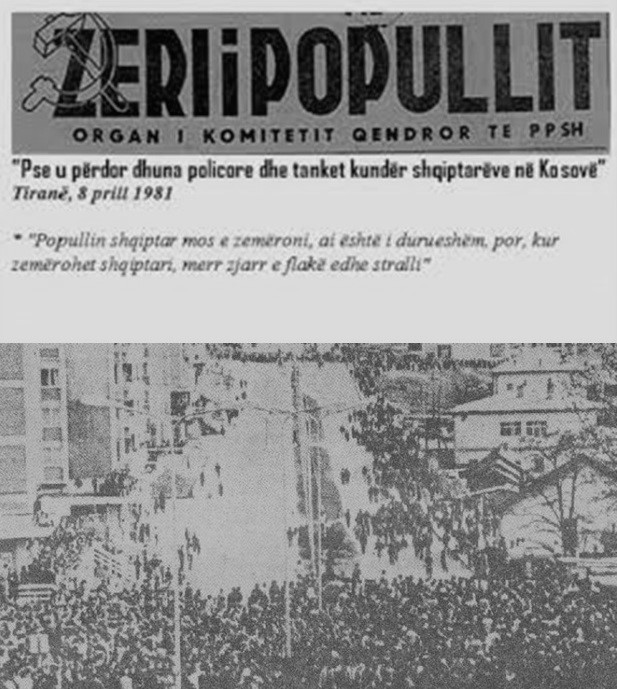
PROCESS-VERBAL (TRANSCRIPT) OF THE MEETING OF ENVER HOXHA WITH RAMIZ ALIA IN HIS OFFICE ON JUNE 4, 1981, REGARDING AN ARTICLE TO BE PUBLISHED IN “ZËRI I POPULLIT”, AGAINST THE ACCUSATIONS OF BELGRADE
CONVERSATION OF COMRADE ENVER HELD IN HIS OFFICE WITH COMRADE RAMIZ ALIA ON JUNE 4, 1981, REGARDING THE PREPARATION OF A THEORETICAL-HISTORICAL ARTICLE IN THE FORM OF HARSH POLEMICS AGAINST THE UNFOUNDED ATTACKS MADE BY THE FURIOUS CHAUVINISTS OF BELGRADE
COMRADE ENVER HOXHA: We must speak about the great and continuous struggle that Albanians have waged to secure their national independence. We should write polemically about the Albanian League of Prizren and about the great injustices done to the Albanian people, who committed these injustices, and that they were the result of the great intrigues of the Serb-Great-Power chauvinists and of the Serbo-Croato-Slovene Monarchy. At that time, furious nationalism and chauvinism were so extremely pronounced among them that great crimes were committed by them against the Albanian people in general and especially against the large part of the Albanian people that the Great Powers left within the borders of the Serbo-Croato-Slovene Kingdom.
Here we must raise the issue of Stojadinović and Ciano; we must highlight the theses of Čubrilović and their application for the complete annihilation of Albanians. That is, the notion of integral nationalism on the part of the Serb-Great-Power chauvinists aimed at liquidating the Albanians in Yugoslavia, who numbered in the millions – an action that resulted in mass killings against them.
We must say these things, because they are historical truths and did exist. Then we must highlight the mass displacements of hundreds of thousands of Albanians to Turkey and thousands of others who came to Albania, in agreement with the regime of that time, which financed King Zog’s Kingdom for this purpose.
So, the Albanians had great reasons to fight for the independence of their homeland and to oppose this exclusive, savage, and liquidationist nationalism of an entire people. We should throw these arguments at the Yugoslavs. Then came the Second World War, the Stojadinović-Ciano plot was realized, and “Greater Albania” was created, which the Party of Labour of Albania fought against, but which the Kosovars also fought against. The fact is that at first, the Kosovars did not trust the Yugoslavs, and they were right. They suspected that in the future, the Serbs, and whoever else among the other Slavic nationalities in Yugoslavia, would not grant them national rights.
And, the entry of Kosovo Albanians into the National Liberation War did happen, but it happened with a delay, and it was not only the actions of the Kosovar Ballists in the National Liberation War, but it was the more terrible war of the Chetniks in Montenegro, Serbia, and Croatia that hindered this. In the article, we should point out that the Albanians of Yugoslavia understood that Mussolini’s “Greater Albania” had to be won with blood, that it was not Mussolini’s Albania, but that Albania which ought to exist.
In these matters, we must go on the offensive, we must no longer remain in our previous positions, we must explain these things historically. And in fact, after all these savage nationalist and chauvinist stances of the Yugoslav-Great-Power chauvinists against the Albanian people living in Yugoslavia, in order to win the trust of this people, Tito gave the speech we have mentioned, and we should again show what he said at that time, while simultaneously pointing out that his promises were not kept.
Whereas Moshe Pijade took a more elastic, less radical stance than Tito when he declared that after the war, a republic of Kosovo should be created in Yugoslavia, but this too was not done. But why was even this not realized? It was not realized because Serb-Great-Power chauvinism acted, the goals affirmed in Jajce were changed, and revenge against Albanians was implemented, accusing them of being Ballists, and thus the Yugoslav-Great-Power chauvinists committed the first genocide against the Albanians of Yugoslavia. Here we must state what they killed and what they did not kill – which we know, but which we must fix in this document. This happened in 1945.
Then came the other genocide of Ranković in 1966, which is noted and written in my materials and must be taken up again now. What does this show? It shows that Serb-Great-Power and Yugoslav-Great-Power chauvinism and nationalism against Albanians in Yugoslavia has been terrible, to the point of reaching genocide. Hence, the desire for irredentism on their part arises naturally. This desire for irredentism was caused among them by the furious Serb-Great-Power and Yugoslav-Great-Power chauvinism and nationalism.
This terrible error committed in 1966 was seen, and Ranković’s gang was condemned, but he was not the only one who committed this genocide, which is currently being repeated by the same kind of people and with the same background. These inhuman acts of furious chauvinism and nationalism continued with the same virulence in their subsequent generations, who call themselves socialists and accuse Albanians of nationalism, chauvinism, and irredentism.
All the demands of the Albanians, which from the period of the League of Prizren until now have resulted in hundreds and thousands being killed, suppressed, and persecuted, are evident and necessary, because they have not been granted any right, except for the very limited right concerning educational matters that was given to them late, but even in this direction, a tendency for further restrictions is now being noticed, etc., etc.
From this, we must reach the conclusion that on the part of Albanians, there is not a trace of nationalism, or chauvinism, or irredentism, but irredentism takes this form, which has been caused by the integral nationalism and Serbian chauvinism, which has been and is condemnable. Therefore, Albanians are completely blameless in this matter, and, being in no way guilty, they are being suppressed and killed in a so-called socialist regime, which is nothing but a barbaric regime.
Albania, for its part, has demanded, continues, and will continue to demand until the end, that the rights that rightfully and constitutionally belong to our brothers in Yugoslavia be granted. In particular, we will say that the minimum the Kosovars have demanded is recognition of Kosovo’s status as a republic. Albania has defended this, and it could say even more and has the right to speak more, and here we must explain the essence, because we are not dealing with a purely minority issue.
For a small minority, when it is granted all democratic rights, etc., in the country where it lives, it can and should not become a problem. But, if this minority, even if small, is oppressed, then their brothers who have won freedom and independence and have created their own sovereign state have the duty to protect them. Whereas Albanians in Yugoslavia are not a minority; they number in the millions; they are a whole nation, almost as many as the People’s Socialist Republic of Albania itself.
In this direction, it seems to me we should launch an offensive, because the Yugoslav-Great-Power chauvinists have got us cornered, that is, they want to push us with our backs against the wall, with the intention that if we speak in defense of our brothers in Yugoslavia, they will call us irredentists, nationalists, chauvinists, and whatever else they like.
We must turn this attack to their disadvantage, explain what chauvinism and nationalism are, whether we have been or have not been chauvinists and nationalists, and argue this issue with facts, with our stances, and point out that they have been such. Likewise, we must argue with facts known worldwide about how the Yugoslav-Great-Power chauvinists have acted, and that it was precisely their barbaric stance that gave rise to irredentism among Albanians – an irredentism absolutely necessary for the defense of their very existence.
COMRADE RAMIZ ALIA: These stances of the Yugoslavs have exactly caused the reaction to demand rights on the part of the oppressed Albanian population, which has taken that form that you contemptuously call irredentism, but we do not see it that way, because it is a legitimate right.
COMRADE ENVER HOXHA: Because it is their right, because the Albanians living in Yugoslavia are our brothers; they are part of one nation. We have said this and we say it.
Nevertheless, it should be pointed out that we have wanted and desire friendship and good neighborly relations with Federal Yugoslavia, without interfering in its internal affairs. But when we see that all these bloody massacres are being committed there continuously and with marked intensity against the Albanian population living in that country, then this issue can be called whatever you want, but its name is what we call it.
It seems to me that this should be an important, theoretical, and historical article, in a harsh polemical form, so that the Yugoslavs, when they use the terms “chauvinism” and “nationalism,” will know clearly that they are saying it about themselves, that they know we do not call this nationalism and chauvinism in the theoretical sense of the word, but we call it that this is Albania, and that you have severed a part of this Albania. We ask you: why did you not hold a referendum in time for Kosovo to self-determine? We ask you: why do you not grant Kosovo the status of a republic, when it has been said that it should be granted it? This you call nationalism in us, but no, this is not nationalism, and this must be proved theoretically as well, that it is not nationalism.
COMRADE RAMIZ ALIA: It is good, and we should make this article, because it is of great importance.
COMRADE ENVER HOXHA: This seems to me to be of very great importance. In it, we should also raise the issue of why “Nini” [likely a nickname or reference to a Yugoslav figure], as he understands it, enumerates all the crimes committed against the Albanian people and finally ends his discourse with the thought that “what happened in the past happened, the Helsinki Accords closed the lid on it, they placed a statuette on it.” No, Helsinki did not in any way close the lid on this problem.
No unjust treaty signed by the imperialists can close the lid on such a great issue as half of an entire nation, which unjustly remains within the sphere of another state, when right next to it, very close, its motherland exists. In the article, we should also emphasize that these are not the reasons we did not participate in the Helsinki meeting, but since you accuse us of having not gone for this reason, we will give you the answer on this issue as well. / Memorie.al