Part two
Memorie.al / Today it is undeniable that the communist state led by Enver Hoxha had a highly important and potent Intelligence and Counterintelligence system. Also undeniable is the fact that very little has been said about the Albanian agents and espionage network, who operated shrouded in a mysterious fog inherent to this very profession. Everything was done in secrecy and perfectly camouflaged. The goal was clear: to inform the state about any possible activity directed against it. The Ministry of Internal Affairs and the Ministry of Defense, with their respective Intelligence sectors, had to work hard.
Continued from the previous issue
Two armed Albanian intelligence officers, by order of the Party’s Central Committee, set off towards Poland with a secret and simultaneously dangerous mission: bringing the leader of the Polish Marxist-Leninist Party, Kazhimir Mihalski, to Tirana. An important task for the Albanian leadership, but extremely dangerous for the two intelligence officers who, upon accepting this mission, had to put their lives in question. Everything had to be top secret. No one was to know that two men from Albania would sail on the steamer “Skënderbeu” towards Poland. Even the families of the intelligence officers were not to know their true whereabouts.
But who really was Kazhimir Mihalski and why was this man considered so important? What were the reasons that made Kazhimir an undesirable man for the Polish state? How was it possible that the Albanian state of that time took upon itself such a burden, seeking shelter for a man who was being pursued and faced the risk of prison in his own country? All of this in defense of communism and Marxist-Leninist ideals throughout Europe. If these ideals were strong, Albania would be strong as well. Political intelligence outside the country’s territory was a matter that had always interested the Albanian state.
A large number of intelligence officers operated all over the world to learn of any possible attack against Albania and any danger that might threaten the country from abroad. Secret and dangerous activities, disguised in various ways. When it came to such matters involving intelligence officers and agents, the Ministry of Internal Affairs and the Party Central Committee spared nothing, not even the lives of their employees. They were ready to buy informants and their top-secret information at any price. But the mission to Poland had a different character. There were no intelligence reports or informants there, but armed men who were risking their lives for a mission whose importance they never fully understood.
And these intelligence officers were prepared to fight anyone, just so that Kazhimir Mihalski would arrive alive in Albania. Jonuz Mersini, one of the intelligence officers who traveled illegally to Poland on the steamer “Skënderbeu”, recounts the vicissitudes of a special mission that was, in reality, not carried out as planned. Nevertheless, the Polish leader did manage to reach Albania. Through falsifications, the Albanian embassy in Warsaw itself managed to get the Marxist-Leninist leader out of his country’s borders. But who was the man for whom the Albanian state risked and spent so much? The story of a fraudulent leader, who badly disappointed the Albanian leadership…!
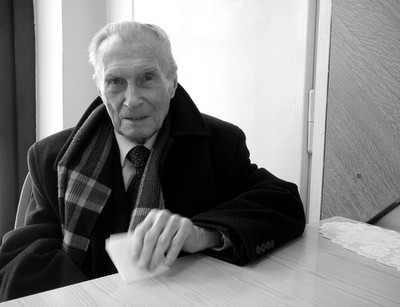
Mr. Mersini, your main duty during your work in intelligence was that of creating the agent network. But did you have any operational and dangerous missions for yourself during your career?
Of course. The very nature of this work carried risks, but there were special missions where you set out with a question mark over your life. Such was the mission to extract from Poland and bring to Tirana a certain Kazhmir Mihalski. He was a Pole who, as we were told, had created a Marxist-Leninist party in Poland. He had apparently worked in illegality and, apparently, his activity had caught the eye. He was at risk of being arrested by the Polish authorities. At that time I was serving as head of a branch in intelligence. I was summoned to the Party Central Committee together with Kleanth Andoni. Both of us had to depart for the large port of Gdansk in Poland.
What exactly was the order and how important was this mission considered?
The order was clear: Kazhimir had to be brought in good health, no matter what. If necessary, we were not to count our own lives. This mission was of great importance for the International Marxist-Leninist Movement. There, we prepared ourselves mentally, as well as for armed readiness. Anything was possible.
Did you tell your families that you were leaving on a dangerous mission?
In my family and in Kleanth Andoni’s, we had left word that we would be leaving for a few days on an important duty in the border areas of our country. It was common for us intelligence officers to move frequently to the border areas to inspect and check the situation there, so this raised no suspicion in our families.
How reliable was the colleague they chose for you?
Kleanthi and I had been close friends from early on. Together we had taken part in countless operations. A boy from Vunoi, he inherited the best virtues: brave, but also simple, calm in actions, and very far-sighted. With Kleanthi, I maintained pure fraternal relations. Even later, when we started families, we did not stay far from one another. Even if they had asked me, I would not have named anyone other than Kleanthi. We went to Durrës, where we met with the captain of our steamer, “Skënderbeu”, Fore Kureta.
Was the captain aware of the operation?
Yes. He had been informed about everything and was waiting for us. We both disguised ourselves as sailors. We would be part of the crew of this steamer. The captain introduced us to the ship’s crew, telling the sailors that we were on the steamer with a special mission. The sailors had to keep this secret, and whoever asked them about us had to say we were new members of the steamer’s crew.
Was there a risk of being exposed by the sailors?
They didn’t know anything about our mission or who we really were, so the possibility of exposure was small.
You mentioned earlier that you were prepared for an armed engagement. Did you have weapons with you?
Of course. We had brought two Kalashnikov automatic rifles, the necessary ammunition for them, and four offensive hand grenades, which we would only use if unexpected and extremely difficult situations arose.
What was considered a difficult situation?
The first and most important thing in that mission was for Kazhimir to arrive alive in our country. Ultimately, even if the Polish authorities caught on that we had illegally taken Kazhimir on board, we had to protect him and bring him to Albania. Secondly, self-defense in case of an armed attack was also considered a difficult situation. On the way, while sailing in the Mediterranean, we talked to the captain of the steamer to find a secret place on board. Fore Kureta, an experienced cadre, felt uncomfortable when he heard our request.
– “Damn it!”
– “What’s the damn problem here?” – I replied to him in private. He slammed his fist on the cabin table. He got to his feet. He paced back and forth a few times, turned abruptly, and without lowering his tone, continued:
– “Now everything is messed up here. You by profession may indeed be devils. But what about me? You see what you’ve done to me?…”
– “Take it easy,” Kleanthi tried to calm him down. “You were informed from the start, you voluntarily accepted that we…!”
– “No. There are international laws, there are minute inspections. Do you understand what could happen? You are intelligence officers, now you’ve become sailors. That’s enough. Huh, but you are armed for war. No, no brothers. My steamer deals with trade, carries goods back and forth, not weapons on the ship.” He fell silent only after feeling tired. He showed us one idea, two, three. The secret hiding place had to allow a person to sit. In the end, we found common ground. The three of us chose a spot under some stairs. It was a suitable corner that was not frequented, except on special occasions. No one would suspect it.
What was that hiding place for?
We thought that Kazhimir would stay there during the return journey.
How was the voyage?
In the Adriatic and Mediterranean seas, the navigation was normal, except in the Strait of Sicily, where there were waves and rocking of the steamer until we reached the Atlantic Ocean. There, the steamer began to roll heavily. It was a small-tonnage steamer, built in Bulgaria, not for ocean voyages. We entered the Bay of Biscay, where the Atlantic Ocean is about 9,000 meters deep. A great storm began. The steamer was cracking all over from the rocking. We notified Durrës via radio. To avoid the risk of sinking, they ordered us to take shelter on one of the Spanish coasts until the storm passed. But our captain refused. Upon entering the English Channel, the voyage continued calmly.
Did you have any port stops and inspections?
At the entrance to the Kiel Canal, the Germans conducted an inspection of the steamer and its cargo. Our captain knew this, so before we reached the Canal, he told us to place the weapons in his cabin, since, according to an international rule, the captain’s cabin on a steamer was not inspected. When we learned that such a law existed, we calmed down. We left the weapons there even during our stay in the port of Gdansk.
How many days did you stay in that city?
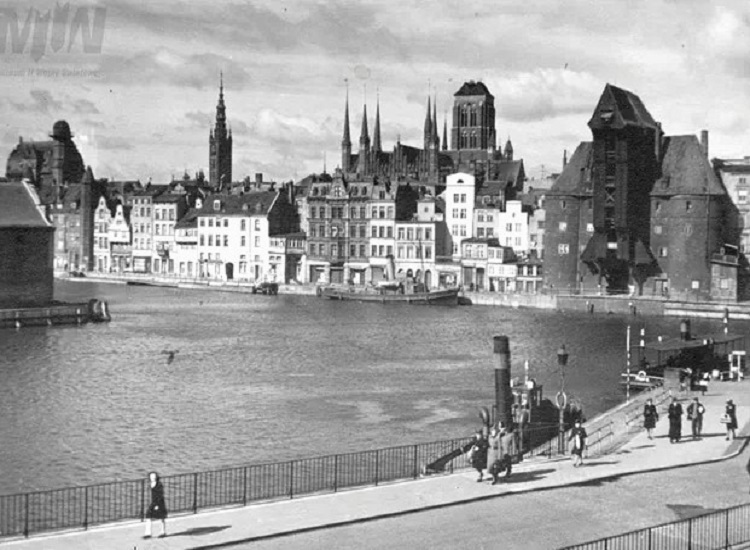
In Gdansk, we stayed about 15 days, as long as it took for the steamer to unload and load cargo. It was a harsh winter and it was very cold. The port of Gdansk and the city with that name were covered in snow. About 4-5 times late in the evening, I and Kleanthi, along with some other sailors, would go out into the city of Gdansk to study the situation and test whether we would have any obstacles in picking up Kazhimir, when his comrades would bring him from Warsaw.
Was entering and leaving the port free, as you wished?
At the entrance/exit gate, there was a guard stationed in a hut who carried out checks. But whenever we wanted to go out to the city, we would give him a bottle of “Skënderbeu” cognac. He seemed delighted and would allow us to pass in a group, without making any checks, as we were 7-8 people.
Meanwhile, how did you get information about Kazhimir?
We contacted Tirana, and from there we received every instruction for further activity. It was the Intelligence Directorate, and even the Central Committee itself, that had direct connections with Kazhimir and his people. But on the 10th day of our stay in the port, we received a radiogram. We were informed not to wait any longer, because the person we were to take had now arrived in Tirana.
How was that possible?
It was simple. He had followed a different itinerary, so there was nothing left for us but to wait for the steamer and return home. However, on the way back, when we entered the Mediterranean, the steamer received an order to turn to Algeria. There, they would load some iron beds. Disguised as sailors, we both also went out into the city of Algiers for a walk. We told the guard in English that we were Albanians, but he took it for Germans (because of the similar sound) and let us pass without any control.
How many days did you stay in Algeria?
We stayed there no more than 2-3 days, but we found ourselves in a difficult position when we learned that our ambassador in Algeria, Musin Kroi, would come to the steamer for a visit along with his wife. He knew both me and Kleanthi, so since we were illegally on the ship, we both dressed in overalls and went down to the engine room. We stayed there until the two of them left.
And about Kazhimir, the man for whom you had to go through these vicissitudes, did you find out anything more, besides the fact that he had arrived in Albania?
When we came to Tirana, I learned that our embassy in Warsaw had secured a fake passport with which Kazhimir had traveled from Warsaw to Berlin and then to Tirana. Kazhimir was safe and sound. The International Marxist-Leninist Movement should have been in equally good health, as it was very concerned about Kazhimir’s condition, although later, as it turned out, he was like all the swindling speculators who flourished under the name of popular ideals. Nevertheless, nothing else concerned us, and we couldn’t learn more. Our mission ended there…! / Memorie.al