By DASHNOR KALOÇI
Part One
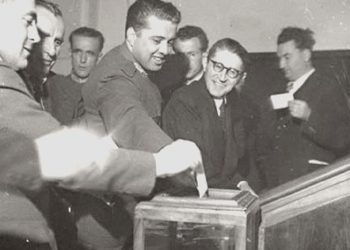
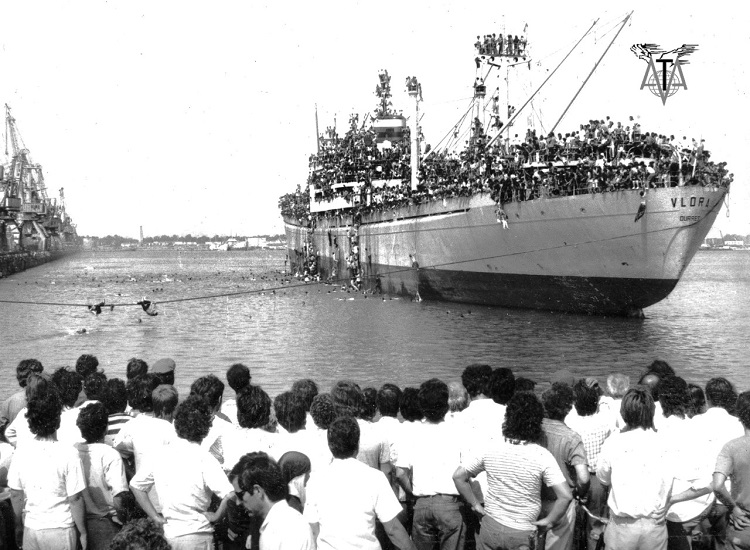
Memorie.al / When not even three months had passed since the declaration of political pluralism in Albania, and the country was on the eve of the first pluralist elections to be held after nearly 45 years of rule under the communist regime led by Enver Hoxha and his successor Ramiz Alia, on March 6, 1991, the Politburo of the Central Committee of the Party of Labour of Albania, led by General Secretary Ramiz Alia, held a lengthy meeting. During this meeting, several key events that had occurred in the country over the previous year were analyzed. Beginning with the events in Shkodër in January 1990 concerning the removal of Stalin’s bust, followed by those in Kavajë, the July 2nd events in which around 6,000 people entered foreign embassies in Tirana, the massive August exodus in which thousands of Albanian citizens seized ships in the country’s main ports and departed for Italian shores, the student youth protests in “Student City” in December, which led to the declaration of political pluralism, the mass departures of Albanians from the country across the northwestern and southeastern borders towards Yugoslavia and Greece, the toppling of Enver Hoxha’s monument on February 20, 1991, and up to the preparation for the first pluralist elections to be held on March 31, 1991.
Concerning these and other matters, this archival document, extracted from the Central State Archive (the former Central Committee of the PPA), bearing the classification “Secret” but long since declassified, contains the minutes of the Politburo meeting. Alongside Ramiz Alia’s speech, it includes all the discussions of the “comrades of the Politburo” and the secretaries of the Central Committee of the PPA. Besides the extremely detailed annual analysis of the events mentioned above, the meeting also devoted special importance and attention to the parliamentary elections scheduled for March 31, covering everything from the selection of the Assembly’s presidium and the deputies who would constitute the parliamentary commissions, to the opening of the Assembly on the first day by the oldest deputy, etc.
Likewise, during that meeting, both Ramiz Alia and all the members of the Politburo or ministers of the cabinet led by Prime Minister Adil Çarçani, discussed the main leaders of the Democratic Party, including Sali Berisha, Azem Hajdari, Aleksandër Meksi, Genc Ruli, etc. For more details on this and other matters, the document in question, published for the first time with its corresponding facsimiles by Memorie.al, informs us.
ARCHIVAL DOCUMENT WITH THE MINUTES OF THE POLITBURO MEETING OF THE CENTRAL COMMITTEE OF THE PPA, MARCH 6, 1991
THE PARTY OF LABOUR OF ALBANIA Secret
CENTRAL COMMITTEE
– General Sector –
MINUTES
OF THE MEETING OF THE POLITBURO OF THE CC OF THE PARTY
March 6, 1991, 5:00 PM
The Politburo of the Central Committee of the PPA, at its meeting of March 6, 1991, discussed the events of recent days and the Letter to be delivered to the Party’s base organizations. The meeting is chaired by Comrade Ramiz Alia, First Secretary of the Central Committee of the Party of Labour of Albania.
Participants are the members and candidate members of the Politburo, comrades: Adil Çarçani, Besnik Bekteshi, Hekuran Isai, Pali Miska, Vangjel Çërava, Xhelil Gjoni, Llambi Gegprifti, Niko Gjyzari, Xhemal Dymylja, as well as the secretaries of the Party’s Central Committee, comrades: Spiro Dede and Abdyl Backa. Comrade Kiço Mustaqi is absent for valid reasons.
PROCEEDINGS OF THE MEETING
COMRADE RAMIZ ALIA: We are holding this meeting of the Politburo to discuss the events of recent times, although we have exchanged views on them, more or less, every day, as well as to discuss their prospects. We have an extraordinarily large lack of information, so we must figure everything out by reasoning, because even when something happens, we don’t know who does it. For example, no one knows who instigated the mass departure of the residents of Vraka in the Shkodër district. Theoretically, it is known and true that the Yugoslavs instigated it, but practically, no one knows through whom the Yugoslavs did this, not even the Security organs, the authorities, or the Party in the district. And it is not just the issue of Vraka, but this whole situation that has been created.
It seems to me that the Party’s activity is currently at an extremely delicate point, first and foremost under heavy psychological blows, because the enemies have attacked it regarding its path so far, assigning it responsibilities and faults it does not have, or exaggerating faults or responsibilities that did actually occur, because a 50-year-old party, throughout its entire path, cannot have avoided actions which, viewed retrospectively, might not have been taken, could have been resolved differently, or other paths could have been found. Such things exist in the economic field, as well as in the political and cultural spheres.
This attack by the enemies on the Party coincides with the severe economic situation in which we find ourselves today, which I do not link only to the Party’s past policy – undoubtedly it has a connection to it – but it is at the same time also the result of great external pressure, of the complete blockade imposed on us by Western and Eastern reaction, just as it is the result of a psychology of expectation created in our country, which is a sickness of all Eastern countries: “Let us stay, let us wait, because the world will give us aid.”
And the opposition has inflated this to the maximum. But we, on our part, by speaking of economic agreements with this or that country or firm, of the representatives of the International Monetary Fund who came here and other things, it seems as if dollars will inevitably flow in, goods will be plentiful, therefore; “Oh men, put your spoon in your belt, because you have nothing else to do but eat.” This has created a great demobilization among people, which has swept through city and village, to the point that we are at the beginning of March and there are no leeks in the market, let alone garlic or other things.
In this difficult economic situation, we also have a large number of unemployed, estimated at around 30,000 people, along with another 40,000 or so who are paid without working due to a lack of raw materials. So, within the framework of the total workforce, we can say without exaggeration that unemployment reaches about 15 percent, not a small figure. We have been afraid to speak in these terms, and it seems to me that here we have made our biggest mistake, because we have coddled ourselves and reality, just as we have spoken about inflation with half-fear or half-voice, when the reality is that there is inflation: money is in circulation, but goods are not, and we are not in a position to calculate where and how much this inflation is, which surely must be around the 20 percent mark.
There is no doubt that the opposition exploits this complex of situations to criticize the Party of Labour. The party in power always gives account, always submits to criticism. That is the law. We, in our tradition and our path, have undertaken to do everything ourselves, from building houses to securing milk, bread, eggs, and other things, meaning we ourselves bear every kind of shortage, every kind of difficulty that exists in the country.
The general framework of the situation created among us, more or less, is this: there is confusion in the Party? Faced with great pressures, we cannot say that it directs all the operations we have undertaken, that struggle we have tried to wage to heal the economy, to stabilize the economic situation, in order to win the masses over to ourselves and move them forward in implementing the great tasks the Party has set forth, both for the democratization of life and for its economic and cultural development.
The Party is not at the forefront of this action; in fact, I could say that at this time it is not only confused but also in passivity. At one of the Central Committee plenums, we said that the work of the Party organs should be separated from the work of the state organs, and the latter should take full responsibility for their activity. Everyone agreed that such a thing should be done. But what happened in practice? A void was created, which the organs of power could not fill because they did not adapt to the new situations, from a functional point of view either.
Let me take agriculture. The summer potato and sunflower were not planted on time. Two years ago, the secretary of the district Party committee would immediately gather the secretaries of the Party organizations of the agricultural cooperatives, even the chairmen, and tell them: “Comrades, let the Party be gathered and, led by the communists, they must finish the planting within the specified deadline.” In short, all communists would gather, the secretaries, the bureaus, the cooperative chairmen would take the lead, and all together they would fulfill the task. So, the Party carried out great economic activity. Now the Party no longer does this work. This is because, firstly, the Party secretaries find it more convenient, more comfortable; and secondly, because we ourselves told them not to get involved in this work.
What does the Party organization in the village deal with? For myself, I still do not have a clear idea of what remains for it, what contribution it makes to the economy. So, the Party did not rebuild or reorganize its work in accordance with the new demands we set. On its part, the authorities, with the sections and heads of the executive committees, remained as they were. They should now think, reflect, plan, conduct economic policy and other things, but in fact they are not doing it.
This also relates to another important fact: power has now taken on a very great role and function, but the most qualified cadres – I am speaking of various specialties – we have on the Party side. The most capable agricultural specialists, for instance, are often found in the Party committees and more rarely in the executive committees, which is not normal when the Party committees should have specialists in Party work, good agitators and propagandists.
This void created between the Party and the authorities has gone from the lowest organs up to the Government. Our political bodies, such as the Ministry of Internal Affairs, the Ministry of Defense, and others, now have little contact with the district Party committees and often find themselves facing difficult situations. When something happens, the police or State Security organs say, “We have nothing to do with it, the Party must work.” The Party, for its part, says, “We do not have this duty, it’s the police’s job.” And we encounter such phenomena almost every day.
For instance, some people have taken to the streets wanting to enter embassies. Only the police confront them. No communists or others come out to oppose these elements that are disturbing the peace, because there are two sides acting each on their own account. Someone might say, why should the Party come out? If it is not the Party’s duty to come out, at least let it close the door to them, because the doors of apartments have been opened to these elements. At this time, everyone has taken cover in the houses of neighborhoods and waits for darkness to come out and begin their hooligan actions.
So, there is no coordination in this situation. This undoubtedly not only does not influence the Party positively in moral terms, but it also discourages the communist. At the same time, he begins to be critical towards the organs of power: “The police are not capable of doing anything. Why doesn’t the authority do its duty? Why don’t the organs that are charged do their duty? Where is our army? Where are our police?” Communists are constantly asking these questions.
In this situation, the first task that arises before the Party is to stand up, for communists to take responsibility for the country’s development, especially for political mobilization, for the fight against elements who want to destroy the country. The opposition created in our country is a political opposition that does not seek the construction of Albania in the sense that we do much less its construction as a socialist one; it is an anti-socialist opposition, it is for the capitalist development of Albania, even without the communists.
In short, it seeks to exclude communists from leadership, to disarm them, to cast them into opposition, to make them guilty for what has been done until today, not to say to eliminate them, in the bad sense of the word. It is showing this openly, through all its actions. If many of our comrades have not understood this that is the gravest mistake. Our people still think that these are our friends. The word “friend” might have applied some time ago, but today it does not apply to them. You may address them with the word “friend,” but they are not our friends; they have other aims and goals that conflict with ours.
The activity of the opposition forces, regardless of the nuances among them, has shaken the peace of communists and the people. Some of their actions, especially in some areas, have provoked fear, which has spread like cholera throughout Albania. I cannot say that the pressure of these forces on our comrades, on cadres, and communists has passed and passes without being felt. On the contrary, the pressure of these parties on our comrades has left its mark, neutralizing some, causing others to withdraw, and still others to soften their struggle, in order to create for themselves an image of being supposedly democratic. This cannot but lower the combative spirit of the communists. It is a fact, as we have seen in the press, that words circulate: “Let us wait and see how the March 31 elections end, then we will turn the page.”
Here we are speaking mainly about people from the intelligentsia, who still has not taken a definite position. Even today, the newspaper Zëri i Popullit emphasized in one of its articles¹ that at these moments many intellectuals have not taken a clear stance: for the left or the right, with our Party or not, but wait to see who will win, to side with them. (This refers to the article “Withdrawal, Reflection or Retreat?”, written by Xhezair Abazi). There are also many cadres from among our own who seek to appear supposedly correct, proper, to keep the side of both parties, or to court the opposition people, so that their image is that of democrats.
The Party is in a situation that makes us reflect, because this confusion in its ranks has led to its demobilization. To raise it on its feet today, we must necessarily act in an extremely energetic manner, because as it is now, it cannot move easily. We have decided to go to the Party Congress, but with the actions being taken, not only are we not doing it a service, but we are creating conditions for it to be an event without any weight in the Party’s life. Why?
A congress that would shake the Party means to elaborate a political, ideological, and organizational program appropriate to the tasks of the time. In fact, we have made an electoral program that is quite advanced, but the Party’s organizational structure and its cadres are extremely backward in comparison to this program. The Party’s propaganda and its slogans are far behind, or we could say they are stuck to old schemes that do not suit this program.
We have elaborated a draft constitution, which in all aspects is very progressive, regardless of the remarks made: whether this or that point should or should not be like this, and other things. In its general line, in the most fundamental issues, such as human rights, the stance on property, and others, it is extremely progressive, whereas our practical actions are extremely archaic. So in this direction, there is a paradox, because on the one hand the electoral program and the draft constitution, and on the other hand the Party’s activity, are in contradiction with each other.
In the Party, two concepts coexist: first, there is the concept that tries to adapt to the new situations and conditions and to give the Party arguments to cope with this situation, so that our Party is not a conservative party, an archaic party in ideology and politics; and second, the aspect that we are realistically still where we have been. This contradiction, it seems to me, is one of the causes that hinders us from moving forward and demobilizes our cadres. It is noticeable that for everything that happens, no Party cadre has the courage to go and take contact with the masses. Comrade Vangjel Çërava openly says that no one listens to him anymore. And no one listens to Xhemal Dymylja either.
In Vraka, he himself did not go, but sent Xhemal Selimi and Andro Jovani, because he knew that no one listens to him. Why don’t they listen to him? Because the arguments we have are such that they do not convince the masses. After the toppling of Comrade Enver’s monument, I met in Tirana with representatives of the people from all over Albania. The people of Vlorë were among the most ardent: “They should have walked over you first, and then gone to the monument,” they said. “What is this being done? This is treason!”
You would say these comrades are not only determined but also capable organizers! But what is happening to us in Vlorë? About 2-3 thousand people seized ships and fled to Italy. People gather in front of the Party Committee, and the first secretary does not have the courage to come out before the crowd and speak to them. The fact is he cannot come out. I was told that today Azem Hajdari went to speak to them, because they too are concerned, as their voters are leaving them. The opposition goes everywhere, because it is ready to agree with them. “You are right to leave,” it tells them. Whereas our man cannot tell them they are right; he must convince them that what they are doing is not right. / Memorie.al