


By Lefter Çipa
Part Two
Memorie.al / I had come to know Professor Dhimitër Shuteriqi without ever having met him in person, through his writings and studies – works he carried out and published from time to time in various publications and organs, especially in the weekly newspaper “Drita,” the organ of the League of Writers and Artists. I was drawn to the articles he published on Albanian folklore in particular – the folklore of the South, of Toskëria and of Greater Labëria – where his wisdom and knowledge illuminated my eager and passionate soul for the folklore of my homelands, especially for the song and dance of the Labëria-Himara region. It is difficult to judge someone unknown and never met, without even having had the chance to shake their hand in greeting. Yet in my soul, Dhimitër Shuteriqi had built the nest of my admiration. Truly, I dreamed of meeting him and becoming his friend…!
Continued from the previous issue
I concentrated in conscious silence on the words of this personality of our letters. His complete culture, his encyclopedic wealth of knowledge, distinguished him from others, even from the very plasticity of his face. With his encyclopedic knowledge, he not only made others wise, but also made his interlocutors knowledgeable.
After I argued that the text of our song was original from Pilur, with an identified author from Pilur, he was convinced and rose to his feet, also gaining the approval of Dritëroi and Petro Marko, and embraced me with a thump on the back, turning to the others and pointing at me: “Son, bravo to you for this talent and this illumination from a song-poet!”
As soon as Shuteriqi finished speaking, Dritëroi did not hesitate to tell me: “Hey Lefter, you are surprising us with these historical and folkloric accuracies, with values that are valuable not only to Professor Shuteriqi, whom we consider the dean of national literature, but also to the rest of us who could not have known them. Am I right, Petro?! Do you agree with me about what Lefter told us and confirmed for us tonight?! I want him to clarify once more for me the author of the versification of the song about Abdyl Frashëri?”
They followed my account with maximum attention about the young man from Pilur, who had recounted several historical events – from the League of Prizren, to the Battle of Lëkurësi, the Treaty of Corfu, and onward, to the other political upheavals in the Balkans. He had been an emigrant for 15 years in France. He was born in 1854, unmarried, a singer of the first recordings in Chicago, America.
He was the versifier of several songs about the Battle of Lëkurësi, a fervent supporter of Independence and of the great Ismail Qemali, until 1918, when he died in Lyon, France, unmarried, along with his brother. The versifier from Pilur was called Kostandin Gjikëdhima, and his brother Stefan Gjikëdhima. He left behind a large number of songs and very intelligent verses with surprising poetic figures and style. Professor Shuteriqi called him an artist with a strong sense of Albanianism. This was my first acquaintance with Professor Shuteriqi.
The dream of my friendship with him was later fulfilled. His interest in the national treasures of folklore, his patriotic feeling, always gave one the taste of the Renaissance man. He belonged to everyone and everyone belonged to him. He always carried the curiosity of a scholar of language and culture. He was a scholar with radiant knowledge. In the years 1971–76, there was a time when I had the opportunity to speak often with Shuteriqi and Agolli and to benefit greatly.
Both of these personalities gave me the visible value of an artist in the national space. They were unattainable in their kindness of spirit toward me. Shuteriqi would from time to time ask me about the creators of the Coast (Bregu), about their patriotic traces, about songs and dances, about men’s and women’s clothing, about deaths and weddings. He loved and valued the Coast especially for its history, for the Olympic stances it had held and for its resistance with particular bravery especially against the Ottoman Empire.
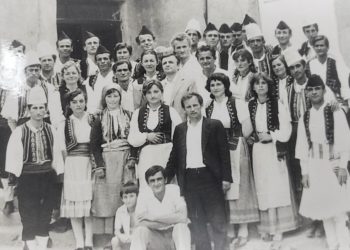
In 1973, when the Pilur Group at the National Folk Festival in Gjirokastër was laureated as a winner, I had another moment and story of acquaintance and friendship. Moreover, the Group in the field of national song was presented and valued for its surprising artistic contributions with my famous song “Tundu Bejkë e bardhë tundu” (Shake, White Bejke, and Shake). Professor Shuteriqi was interested in having a meeting with me as the author of the song, but also as the artistic director.
The singing style I had discovered, the musicality, the stylistic variant, and especially the maturity of the poetic text, the lyrical-erotic theme, as well as the inclusion of instruments for the first time in Albanian polyphony, had aroused the interest of the scientific scholar. This request and the kindness of Professor Shuteriqi were realized at the concert of the “May Decades” in 1974, after the Pilur Group had been invited by the Theater of Opera and Ballet to officially greet the closing of the May Concerts.
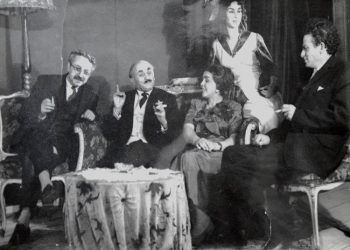
I had written and prepared the song “Në të marrsha moj manushaqe” (If I Could Take You, My Violet). The performance was carried out satisfactorily. After the concert ended in the Opera hall, Professor Shuteriqi, Dritëroi, and the Deputy Minister of Culture, the writer from the Coast Anastas Kondo, were waiting for us with a smile. Among them was also my warm friend of many years, the editor-in-chief of the newspaper “Drita,” Zija Çela. All together. Anastas Kondo spoke in his baritone voice: “Who took first place, Lefter?” The love and warmth of the Coast were felt.
Shuteriqi and Dritëroi answered with one voice: “Pilur”! A phosphorescent laugh burst out. Meanwhile, other artists coming out of the hall and the concert stage congratulated us. We embraced and greeted one another. At one moment, Professor Shuteriqi, with a crystalline sparkle, tells me: “I believe that an opportunity should be created for us to meet and converse tomorrow at the League, at whatever time is convenient for you.”
Dritëroi heard and intervened: “Hey Lefter, come, because this meeting with Professor Shuteriqi will turn out well for us, since such a meeting with the Pilur Group is valuable, because there is interest in the people’s treasures. Because you have appeared at the right time for this issue.” Dritëroi added at the same time: “I think around 4 o’clock, in the afternoon, we will be waiting for you at the League.” And so it was. The next day, on the beautiful May afternoon of flowers and the blood of martyrs, a folklore afternoon was going well at the League.
As we were walking toward the League building, at the intersection, Shuteriqi himself had come out of the building, his hair visible. In the League hall stood out the bust of Naim Frashëri. The phosphorescent song of Pilur was addressed to him: “Three brothers, men of the nation.” At one moment, Dritëroi, throwing his arm around Shuteriqi, said: “Here you are, this is Naim Frashëri, the great one of our soul. That is why he knew how to speak beautifully.”
The conversation at that meeting began with a free enthusiasm. Professor Shuteriqi took the floor with his well-known elegance. “Lefter,” he says to me, “I want you to clarify clearly and cleanly for me, who created ‘Vajza e valëve’ (The Daughter of the Waves) and in what years this accomplished legend was created. It is the work of a perfect poet and realized in the character of its singing. Is its fable alive or created by the author?
This is a song with a universal value, not only for the Albanian treasure, but also within European treasures. It is fantastic.” Taking a breath, Professor Shuteriqi continued: “Dear Lefter, I would like to express to you at once and afterward the right to your source explanations. I hope they will be satisfactory and sufficient from your accurate knowledge and understanding.”
And he continued: “I want to know who created the hymn of Himara, and in what time? And who is the author of this popular creation, autochthonous, regional, and with the utmost historical truth? This gives us light from the great Himara, from the Himara of the principalities. As for the third question, it concerns you directly: ‘Tundu Bejkë e Bardhë tundu’! A lyrical symphony. Before you break them down for me, I would like, together with all the members of this audience, to hear them sung.
We want them from this marvelous group, with these rare voices harmonized perfectly in a high artistic quality.” As the singer Katina Mërkuri began the song, Shuteriqi and Dritëroi exchanged glances. After the group performed the three songs that Professor Shuteriqi preferred, applause finalized the atmosphere at the League.
After the applause, the Professor awaited my explanations for the three questions that concerned three famous songs: “Vajzë e valëve” (Daughter of the Waves), “Kush është lule vilajeti” (Who is the Flower of the Vilayet), and “Bejkë e Bardhë” (White Bejke). The Professor followed me with attention and special interest. In my personal memory, the diary of my friendship with Professor Shuteriqi is very precious, as it is linked to a personality very devoted to folk literature, Albanian polyphony, especially that of the Coast, and to my creations.
In the continuation of my creative work, Professor Shuteriqi followed me with benevolent care. Year after year, he created opportunities for us to meet and converse. In 1974, while I and my Pilur Group were in Tirana with the song “Nga kjo baltë e kësaj toke” (From This Mud, From This Soil), Professor Shuteriqi was the first in official analyses to lead the open and public evaluations for the Group and our creative work.
He became the special encourager, together with Dritëroi, for me to complete my courage, from a provincial creator, and not to cease in my daring to become an artist of national reputation. His emancipatory voice and work had a great impact on our homeland for several decades. Professor Shuteriqi did not make the mistake of confusing hemp with honey. His favorite expression was: “If you do not want the stone of your father, you have forgotten the fire of your Mother.”
I dictated and confirmed this philosophy of his in the continuation of my years of creative work. His reflection upon others was penetrating and extremely powerful. I cannot fail to mention the other instances of his kindness toward my person, toward my creations in the years from 1975 to 1990. Often Professor Shuteriqi, in the annual analyses of the League of Writers, declared that my creations and the contributions of the Pilur Group are precious treasures in national culture.
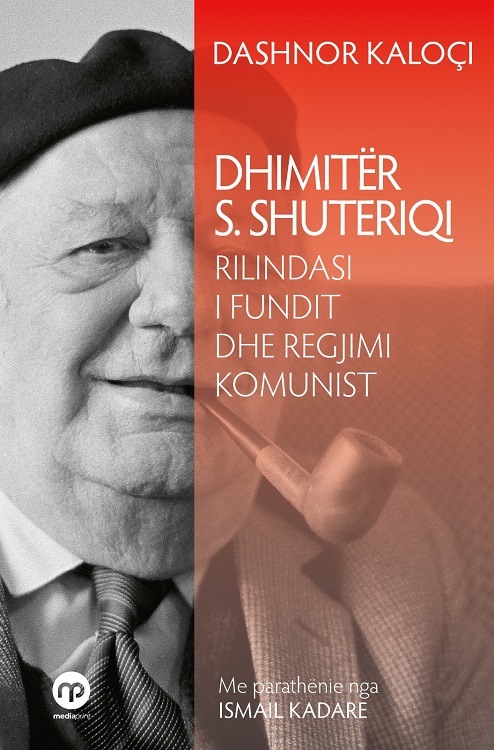
Professor Shuteriqi remains a distinguished personality of Albanian letters, knowledgeable in the history of literature and of philological studies. He is a leafy tree with a crown. I thank the author of the book, Mr. Kaloçi, for the opportunity he gave me to express the truths of my soul at this age of my eighties, for a learned friend who enlightened us and left us knowledge for the future as well. / Memorie.al