

From Faslli Haliti
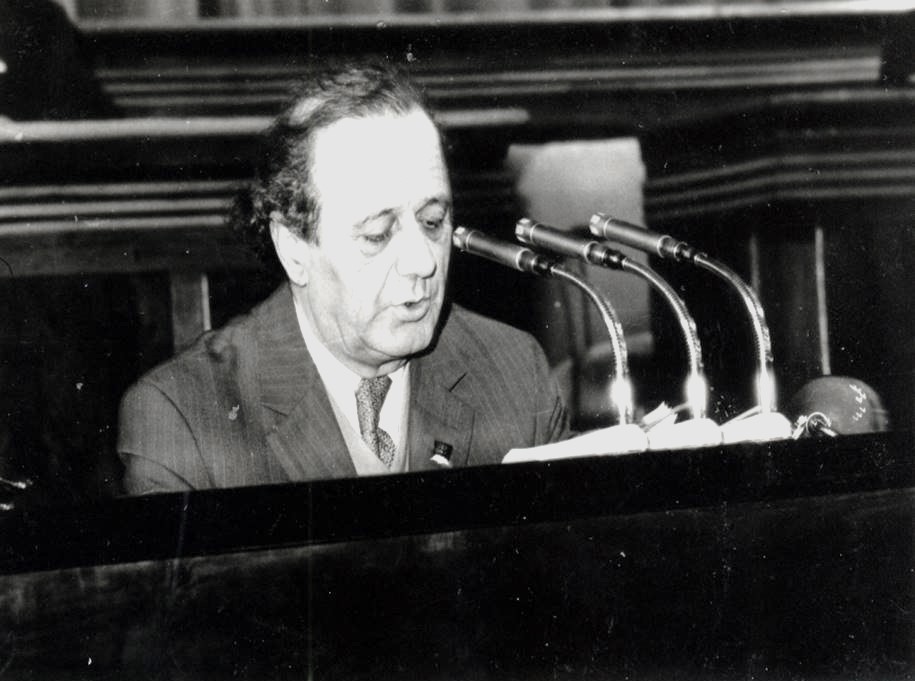
Memorie.al / I knew Dhimitër Shuteriqi through his writings in prose and poetry, as well as from his sketches and croquis drawn with a rapidograph, but for the first time I saw him up close in 1953, in a conversation with the students of the Artistic Lyceum “Jordan Misja” in the large hall of the cafeteria. The hall was packed with students studying music, painting, acting, and their respective pedagogues. There I saw for the first time the famous soprano Marie Kraja, the well-known sculptor Kristina Hoshi (Koljaka), the sculptor Janaq Paço, the famous actor Kadri Rroshi..! I listened attentively to the writer Dhimitër Shuteriqi, who spoke to us from the stage of the cafeteria hall, adapted especially for such events.
Next to me was Bujar Elmazi, who had read the professor’s poems and stories, since he himself also wrote poetry. “How simply and clearly he speaks with us students,” said my friend, “and he does this intentionally so that we students follow and understand his lecture as best as possible.” – “A true intellectual who has all the credentials of a great intellectual,” my friend next to me tells me. – “There is no reason for us to envy the intellectuals who come to us from the world and speak to us here and we listen to them, as if they had descended from heaven!”
I listened to my friend and I liked that he valued our polyhedral writer so highly, so I listened with great attention. But when Prof. Dhimitër Shuteriqi began to speak about his drawings and about the genius painters, Leonardo da Vinci, Michelangelo, Titian, Tintoretto, Repin, Surikov, Shishkin, Klimashin, whose works he had seen in the original at the Louvre, at the ‘Tretyakov Gallery’, I was left open-mouthed and was no longer listening to my friend. I wanted nothing to escape me without hearing from the word of the distinguished polyhedral writer and intellectual.
Later, in 1972, I would meet with the chairman of the League of Writers and Artists of Albania, Dhimitër Shuteriqi, in his office. He had summoned us for a conversation about poetry. We were a small group from different cities of the country. After each spoke about the state of poetry in the literary circles they were part of, among other things Shuteriqi said: “Poetry should be read with attention and not as if reading the newspaper, because it is a synthesis of life, of thought, philosophy, and world history. Poetry should not be read as if you are reading the daily newspaper.” –
“Why the newspaper shouldn’t be read with attention, but skimmed through,” said one of our friends at once, a military poet. – “Even the newspaper, Comrade Chairman, like poetry, should be read, perhaps even more attentively than it!” The Chairman did not prolong it. He was prudent. He saw that he was misunderstood. It had been politicized. After a short silence, a conversation continued. In truth, the military poet politicized the conversation, which is why the professor chose silence. To tell the truth, I got angry with the military poet.
He wanted to show himself as a party man, zealous before the chairman of the League of Writers, and as a commander among fellow poets, as if he wanted to line them up and turn them into a poetic stanza. My admiration increased for the professor, the writer, the great sage. I valued him more as a creator, intellectual, but also as a man. Paraphrasing Gorky’s words, I said to myself: “Yes, Dhimitër Shuteriqi is the most human man in the world.”
I am not the man and creator who has had many meetings with Dhimitër Shuteriqi; on the contrary, but those meetings I have had with him have remained in my head. Around 1965 or ’67, Dhimitër Shuteriqi happened to stop in Lushnja, as he was going elsewhere. He stopped to drink a coffee together with his wife, Myneverin. Meanwhile, he asked to meet me, as he had the habit that wherever he went, he would meet the creators who caught his eye.
And I met him excitedly at the café “Myzeqeja”. As we greeted each other, he told me that he had liked a cycle of mine published two Sundays earlier in the newspaper “Drita,” about the Myzeqeja field, and he began to say encouraging words to me about the cycle in general and especially about the poem for the field.
Then he delved into the origin of the word Myzeqe from the Muzakët…! Joyfully, I too spoke with enthusiasm to our chairman about a poetic cycle of his, published in the newspaper “Drita.” I told him that the cycle seemed dynamic and youthful to me, almost like the cycle of a young man. “Well, Dhimitri is young,” said Myneveri, as if in surprise, without which one could not imagine Dhimitri.
I blushed. I had said a foolish thing, I had completely ruined it, but Dhimitri himself got me out of the awkwardness, which intervened at the moment: “Mynever, leave it, that’s how these people from Myzeqeja are. By calling you old, they honor you. Don’t be surprised, it might happen that someone says to you, how are you, old woman of Dhimitri?!”
How Shuteriqi defended Kadare from the accusations of the First Secretary of Lushnja…?!
I remember another event, when Dhimitër Shuteriqi came for a meeting with us young writers and poets who had been gathered for a course on poetry, somewhere at the vacation camps, by the sea, near the Rock of Kavaja. After that meeting, the “Fiat” car of the League of Writers and Artists of Albania, in which Shuteriqi and two other writers who accompanied him were, left behind the Poplars of Durrës and set off to go to Tirana. After driving 10-15 minutes, someone at the edge of the road raised their hand.
The driver stopped the car. – “Where to?” – he asked the man who raised his hand. – “To Tirana,” he said. – “Shall I take him?” – the driver asked the two writers. Kadare, who was in the front seat, told the driver: take him, we have an empty seat.
– “Where are you from?” – Ismail asked him. – “From Lushnja,” said the other. – “From Lushnja, what were you looking for at the Poplars?” – “I am in the course for young poets,” he said. – “Are you a young poet?!” – “In age I am not young, I am middle-aged, but in poetry I am young, like all the others who follow the course here at the poplars. The course is also followed by some who have taken the initiative to become volunteer correspondents, who will write in newspapers, without asking to be paid or, as they say otherwise, without accepting to take the honorarium that the state gives,” said the “young poet” jokingly. – “Since you are a ‘young poet’ from Lushnja, I want to ask you, do you know the young poet Faslli Haliti?”
– “I know him. But I am not his friend, because I don’t like his poetry, all pomp and holes.” – “But that secretary of the Party Committee, why does he attack young literary figures, what the hell does he have that he fights talented creators and young poets?! – “Driver, stop the car,” said the course participant, Spiro D., – “otherwise I will jump out of the car. I will not stay in a car with this one who insults the party secretary…”?! – “The Secretary of the Party Committee criticizes us, he does not fight us young poets…”! The driver stopped the car on the spot; the young poet who was following the poetry course at the poplars got out with vigor, canceling his trip to Tirana.
He stopped by the road and raised his hand to a “Skoda,” which braked on the spot and he got in and set off for Lushnja. As soon as he reached the city bridge, he got out of the “Skoda” and rushed in one breath straight to the Party Committee, straight to the office of the secretary who covered ideology and culture, where he entered without even knocking on the secretary’s office and recounted in one breath everything Kadare had said, regarding the secretary’s discouraging behavior towards talented young creators…!
The secretary did not wait, but grabbed the telephone receiver and dialed the number of the League of Writers and Artists of Albania. The secretary came out. – “Give me the chairman urgently, Comrade Dhimitër Shuteriqi,” he shouted at the secretary, and after he came on the phone, he told the chairman of the League, word for word, what Kadare had said about him. – “Kadare is our most serious man, the most distinguished poet and writer, who honors the country in the world, Comrade Secretary, and he never says such banal words about a party secretary.
Perhaps that course participant, Spiro D., has misinformed you?!” – “Comrade Spiro D. never slanders,” said the ideological secretary of the Party Committee. – “And Kadare never says such banalities, not only about you, but about anyone. I am telling you. Be calm!” And after this short debate, the chairman of the League hung up the telephone receiver.
Shuteriqi’s meeting with us writers and artists of Lushnja
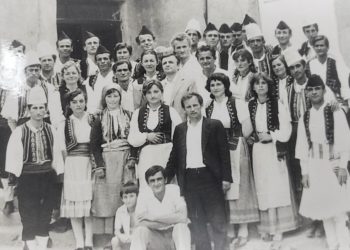
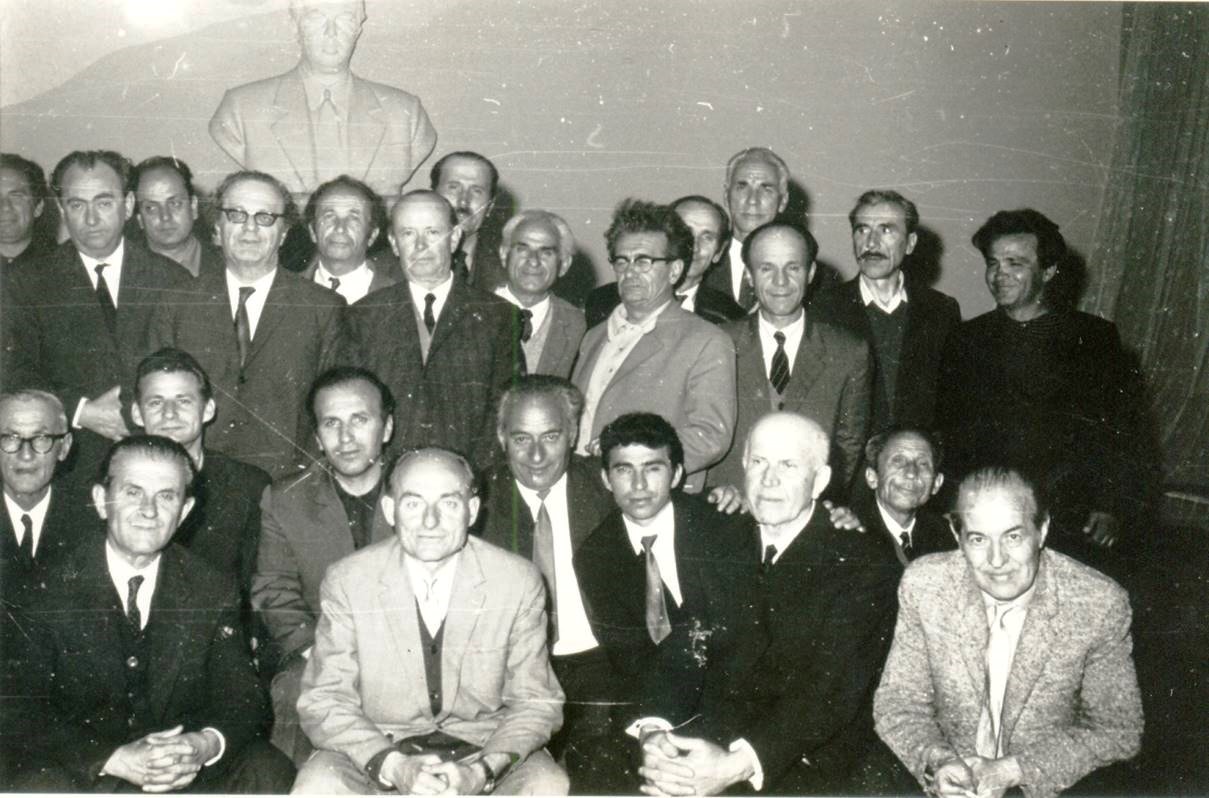
In October 1966, all the creators of Lushnja gathered at the House of Culture in a meeting with the chairman of the League, Shuteriqi, on the occasion of the November holidays, to talk about the creativity of literature and art creators, on the occasion of the great competition announced for the “Jubilee of the Liberation of the homeland from the Italian and German occupiers.” Dhimitër Shuteriqi asked us in turn to introduce ourselves to each creator and to inform him about what each would present in the great national competition of the 30th anniversary of the Liberation of the homeland from the Nazi-fascists. Some of the creators whom the chairman knew, he did not ask, while others he asked what their names were and what they were writing, painting, and composing for the Jubilee competition.
When he asked Hekuran Zhiti, who you are and what you are writing, Hekurani told him with humor: “I am a neighborhood poet and I am not known like the others who publish in the central press.” Everyone laughed. The chairman of the League, Dhimitër Shuteriqi, also laughed. It was understood that he was the actor, poet, and author of several comedies and sketches, countless parodies played by himself at the Lushnja Estrada. – “Forgive me, Hekuran,” said Chairman Shuteriqi.
The joke of the great humor actor, Shuteriqi’s feeling towards Hekurani, and his long word, full of erudition about the origin of the word Myzeqe from the Muzakët, remained long in my memory. Shuteriqi’s erudition amazed, but also opened the eyes, to see more, more clearly, longer, farther, deeper, and to understand clearly that the world had more colors, more sounds, more light…!
I, with Skënder Kamberi, visit Shuteriqi’s house
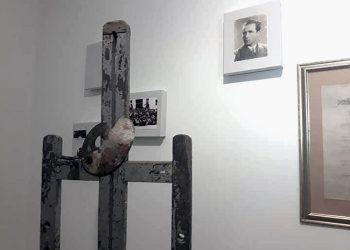
It happened that I went to Dhimitër Shuteriqi’s house with the painter Skënder Kamberi, whom he valued greatly as a highly talented painter. Together we saw the library with the walls of the large apartment, covered entirely with books. We also saw a multitude of sketches and croquis worked with rapidograph and pencil by the chairman, poet, storyteller, researcher, polyhedral, “Albanian Diogenes,” Dhimitër Shuteriqi. I have always liked his croquis published in newspapers and magazines, but the sketch for Lasgush left me stunned.
Before we left the house, I caught a book among the books of the library. It was the book of the hermetic poet, Nobel laureate, Salvatore Quasimodo, and I read in a low voice the poem: “Ognuno sta solo sul cuor della terra / trafitto da un raggio di sole: ed è subito sera.” Dhimitri, of whom it was said that he did not give books to anyone, to my surprise stretched out his hand and took from the library the poetry book “La terra impareggiabile” and gave it to me to read, with the right of return. I could not leave without mentioning in my memoirs this great gesture of a great man, “Albanian Diogenes.”
Shuteriqi’s unexpected visit with Koreshi, Laço, and Kamberi, to my house in Lushnja, where we had just moved in…!
On December 16, 1972, I entered the new apartment, as my old hovel house was taken by the city’s regulation plan and was demolished. But precisely on December 16, my poem “Dielli dhe rrëkerat” (The Sun and the Rags) was also published, on the literary page of the newspaper “Zëri i Rinisë.” And precisely on the morning of that Saturday, there is a knock on the door of my apartment located on the second floor. I opened the door. What did I see? At the door of my new house, Dhimitër Shuteriqi was knocking. He was coming to congratulate me on the new house, but he was not alone. With him were also the writers Teodor Laço, Vath Koreshi, Kiço Blushi, and the painter Skënder Kamberi, who held in his hand the newspaper “Zëri i Rinisë,” where my poem “Dielli dhe rrëkerat” was published.
Skënder Kamberi, impulsive as he was, did not wait for us to greet the newcomers to congratulate, but stretched out to the chairman of the League of Writers and Artists, Comrade Dhimitër, the newspaper “Zëri i Rinisë,” telling him that there was published the poem of Faslli Haliti, “Dielli dhe rrëkerat,” which was dedicated to the homeless and which gave strong blows to bureaucracy.
Professor Dhimitri tells the painter whom he loved and valued greatly: “Leave the newspaper aside, Skënder, the homeless are being sheltered; here we have come today to Faslliu to congratulate him on entering the new house. May he enjoy it, and may inspiration be added to him, and may he write new and even more beautiful poetry and poems.”
Then we talked about literature, painting, music, and about the New Year 1973, which was knocking at our door. How much joy the visit of that man on the eve of the New Year gave us, of that writer, intellectual with high credentials, as well as of his colleagues: Teodor Laço, Vath Korreshi, Kiço Blushi, and Skënder Kamberi, this old friend of our house?
– “He was a man, that man who came to us accompanied by men like himself,” said my 80-year-old mother. – “The son of Haxhi Korreshi also came to congratulate us on entering the new house. We made a father to resemble you – said mother, – Haxhiu did not take payment from the poor who came to grind in his mill.”
After New Year 1973, I met with Dhimitër Shuteriqi at the café “Tirana.” I had just been severely criticized for the poem “Dielli dhe rrëkerat,” in the newspaper “Shkëndija,” and in all the newspapers and magazines of that time. I was very depressed. Dhimitri at the café was with Petro Marko and Kiço Blushi, the writer and his son-in-law. They were also talking about Petro’s troubles, since he too did not have things going well.
They talked, I listened. After the conversation with Petro about his problems, Dhimitri turned to me and asked: “Were you happy about the creative leave that the League of Writers gave you? – “I was very happy, Comrade Chairman, and I thank you very much and I am grateful to all of you, especially you, Comrade Chairman, but I am afraid I will not enjoy that leave, as things are going,” I replied.
– “Why, how are things going?” asked Shuteriqi somewhat surprised. – “I was badly exposed in an auto-da-fé meeting of the type organized in medieval Spain, against artists and writers, Comrade Chairman of the League,” I told him with a certain timidity. – “The creative leave, they told me, you will not do it at Metalurgji, where the League of Writers assigned you, but there where we of the Party say: at the Agricultural Cooperative of Fier Shegani. Let’s see if you will do it there or not,” I told him…! –
“What do those people of Lushnja have with you like that, what have you done to them?!” – “It is understandable”… – said Kiço Blushi without waiting for me to answer, the chairman of the League. He answered for me: “It is enough that you of the Presidency of the League gave him 6 months of creative leave, for them to become jealous and hate him and try to eat your Faslli Haliti alive with all his rags.” – “But, are we going to let them eat him?” – said the chairman with Olympian calm and absolute self-confidence. – “We shall see,” said Kiço…!
The letter that Shuteriqi sent me on the occasion of New Year 1999
My dear Faslli,
I say “dear,” – in the distinguished sense, because you are very dear and to many, as a poet and as a man, and among them I am myself. The three books with which you honored me, I have read, – sung in time, – songs of joy, but also of wormwood, gall, bitterness, born from distinguished supplications, – humane ideals. And I see you sometimes smiling! This time is capable of killing every smile. Guard yours tightly, for it is your part as a man and as the poet that you are. I thank you for those books. I have them nearby on the shelf, as I reread them. I come to wish you this New Year ‘999, which is rushing to close a millennium, to say well that the next one is coming.
You, who preserve the smile, do not lose it, for, without it, man has lost completely. Even if hope is an illusion, it is still beautiful and comforting; even if disappointed, without it one cannot live. So this Other, the Third, may it be the real one! – Which I do not believe, but which I also smile at, however much I am bruised. May you live and be well, may you sing and may you succeed! And, for all my loved ones, the wishes of my heart! And to poetry, – a finger to the ear, no! / Memorie.al
With much love, yours
Dhimitër S. Shuteriqi
Tirana 22.XII.1998