

From Lefter Çipa
Part One
Memorie.al / I had come to know Professor Dhimitër Shuteriqi without ever having met him in person, through his writings and studies – works he would carry out and publish from time to time in various publications and organs, especially in the weekly newspaper Drita, the organ of the League of Writers and Artists. I was drawn to the articles he published on Albanian folklore in particular – the folklore of the South, of Toskëria and of greater Labëria – where his wisdom and knowledge illuminated my eager and passionate soul for the folklore of my homelands, especially for the song and dance of the Labëria-Himara region. It is difficult to judge someone unknown and never met, without even having had the chance to shake their hand in greeting. Yet in my soul, Dhimitër Shuteriqi had built the nest of my admiration. In truth, I dreamed of meeting him and becoming his friend!
He was a singular personality, whom I imagined as an extraordinary man, with virtues, beauty, wit, and a bearing in which wisdom, prudence, and patience stood out. I often heard from intellectuals who knew him that he was learned and unapproachable. Overall, I began to read his published works – from philological studies and literary criticism, to studies and contributions on folklore, all the way to historical studies. Each day my esteem grew, as did my silent love and my full and open admiration in the conversations we had in groups. I liked his portrait and especially his manner of communication and speech in interviews in magazines, newspapers, television, and radio.
When I followed him in the early period of my own creative work, I would often say to myself: truly I would be fortunate to get to know him, to converse and become friends with this writer of my country, who each day stirred in me the feelings of a youthful age in the field of culture. The voice of Dhimitër Shuteriqi’s work was heard as a voice of the height of hopeful messages, of continuity and uninterruptedness in the field of Albanian literature. He encouraged all intellectuals and creators on the national stage, because the writer Shuteriqi was a talented personality. He carried an inexhaustible universe in several academic fields. He was a complete writer with a broad national and European culture.
He was the first among the first to illuminate the field of folkloric heritage, as a compassionate lecturer for the treasures of the nation and of the long-suffering people. He conveyed data and love with an unclouded clarity, penetrating through centuries of darkness and obscurity. He appeared publicly with a soul full of light – of knowledge, culture, and identity – and without bending among various circles and in relation to numerous currents. Shuteriqi, as a patriot of knowledge and far-sighted wit, had the courage and boldness to reflect – through memories, studies, and often unattainable creativity – the dimensions and measures of his own personality. On one of those beautiful days, after many years, I had the opportunity to meet the noble writer and sharp-witted scholar. It was the year 1971.
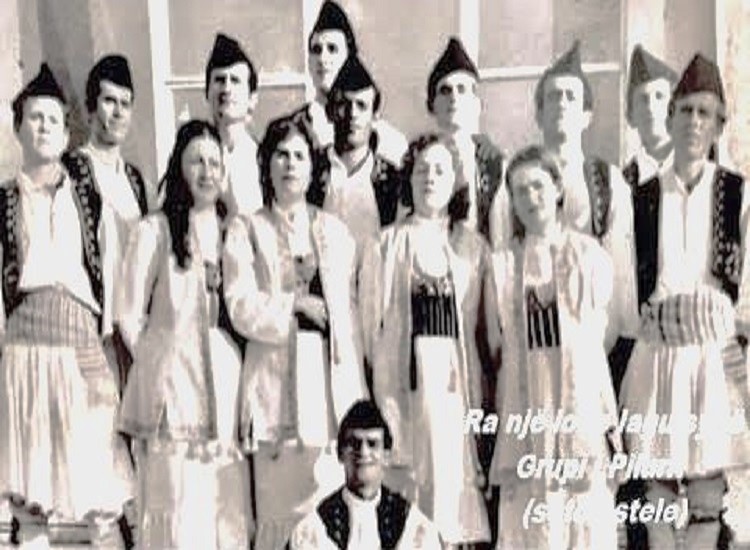
In Tirana, the 6th Congress of the Party of Labour was being held. Like all other artistic groups of Albania, the Folkloric Group of Pilur was assigned to participate in the jubilee concert. It was the Olympic November of the traditional celebrations of national history. Naturally, in those years of political storms, it was a privilege to be selected for such a concert. There were various criteria, but artistic merit stood out as the main one. The artistic achievements of Pilur had made it possible to present the song “Komisar i kohëve” (“Commissar of the Times”). It was the group’s largest contingent, with 18 members – six women and twelve men. Naturally, enthusiasm and youth added energy and revealed a temperament of young artists full of impulses. This drew maximum attention from the country’s artists and writers, who generally participated in the cycle of these year-end activities.
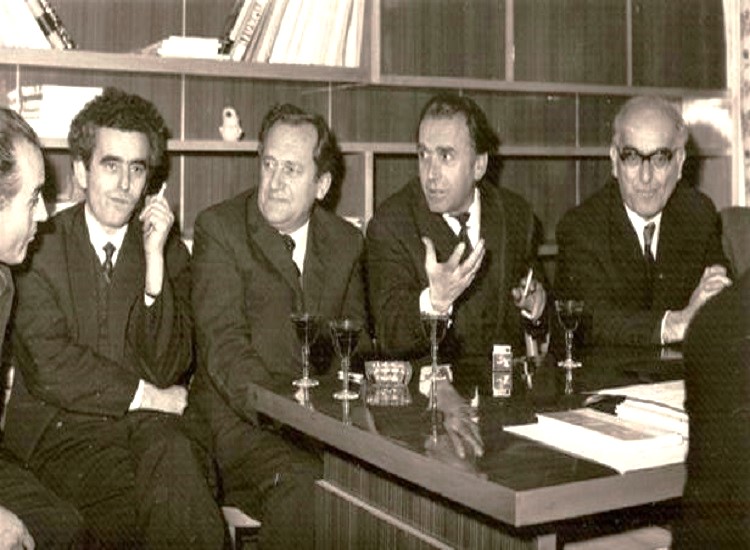
After many days of tense rehearsals, one afternoon at the Palace of Culture in Tirana, the painter Petro Kokushta – sent by the League of Writers and Artists – came and asked for me personally. After we greeted each other and met as patriots from the same region (he from Vuno and I from Pilur), we went to the Palace buffet for coffee. During our conversation, Petro said to me: “Dear Lefter, tomorrow afternoon, after you finish your rehearsals, you are invited to the League of Writers and Artists for a friendly and entertaining concert in the League’s hall. The writers Dhimitër Shuteriqi, Dritero Agolli, Petro Marko, and many others will be in attendance. It will be a great pleasure for you as the Pilur Group, but also for us as the League, especially on the eve of the Congress. I trust that you find such an invitation from us agreeable, as an institution belonging to the spiritual side.”
And so we agreed to hold the activity the next afternoon. And so it was done. The next afternoon we went to the League. The hall was filled to the brim. As soon as we entered, we found ourselves in a different environment – utterly captivating, enthusiastic, and with a spiritual verdancy. We felt as if we had wings. Everyone greeted us with choice words. This was the hearth of cultural knowledge. That unforgettable evening for us – the concert and all the congratulations – were the merit of Dhimitër Shuteriqi, Dritero Agolli, and Petro Marko, as patriots from the Coast. But it was also the support of many others, especially the composers Çesk Zadeja, Pjetër Gaci, Limoz Dizdari, the folklorists and scholars Beniamin Kruta, as well as the Deputy Minister of Education and Culture, Mantho Bala.
This happened because the Pilur Group had been appreciated during rehearsals and onward, for the great concert to be given on the evening of November 7 at the “Partizani” Sports Palace. With a smile as clustered as ripe wheat adorned with the dew of the moon during the night, upon which the rays of the sun’s eye are poured in the morning – the same happened to me. Professor Shuteriqi was the first among the League’s leaders to ask: “Who is Lefter?” At that moment I felt a flush of blood throughout my body. It was something special. The professor seized my hand and drew me into an embrace. Meanwhile, we followed with embraces with the other artists and writers present that evening at our concert at the League. It was an activity that lasted several hours.
It was a meeting marked by our curiosity, and that of the artists as well. The personalities surrounded us with benevolent curiosity. After I had greeted everyone, Professor Çesk Zadeja remained closest to me. Meanwhile, Petro Marko did not wait and launched into the Himariot song “Vajzë e valëve” (“Maiden of the Waves”). All of us, like beautiful birds above the sea waves, poured forth the symphony of Pilur’s many voices, but also the passionate voices of the artists of the pen. Suddenly, Shuteriqi and Agolli opened the braces of their arms and began to fly.
At this moment of rainbow-making polyphony, the poet Xhevahir Spahiu let out an “oooiiii” in the Skrapar style, and the ceiling of the hall seemed to us to be covered with a Persian carpet, draped over our shoulders. At the close of this spiritual symphony, the director – “Artist of the People” – with his dramatic voice shattered the rocky crags. He poured out his trembling diction, saying: “This is a Shakespearean marvel! This must be mounted on the stage of the concert they will give tomorrow.”
A gust of coastal wind dictated itself in the hall, as each took his place and the activity continued. Professor Shuteriqi again threw his arm around me, together with Dritëroi, and I found myself seated between them. The two of them like a contre to Paris, while I was like a deer of the mountain scrub, battered by hail and the fierce wind through the straits of my homeland. The concert of the Pilur Group began with the first song, “Komisari i kohëve.” The song was listened to with great curiosity. For the Group, this was a most general rehearsal. This concert at the League was an appearance before the most distinguished representatives of academic and artistic values. For the first time, we had so many learned personalities before us, to whom we were unfolding our repertoire as a group. We had just appeared on the national stage with the contribution and value of a phenomenon unheard of in style and in words.
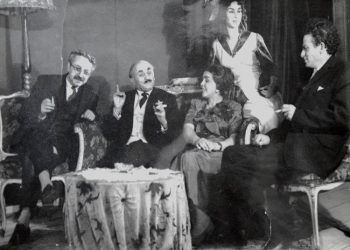
We had begun to make our difference from the phosphoric styles of the southern regions of Albania. State-level problems had been raised concerning the spiritual and material heritage of our traditional folklore. For this reason, listening to the Pilur Group was of great interest to the scholars, researchers, trackers, and collectors of these treasures. The personality, who assisted and supported such gatherings of Albanian folk art, while also encouraging continuity for the future, was Professor Shuteriqi. Naturally, I do not exclude others in these fields. After the concert – which was applauded and liked immensely, especially by great academics and artists such as Professor Shuteriqi, Dritero Agolli, Petro Marko, and Çesk Zadeja – they all came to us and invited us for coffee at the League’s bar. We sat down as a complete group.
The order for refreshments was given, and we engaged in conversation. Professor Shuteriqi addressed me with a proposal and a wish: could we sing the song about Abdyl Frashëri? He very much wished to hear it sung freely, for the pleasure of spiritual merriment, with those present joining in the iso [polyphonic drone]. I gave the lead singer my approval: “Go ahead, Katina!” She began the song with her epic-lyric voice: “Avdul destroyed his wealth / a bar of gold / boarded the steamer and went / to Berlin…!” The song continued in its entirety until it was finished. Professor Shuteriqi and Dritëroi, along with the others present, not only participated in the iso but also accompanied it with mumbled words through lips and throat – at times through the soul, at times through the light of their eyes…! They imitated the rhythm of the song with shoulder movements and the heaving of their chests. I could not take my eyes off either Shuteriqi or Dritëroi.
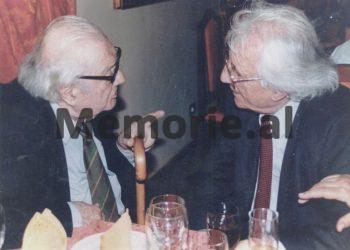
After it ended an angelic pause. Immediately Shuteriqi did not hesitate and addressed me with that elegance of his – a stylist like a violin bow playing the sounds of finesse upon tempered strings. With masterful delicacy, he opened the leaf of his heart and said to me: “Dear Lefter, I am very interested in this deeply national song. It has great historical value and makes me proud of this man, so majestic in the most critical and delicate moments of European politics at that time. It speaks of that so turbulent Balkan period, when they intended to dissolve Albania entirely, even as a nation. Is there any trace of this song, which remains fresh after nearly 100 years? It is almost anonymous, not addressed to any region, village, or individual. In your singing, I was struck by the stylistic aspect of the pronunciation and emphasis of the name Abdyl Frashëri – you say ‘Avdil’ and not ‘Abdyl.’ This is very important for dialectal reasons, but also for addressing origin!/Memorie.al”