

By Prof. Dr. Aleksandër Meksi
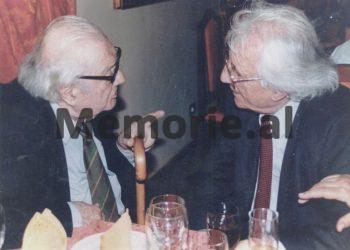
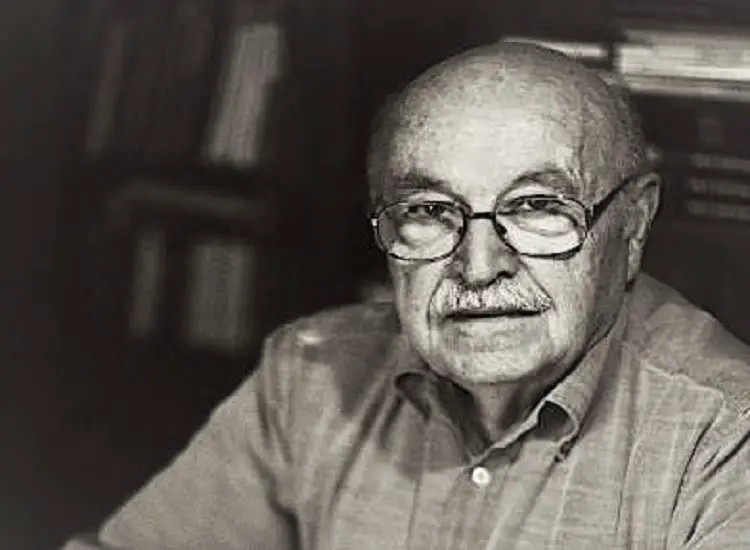
Memorie.al / Dhimitër Shuteriqi were a very well-known name at the time; he was a public figure who appeared on television, in newspapers, magazines, and elsewhere. Besides being a scholar of the History of Literature and early Albanian writings, he was also a scholar of Medieval History – a field that interested me personally – and one who made significant contributions because he strove to make effective use of historical sources, distinguishing himself greatly in this regard. At that time, he contributed to the study of early writings and their authors, even writing a monograph about them, as well as to Medieval History, specifically through works like “Arbëri Mesjetar” (Medieval Arbëria), “Mbishkrimet e kishës së Gëziqit” (The Inscriptions of the Church of Gëziq), “Shtrirjet e Arbërisë Mesjetare” (The Extent of Medieval Arbëria), and “Sundimtarët e Arbërit” (The Rulers of Arbër).
It must be noted that as a true scholar, whenever new findings emerged, he refined his earlier conclusions rather than adhering strictly to what had been established long before. Alongside his role as a writer and Chairman of the League of Writers and Artists of Albania, Professor Shuteriqi possessed broad interests in the Medieval Art and Culture of Albania.
These were the reasons why the director of the Institute of Cultural Monuments at the time, Gani Strazimiri, included him in the Institute’s Scientific Council. There, during the review of articles for the journal, projects, and other matters, he offered us invaluable support, providing me the opportunity to know him closely. Beyond those professional ties, I had numerous contacts and conversations with him because he was keenly interested in the first full publication and translation of the New Testament by Vangjel Meksi (a member of my lineage). Prof. Shuteriqi was the first to highlight this major figure and attribute the authorship to him.
Later, during our meetings and conversations, he also told me about another familial connection between us involving Kristoforidhi: one of his sisters had married into the Shuteriqi family, while the other had married into the Kapedani family in Berat – whose daughter was my maternal grandmother. Over the years, I had the opportunity to meet him often and discuss various matters, where his warmth and respect for his interlocutor stood out; he always treated others as equals rather than speaking down to them.
At the time when the campaign against religion broke out (in 1967) and the mass destruction and demolition of places of worship began, the issue arose of selecting and documenting which sites would be taken under state protection – specifically by the Institute of Monuments. It was precisely at this moment that Professor Shuteriqi came to our aid during a meeting of the Collegium at the Ministry of Education and Culture, where the final list of places of worship to remain under state protection was being reviewed – a meeting attended by both myself and the director of the Institute, Gani Strazimiri.
Before the meeting started, the two of us seized the opportunity to approach Prof. Shuteriqi and spoke to him in a low voice so that no one else would overhear: “Professor, there is resistance from the state commission to reduce as much as possible the number of places of worship that will be taken under state protection.” Prof. Shuteriqi nodded, letting us know he understood the situation completely. As soon as the meeting began, openly and without fear that his action might be interpreted through a political lens, he turned directly to Minister Thoma Deljana with a straight question:
“Comrade Minister, is there a predetermined limit on how many places of worship will be taken under state protection and declared cultural monuments? That is to say, have you issued any such order regarding how many sites should be left…”? This was a question that completely disarmed Minister Deljana, as no one could offer a logical justification or specify a arbitrary limit for the number of cultural sites to be preserved. Thus, somewhat flustered by the unexpected question, the minister hesitated briefly and answered: “No.”
Following this, the meeting proceeded with extensive discussion, but it was Shuteriqi’s wise and well-intentioned intervention that ensured the list of places of worship to be declared cultural monuments under state protection was not reduced as had been planned, but rather preserved as we had presented it. This tactful and timely intervention made it possible to save numerous places of worship from the destructive wave. / Memorie.al