
Part Eleven
Memorie.al / The CIA have revealed the significant role that the Soviet Union played in communist Albania. In several documents labeled “Top Secret” but declassified years ago, it is shown that the USSR built several important military bases, especially in the south of the country. There, details are given about the submarines that Moscow had on the island of Sazan and in the Bay of Vlorë, as well as air bases, such as those at Rinas, Kuçova, and others. Subsequently, an overview of political developments is provided, mentioning the dismissal of Defense Minister Beqir Balluku in the summer of 1974 from all his functions in the army and the party. Likewise, a special place in the declassified CIA documents is given to those dealing with Albanian political emigrants in Yugoslavia, who were incorporated into the Prizren Committee initially chaired by Apostol Tanev and under the pressures of the UDB [Yugoslav secret police], which recruited them through coercive measures, such as return to Albania, etc.
Continued from the previous issue
Russia claimed to have been decisive in Albania’s victory over the Nazi-fascist occupiers. The CIA has released a document on Albania from 1953, providing details from a Russian book describing the situation in our country according to Moscow’s perspectives. There, the entire history of the country is laid out, from the rule of Ahmet Zogu to the victory over the occupiers.
1953
The Soviet Version of Albania’s Modern History
Talks
Evangelos Kirkos spoke with the Greek ambassador to Italy, Giorgios Exindaris, and the latter expressed himself in favor of the union of Albania with Greece. According to what Konstantinos Rendis told Kirkos, the New Greek Deputy Foreign Minister Politis held the same idea and would soon receive Kirkos. The Northern Epirote League “Celasforos” maintained a stance against the union of Greece with Albania and had published several articles on the matter.
But recently, in an article by the League’s president, Colonel Karisiadis, support for the union has been expressed. Muharrem Bajraktari rivals Ermenji for the leadership of the organization. In this regard, our source emphasizes that Bajraktari is a friend of the Slavs and cooperates with the British.
Comment: The information is believed to refer to Ermenji’s visit to Athens, between June 15 and July 1, 1950.
February 1953
Albanian and Soviet Press on Healthcare
Achievements
According to the newspaper Puna of January 29, 1952, a total of 157 million lek had been spent during 1951 for workers’ welfare purposes, including maternity care and vacations at state camps – a figure representing an increase of 41 million lek compared to 1950. The newspaper states that the amount spent in 1952 for these institutions was 72.5 million lek, about 20 million lek more than the 1951 figure.
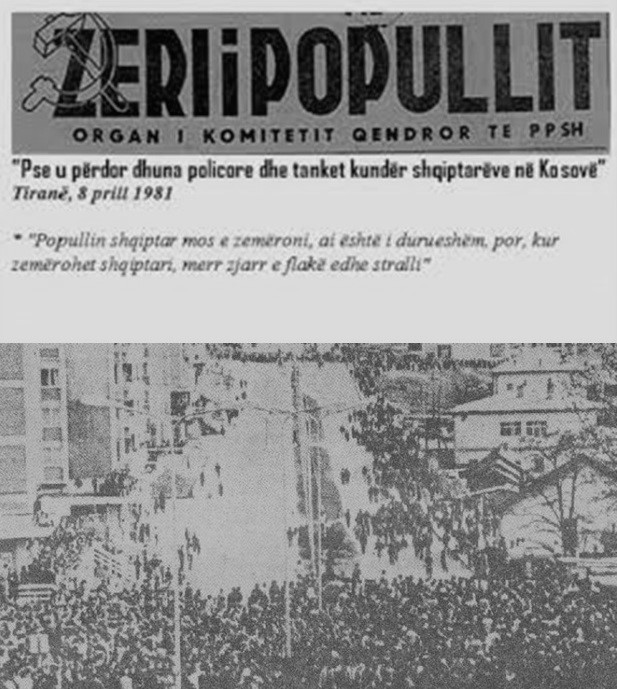
Zëri i Popullit reported on March 13, 1952, that public health workers in Durrës had been mobilized in the double vaccination campaign against typhus and cholera; the newspaper added that the vaccine was of good quality and had come from the Soviet Union.
On March 9, Zëri i Popullit reported that in the second half of February, the Red Cross sent several brigades to the localities of Vërtop, Roshnik, and Hajdërbenaj in Berat, to raise public awareness about harmful and prejudicial customs affecting public health.
The brigade that went to the village of Dardhë in Roshnik found a girl who had been ill for 20 days. Her parents had not taken her to the doctor but had ordered a charm from the Muslim hoxha. The brigade intervened immediately by treating the girl, who improved. Upon seeing the improvement, the girl’s father thanked the Red Cross brigade. Subsequently, all the villagers received a book on hygiene rules, for which they were very grateful.
According to Zëri i Popullit of May 13, measures were taken against malaria in the Berat district and in “Stalin City.” In the village of Orizaj and in “Stalin City,” approximately 90,000 square meters were sprayed with RF-25 disinfectant solution.
The newspaper states that in the city of Berat, about 20,000 meters of canal were cleaned of malaria larvae, while disinfectant was sprayed on the cultivated lands of the city. On May 10, Zëri i Popullit wrote that the highlanders of Tropoja had suffered from many diseases in the past, and that the entire area had only one ambulance.
The newspaper states that today, the locality has a hospital in Kolgecaj with one doctor, one ambulance, and auxiliary staff. Additionally, six ambulances operate in the surrounding villages, as well as three pediatric nurses and several health officials. The newspaper declares that science has intervened in the mountain regions, to put an end to the primitive treatments of backward and irresponsible people.
Soviet Intervention
In another item from Zëri i Popullit, Dr. Fejzi Hoxha, speaking before the Albanian-Soviet Society on May 26, said that the application of Soviet medical methods at the Tirana hospital had made possible a series of operations that had never been performed before in Tirana. He stated that many diseases previously considered incurable were now being treated quickly and with low mortality, through new Soviet treatments.
According to the newspaper, he believed that it was not enough for Albanian doctors to learn only a few new treatments, but they should always remain in contact with Soviet medical literature to expand their theoretical foundation with new Soviet concepts. On November 29, the daily Uchitelskaja reported on the opening in Albania of a new medical institute with eight departments, including biology, histology, physics, chemistry, and Marxism-Leninism.
It wrote that the institution would have anatomy, chemistry, and physics laboratories. Fifty students would be admitted to the first courses. Soviet specialists had provided great assistance in organizing the institute, the newspaper wrote.
Complaints
On March 14, 1952, a letter from E. Tefiku published in Zëri i Popullit declared that in early March, a poor peasant named Hasim from Novosela in Elbasan fell ill and asked the doctor to visit him at home. The district doctor Mihal Çaushi went to the peasant’s home by order of the public health sector.
After completing the visit and administering medication, the doctor reportedly said that the visit cost 2,600 lek. In a letter written by Misto Gjoka from the copper mine in Rubik, published in Zëri i Popullit on May 11, 1952, the poor service of the local hospital am described.
According to Gjoka, the doctors were not on duty at night, and patients complained about the condition of the beds, but no action was taken on the complaint. The same issue of Zëri i Popullit stated that Sadik Bilaj had complained about the conditions at the dispensary in the village of Dhëmblan in the Tepelena district, where Hasan Musaj works as a guard.
The premises were unsanitary, and Bilaj complained that the guard had not given him prompt assistance. Patients arriving with high fevers were not given medication on time. The local authorities were notified of the situation, but Bilaj said that the necessary measures had still not been taken.
The same newspaper declared that medication had not been given on time at the Vlorë hospital, citing the example of a patient who did not receive an injection as ordered by the doctor until the evening. The patient was also supposed to have a blood test, but this was done only after he had left the hospital. / Memorie.al