From Bashkim Trenova
Part Twenty-Nine
– NAZIBOLSHEVISM – LITERATURE AND THE ARTS –
FOREWORD
Memorie.al / Historians, political philosophers, intellectuals from various schools or positions have dedicated thousands upon thousands of pages, entire volumes, studies, and articles to the comparison between Nazism and Communism. Generally, their publications and studies focus on the police control of society by these dictatorships, the role of the dictatorial state hierarchy, the head of state as a suppressor of free thought, the omnipresence of official propaganda in society, the mass massacres, and the network of concentration camps, the activities of the police, the NKVD in the USSR (later the KGB) and the Gestapo in the Third Reich. In his book Le Passé d’une illusion (The Past of an Illusion), François Furet observes that Nazism and Communism share the same opposition to liberal democracy and to what they call “capitalist bourgeois society.” Both ideologies claim to be socialist and use the image of socialism. Communist countries called themselves “socialist.” “Nazism” is a shortening of National Socialism.
Continued from the previous issue
PAINTING AND SCULPTURE
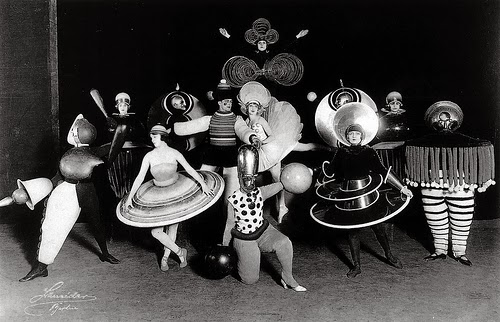
In Hitler’s Germany, the same policy of repression, persecution, and strict censorship – just as in all the arts – was practiced, from the very first days of the Nazis’ rise to power, against painting and painters, sculpture and sculptors who did not conform to the Nazi “ideal,” who opposed it in one way or another, who did not propagate the “qualities” of the Aryan race, etc. On March 1, 1933, Oskar Schlemmer opened his exhibition at the Stuttgart Municipal Gallery. On March 5, the Nazis came to power.
On March 12, 1933, the exhibition was banned. The day before, the National -Socialistisches Kurier had written: “This exhibition is, without any doubt, the last time the public may have the opportunity to see Kunstbolschevismus [Art Bolshevism] in painting, indeed, on a large scale. Who wants to take these paintings seriously? Who respects them? Who wishes to defend them as works of art? They are unsuccessful in every respect. Looking at their decadent spiritual side, it can be said that they can very soon be abandoned on a rubbish heap where they would decompose undisturbed.”
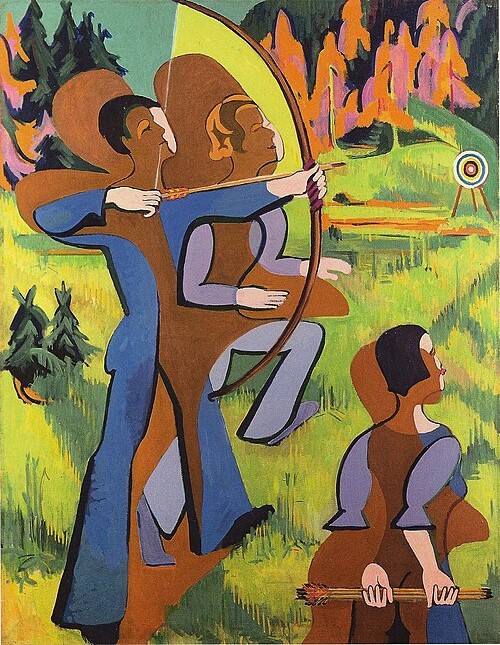
During the Third Reich, in total, across 101 institutions, between 16,000 and 20,000 paintings, sculptures, drawings, and prints were confiscated, which were then destroyed or sold abroad. At the conclusion of the “ethnic cleansing” campaign of art objects, 15,997 paintings were withdrawn from the country’s museums, including 51 paintings by Schlemmer, over 260 by Otto Dix, over 400 by Kokoschka, and 639 by Ernst Ludwig Kirchner. In March 1939, 1,004 paintings and 3,825 drawings and engravings were burned in a fire. The murals that Oskar Schlemmer had painted in the Weimar museum were painted over with white paint.
A kind of comparative model was also established to determine whether a work was of a nature that disturbed the social and political order or aimed to overthrow it. Among the painters whose works were banned, we can also mention Edvard Munch, Die Brücke, Marc Chagall, Chaim Soutine, George Grosz, Van Gogh, Pablo Picasso, Gauguin, Cézanne, Modigliani, Schmidt-Rottluff, Pechstein, Hofer, Matisse, Braque, Klee, etc.
Quite a few German painters of the time, such as Erich Heckel, Nolde, etc., constantly persecuted by the Gestapo, were forced to hide and live in clandestinity. Others were forced to emigrate. In 1933, Kandinsky, Grosz, Schlemmer, and Jankel Adler left Germany. In 1934, Kokoschka settled in London. In 1936, Paul Klee left for Switzerland. In 1937, Feininger left and settled in New York. Otto Dix, accused of “insulting the German sentiment,” also left in 1938 and settled in Switzerland. Beckmann was also forced to emigrate, and so on.
For some artists, the situation was even more tragic. Kirchner, traumatized by the Holocaust, committed suicide in 1938. Others, like Mathias Barz, were arrested. Juro Lewin was deported to Auschwitz, where he died in 1943. During World War II, Leo Haas was confined in the Theresienstadt Ghetto. Later, tortured, he too was sent to Auschwitz. His paintings from this period, created in secret, reflect life in the camp. They are testimony to the horrors and violence of the Hitlerian dictatorship as well as to the artist’s courage to reflect what he lived and felt.
Nazism also demanded that painters line up in service of the new order, to become its propagandists. In a speech given on June 23, 1935, in Hamburg, Goebbels stated openly: “What would our movement be without propaganda? And where would our state have fallen if even today a truly creative propaganda did not give it its spiritual appearance? Is not art also a possible form of shaping? Does art degrade if it is placed on the same level as that noble science, such as folk psychology, which first led the Reich out of the abyss? A people cannot be helped, in a miserable era like today’s, only with theorems. They need to be given practical opportunities to begin a new life. That is what we have done.”
The Nazis favored and mobilized a number of painters and illustrators for their purposes. Among them are known Claus Bergen, Ludwig Dettmann, Hermann Gradl, Arthur Kampf, Willy Kriegel, Fritz Mackensen, Alfred Mahlau, Werner Peiner, Philipp Rupprecht, etc. In their support, the Nazis organized a large exhibition of official art in Munich – the Grosse Deutsche Kunstausstellung (Great German Art Exhibition). This exhibition was inaugurated by Hitler on July 18, 1937. It featured 900 works by 580 painters and sculptors devoted to the regime.
Within the framework of official German art, painting was limited to hundreds of portraits of Hitler, the imitation of antiquity, the worship of the nude body, the delicacy of woman, and the strength of man. Other fields included war, battles, the fatherland, male society or military friendship, heroic figures, symbols, the glorification of the village and peasants, of work in the countryside and work in factories, of the family in general, primarily the role of hierarchy within the family, and fertility. Much more than a simple tool in the hands of power, the visual arts, including painting, can also be seen as symbols of the Nazi desire to stand against time, to place the German nation in an eternal space-time.
This dimension, christened Erlebnis (experience), according to the Nazi leaders, is most fully represented in the art of painting. Canadian historian and lecturer Eric Michaud, speaking about the painting of this period, expresses himself thus: “In the Nazi apparatus for the reproduction of images, the role of not compromising life belonged first to painting … painting had the duty to continually update the Erlebnis and to entrust it with the value of eternity that it carries within itself.”
As mentioned above, one of the central themes of art, in this case of Nazi painting is the cult of the chief. Initially, it can be said that the paintings featuring Hitler are countless. An artist in Nazi Germany could always enter the ranks of the well-treated, the well-regarded by the regime, if he created at least one painting dedicated to the dictator.
In the open and unbridled preparations of the Nazis for a new World War, conviction and blind, unconditional, absolute, military loyalty to the Führer was indispensable. Not a few painters of the time focused on depicting Hitler with messianic proportions, Hitler as a warlike, charismatic leader who draws crowds. In painting, even when he is absent, he is present, always at the center, for example through a portrait of him placed on the wall, or through the chosen theme and the official ideology that permeates every painting.
The organ of the Nazi Party, Völkischer Beobachter, wrote in 1934: “They (the artists) all know: among millions of Germans, it is the society of true artists that never ceases to present the Führer. The German artist exists thanks to the Führer, his interest, and his great heart. The authority of the Führer and the artists, today and in the future, are united as one. In the Reich of Adolf Hitler, there is not a single artist who does not respond positively, with the deepest conviction, to Hitler’s thought and idea in politics and art.” The artist, of course, must merge into one with his Führer, with Nazi ideology and aesthetics. In fact, upon usurping power in 1933, the Nazis dictated a “Hitlerian” style to art as well.
Within the framework of a “cultural dictatorship,” of the subjugation of art to the State, painting too was forced to integrate into the totalitarian system. The lack of originality characterizes the poverty of all artistic activity, especially the field of painting. Hermann Hoyer is one of the first to choose to give messianic proportions to the Nazi dictator. His painting Am Anfang war das Wort (In the beginning was the Word) from 1937 shows Hitler at the beginning of his political career, in the 1920s. It is the time when the Nazi Party was confined to its historical capital, Munich in Bavaria.
The title of the painting is quite significant. The Word addresses Christian theology and Jesus Christ, who in this case is embodied by Adolf Hitler, who preaches the Word… He is shown standing, in front of a small group of very attentive people who appear to be the first disciples of the Nazi Party. He casts his gaze into the distance as if the hall were larger than it actually was.
The myth of Hitler as a warlord reaches its peak in the large-format painting by Hubert Lanzinger titled Der Bannerträger (The Standard Bearer). Hitler is shown here with scars on his face, holding aloft a flag with the Nazi swastika. He takes the form of a Teutonic knight of the middle Ages, on horseback. Other works dedicated to the Nazi leader respond to the same stylistic and iconographic criteria. Such is the 1939 painting Der Führer Spricht (The Führer Speaks) by Paul Padua. The painter presents the dictator’s portrait hung on the wall, a radio placed in a corner of the room, and all generations of a family listening attentively to Hitler’s word.
Another painter, Ferdinand Stager, shows Hitler and the SS marches, surrounded by the admiring shouts of the crowds. During the Third Reich, painting did not deal with themes of individualistic dimensions. Its axis was events affecting the people as a whole. Art, and painting as part of it, must convey to the people the idea of greatness and lead them towards this greatness. Race and blood became the two main sources of inspiration for all artistic life in the country.
Let us not forget that the political unity of Germany dates from 1871, not long before. Thus, Nazism saw as an immediate and necessary duty the strengthening of the sense of belonging of a people, the elimination of regional peculiarities and individualism. In victory, as well as in defeat, all Germans must be united. Only thus would their survival be guaranteed for eternity.
Countless paintings are dedicated to sailors, aviators, infantrymen, exalting courage, heroism, and discipline at the front. They show, for example, two soldiers carrying a third wounded one. Nazism, in art and in life, elevates death to a cult. This is expressed through a kind of nostalgia for the “glorious” era of wars, where soldiers formed a single and indivisible society. Nazi painters glorified the myth of “social solidarity” aiming to convey to the people the idea that it is their duty to support the fighters at the front with all means and forces.
This is illustrated by Adolf Reich’s Das größere Opfer (The Greater Sacrifice) from early 1943, the time when news of the German army’s disaster at Stalingrad arrives. The painting presents a small group of citizens, alongside two activists of the Hitler Youth. It appeals to the National Community, its will, to stand in solidarity, to sacrifice in order to gather aid for the German soldiers fighting in Russia, to continue the war until victory!
The main character in this painting is a war invalid, dressed in his military uniform even though he is no longer at the front. He shows no suffering over his fate. This invalid has sacrificed his body, a sacrifice much greater than a few coins that citizens might throw into the cans of the Hitler Youth. The painting echoes the thought expressed by Adolf Hitler: “If anyone doubts the usefulness of giving again, let him look around him. He will see that someone has made a much greater sacrifice.” This painting by Adolf Reich was warmly applauded by Hitler himself.
The painting Die letzte Handgranate (The Last Hand Grenade), from 1937, by Elk Eber, is dedicated to the German soldier, but in this case placed in the fire of action of the First World War. Through it, the aim was to convey to another generation of German soldiers the message of bravery and sacrifice in war. They are asked, following the example of their fathers, to shed blood in the war that the Nazis would soon provoke. In 1939, he would exhibit another painting – So war die SA (That’s How the SA Was) – which continues chronologically, thematically, and in thought from The Last Hand Grenade.
This painting shows the march of an SA troop under the Nazi flag with the swastika. In the center, in the foreground, is a man with a bandaged head, and beside him stand some onlookers, among them a young man admiring the troop. The painting of the time, as an active propagandist in service of the war, could not set aside the treatment of the beauty of the Aryan race, the perfect physique of its members, the superiority and genius of this eternal race! In Nazi painting, all this was expressed through nudity.
This is given to us by the greatest official painter of the Third Reich, Ziegler, in Das Urteil des Paris (The Judgment of Paris) from 1937. Ziegler presents in this painting a completely naked woman under the gaze of a man dressed in the colors of the S.A., i.e., the Nazi paramilitary organization, predecessor of the Nazi S.S. Hitler placed this painting in his Munich residence. He did the same with another painting by Adolf Ziegler, Die vier Elemente (The Four Elements).
Ziegler was among Hitler’s favorite artists. Die vier Elemente presents a classical subject, referring to the basic myth of every civilization, since the creation of the world. At the center are four women, each representing an element of nature (fire, water, earth, air). These women are a symbol of the formation into one single entity of the German people, the Aryan race, leaving no room for the foreign, and the different. These four women have the bodies of mothers formed to give birth to fair and strong children for the German nation. / Memorie.al
To be continued in the next issue