




By DASHNOR KALOÇI
Part One
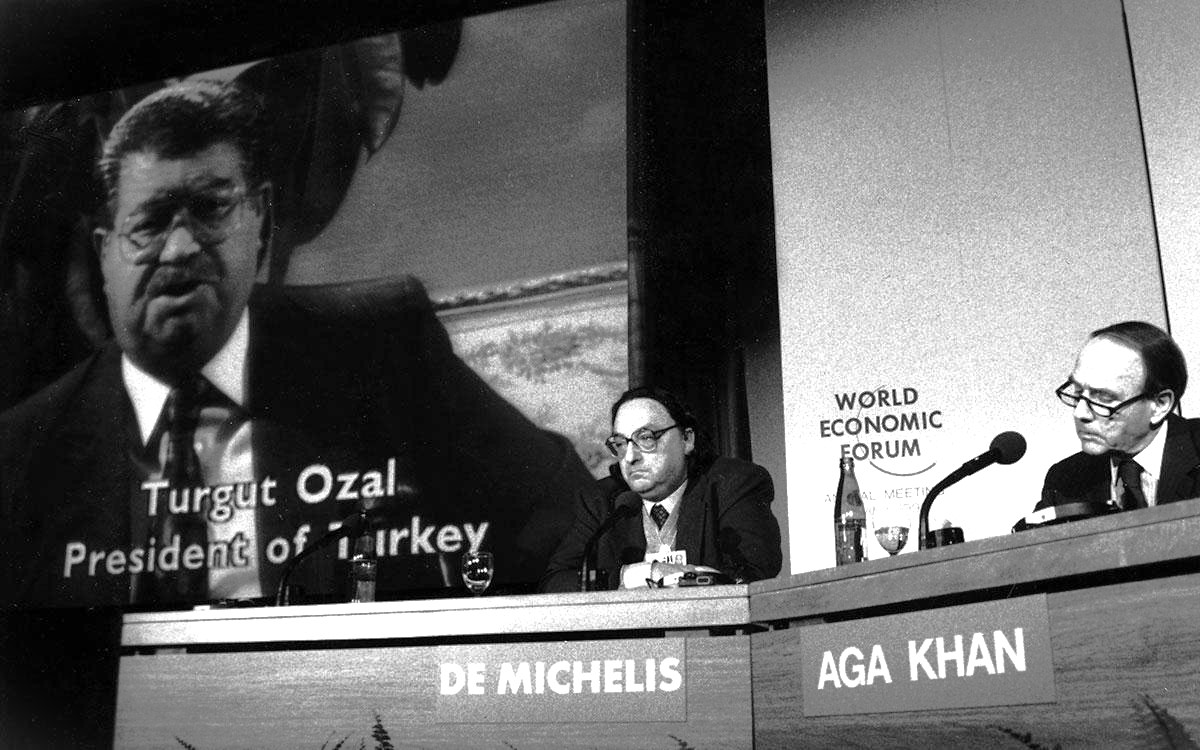
Memorie.al / A full 35 years ago, in early January 1991, when not even two or three weeks had passed since the declaration of pluralism in Albania and the first opposition parties had been formed, the government of Prime Minister Ylli Bufi – which had almost entirely replaced the “Çarçani” cabinet -, within the framework of the economic and political reforms undertaken at that time and the opening of Albania to the outside world, had begun to respond positively to the numerous invitations coming to official Tirana for the country’s representation in various international activities. Such was the World Economic Forum in Davos, Switzerland (established in 1971), which would be held in early February of that year, where numerous personalities from political and economic life from all over the world participated, such as heads of state, prime ministers, ministers, renowned businessmen and entrepreneurs, members of various organizations from five continents, etc.
In this context, according to the invitation that the President of the Davos World Forum, Klaus Schwab, had officially presented to the Albanian Mission in Geneva on November 14, 1990, the Albanian government of Prime Minister Ylli Bufi had decided to be represented at the highest level, sending there the Secretary-General of the Prime Minister’s Office, Fatos Nano, Doctor of Economic Sciences, a renowned economist and lecturer at the State University of Tirana, who, besides being part of the government cabinet since December 1990 and the coordinator and person responsible for the economic reform of that cabinet, had also made a big name at that time from several interviews given to Radio “Voice of America,” etc.
But how was it possible for Fatos Nano to go to that international forum where Albania, just emerging from 45 years of communist rule, was represented for the first time? Who were some of the high-ranking personalities that Fatos Nano met at the Davos World Economic Forum, and what were the impressions they had about the small communist country of the Balkans, most of whom barely knew it at all, or had heard very little about it? What did they suggest and promise to the head of the Albanian delegation, Fatos Nano, and what were the conditions set for Albania in the context of the aid it would receive? And why did Albania’s further participation in the Davos World Forum fail in June of that year, and what is said in the strained correspondence between the Ministry of Foreign Affairs and the organizers of that economic activity, regarding the low level at which Albania would be represented there? Regarding this, etc., several archival documents recently extracted from the Archive of the Ministry of Foreign Affairs inform us, which are published for the first time along with the corresponding facsimiles by Memorie.al.
OFFICIAL LETTER OF COUNSELOR ALFRED PAPUÇIU AT THE ALBANIAN MISSION IN GENEVA, SENT TO THE MINISTRY OF FOREIGN AFFAIRS IN TIRANA, REGARDING THE INVITATION MADE BY THE PRESIDENT OF THE DAVOS WORLD ECONOMIC FORUM, FOR ALBANIA’S PARTICIPATION
Permanent Mission of the
People’s Socialist Republic of Albania to the United Nations Office at Geneva and other International Organizations in Switzerland
No. 35 of Prot. Geneva, 14.11.1990
Subject: The letter of the President of the World Economic Forum is forwarded
TO THE MINISTRY OF FOREIGN AFFAIRS
TIRANA
Enclosed, we are sending you the letter and materials brought to us by Klaus Schwab, President of the “World Economic Forum,” headquartered in Switzerland, who spoke with the Secretary of State, Klaus Jacobi, upon his return from his visit to Albania. He expresses the wish that Albania also participate in the annual meeting in Davos of the Foundation he leads. If our participation is seen as of interest, please inform us so that we may notify the interested party.
COUNSELOR
Alfred Papuçiu
REPORT – INFORMATION FROM THE ALBANIAN MISSION IN GENEVA, REGARDING THE INVITATION RECEIVED IN TIRANA, CONCERNING ALBANIA’S PARTICIPATION IN THE DAVOS WORLD ECONOMIC FORUM
TO THE MINISTRY OF FOREIGN AFFAIRS
In the meeting we had with Serge Guillaume, a member of the Steering Council of the “World Economic Forum,” it emerged that about 800 people will participate in the annual meeting in Davos, including heads of state, prime ministers, ministers, businessmen, etc., from various countries.
Issues of economic integration, the situation in the Gulf, developments in the Soviet Union and their global economic consequences, the situation in Central Europe, etc., will be discussed.
The head of our Delegation can also speak for about 20 minutes in a session, where the press will also be present; the dates suggested were February 4 or 5.
It is requested that delegations be as reduced in number as possible, due to the limited space available in Davos.
They will cover the transportation costs from Zurich to Davos and the hotel expenses for two people.
They request, if possible by the end of the week, a short curriculum vitae of comrade Fatos Nano, and later a photograph.
Details about the participants and the general program outline will be sent to you by fax.
Geneva, 8.1.1991 THE MISSION
412 278 MALB CH +
21 64 MPJ AB
ARCHIVAL DOCUMENT WITH THE TELEGRAM OF THE SECRETARY-GENERAL OF THE COUNCIL OF MINISTERS FATOS NANO, REGARDING HIS PARTICIPATION IN THE WORLD ECONOMIC FORUM IN DAVOS ON FEBRUARY 1, 1991, SENT TO THE MINISTER OF FOREIGN AFFAIRS, REIZ MALILE
TELEGRAM FROM DAVOS (1 FEBRUARY 1991)
TO: MINISTRY OF FOREIGN AFFAIRS
(Comrade Reis Malile)
TIRANA
Classification: (Urgent / Telegraphic)
The 1991 World Economic Forum began its work in Davos. The participation of political, business, and scientific personalities is extensive, but due to the war in the Gulf, the level of representation is not what was announced by the organizers. High-ranking personalities such as Genscher, Rocard, De Michelis, etc., are expected to participate in special sessions and leave within the day.
The topics of discussion at this year’s forum include such major issues as:
– Overcoming difficulties in Eastern countries through economic reforms;
– The perspective of emerging from the current state of global economic decline and the consequences of the crisis in the Gulf;
– Necessary policies for integrating developing countries into the world market;
– The tightening of credit in the international financial market, priority measures for environmental protection, etc.
Various speakers expressed their views on these issues in special sessions, answering questions and providing the requested explanations regarding the realities of their respective countries.
On three such occasions, the floor was also given to comrade Fatos Nano, who acquainted the participants with the broad democratic processes in Albania, focusing particularly on economic reform and the new opportunities it has created for expanding our country’s cooperation with the world. The moderator of the discussions on one of these occasions was the former Prime Minister of France, Raymond Barre.
Today our delegation met with the Swiss Secretary of State for Foreign Affairs, Klaus Jacobi. During the proceedings, he also had meetings with the Executive Secretary of the UN Economic Commission for Europe, Gerhard Hinteregger, with the member of the Yugoslav Presidency, Janez Drnovšek, with the Japanese Deputy Minister for External Economic Relations, Yasuo Matsushita, as well as with representatives of banking and business circles from various countries participating in this Forum.
This year’s Forum is chaired by Prince Sadruddin Aga Khan, and its opening was greeted by its president, Klaus Schwab.
Davos, 1 February 1991
Fatos Nano
(signed)
TELEGRAM OF THE SECRETARY-GENERAL OF THE COUNCIL OF MINISTERS FATOS NANO, REGARDING HIS MEETINGS WITH HIGH-RANKING PERSONALITIES AT THE WORLD ECONOMIC FORUM IN DAVOS, ON FEBRUARY 3, 1991, SENT TO THE MINISTER OF FOREIGN AFFAIRS, REIZ MALILE
TELEGRAM FROM DAVOS – (FEBRUARY 1991)
REPORT ON THE MEETINGS
TO: MINISTRY OF FOREIGN AFFAIRS
(Comrade Reis)
During yesterday, alongside the work in plenary and special sessions, the personalities of the participating countries and international organizations separately discussed the preliminary conclusions on the main issues of this forum (as we informed you in our previous fax). The work was organized in such a way that these personalities were in contact with each other throughout the day, which will continue today as well.
This gave me the opportunity to have special meetings with:
– The Minister of Finance of Austria, Ferdinand Lacina;
– The Hungarian Minister for External Economic Relations, Béla Kádár;
– The President of the forum, Klaus Schwab;
– The President of Croatia, Franjo Tuđman (the meeting was requested by him);
– The Economic Counselor of the IMF, Jacob Frenkel;
– The Director-General and Special Advisor to Jacques Delors, Antonio Costa, etc.
Among Westerners in general, a reserved attitude is noticeable, which they justify with unclear and contradictory data from their representatives or envoys in Tirana. It is explicitly emphasized that they are not just waiting for the March 31 elections, “but for the departure from the scene of the old political class.”
Tuđman (in a meeting also in the presence of television), expressed interest in direct relations between Croatia and Albania under the conditions of complicated situations around us. I had a chance meeting with Raymond Barre, who showed only courtesy and not particular interest, as well as with Petre Roman, who said: “you are amidst turmoil that I hope will be overcome.”
In the afternoon, we were specially received by the Federal Councillor of Switzerland, Jean-Pascal Delamuraz, who, after asking many questions about the new developments in Albania, promised that the Swiss government in the coming year will try to include Albania in its plans for financing in Eastern European countries.
During dinner, I exchanged greetings with De Michelis, who said he knew me by name and promised a special meeting for today. I also exchanged greetings with the Soviets Bogomolov, Aganbegyan, Shmelev, with the Secretary-General of the OECD, Jean-Claude Paye, and with the Director of the Treasury of the French Ministry of Finance, Jean-Claude Trichet, who said he knew Albania through Kadare’s books. Genscher is expected to arrive and speak today.
We note that the general attitude towards the SU (Soviet Union) at this moment is reserved, while towards the other 6 Eastern countries there is readiness to help economically and financially.
Davos, 3.2.1991
Fatos Nano
(signed)
TELEGRAM OF THE SECRETARY-GENERAL OF THE COUNCIL OF MINISTERS FATOS NANO, REGARDING HIS MEETINGS WITH HIGH-RANKING PERSONALITIES AT THE WORLD ECONOMIC FORUM IN DAVOS, ON FEBRUARY 3, 1991, SENT TO THE MINISTER OF FOREIGN AFFAIRS, REIZ MALILE
TELEGRAM FROM DAVOS (3 FEBRUARY 1991)
– REPORT ON DISCUSSIONS AND REFORMS –
TO: MINISTRY OF FOREIGN AFFAIRS
(Comrade Reis)
This morning, in the same auditorium as yesterday (the main political personalities of the business and scientific world), discussions continued on Eastern Europe and the Soviet Union (on the progress of political and economic reforms and the West’s stance towards them).
Several ministers spoke (Hungarian Kádár, Czechoslovak Vladimír Dlouhý), the Romanian Prime Minister Petre Roman, the Mongolian Deputy Prime Minister D. Ganbald, who presented the difficulties encountered, especially by economic reforms, and the need for their support from the West with aid, loans, and technical and technological assistance.
It was striking that the Westerners showed readiness to help Poland, Czechoslovakia, Hungary, Romania, and Bulgaria (expressing positive views on the reforms in these countries!), while they expressed marked reservations, even a lack of desire, to help the Soviet Union, linking this to the events in the Baltics and to “a backward turn of the Soviet Union.”
We note that when speaking about the countries of Eastern Europe, neither Albania nor Yugoslavia was mentioned in any case.
In the above discussion, comrade Fatos Nano also took the floor, saying:
“When it comes to supporting reforms in Eastern Europe, it would not be appropriate to leave out Southeastern Europe, which includes a good part of the Balkans, of this highly sensitive region, whose economic and political stability is closely linked to and directly affects the stability of Europe. We in Albania are engaged in a deep process of democratizing reforms that affect politics as well as the economy.
With political and party pluralism, with the law on free and democratic elections, with the improvement and completion of legislation aimed at the rule of law, the necessary climate has been created for the realization of deep economic reform for the transition towards a market economy, where state (public) property, cooperative (collective) property, and private property will coexist, where the state has an irreplaceable role and mission as a regulator of overall societal interests.
Naturally, Albania also needs fruitful cooperation with Europe and the world, for concrete support. Unjustified ‘wait and see’ attitudes should not turn into ‘wait and don’t see,’ otherwise democratic processes would not be truly pan-European.”
During today’s proceedings, we had meetings with:
– The Vice President of the World Bank, Wilfried P. Thalwitz, whom we informed about our country’s request for membership in the International Monetary Fund, while Thalwitz said that this automatically brings cooperation with the World Bank;
– The Vice President of the Commission of the European Community, Sir Leon Brittan, who, after being informed by us about the reforms in Albania and our interest in cooperation with the Community, expressed readiness for organizing contacts between the two parties;
– The Director-General of GATT, Arthur Dunkel, to whom we expressed our interest in our membership in GATT. He, for his part, said: “GATT is an open house for everyone, but the entry ticket is expensive,” which implies strong criteria for trade policy;
– The Executive Secretary of the UN Economic Commission for Europe, Gerald Hinteregger, with whom we exchanged views on the possibilities and paths of cooperation between Albania and the commission. Hinteregger proposed organizing seminars and consultations in Tirana with the commission’s experts alongside Albanian specialists in economic, financial, and other fields;
– We also had chance meetings with the US under Secretary of State for Economic Affairs, Richard McCormack, with the Bulgarian Prime Minister Dimitar Popov, with the President of Cyprus George Vassiliou, etc.
Tomorrow, according to the program, comrade Nano will speak in one of the forum’s sections on the topic “The Path of Reforms in Albania.” / Memorie.al
Davos, 3.2.1991 Fatos Nano