By Dode Progni
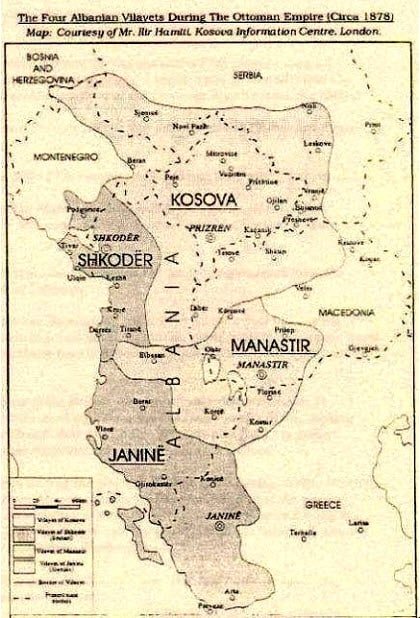
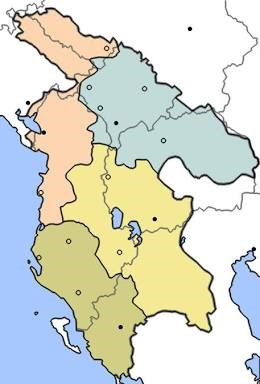
Memorie.al – In 1888, the division of the four vilayets into sanjaks, and the sanjaks into kazas, was carried out, a division that remained in force until the end of Ottoman rule. The vilayets remained divided into sanjaks, kazas, and nahiyahs. Following the example of European states, under the orders of the vali stood the Mejlis – the Administrative Council of the Vilayet, on which depended the directorates of finance, of waqfs, of economy, of education, etc. Alongside the Mejlis stood the military departments of the vilayet, a series of judicial bodies and sharia offices; the gendarmerie and police organs, which depended directly on the vali. A more or less similar administrative system was also held by the sanjak with its kaza, with the difference that the mütesellim and the commander of the kaza depended on the mutesarif and the commander of the sanjak, while the latter depended on the vali and the commander of the vilayet.
Here is the administrative division:
I – The Vilayet of Shkodra:
Sanjak of Shkodra (Kazas of Shkodra, Lezhë, Pukë, Ulcinj, Tivar, Mirditë, Malësia, and Podgorica).
Sanjak of Durrës (Kazas of Durrës, Tirana, Krujë, and Kavajë).
II – The Vilayet of Manastir
Sanjak of Manastir (Kazas of Manastir, Florina, Kičevo, Prilep).
Sanjak of Korçë (Kazas of Korçë, Starova, Kolonjë, Kostur, Bilisht, Hurupisht, and Opar).
Sanjak of Elbasan (Kazas of Elbasan, Gramsh, Peqin, Çermenikë).
Sanjak of Dibër (Kazas of Dibër, Mat, Radomir, and Rekë).
Sanjak of Ohrid (Kazas of Ohrid, Struga).
Sanjak of Serfidže (Kazas of Serfidže, Kozhani, Naseliç, Lapsisht, Grevena, Kayalar, Elassona).
III – The Vilayet of Janina
Sanjak of Janina (Kazas of Janina, Leskovik, Konica, Filat, Paramythia, Metsovo).
Sanjak of Gjirokastër (Kazas of Gjirokastër, Delvinë, Tepelenë, Përmet, Himarë).
Sanjak of Berat (Kazas of Berat, Vlorë, Myzeqe, Mallakastër, Skrapar, Tomorricë).
Sanjak of Preveza (Kazas of Preveza, Margëlliç, Loros).
IV – The Vilayet of Kosovo
Sanjak of Shkup (Kazas of Shkup, Kumanovë, Kaçanik, Veles, Shtip, Radovisht, Koçanë, Kratovë, Peçevë, Palankë).
Sanjak of Prizren (Kazas of Prizren, Tetovë, Lumë).
Sanjak of Pejë (Kazas of Pejë, Gjakovë, Gusinje, Berane, Tërgovishtë).
Sanjak of Prishtina (Kazas of Prishtina, Gjilan, Mitrovicë, Vuçitern, Preshevë).
Sanjak of Novi Pazar (Kazas of Novi Pazar, Sjenica, Akovë, Novavaroš, Prepolje).
Composition, distribution, and population numbers at the end of the vilayets (1912)
The population inhabiting the territories of the four vilayets in 1912 numbered approximately 3,220,000 inhabitants. The Vilayet of Kosovo had the largest population. Then came, in order, the Vilayet of Manastir, Janina, and Shkodra. The Vilayet of Kosovo had 1,150,000 inhabitants; the Vilayet of Manastir 920,000 inhabitants; the Vilayet of Janina 720,000 inhabitants; the Vilayet of Shkodra 440,000. In total, they consisted of 3,220,000 inhabitants.
According to approximate calculations, the ethnic composition of the population in the 4 vilayets in 1912 was: Albanians 1,760,000; Macedonians 680,000; Greeks 350,000; Turks 180,000; Serbs 190,000; others 60,000. Total sum 3,220,000 inhabitants.
The distribution of the Albanian population was not the same in all vilayets. The largest number of Albanian population was in the Vilayet of Kosovo (about 710,000 souls). Then came, in order, that of Janina (370,000 souls), that of Manastir (360,000 souls), and that of Shkodra (320,000 souls).
Sanjaks with an entirely Albanian population were the sanjaks of Berat, Durrës, and Elbasan; sanjaks with an absolute majority (the sanjaks of Shkodra, Gjirokastër, Pejë, Korçë, Prizren, Prishtina, and Dibër); sanjaks where the Albanian population formed a minority were Novi Pazar, Preveza, Manastir, Janina, and Shkup. The only sanjak where the Albanian population carried no weight whatsoever was that of Serfidže in the Vilayet of Manastir.
Mehdi Frashëri’s project, the most accurate of Albanian administrative divisions
Although nearly a century has passed since then, the foundations of Albanian administrative reform remain those laid in 1931 by one of the most renowned and active figures of Albanian politics across several historical periods, Mehdi Frashëri. Mehdi Frashëri’s study is a study of great value and remains relevant in many aspects.
The current project, of 2015, closely resembles that of Mehdi Frashëri. The current one has five administrative units, while Mehdi Frashëri’s had ten such units, but we must take into account here today’s road and communication infrastructure, whereas at that time communication was extremely difficult.
Division according to Mehdi Frashëri, 1931 – 1932
Prefecture of Drinopojë (Dropull): Sub-prefectures of Sarandë, Delvinë, Konispol, Libohovë, Himarë, and Kurvelesh, with the prefecture center at Gjirokastër.
Prefecture of Vjosa: The Vjosa basin, meaning Vlorë, Tepelenë, Përmet, and a part of Leskovik.
Prefecture of Aps (the Albanian name for the Osum River): Kolonjë, Dangëlli, a part of Leskovik, Vakëfet, Skrapar, and all the highlands of Berat, with the prefecture center at Frashër.
Prefecture of Gjenis, center Korçë: The Plain of Korçë, Bilisht, Voskopojë, Opar, Gora, Pogradec up to the Qafa e Plloçës pass, Verricë, and Tomorricë.
Prefecture of Seman, center Berat: Mallakastër, Fier, Lushnjë, Sulovë of Gramsh, the plain of Berat with all the upper part up to Dobrenj.
Prefecture of Shkumbin, center Elbasan: Pogradec, Librazhd, Çermenikë, Zaranikë, Shpat, Dumbrea, Krraba, Darsia, the highlands of Peqin, Rogozhinë, Kavajë, and Durrës. As for Pogradec, up to the watershed of the lake with that of Shkumbin, it could be left to Korçë.
Prefecture of Erzen, center Tirana:The district of Tirana, Krujë, and Shijak.
Prefecture of Mat, center Burrel: The gorges that separate the Drin watershed from the Mat watershed, Mat, Upper and Lower Kthellë, Mirditë, and the part of Kurbin whose waters flow into the Mat.
Prefecture of Drin, in Albanian the Prefecture of Burim (Source), with center Anas or Homesh:
Kolbardh (Golloborda), Great Gorge and Small Gorge, Bulqizë, Peshkopi, Lumë, and the Has of Gjakovë.
Prefecture of Bujanë, center Shkodër: The highlands of Gjakovë, the highlands of Shkodër, Lezhë, and the plains part up to Lake Hoti.
The history of the administrative division of the Albanian state (1912 – 2015) – The dismemberment of Albania in 1913
The London Conference institutionalized the Balkan crime against Albania, but the international butchery was formalized at the Congress of Berlin. While the Balkan neighbor’s appropriated large territories from the Albanian borders. Serbia benefited from the regions of Pirot, Vranje, Niš, and Toplica. Since it was not supported by Russia, the Serbs were forced to withdraw from Prishtina and Gjilan, failing to take all of Kosovo and the Vardar valley.
Meanwhile, Montenegro, which for the first time also gained independence, benefited from the regions of Nikšić, Kolašin, Spuž, Podgorica, Žabljak, Tivar, Plav, and Gusinje. After the great Albanian resistance, instead of Plav and Gusinje, Berlin would give Montenegro the entire region of Ulcinj. This historical injustice removed from the map of Albania: Prishtina, Gjakovë, Prizren, and all of Kosovo, the Plain of Dukagjin, Ulcinj, a part of the Vermosh areas, Plav and Gusinje, Shkup, Tetovë, Janina, Preveza, Chameria, a part of Lake Pogradec, a part of Lake Shkodra, and so on.
The Albanians, with the anti-Albanian decisions of the Congress of Berlin (1878), the Conference of Ambassadors in London (1912-1913), and the Peace Conference in Paris (1919), became the only people on the globe that borders with itself, respectively that has itself as a neighbor.
Reforms, 1912 – 2015
The declaration of Albania’s independence on November 28, 1912, led to the creation of an independent state (albeit truncated), which urgently needed the formation of local administration. The first government accepted the organization of the “Common Canon of the Civil Administration of Albania” that had been formed on November 23, 1913, according to which the country would be divided into 10 prefectures, headed by prefects, and alongside the prefect stood the administrative council, which limited his power. As a subordinate executive legal unit, the sub-prefecture was accepted, headed by the sub-prefect, and below it, the province (krahinë) was accepted, headed by a provincial governor (krahnar).
When the Albanian state began work on implementing such a project, the Conference of Ambassadors rejected everything that had been created and imposed on the Albanian state the Organic Statute of Albania. This statute was approved in Vlorë on April 10, 1914. According to the “Statute” (articles 95-97), Albania (which was under the rule of Prince Vid) was divided, from the administrative-territorial aspect, into 7 prefectures.
At the Congress of Lushnjë, the “Canonical Bases of the High Council” were approved and the monarchical regime was accepted, but due to the inability to determine a “King,” leadership was left to regency composed of four persons. The “Canonical Bases” maintained the previous administrative organization until 1924. In 1924, the prefectures were: Berat, Dibër, Durrës, Elbasan, Gjirokastër, Korçë, Shkodër, Vlorë, with a total of 39 sub-prefectures, where Tirana was a separate sub-prefecture.
With the declaration of the republic, the administrative-territorial organization was carried out by dividing the country into 10 large units (prefectures), into sub-prefectures, communes or provinces, and into municipalities in urban areas. With the approval of the new statute of the Kingdom, on September 1, 1928, the administrative-territorial organization did not undergo any significant change. The subunit “province” was abolished, and the concept of “commune” was introduced.
In the organization of 1937, this vertical pyramid was also maintained, but in the designations, the term “district” (rreth), “commune,” and “municipality” was also used. During the Italian fascist occupation of the country, which in 1940 made a new administrative division, maintaining the 10 large units divided into 30 sub-prefectures, and these were divided into 159 small local units (23 municipalities and 136 communes) with 2,551 settlements. After the end of the Second World War, until the middle of 1946, the existing administrative division was accepted on the basis of 10 prefectures and 61 sub-prefectures, abolishing the commune and municipality element and introducing the locality.
With the new administrative division in 1947, the county (qark) and the locality came into wide use. The country was now divided into 10 large units called prefectures, 2 subunits called districts (rrethe), and further into localities, villages, and cities. In 1953, a new administrative division was adopted, where the largest unit was accepted to be the county (qark) (10 units), which was divided into districts (49) and into localities (30) as a subunit of the district.
By the decree of 1958 (July), a new administrative division was adopted, where the county unit was abolished and the district (rreth) was designated as the largest local unit. The entire country was now divided into 27 units, of which 26 were districts, while the city of Tirana emerged as a separate administrative unit. The aforementioned administrative division remained until 1967, when a new element, the “united village,” entered administrative morphology, born as a result of the socialist cooperation process in agriculture. In 1968, in Albania there were 26 districts (Tirana lost its special status), 104 localities, 315 united villages, 2,545 villages, and 56 cities.
In 1990, there were 26 districts, 539 united villages, 306 city neighborhoods, 57 cities, and 2,848 villages. In 1992, the largest local unit, the “prefecture,” was introduced into the administrative division. The implementation of these decisions created a local morphology composed of 12 prefectures, 36 districts, and 357 communes and municipalities. In 2000, 373 local units were created: Of these, 308 communes, 65 municipalities, and 12 counties (qarqe).
Administrative division 2015 (12 counties, 61 municipalities)
County of Berat: Municipalities: Berat, Ura Vajgurore, Kuçovë, Skrapar, Poliçan.
County of Dibër: Municipalities: Peshkopi, Bulqizë, Burrel, Klos.
County of Durrës: Municipalities: Durrës, Shijak, Krujë.
County of Elbasan: Municipalities: Elbasan, Cërrik, Belsh, Peqin, Gramsh, Librazhd, Përrenjas.
County of Fier: Municipalities: Fier, Patos, Roskovec, Lushnjë, Divjakë, Ballsh.
County of Gjirokastër: Municipalities: Gjirokastër, Libohovë, Tepelenë, Memaliaj, Përmet, Këlcyrë, Dropull.
County of Korçë: Municipalities: Korçë, Maliq, Pustec, Kolonjë, Devoll, Pogradec.
County of Kukës: Municipalities: Kukës, Has, Tropojë.
County of Lezhë: Municipalities: Lezhë, Mirditë, Kurbin.
County of Shkodër:Municipalities: Malësi e Madhe, Shkodër, Vau i Dejës, Pukë, Fushë-Arrëz.
County of Tirana: Municipalities: Tiranë, Kamëz, Vorë, Kavajë, Rrogozhinë.
County of Vlorë: Municipalities: Vlorë, Selenicë, Himarë, Sarandë, Konispol, Finiq, Delvinë. / Memorie.al