



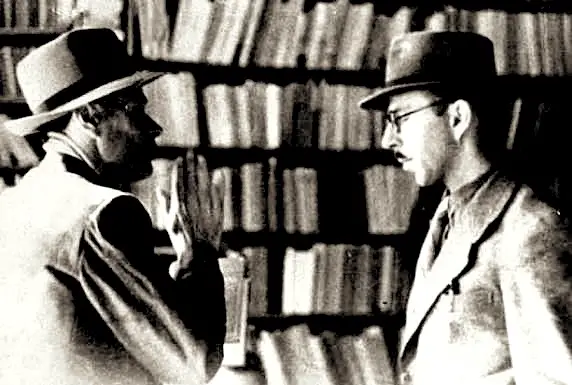

A testimony by Mevlan Shanaj about Lasgush Poradeci
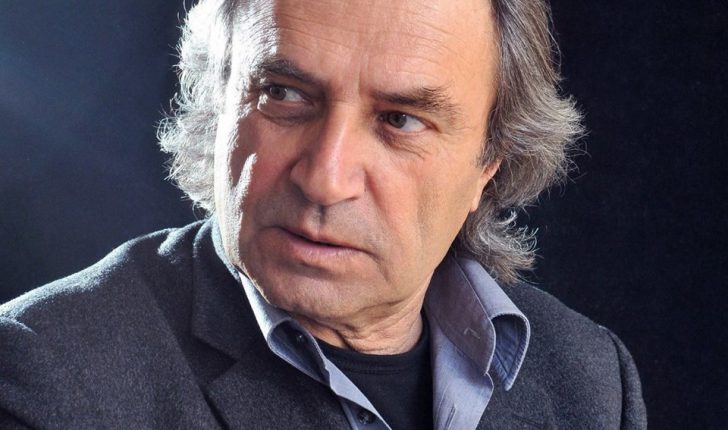
Memorie.al/ The well-known actor Mevlan Shanaj has recently spoken about his spiritual connection with the great writer Lasgush Poradeci. He recounts that he had the fortune to meet and talk with the writer, from whom he learned a great deal.
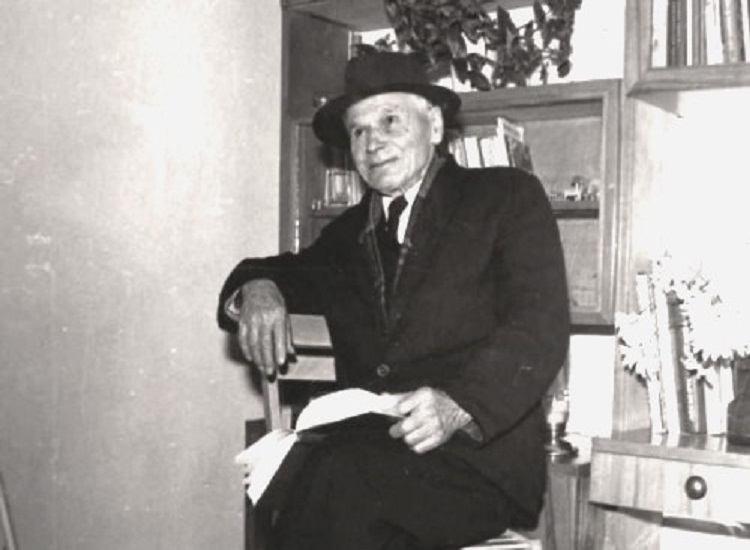
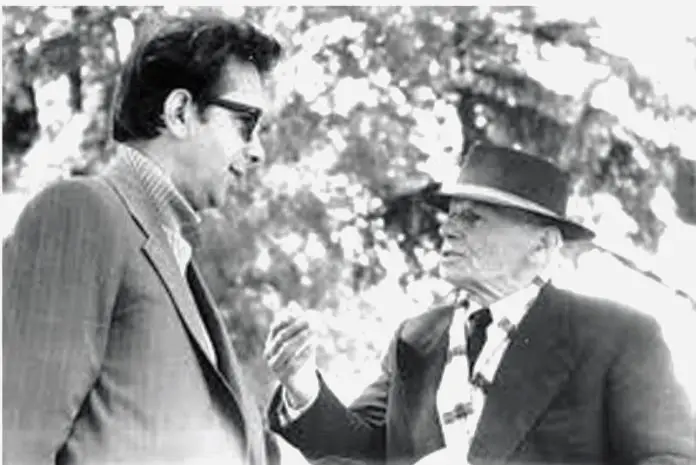
Lasgush! How frightening it is to approach that name! I had the opportunity to approach him, to converse with him, for him to tell me many things – not only about aesthetics, about life, about school, about women – and always proud, vain, dictatorial (in fact an emperor of free thought). In July 1981, Mario Ashiku, a director in Pogradec (of course, as a former student expelled from the Institute of Arts), together with his troupe of actors, had prepared a performance based on Poradeci’s poetry.
Sgalemi’s work had fallen into my hands. I spoke with Dr. Misto Marko, a friend of Lasgush’s, a learned man. We went to Thomaqi’s, the closest friend. Thomaqi had a sort of studio; let’s call it, where he worked as a painter, or as an executor of the city’s posters and announcements.
His passion was movie posters. Lasgush would spend hours there in that studio with Thomaqi; right there, on one of those tape recorders that the League of Writers had distributed, from time to time Lasgush would recite! I don’t know where those poetic readings with his own voice might be now.
In order to persuade him to give an interview, we went to meet his childhood friend Nuçi Tira, who was “in power” as deputy head of the Internal Branch. It was decided that the next day Lasgush, his friend Nuçi, and Dr. Misto would meet us in Drilon – there was peace and beauty! It was the place where Enver Hoxha used to vacation. We, as television people, convinced them, since Enver would come in August!
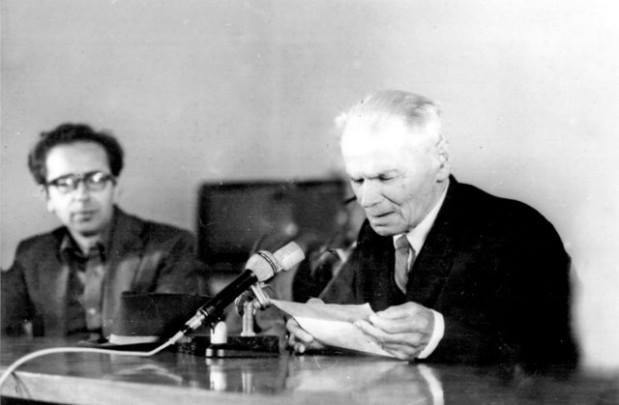
We met, and the conversation among them was free, like between daily friends. The raki “Perla” or “Moskat” – which he loved – also arrived. While filming, he was completely free in his thoughts. With Stefan Gajo’s camera, using 16 mm film, we shot nearly two hours.
At one point, referring to Naçi (the cameraman), he said to me: “Why does this one just stand there like a statue, not saying a word at all?” Among many conversations, he cited Kosovo: “Kosovo – a Skanderbeg-style struggle… it will suffer because it did not go through the Rilindja (National Renaissance); no people develop without going through the Rilindja.”
Then he says to me:
– “I don’t just write poetry any old way; the millstone has to move! Do you know – the millstone?”
– “Yes,” I say to him.
Without warning, he shouted at me: – “You don’t know anything!”
I fell silent. Those who knew his quirks didn’t react, but Dr. Misto said to him: “Mr. Llazar (no one called him Lasgush to his face, only Mr. Llazar), this one knows that he is Natasha’s husband!”
– “Ah,” he said to me, “she is good!”
During the conversation, he mentioned only Ismail Kadare – and of course, in a positive way. And the world-renowned names: Lermontov, Heine, and Leopardi!
– “Do you know how many books each of these wrote?”
I shrugged my shoulders!
– “Only one each,” he told me, and raised his little finger. “Because poetry is not an art that can be done on commission. For me to write one poem, I stay at it for months or years! They ask me why Llazar doesn’t write. Well, I wrote one about Reshit Çollaku because I knew him, and I said: ‘Come on, Reshit Çollaku, you shot seven and killed eight’ – why did I write it like that? Because he was a brave man!”
From the interview, 31 minutes were broadcast on TVSH (Albanian State Television), and another 30 minutes I synced and delivered to the archive, because they were free thoughts that certainly would not have been approved for broadcast at that time. Ten years later, in 1991, I went to the TVSH archive and asked for those synced materials, ready for broadcast, but I did not find the film.
When the documentary about Lasgush was shown at a film festival, I was walking down the stairs of the Palace of Culture with Viktor Gjika, who held in his hand the festival cup for the documentary “4 Songs for the Party.” He said to me: “This cup belonged to Lasgush, but the Party takes everything.”
I return to that time with Lasgush. On the evening of that day, there where they now call “Turizmi” (Tourism), the five of us were taking a stroll. Dr. Misto says:
– “The wind is blowing, Mr. Llazar, let’s go!”
“No,” he says, and he grabbed my hand and showed me that under his shirt he had cardboard, to protect himself from the wind – “The wind can’t do anything to me, I’m protected.”
And a little further on, he took out his watch from the pocket of a worn-out suit. The watch was a Chinese table clock. It fell from his hand; I bent down and picked it up. He put it to his ear and said:
– “It’s still working! Why are you looking at me like that, surprised?” he said. “A watch is for telling the time, not for strutting around with expensive watches! This one does the job for me…” – and he put it back in his pocket! Of course, when you were with him, he talked, talked, and told endless stories with a phenomenal memory!
That is who Lasgush was to me! More than a legend – not a man, but a magic that continues to wander through the minds of every citizen of Pogradec! You know, once they brought him from the hospital dead, but after a few hours he rose from the coffin! And he said: “I am Saint Lazarus; I do not know how to die!”
That was Llazar Gusho! Much later, together with Natasha, we prepared a script for a feature film; we went to meet his daughter Marie to ask for permission for the rights. Only a wish remains! The script sits in a drawer, as do many, many other works by creators. / Memorie.al
![“The ensemble, led by saxophonist M. Murthi, violinist M. Tare, [with] S. Reka on accordion and piano, [and] saxophonist S. Selmani, were…”/ The unknown history of the “Dajti” orchestra during the communist regime.](https://memorie.al/wp-content/uploads/2026/02/hotel6-75x75.jpg)
