Memorie.al / In the dimensions of time, when it came to life, the Vlora trio found itself on suitable ground, almost “embers and flames” as one might say in the local tongue. A “time of hunger” for the needy soul was felt for the urban song of Vlora. This kind of urban folk song, accompanied by folk instruments, spread and truly began a beautiful tradition. It was winter, though the season of its arrival was not very decisive. What mattered was that in the life of Albanian folk song, the Vlora trio appeared, was born or came – a solid group, with harmonic voices, a brilliant group of three members. Its arrival is like the time a mother waits for her son, like the bride’s longing for her husband, the father’s longing for his child.
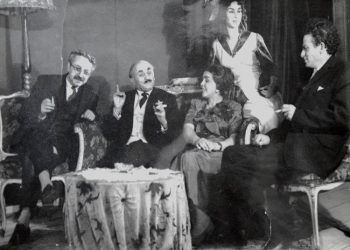
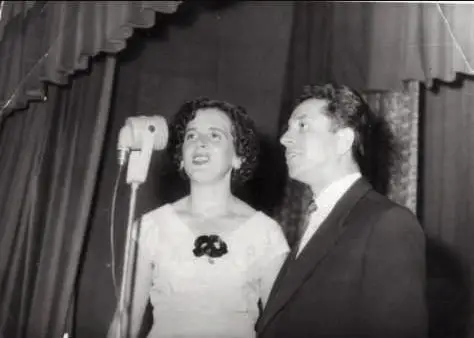
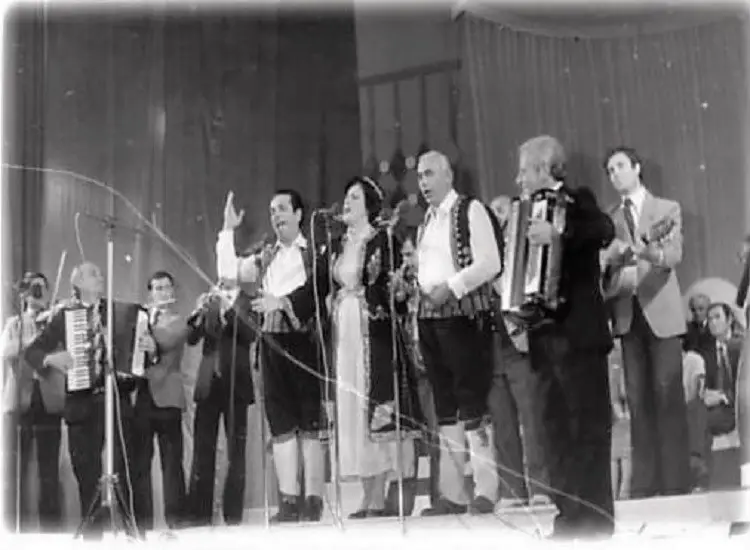
The time of the Vlora trio is the 1970s. A quarter of a century ago, in the coastal city, in the variety theatre hall, a small brilliant group was born, named simply and clearly: “Vlora trio”, but in essence it signified the trio of an urban folk song group, with protagonists: Meliha Doda, Konstandin Thana, Reshat Osmani. Is the silhouette of the Vlora trio felt today, in this time of rock and all kinds of musical currents? Specialists say that trios do not appear often, like stars – they come, bring their light, and disappear. In truth, poetry, song – that inspiration – also has a source from there, from the immeasurable sky-space.
Perhaps it did not come with crying and noise like every arrival in our life, but sweet, warm, surprising, inspiring. Thus her contemporaries describe the arrival of this group, as well as others of Albanian folk music. 30 years after the time of the Vlora trio, the City Municipality has put a brilliant idea on paper. Recalling the Vlora trio and folk music, today there is a disfigurement of folk song – but not in all cases, but in most cases, this type of song arrives with mess and noise, sometimes copied from neighbours, sometimes stolen from somewhere farther away; but what pain you feel, oh God, how nervous you become when the soul seeking beautiful music feels its sole slipping, a composer from this city complained to me.
The innovations and traditions that are changing so suddenly and crazily are collapsing before you, like an entire building, ash and dust – that part of that generation which brought them remains unrepeatable: those songs, melodies full of grace and beauty, sweet as honey, lovely as beauty itself; one didn’t know from which element of the creative soul they had been created musically; they seem not to reach us as we expected – only brought and processed without originality.
35 years ago
Thus, 50 years ago, under the frost of the coastal city, under the iodine wind, but without changing the graph of its existence, a musical group was conceived, the only one with three selected participants. It was the Vlora trio, born among tears, melodies, and the poetry of beauty. 50 years ago, the “diagram of musical groups” underwent an extraordinary movement; it was a significant indicator for souls that sought space – or perhaps let me call it a kind of eclipse, but of the musical moon!
Three names of one group: the Vlora trio. Meliha, Konstandin, Reshat. In a segmentation of this group we find two male voices and one female voice. A combination easily found in the people’s sole, in Lab folk music. On this trail, the reference was taken around a single point. The Vlora trio came, lived perhaps over 30 years, a dense path. It appeared like a boreal vision among us, yet the durability of its songs remains undiscovered – songs that are becoming a source for young singers today.
They are processing the leaven, you might say?! But to this day there is no singer or group among today’s noisy ones that possesses the beauty of the trio and the sweetness of Meliha Doda’s voice. But in the future, we do not rule out this possibility. Although the trio is rhythmically supplying today’s singers, who have taken and are taking songs from the Vlora trio for their repertoire.
The constellation of singing stars
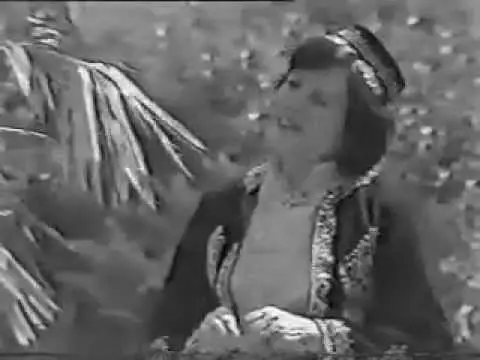
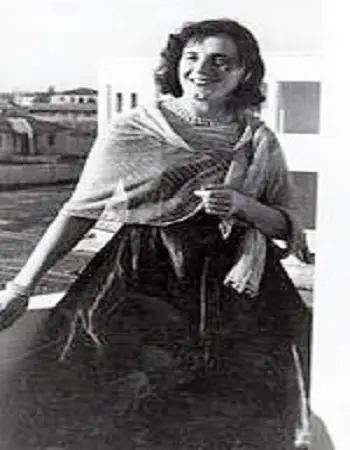
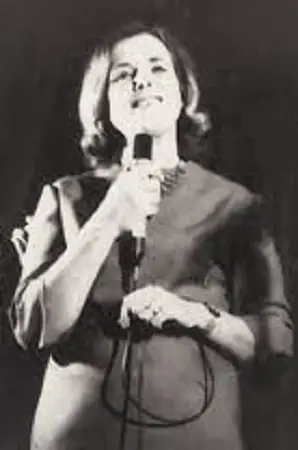
In the constellation of folk singing stars, Meliha Doda, I would without fear call a bright star. A jewel of the Vlora trio contains a height in the wall built by urban folk singers. Meliha Doda, the urban folk singer, the most adored for 30 years in folk music, received me in her apartment near the old clock in the city center; she was the only artist of this urban folk art group who remained in her city; she passed away many years later.
I keep this interview as special. Reshat, the artist and composer of this special group, passed away some time ago. While Konstandin, I believe, is abroad in emigration. Meli, as they call “the beauty of Vlora’s songs”, retains the same timbre of voice as in her youthful songs. Melihaja is the singer of Vlora’s anthem song “Orange Aroma”; you used to hear its melody at youth actions during massive deforestation, on railways when a new route was opened, among high school students who wove love verses over her lyrics: “Lift your head high, for I miss you / your throat, my dear, smells of orange aroma…”! It was truly a lyrical song. It contained simple verses and a quickly catchy melody: “Mother Orange tree, what have I stopped you for? / the lemon flowers, my dear, would fall into your eyes…”!
At weddings, before the bride’s veil, the groom sang to love while the small rooms filled with the sounds, the burst: “Lift your head high, for I miss you… orange aroma”. With this song a wedding here in the south, in urban homes, would begin, take shape, and end – and even today it is exactly so.
The song of unknown travellers
There is an early axiom that says, when I was born I didn’t ask the world, or… etc., etc. But Meliha Doda, one of the stars of this musical group, tells it somewhat differently: “I came into life in the capital city. I was born in 1933, in Tirana. My origin is from Kosovo. From the city where the famous league of Albanians was formed in Prizren. My parents came down from Kosovo around the 1930s. We lived in Tirana, where we had a house. My mother was a noble highlander from Dibra e Madhe, from the Shehrit tribe. I learned my first letters of Albanian at the ‘Avni Rustemi’ school. At that time, it was a 7-year system. I stayed in Tirana until the second year of the 7-year school.”
Unfortunate tumbles or separation through pain
In the south, people begin their narratives tied to the history of your country. Meliha’s narrative followed exactly this bed: “My father, an anti-fascist, shaken by the pain of the occupation of the country, together with my uncles, was interned by the Germans. My uncle, Xhevdet Doda, is a ‘Martyr of the Fatherland’, who could not escape the horrors of the Nazi concentration camps. Only my father survived that mad hell. My father went to Kosovo. After Albania broke with Yugoslavia, where Albanian lands were unjustly located, following the ‘merciless surgery’ of the early century, father went over there; we remained here, me and my mother. It is difficult to describe a double pain.”
Wounded hearts
The tracks along which the singer’s life flowed are legible, but she adds: “The only ones who became our shelter were our people in Tirana, but even there things would soon change. By then, the concept of social movement touched my childhood. Around 1947, our relatives – uncles, aunts – were expelled from the capital as large trading families, sent away never to return. Mother and I went to Shkodra, we had some support there. I finished secondary school at ‘Shejnaze Juka’. In 1952, I received my assignment to the southern regions.”
The city with orange aroma
An unknown journey to the south of the country marks the beginning of the singer’s arrival toward the southern regions. “I was terrified as we turned the pages in our hands. There it read: teacher in the village of Piqeras. I don’t know even today where it falls, but I know it is on the coast of Saranda. My mother felt equally desperate. The journey was completed, but we ‘got stuck’ in Vlorë, halfway. The southern city thereafter became my permanent shelter. It was the year 1952. Under these circumstances, I got to know the city with the aroma of oranges. I stayed 4 months without work.
We would dawn and dusk alone with a basket of belongings at the doors of the Hotel ‘Sazan’. Great financial difficulties began to appear, because we lived on the help sent by our uncles. All those days turned into anxiety. I realised we couldn’t make it any longer. It was written that we would go through this – endless suffering. Money was diminishing every day, while my mother kept falling ill. We did not want to go further, at least in those circumstances we were in. It was a terror. Not even chance could bring us anything at that moment. So worried, not wanting to leave this city any more, but feeling a thread of hope, I went to the House of Culture. There, where I met Themistokli Mone, song entered me like that cold deep into my soul.
Generally, I come from a family of musicians. My aunt kept freshness for song. My grandfather played the dajre, my uncle the violin, while my father the mandolin. That is a musical instrument used in the lands of Kosovo. But already when I was at ‘Shejnaze Juka’, I had been identified as a singer. My voice flowed at least without interruption, it was clear. In Shkodra, when I was a high school student, I had sung with Simon Gjoni, a well-known composer from Shkodra. Professor Liu managed to capture all my sufferings and experiences. I will sing, I told him, because I need to live. Professor Liu helped me when my mother and I were at the peak of trouble.
He took care to place me as a teacher at the ‘1 Maji’ school. I was 19 years old and whatever I sang, although with a girlish fragility, brought me closer to this city. I worked as a teacher at schools No.1 and 2. During this time I was very active. My voice had crystallized. I was offered a place the day the city’s variety theatre was formed. That was also my first family. We felt liberated within that first nucleus. The variety theatre of Vlorë was formed with 15 people. Through the effort and persistence of artists – M. Ferra, G. Vishi, V. Panozaqi, P. Sava, E. Shtrepi, M. Lako – they created a variety theatre whose voice would be heard far, not only within this city.
The unrepeatable folk creation – Vlora trio
Identified in this city, in its urban music. Haven’t you heard the famous Vlora trio, the trio of Konstandin, Meliha and Reshat? It was a form of singing by three people, the ‘lebrëit’ – when three sang, otherwise they had nothing to do. Dukati brought out a way of singing in a polyphonic trio. This tradition, traced by Themistokli, perhaps fell on his ear in the villages of Labëria – the source remains unidentified – the best, simplest, shortest, concise way of urban song by three people that would bring success to the stage, and perhaps this was also a way to test, a way that would result for that time in an ascent to unattainable and indisputable musical heights. Meliha has recounted the discovery of this way as follows:
“Themistokli Mone, with the dimensions of an artist, with eyes and mind on the stage, created ‘Vlora Wedding’. It was the song of all areas like Kanina, Lumi i Vlorës, ‘Bilbili’. After ‘Vlora Wedding’, the group was pinpointed. The trio was Reshat Osmani, Kostandin Thana and I. The Vlora trio was built like that: two men were the takers and a kind of thrower of the song; I was the woman’s voice. So it was a form of folk song with the contours of the Lab group. The Vlora trio was the first form at that time. After us, Gjirokastra and Lushnja produced trios. On the day of its formation, the Vlora trio consisted of the youngest age of song. Reshat were 25 years old, Kostandin 26, I 22.
Other trios have been tried, they could not reach the Vlora trio
About 10 years ago, I contacted the leaders of the ‘Labëria’ Palace of Culture, who told me: ‘Several trios have been tried, at least 4-5 such trios, but all the attempts have died out, bringing only despair. At every city and district festival, we have presented a Vlora trio – thus this manner of singing by three is issued – we have sent a Vlora trio, but they have not been as successful as the immortal trio of Meliha, Konstandin and Reshat.’
Efforts have even been made to revive this branch of folklore, but reality has proved merciless: trios have been forgotten immediately, or these trios have copied the songs of the famous trio, and it is known that the copy is not remembered in front of the originality, finesse, beauty, and sweetness of the Vlora urban songs that the first trio in the country created. Perhaps, say the specialists, this trio had its own place and its own time, when it reached its heights. It was longingly awaited like rain clouds, or the rush of wind in spring – but they never hope to reach the dimensions of the first Vlora trio.
At every folk festival it has been attempted, we have sent a trio – the director explained to me – the public awaited it like the sea waits for seagulls, the shores witness the waves, but the trio of this time no longer raises. Its time was a furrow of years that had as its cubature: birth, the point of success, just as the minute waits for the minute – the trio began with the 1980s, aged and felt its dissolution. In the spaces of folklore, it was the clearest part, a sign of the uniqueness of this urban folk. In the verdure of songs, let it be called the most special four-leaf clover. In its beauty with stars – a meteor of song.”
The moment of divine wandering or spiritual magic
After the birth of the idea came the first creature conceived on musical pentagrams. The appearance of the first song of the trio, Meliha recalls: “The first song of the Vlora trio is: ‘Where the birds sing, oh’. It is a song with a wonderful melodic line. Its source was taken from the village above the city with tradition and history – Kanina.”
The seeker and researcher – Reshat
But the promoter of the trio was Reshat. Reshat Osmani, for the most part, was a searcher, a researcher of melodies and motives in villages where the sole of the song lay, conceived so early in the minds of people who had preserved it within their soul. Melihaja describes him in this way: “He roamed the villages for days, digging with passion. The songs he found he would take, process with the folk orchestra, characteristic for the Vlora trio. And these songs of the Vlora trio are not few. He discovered this treasure. The wonderful reception of the trio increased our desire for this discovery. We started making tours, even for the first time – how would it be received? Curious people would ask by the bus: Has the Vlora trio arrived?”
The trio’s songs on the Russian steppes
On the steppe, twilight absorbed the drizzling rain. Meliha remembers concerts in the former Russian republics of the Soviet Union. “In 1957, we were sent to the Soviet Union, to a concert at the Moscow Festival. There we won third prize. The trio’s songs, under that quiet of the Russian steppes, were enchanting. We toured through the Soviet Union; our songs were very melodic, they did not have the coldness of the far west of the steppes. The songs were: ‘Come, my Vlora plum’, ‘Myzeqe girl’.
When the song festival opened for the first time at the end of 1961, I sang two songs. ‘I sing’, a composition by Avni Mula, and the song ‘Vashëzo’ by N. Uçi. The press made important evaluations. They first called me the Milva of Italy. In 1964, we were invited to the Mediterranean Festival in Egypt. There they gave us second prize, and we also toured in Algeria and Morocco. After the trio gained this fame, I also began to carry the greater weight of the variety theatre. My composer was Reshat Osmani.”
Spiritual drive
“Until 1968, I was a professional singer in the variety theatre. But 4 years after marriage, I was removed from the stage and sent as a teacher to the ‘Teli Ndini’ school. I trembled with anxiety, but the fear of not returning frightened me; everything was built like that house and could be destroyed.”
The magical voice
A beautiful, resonant voice, sprung and nurtured in the south, was the voice of Meliha. In the narrative carefully brought by the famous singer, now elderly Meliha Doda. Perhaps a time comes that she has allowed herself to transcend spaces and possibilities. There is also a typical Albanian paradox, which appeared seriously in the past: the more famous you are, the more they bring you down, because it was not difficult to rummage through biographies and files to find the hidden mystery that would bring ruin. Melihaja recalls that time thus:
“At night I would go and sing on the stage. I had success guaranteed. Even directors, for this reason, would leave me for the end. I would quarrel with them; they would place me at the beginning – tomorrow I’ll go to work and by evening I’ll be here. The variety theatre gave performances every night, except Monday. I participated in every premiere. I sang even eight months pregnant, so much so that the gynecologist who happened to be in the hall shouted: Go, go, otherwise you’ll have the baby in the hall.
And when I was expecting a return, they removed me completely from the school. They sent me as a caregiver to the kindergarten of the ‘Naim Frashëri’ school. Until I retired, I worked there. When I went on tours, they called me a professional; they did not know what suffering I endured; my heart was broken from despair. The Vlora trio faded around 1983. It was the time of pensions; age left the song behind. But put differently, from this trio – some with spirit, some with will – kept it alight.
In the concert meeting of song in Vlorë, with the best singers, the divas were: Vaçe Zela and Qemal Kërtusha. It was a strong rivalry. I couldn’t find peace, because they had placed me after Vaçe. I trembled because, after Vaçe’s prize, every song of ours would sound pale. ‘You will go on,’ they told me, ‘because the people love you.’ The hall was convinced that it was a good song, and it welcomed me. I tried to find the songs the people loved.”
The dawning of morning – the encrypted part of the dream
The trio in the 1990s did not resemble the expression “dead but unextinguished”; rather, the more the years crumbled, the more the trio lit up with brilliance, became more beautiful, shone like light and became more sought after. It resembled gold – the more the hammers beat it, the more beautiful and more brilliant it became. The Vlora trio contained elements of this urban musical gold.
“With hope like all other Albanians. I awaited the changes as a blind man awaits light. We often say: Doesn’t the blind man want light? In the time of changes after the 1990s, our songs began to appear abroad. There was an ‘appetite’ in the cassette market. Today, I rejoice like a child when I go out on the street and they tell me: I need one of your cassettes; my daughter in America asks for it, or elsewhere. But in these recent years the situation has changed.”
On the reverse of the moon’s nectar
They have spotted it in the deep dream. Besides awakening the desire to become famous, they have felt the last tear in their soul. Deeply they have cried out: “I have become famous”! They have walked along the “difficult monopath” of the trio; their voice, their songs have been taken to reach the heights of the trio. They have felt tired hearts, dreams of bad nights. But their journey has continued – persistent and strange. Her tired soul could approach, but besides the ocean of her tears, the trio was at such a distance, in what remoteness.
It has outlined a tradition in the urban music of Vlorë where singers who came after the trio tried to appropriate the trio’s embryo, but its roots already felt dry. A group of singers, according to the time: Kleopatra Skarço, Milika, Anita Bitri (who died tragically in America), Ludmilla Baballëku, Aurela Gaçe, and finally the generation of young girls, the lasses of this city, who have entered somewhat differently into turbo-folk. They are bringing blossoming, they want to express themselves, but their songs are leaves detached from the flowers of the Vlora trio and Albanian folk.
“Poni”, a shortened name, Mariola, dared to take from a folk group “Gollovari” and snatched a bit, told herself “Fly with me”. Silva Gunbardhi, with “the old man and old woman started fighting”, make their journey to find a little place on the pedestal of Meliha, but with a CD in hand one day, far from any imagination, time will find them unremembered. “You have grown old, my friend, you have grown old,” says a folk verse – written in pencil, it is erased. Our unrepeatable sole remains beautifully beautiful.
The miserably poor copyists. In distance they are like hemispheres on the globe – from the equator of song they will be separated, a hundredfold apart, one day like any other day of the Albanian transition. Let this be said with pain by many singers from the generation of those singers who brought urban song to these levels. No one, at least to this day, has been able to take the place of the Vlora trio and the pedestal of the folk singer Meliha Doda. The Vlora trio and Melihaja are unrepeatable. /Memorie.al