By AGRON ALIBALI
Part Two
– According to American archival data –
Memorie.al / During the last two years of his life, Faik Konica was placed under FBI surveillance and investigation. The relevant archival records shed light on the final moments of the life of the distinguished diplomat who had long and with great dignity represented his small country in the American capital.
Continued from the previous issue
Konica, Noli and Kostë Çekrezi
Another interesting piece of information in the report of the FBI’s Cleveland office was the meeting of the APNH with an individual from Boston who was visiting Cleveland, Ohio, on April 27, 1942. According to the report, the latter had known Konica for thirty years and considered himself a “political opponent of Konica.” He explained to the Special Agent Konica’s alleged pro-Italian leanings. He mentioned that during the 1920s, when Konica lived for a time in Italy, the Italians called him “Principe” (Prince).
The reporter presents himself as an official of an organization “headquartered in Boston, Massachusetts.” All the above information leads to the conclusion that the person in question was either Çekrezi himself or a close associate of his who also knew Faik very well. The rift between Noli and Konica on one side and Kostë Çekrezi on the other is among the most tragic disputes in the history of the Albanian-American diaspora.
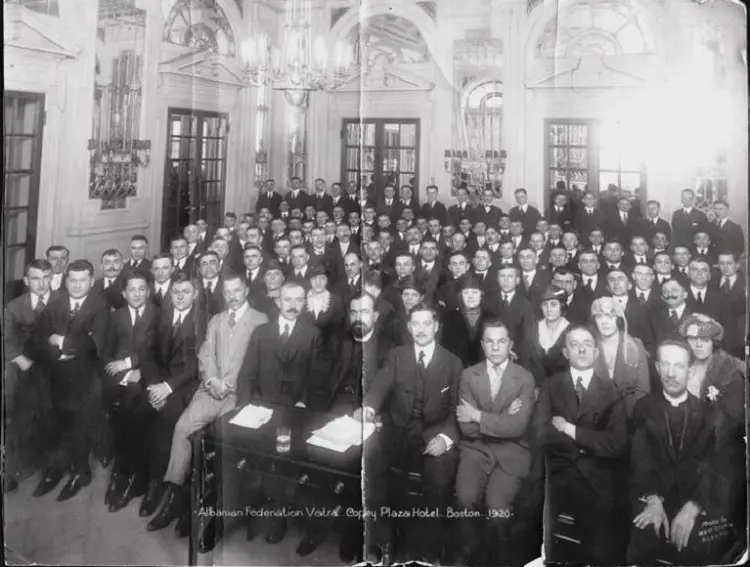
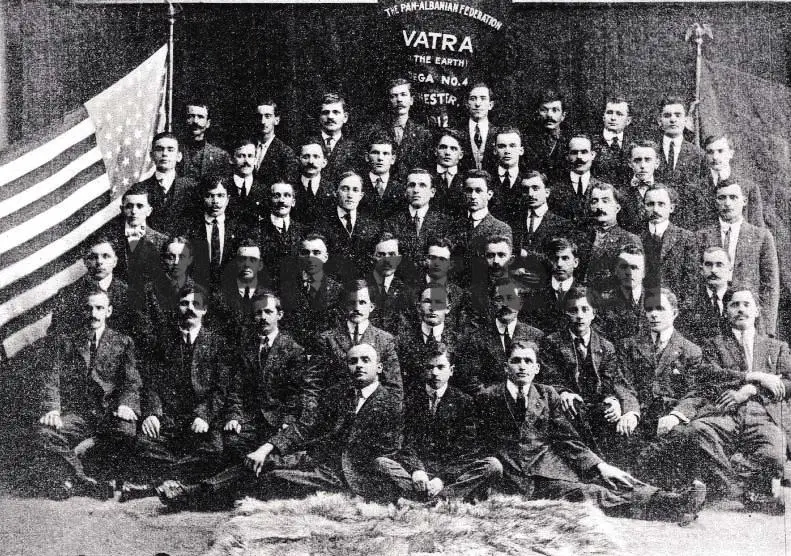
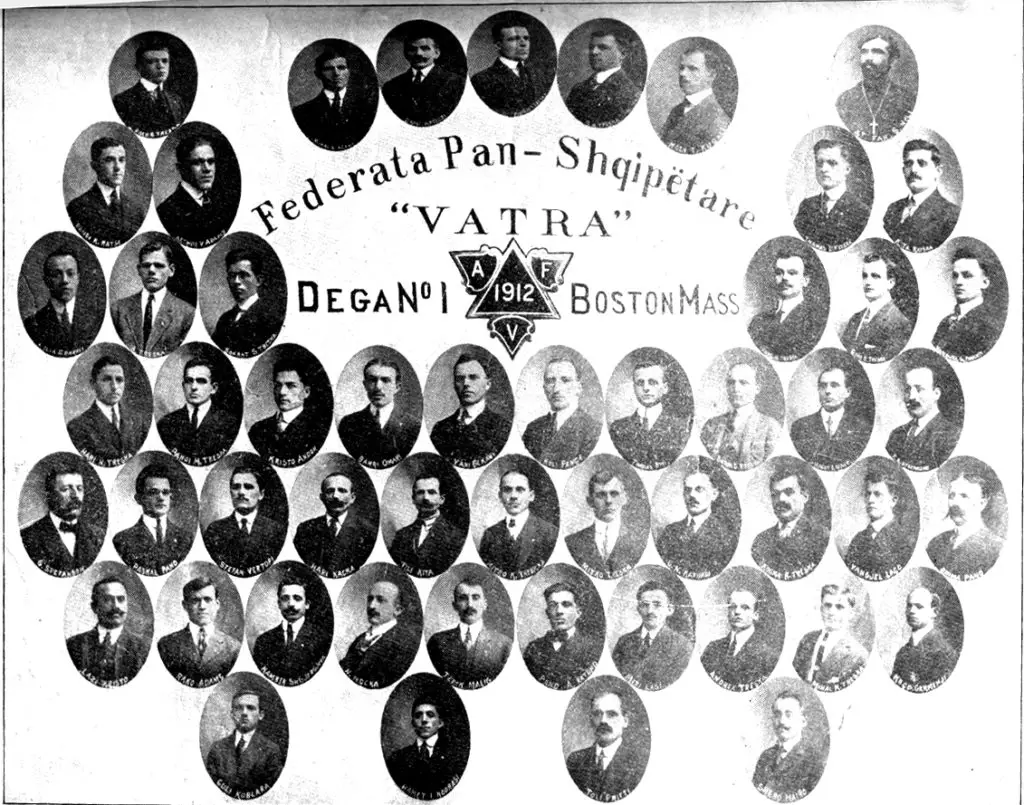
It damaged the unification of the Albanian diaspora at a very delicate moment of World War II and also hindered, to some extent, the formation of a government in exile that would be accepted by the Allies. Yet these three had so much in common with each other: all three had completed their studies at Harvard University; all three had been deeply involved with “Vatra” and “Dielli”; all three had written extensively, in English and Albanian, on the Albanian question; all three had important connections within the U.S. administration.
Çekrezi had been the first representative of the Albanian government in the USA as early as the 1920s, when the USA had not yet recognized Albania, while Noli had been a representative to the League of Nations, and Konica had been Albania’s Minister from 1926 until 1939. All three had had a difficult relationship with Zog, etc.
The beginnings of the rift between them are unknown, but it appeared irreparable after Noli and Konica, being seriously concerned about the danger of Albania’s dismemberment, declared their support for Ahmet Zog in 1942, a stance that Çekrezi strongly opposed. It should be noted that a year later, Çekrezi finally backed down from his intransigent position and engaged in cooperating with “VATRA” as well as reconciling with its stance toward King Zog.
Also, towards the end of the 1950s, Çekrezi addressed a conciliatory letter to Noli, who, for his part, with great devotion and respect, performed the religious services at Çekrezi’s funeral.
Konica’s alleged contact with the Italian consulate in New York took an almost comical turn shortly before Faik’s death.
On September 28, 1942, i.e., when Konica had only 48 days left to live, an acquaintance of Konica named Qemal Veiseli, a U.S. citizen born in Albania and residing in New York, wrote with considerable eloquence but also some anger to Secretary of State Cordell Hull, complaining about Konstantin Çekrezi.
It is likely that within the close circle of Albanians in America, most of whom had the greatest love and respect for Konica, the absurd accusations about Faik’s Italian connections had been fabricated. The letter, which also mentions a certain Asllan Dragoti, who appears to be the father of the famous Albanian-American Stan Dragoti, confirms that the accusation against Faik was unfounded, if not completely groundless, and that the entire investigation into him was nothing but a waste of time and financial resources.
Faik’s death and the closure of the investigation
As we have mentioned elsewhere, at 7:30 PM on December 15, 1942, a completely unexpected phone call arrived at the office of FBI Director J. Edgar Hoover in Washington, D.C. The unknown caller informed that Faik Konica had been found dead that day in his residence in the American capital, and that “he had received information that several unknown persons were removing Konica’s personal belongings from the house without completing the proper formalities”!
For this reason, he asked the FBI to “intervene to stop these actions.” The response he received was that “the Bureau had no jurisdiction over such matters.” Four days later, on December 19, 1942, the investigative file on Konica was officially closed. A report from that date also refers to Konica’s obituary, published in *The Washington Post*.
“The above information was confirmed by the telephone contact we made at the subject’s address (i.e., Konica’s) at 1530 16th Street, N.W.,” the report continues. The final document in the investigative file on Faik Konica is a posthumous Memorandum to Director Hoover from the War Division Office of the Department of Justice. The memorandum informs Hoover that Konica, Noli, “VATRA” and “Dielli” “were under review pursuant to the Foreign Agents Registration Act of 1938, as amended.”
It contains a well-informed summary of the situation within the Albanian-American community at the end of 1942 and its efforts to support King Zog and the unity and territorial integrity of Albania. The summary refers to two OSS “releases” dated October 12 and November 12, 1942, which are located in the American archives.
It must be borne in mind that the OSS prepared similar papers for other communities, such as the Greek-American community, and these activities were necessary given the circumstances of World War II.
The memorandum also mentions a Proclamation of King Zog published in *Dielli* in 1942, as well as an article by Qerim Panariti dated September 30, 1942, explaining “the history of negotiations among various leaders [of the Albanian-American community, my explanation, A.A.] in the United States.”
The two rival groups, it further mentions, were unable to resolve “their disagreements” at the meeting held at St. George’s Church in Boston on September 12, 1942. The memorandum also mentions the July 1942 letter from Sir Edward Boyle of Dorchester, England, who was Chairman of the Balkan Committee, addressed to Çekrezi, Noli and Konica, “asking for the independence of the Albanians and the cooperation of Albanians in the United States, Egypt, Turkey and elsewhere.”
The memorandum concludes that, since “VATRA” appears interested in the political situation of a foreign country and since it appears to be in contact with a support group outside the United States… “[it] may come to the attention of the Foreign Agents Registration Act of 1938.”
According to the Memorandum, it appears that summaries of copies of early FBI investigative reports concerning “VATRA” were also requested.
In his reply dated March 3, 1943, Mr. Hoover states that most of the reports on Konica were forwarded to the Division of Records.
Mr. Hoover also attaches a photostatic copy of a report dated August 16, 1923, from Boston, prepared by a Special Agent, and titled “‘Dielli’ – Newspaper of the Pan-Albanian Federation of America, 456, Tremont Street, Boston, Massachusetts; ALLEGED VIOLATIONS OF NEUTRALITY LAWS.”
From the American documents of the period 1910-1920, it is clear that “VATRA” and Noli were targeted by so-called “Epirote” groups in America, which unsuccessfully tried to pit the U.S. administrative bodies against Noli, Konica, “Vatra” and “Dielli,” raising completely baseless accusations against them. Nevertheless, the above-mentioned report is not available. / Memorie.al
References:
– FBI Archives, NY File No: 100-5889 AEK, report made in New York on 1/26/1942, author unavailable.
– New York Times, 12 December 1942.
– Ibid.
– Hito Sadik, An Albanian Letter, Italian Library of Information, 595 Madison Avenue, New York City, Coce Press, purchased by Harvard University Library on May 29, 1941.
– FBI Archives, 100-70857, F.B.I. 18 – March 6, 1942, U.S. Department of Justice.
– Letter of March 23, 1942 to unidentified individual, 1942, REL: AJB, 100-70857-2.
– Letter of March 23, 1942 to Special Agent in Charge, Ohio, REL: AJB, 100-70857-2.
– Report dated 5/6/42, File No. 100-5033 made at Washington, D.C.
– Letter of 9 May 1942 to Director of F.B.I. by P. E. Foxworth, Assistant Director, F.B.I. New York; NDW: 100-5889.
– Letter by John Edgar Hoover to the Special Agent in Charge in New York, New York, date and file no. unclear.
– See Note 7, p. 2, 00-5033.
– Faik Konica, Background of the Italo-Greek Conflict, in Albania – The Rocky Garden of Southeastern Europe, edited by Qerim Panariti, p. 172.
– Letter of 3 June 1942 by John Edgar Hoover to Special Agent in Charge, Cleveland, Ohio, 100:70857, JPC.
– Department of State Bulletin No. 64, July 19, 1941, mentions as follows: Gaetano Vecchiotti, Consul General, Cecilia Vecchiotti, his wife, Alfredo Spina, chauffeur, Umberto Caradossi, Vice-Consul, Cesare Psquinelli, Vice-Consul, Hito Sadik, Secretary. http://www.ebooksread.com/authors-eng/united-states-dept-of-state-office-of-public-co/department-of-state-bulletin-volume-v-5-jul–sep-1941-tin/page-8-department-of-state-bulletin-volume-v-5-jul–sep-1941-tin.shtml
– *Korrieri*, 30 November 2001. See also, “Hito Sadik, *Pas një Endrre*”, by Novruz Xh. Shehu, ASD Tiranë, 2001.
– Hito Sadik, *An Albanian Letter*, pp. 1-2.
– Ibid., pp. 30-32.
– F.B.I. Report, dated 6-10-42, File No. 100-6232, Title FAIK KONITZA, alias, Faik Konitsa, Character of Case, INTERNAL SECURITY-I.
– F.B.I. Memorandum to Mr. Ladd, Re: F. Konitza, former Albanian Minister to the United States, date December 15, 1942, from the office of John Edgar Hoover, prepared and signed by Burke Mitchell, BM: LHH.
– F.B.I. Report made at Washington, D.C. on 12/19/42, File No.100-5033, Internal Security – I, Alien Enemy Control.
– Department of Justice, memorandum for Mr. J. Edgar Hoover, from Foreign Agent Registration Section, dated February 19, 1943. JPS: MY.
– Letter of J. Edgar Hoover – Director, F.B.I. JSG: MED, Tr 3/16/43; 100-70857.
(Archives – Published in “Dielli” November 28, 2013)