



– From the source to the Adriatic Sea, by a group of youths –
The book’s subtitle reads: A journey in a small canoe and a short and highly summarized history of Albania.
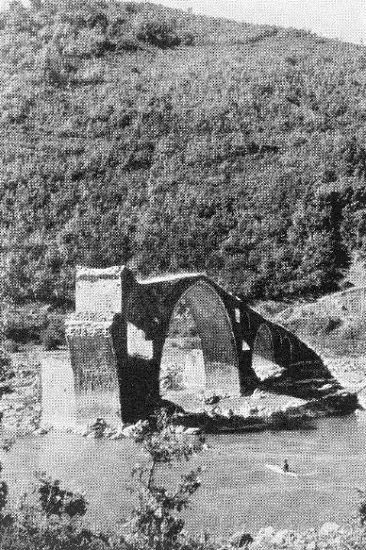
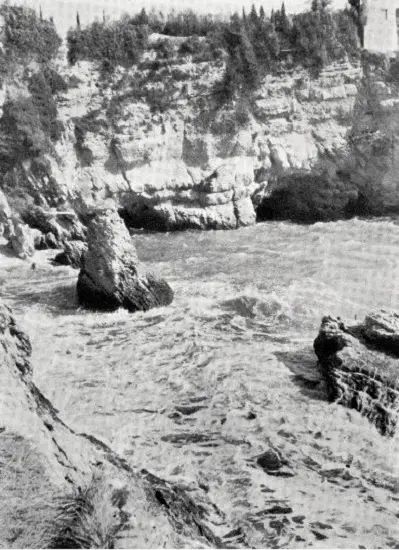
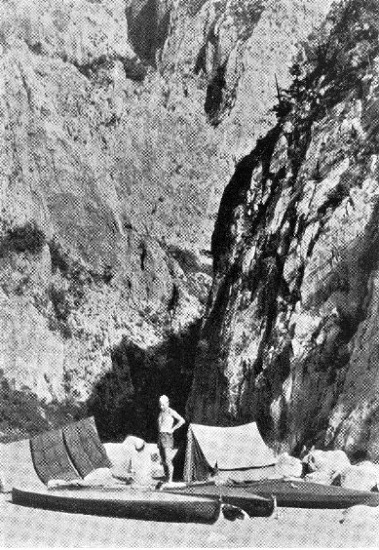
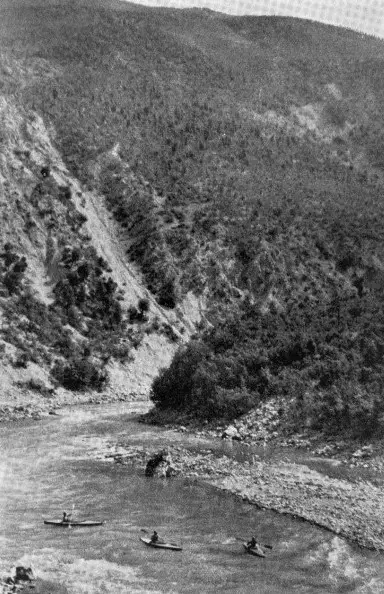
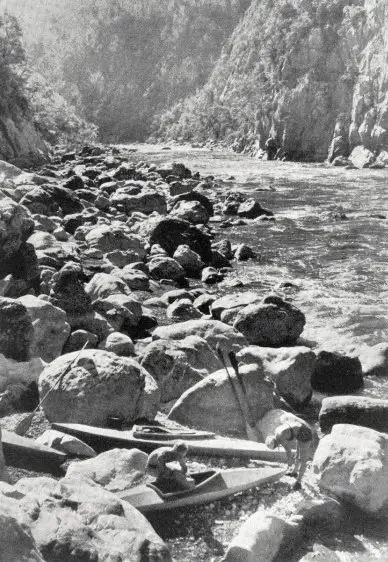
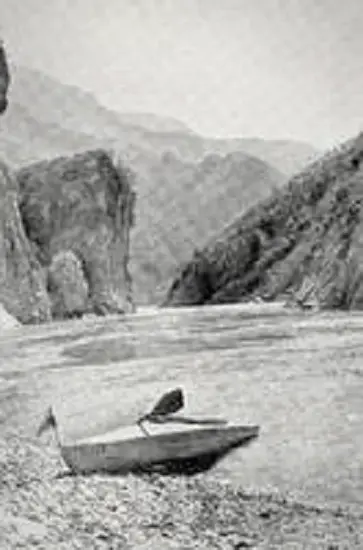
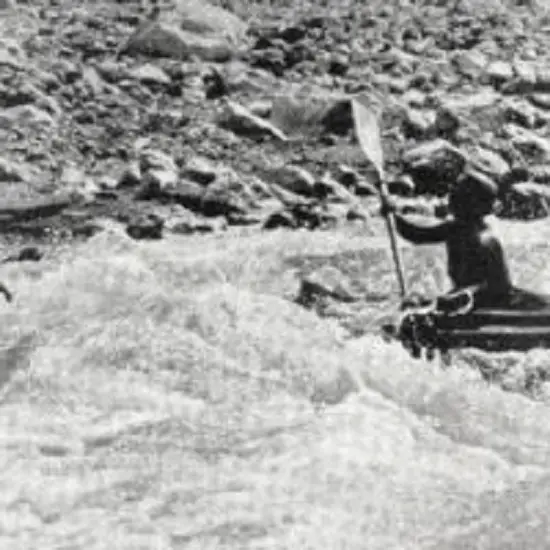
Memorie.al / Among the publications regarding the Albania of the 1940s, I found it interesting to review a volume published in Germany in 1939, which describes a sporting expedition along the Drin River. The 125-page book, authored by Karl Karohl and titled “Durch Albaniens Schluchten” (In the Abyss of Albania), was published by Brücke-Verlag – Kurt Schmersow of Kirchhain and contains 54 black-and-white illustrations. I managed to find the volume in a German antiquarian bookstore and had scanned numerous photographs from the book to include in this article, in order to introduce readers to interesting aspects of Albania at that time. It is necessary to bear in mind, in this case as well, that the book was written more than 80 years ago, and therefore, the author’s observations must be contextualized within that period, when communications and infrastructure, as well as the geographical knowledge of Albania, were certainly very different from the current ones.
I consider it appropriate to recall a few concepts of general geography regarding the Drin River, which – due to the importance of its basin (around 14,000 square kilometers) and the length of its course (around 280 kilometers) – is the most important river in Albania.
The outlet of Lake Ohrid, named the Black Drin, flows from South to North until it meets the White Drin, which descends from the Albanian Alps and irrigates the Metohija plain with its countless tributaries, yielding its place to the Luma at the famous Vizier’s Bridge. From here, the Drin flows into a deep valley, then heads into the sharp bend of Valbona.
From this point, it plunges against the plateau of the Albanian Alps and consequently continues its furious course through a series of gorges so impassable that they are avoided even by mule tracks, traversing the most inhospitable and wild regions of Albania; perhaps tomorrow (we are in the year 1939) this will be the joy, pleasure, and attraction of a special category of tourists.
Following its harsh path, it separates the plateau of the Albanian Alps from the Mirdita plateau until it empties into the plain near Vau i Dejës. And here, the river divides its waters between the Kir and directly into the Adriatic, where it finally finds peace.
The book, which to my knowledge has not been translated into Italian, describes the adventures and travel impressions that the author experienced with three other companions, among them a woman, in four small canoes along the Drin River, from its sources to the sea.
The expedition experienced many thrills in the deep and tumultuous gorge of the river among the mountains where its bed lies, descending from Ohrid to Ulcinj and continuing the navigation into the Drinase and the Buna (Bojana), at the mouth of which the sports enthusiasts entered the Adriatic after a journey of about 280 kilometers.
The river’s course was entirely conquered by navigating in canoes, with the exception of short stretches due to the torrent of the current.
The author, clearly an “ante-litteram” sportsman, enthusiast of “rafting” and a forerunner of this sport so widespread today, emphasizes that the best way to visit Albania is by using inflatable, collapsible canoes.
The author’s observations are interesting.
Karohl writes that in Albania, various oriental customs withstand time: in Albania, the traveler is safe because they are considered a guest and are therefore viewed as a subject to the sacred rights of hospitality.
He also notes that in the villages along the course of the Drin, the time-keeping system of eastern countries continues to be applied, according to which the day is counted from one sunset to the next; consequently, one hour after sunset is one o’clock, while the hour before sunset marks 23 o’clock. Even for reporting weights, the use of oriental weights instead of kilograms continues in many places.
The white head covering has remained that of Homeric times. Karohl points out that while other customs imported from the East are still quite widespread among Muslims, and the use of Eastern Time and weights is in the process of disappearing outside the most isolated villages, the white head covering has become very popular.
The author noted that regarding signs of agreement and denial, Albanians shake their head to affirm something, whereas to deny it, they nod their head downward, reversing what it represents for Westerners. I do not know if this statement is still valid, and the author states that at the time, this manner of expression was also widespread among populations of other Balkan countries that had been under Ottoman domination.
Karohl notes in an admirable manner that the Albanian has his own great sense of dignity and, even the poorest, exhibit a confident dignity that confirms their spiritual demeanor.
The Albanian continues to raise his children in the Spartan way; even in the cold, they are seen moving about barefoot and in just a shirt: this is why the Albanian hardens himself against even the harshest seasons, thus explaining how strong, prudent, and martial people can live in northern Albania, just as it was in prehistoric times: this occurs in many parts of the Balkan peninsula, such as in Montenegro.
The hard work of the fields is not practiced much by Albanians, who traditionally view themselves as shepherds: this explains why people care only to live from one day to the next, working just enough for the present day, since the following day is always uncertain due to the possibilities of an attack, either against a nearby aggressor, to fight off a raid by bandits, or to fall victim to blood feuds: this way of thinking has always been transmitted from father to son.
It seems impossible to Albanians – in the author’s opinion – that the era of warfare should be considered a thing of the past, or that it should disappear: therefore, one must live for the day, with fate.
The impression Karl Karohl gained of Albania was that of a beautiful country, inhabited by a proud people: friendship and blood feuds continue within it as the foundation of honor.
He also confirms his general considerations about the country: the Albanian panorama is stunning, both in the endless plains and in the sublime mountains carved by rivers lost in abysses; the lakes are magnificent, and the shores are rich in floristic landscapes that hold great appeal. And he predicts a great tourism future for Albania, both in the mountainous and coastal areas. A very intuitive prediction for the time, which certainly serves as a stimulus for today and the future.
In truth, the geographical material of the publication is sparse, because the book describes a typical sporting endeavor carried out during the dry summer of the Drin, yet it is always close to the water; the volume is full of numerous, original, and well-chosen illustrations, which are also very useful for the geographer and make for a highly enjoyable read.
The novelty of the sport (canoeing), of which Karl Karohl was a champion at the time, is attractive in itself. Previous attempts by V. Hahn and Steinmetz had been only partial and had described only a few sections of the river. The exploration by the author and his companions can be said to have been successful, from Lake Ohrid to the mouth of the Buna.
Some reviewers noted – at the time – that the enterprise should be considered solely from a sporting perspective, whereas the publication also contains a useful body of anthropogeographical considerations, not only along the hydrographic course of the Drin and its valley – particularly its least-known part at that time, from Dibra to Kuç and from Kukës to Romana – but for the entire Albanian environment.
The geologist, Prof. Mario Mariani, in the “Bulletin of the Italian Geographical Society” published in 1940, wrote: “The descent of the most important Albanian river by canoe is an enterprise that must be repeated, from a geographical standpoint as well, to test its potential regarding navigation, irrigation, and the utilization of hydroelectric plants.” Memorie.al