By Albert Vataj
Memorie.al / I had the privilege of being part of the filming crew for Nikoll Lesi’s show “Koha Jonë Debat”. It was one of those professional engagements that start as a work meeting and end as an encounter with history, memory, and the silent grandeur of knowledge. As we travelled towards the home of Prof. Dr. Aleksandër Meksi, the conversation with Mr. Lesi naturally drifted to the time when Meksi was Prime Minister, during the most turbulent years of post-communist Albania. As two contemporaries, we shared not just political memories, but also an awareness of the historical burden of that dramatic crossing, when the Albanian state was learning to walk on the ruins of a collapsed system. But we were not going there for politics.
We were not going to meet the former Prime Minister of Albania from the years 1992–1997, the period of brutal transformations, crises, and attempts to build democracy on unexplored terrain. We were going to meet the scholar, the archaeologist of our architectural memory, the man who had dedicated his life to reading stone, the silence of churches, and the secret language of monuments.
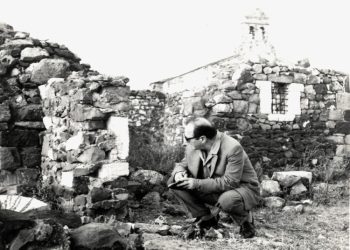
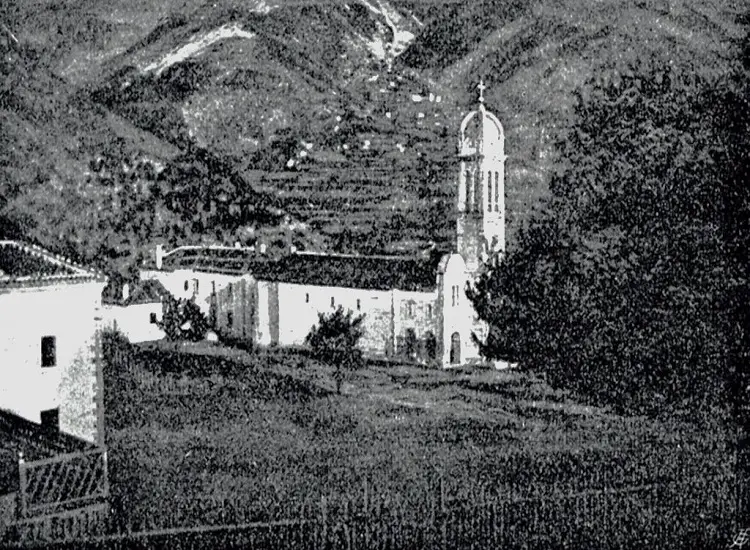
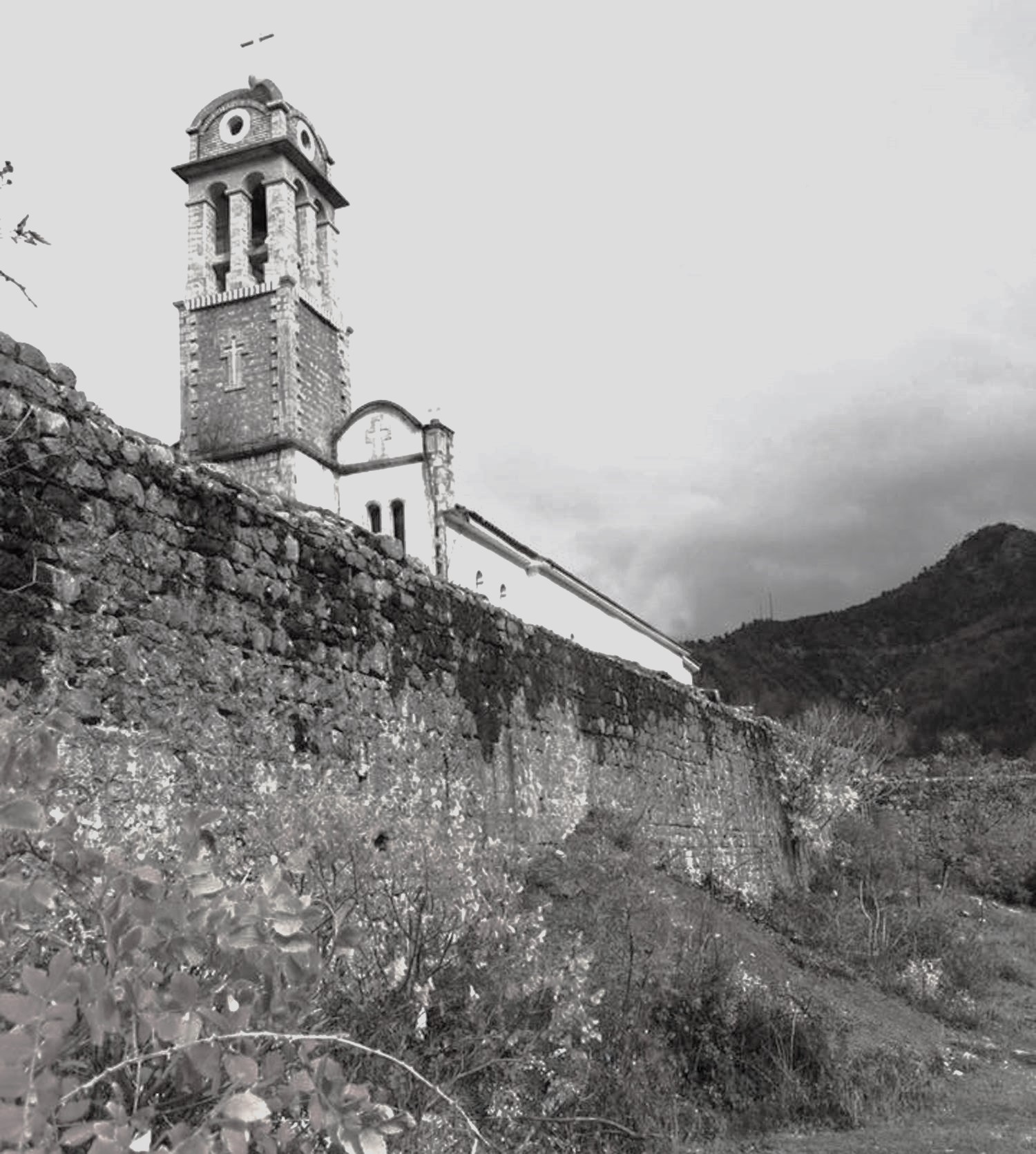
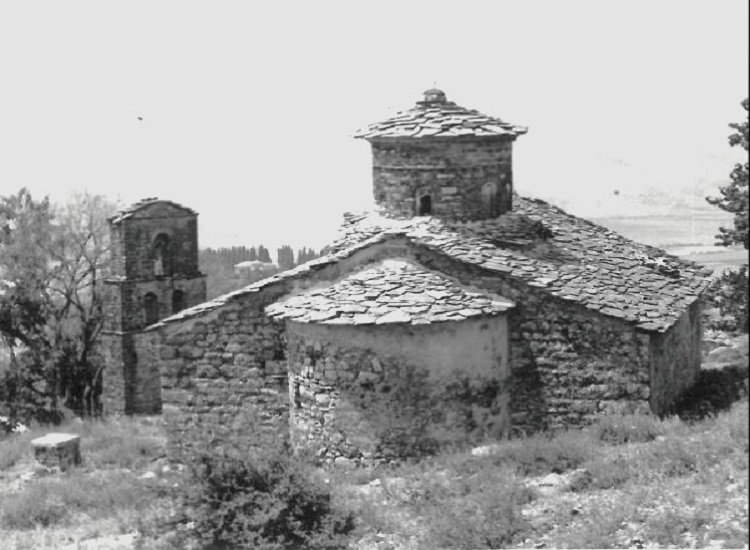
The reason for this meeting was the Church of Shën Llezhdri, or the Church of St. Alexander, in Prullë‑Spiten, a spiritual monument mentioned in documents as early as 1402. One of the earliest testimonies of Catholic faith in those lands, a temple that carries not only architecture but centuries of memory, prayers, ruins, and reconstructions. And to speak about such a monument, it had to be him, Aleksandër Meksi.
Because he is not merely a political figure of modern Albanian history. At his core, he remains one of the most authoritative scholars of medieval Albanian architecture, especially Byzantine and post‑Byzantine. He is among those people who have not only studied monuments but have built the way we read them today. He has carried out typologisation, dating, and structural analysis of dozens of Albanian churches, monasteries, and fortifications, deciphering the architectural evolution from paleo‑Christian basilicas of the 4th–6th centuries to the domed churches of the late Byzantine period and the church buildings of the Ottoman era.
His studies on the churches of Gjirokastra, Myzeqe, Berat, Voskopoja, and Dropull are today reference points for every researcher of cultural heritage. Particularly his work on the Church of St. Mary in Labova e Kryqit remains a cornerstone in the scientific interpretation of this unique monument. But his greatness does not lie only in his bibliography. Aleksandër Meksi belongs to that race of scholars who have not known knowledge solely from books. He has been a man of the field.
As a construction engineer, graduating from the University of Tirana in 1962, he managed to combine technical knowledge with historical intuition and aesthetic sensitivity. In restoration, he fanatically defended the principle of authenticity, the preservation of historical stratifications, and the rejection of aesthetic falsification of monuments. For him, restoration was not decoration, but a moral responsibility towards history.
Little known to the public remains his work in codicology, the study of rare ecclesiastical manuscripts. He has dealt with the history and cultural significance of Albanian codices, including the “Codex Purpureus Beratinus” and the “Codex Aureus”, treating them not only as religious objects but as evidence of Albanian written civilisation through the centuries. When we arrived, our knock on the door was answered by the man himself, Aleksandër Meksi.
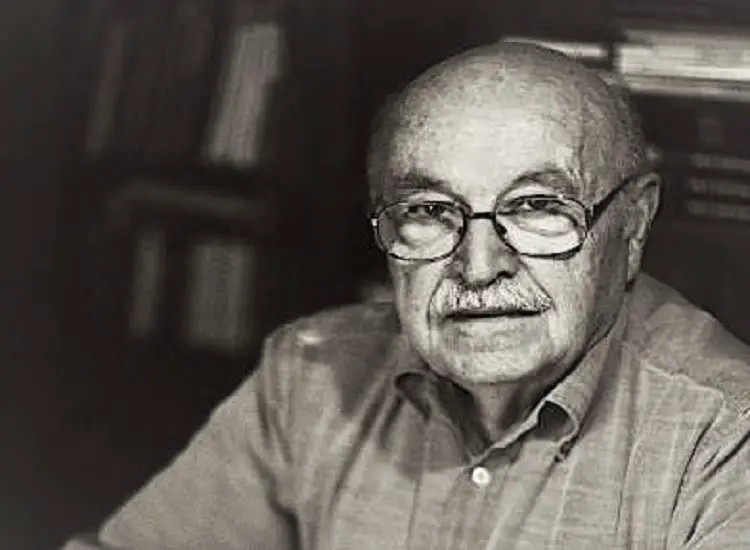
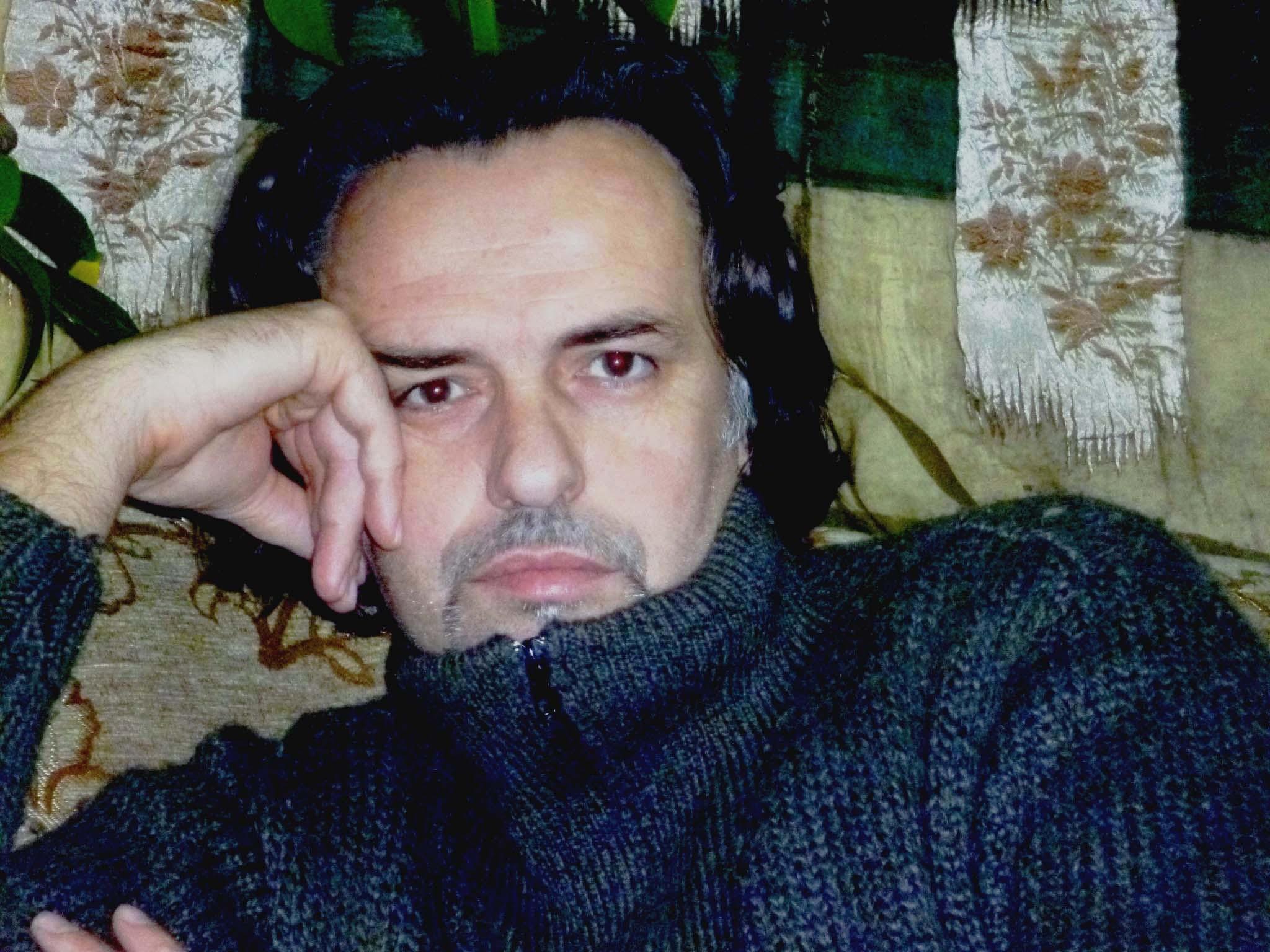
It was one of those moments when reality seems heavier than the image you have created in your mind. Before us appeared a short man, grey‑haired, bearing the weight of years on his shoulders, but with an unusual energy. Nothing demonstrative, no theatrical gesture, no attempt to impose presence. And that was precisely where his strength lay. He received us in his study.
A desk, two leather‑upholstered armchairs, books everywhere. Shelves that did not look like intellectual decor, but like a living organism of work. Every book had its place. Every notebook, every letter, every document seemed placed by a hand that continued to live in the discipline of thought.
The house was modest. Not the house of a former prime minister, but of an intellectual who had been content to have as his wealth the light of knowledge, the sun of thought, brewed for our identity consciousness.
Yes, Aleksandër Meksi reflected that rare nobility of learned people. I had imagined my meeting with this great man of politics and knowledge differently. But nothing was more impressive than being there where a mind likes his still continued to work, with the same persistence and the same thirst for understanding and systematising facts. There was something touching in the way he refused to surrender to age, as if intellectual work was his form of resistance against time.
And time had knocked long on his life.
Eighty‑seven years. But the years had not managed to subdue that man. During the conversation with Nikoll Lesi about the Church of Prull, what amazed you was his iron memory. Dates, events, names, toponyms, archival references, architectural details — everything came with almost mathematical precision. He spoke with the calm of someone who does not need to impress anyone, because he is confident in his own territory of knowledge. But above all, what impressed was the way he thought.
In his analyses there was no dogma. There was logic, comparison, verification of facts.
There was a readiness to accept corrections, to confront hypotheses with new evidence, with an admirable scientific positivity. He remained a scholar even in the way he doubted. And perhaps that is precisely where the greatness of such people lies: not in the power they have held, but in the ability to remain humble before knowledge. As we left that house, I was left with the feeling that we had not merely visited the residence of a former prime minister. We had entered one of those rare spaces where history, culture, memory, and thought continue to project a dialogue between past and present.
What remained most in my mind from that meeting was a kind of silent incompatibility of Aleksandër Meksi to speak about politics, especially about the Democratic Party of Albania, which he himself had founded and represented in one of the most difficult periods of modern Albanian history. It was a withdrawal that came not from avoidance, nor from a lack of opinion, but from a deep awareness of the distance that time creates between ideal and reality.
Nikoll Lesi’s persistent questions about current political affairs, about the Democratic Party, about the developments and deformations of the transition, met not with direct refusal, but with something heavier and more meaningful: silence. And that silence spoke. It spoke through the gesticulation of hands, through a slight smile, through a look that seemed to seek to avoid not the question, but the weariness of returning to a territory where perhaps he had said everything he had to say.
It was a silence that carried not indifference, but a kind of restrained, noble, almost ascetic disappointment. Because Aleksandër Meksi could not be outside Albanian political reality. He had been one of its protagonists. He had entered politics at a time when Albania was emerging from the darkness of communist dictatorship and when many intellectuals felt it as a moral duty to become part of a collective dream of freedom, pluralism, and democracy.
His role at that time was not that of the classic politician.
He did not come from the laboratory of power, but from the library, the archaeological field, study, and culture. He was, at heart, an idealistic intellectual who agreed to enter the political maelstrom not for personal ambition, but because he believed that Albania needed people who thought and not only people who ruled. And perhaps that is precisely what always made him somewhat a stranger in politics.
Because Albanian politics of the transition, with its brutality, conflict, and compromises, has rarely known how to keep such natures within itself for long. In the way he fell silent, one got the impression that he had long since understood this incompatibility between his ideal and the reality that took other forms.
His position today, somewhat on the periphery of public and political debate, seemed to carry within it not resentment, but a quiet acceptance of human and historical limits. As if he accepted with dignity that his efforts, however honest and serious, had not been enough to change everything he had dreamed of. But there was something magnificent even in this withdrawal.
Because he did not remain a hostage to politics. He did not cling to it. He did not turn into a figure endlessly seeking a comeback or protagonism. As a man of work and dedication, he chose to leave in time to return to what he knew best and what fulfilled him more deeply: research, study, investigation, dialogue with history and monuments. And perhaps that is the noblest form of an intellectual’s survival. To return to knowledge.
To choose the book over the noise. To remain on the side of thought, when politics consumes everything. That man, in that room surrounded by books, with cameras before him and an almost liturgical calm in his speech, seemed not to be conversing only with us. There was something of endless audiences in the way he constructed sentences, argued, remembered. He seemed to speak before time, not before people.
And what expanded his dimension was not his former political authority, but the light of thought and the competence of an academic who had lived his entire life in the discipline of knowledge. Within that aura I tried to understand the man. But at a certain point he ceased to be merely human and took on the form of an almost mystical being, like those figures who emerge from the pages of history and continue to live on an intermediate boundary between the real and the symbolic.
Under the shadow of that fluent discourse and that steady voice, he seemed like a living testimony of a time when thought had moral weight. The meeting did not last long. But there are meetings that are not measured by time. When we left Aleksandër Meksi’s house, we took with us not only the memory of a conversation, but the cordiality of a humble, simple man, white in presence and communication. There was something almost testamentary in that quiet parting, as if we were leaving the presence of a living monument of our cultural and historical belonging.
He was exactly as I had tried to imagine him, and at the same time completely different. A creature that seemed to have stepped out of books, out of history, out of the deep memory of this land. A man who carried within himself the idealist, the scholar, the passionate, the scrupulous, and a kind of silent holiness of the human, which was not proclaimed with pomp, but revealed slowly through word, thought, and the way he had chosen to live.
He belongs to that generation of scholars who did not produce knowledge for academic decoration, but to build a national consciousness on scientific foundations. Every study of his is an effort to save from oblivion the stone, the church, the fresco, the codex, the memory. In this sense, his work has not been merely academic; it has also been a silent act of defence of identity. His scientific heritage is scattered across some of the most fundamental works of Albanian studies on architecture and cultural heritage.
Dozens of articles published in journals such as “Monumentet”, “Studime Historike”, and “Studia Albanica” remain today essential references for researchers of history, architecture, and restoration. Among his most important works stands “Architecture of the Churches of Albania (7th–15th centuries)”, a scholarly monument in itself, where Aleksandër Meksi manages to construct not only a cataloguing of church structures, but a whole reading of the cultural and civilisational influences that have passed through Albanian territory.
In that work, Albania appears as a great bridge between the Byzantine East and the Romanesque West, a territory where architectural forms are not merely building techniques, but traces of civilisations that have communicated with each other through stone. Equally important remains the book “Restoration of Architectural Monuments”, a theoretical and practical manual that laid the methodological foundations of scientific restoration in Albania.
Through this work, Meksi articulates a clear professional philosophy: the monument should not be decorated according to the taste of the time, but should be preserved in its historical authenticity, with all the stratifications, damages, and traces that time has left upon it. For him, restoration was not an artificial recreation of the past, but an honest dialogue with it.
In collaboration with Emin Riza and Pirro Thomo, he also contributed to the synthesising work “Medieval Architecture in Albania”, one of the most serious products of the golden period of the Institute of Monuments. It was a time when the study of cultural heritage in Albania had the dimension of a national mission and when scientific research was built on fieldwork, measurement, documentation, and dedication.
This research universe is further enriched by special monographs such as “Labova e Kryqit: History, Architecture and Restoration”, dedicated to one of the most enigmatic and important churches of the Balkans, as well as studies on the “Codices of Albania”, where he penetrates the Byzantine manuscript heritage not only as a student of objects, but as an interpreter of an entire spiritual and cultural tradition. And yet, what strikes you most is not only the magnitude of this work. It is the fact that he still works.
At an age when most surrender to time, Aleksandër Meksi still strives to put on paper the truth of his political involvement, from the first steps of pluralism to his departure in the dramatic March of 1997. And thus, as I left that house, I was left with the feeling that I had met one of those people who do not live only in their own time.
They remain as bridges between eras. As evidence that thought, work, and dedication can resist oblivion. Aleksandër Meksi seemed to me like one of those men who have spent their lives speaking with stones, churches, codices, and history, until they themselves became part of that history they once studied. / Memorie.al