

– Published in Italy, the novel “Roads of Hell” by the writer Visar Zhiti –
Memorie.al / “This is the testimony of the tragedy lived in silence by thousands of people, opponents, dissidents and martyrs of the bloody communist dictatorship. An experience lived in the first person and transformed into a narrative that, due to its universal character, interprets the emotions, memories, sufferings and unheard-of cruelties of those who had the misfortune to clash with the uniforms of Enver Hoxha’s political police. Visar Zhiti was imprisoned precisely for his poetic work, deviating from the dominant dogmas of socialist realism. His vicissitudes, which are human, give us a merciless rupture, as raw and true, about the inhuman condition of political prisoners in the Enverist prisons within the cruel system.”
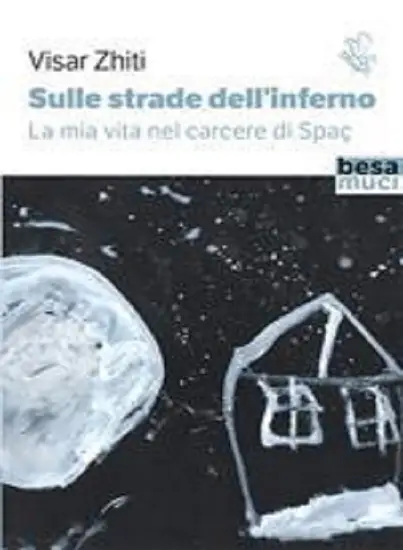
Thus it is written on the cover of the book “Roads of Hell”, subtitled “My life in the Spaç prison”, published this year in Italy by “Besa” Publishing House, with the powerful translation of Professor Matteo Mandalá, head of the Albanology department at the University of Palermo, author of many publications, studies and critical articles, known in the university world in Europe and beyond.
“Sulle strade dell’inferno” (“Roads of Hell”) has already been distributed in all bookstores in Italy and has attracted the attention of readers, as well as Italian writers and critics. The 576 pages of the book “Sulle strade dell’inferno” (Roads of Hell) are appreciated for their artistic testimony and their shocking language, as stripped down as it is metaphorical, full of pain like that of tragedies, but also with lyrical subtleties.
On the front page is a painting by Atjon Zhiti, the author’s son, full of night and crooked windows and a whitish mass that, more than a large moon, looks like an avalanche of snow or a fatal rock.
And in the first fold is placed a fragment from the book, precisely this:
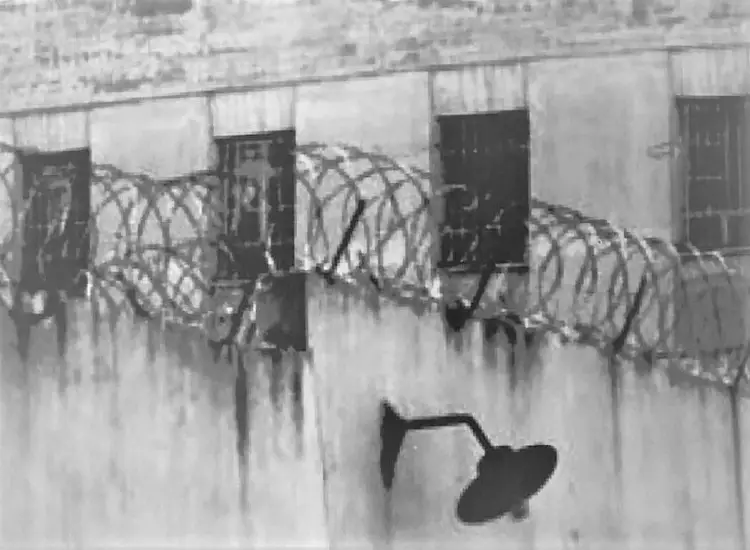
“The true prison, the heaviest, the unbearable, begins when everything repeats. Sameness. Nothing new from the hellish front. Terrible. The same black bread and the same black policemen. The same shovel and pit and the same New Year, not at all new. The same hunger, like the snow that covers everything. Death is no longer death, but repetition of itself. Work is no longer work. Family is no longer family. Man is no longer man. Nothing is different anymore. The days are horrifyingly alike. Like the handcuffs, like the howl. Like the water that flows in vain from the prison taps. The same sky and the humming beneath it. The same barbed wire. The other person is the same. Like oneself. There are no more emotions. And no woman in a dream. Neutered ground. Forgotten. Lost. Like the skin of a dead animal. Dictatorship.”
On the back cover fold is a short note about the author:
VISAR ZHITI, Albanian poet and writer, in 1979 was sentenced to ten years in prison for his “decadent and intimist” poems, contrary to what socialist realism demanded. His poetry collections from “Memory of the Air” (“Memoria del vento”, 1993) to “The Living Doors” (“Le porte vive”, 1995), bear witness to life in prison and the dawn of democracy.
He has published short stories and novels, translated into various languages, including “The Endless Funeral” (2017).
He was elected deputy of the Assembly of Albania in 1996, Minister of Culture in 2013. He has received many awards for his literary activity, including “Ada Negri” in 1997 and the “Mario Luzi” International Prize for unpublished poetry.
The work begins with the note, in both Albanian and Italian:
“A novel with real characters and events that I wish were not true, yet I invented nothing, I only selected from experiences. But writing them was like another prison.”
– * –
With the publication of the novel “Sulle strade dell’inferno”, the journalist and connoisseur of Albanian literature (translated into Italian), Anna Latanzi, conducted an interview with the author for the media of her country. Visar Zhiti is known in Italy for his poetry and novels and has been awarded many literary prizes. This body of work has been masterfully translated by Professor Elio Miracco and has received many literary awards in Italy.
Among other things, the journalist writes:
…I relived that time emotionally… It is a choral book, composed of pain and suffering.
– Were those poems really against? – asks the Italian journalist. – In what spirit did you write them? And Visari answers:
– I wanted to write with my soul…
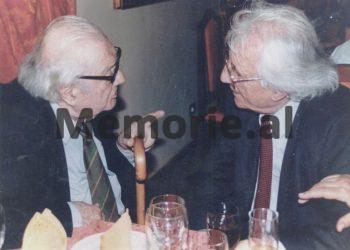
As the great Umberto Eco said, even citing Visar Zhiti, totalitarian regimes wanted poetry and poets in their service. “If their compositions were not in favor of the dictatorship, they were considered against, and never simply creations of those who wrote poetry. Just as happened with Visar Zhiti, who sent a book of poems and when the regime read the verses dedicated to roses (it is about Zhiti’s collection ‘Rhapsody of the Life of Roses’, editor’s note) and not to power, they were judged as opposed to the dictatorship.”
“At that time,” testifies Visar Zhiti, “when I write secretly in prison, I thought to write to leave a testimony; later, I understood that the motivations were much deeper, more magical and almost of divine inspiration…! We wanted to create our own freedom, because when you write, you invent your own freedom and you are the same as all other writers outside prison, with those who are in Rome, Paris, Moscow, Washington, etc. For this reason the regime banned poetry, because at that moment you are free…!”
– Would it be right for those people who did wrong to ask for forgiveness? – asks the Italian journalist.
– In Albania, two important issues have been missing, Visari replies, – the asking of forgiveness by those who committed criminal sins and the moral and legal condemnation of the dictatorship…! I can forgive those who condemned me, but I cannot forgive for others who have been killed and are no more, those who have harmed Albania. Those who were executed have the right to forgive; – concludes Zhiti – My poems are my revenge and my forgiveness…
This was also the message that the Italian journalist, Anna Latanzi, placed at the head of the interview. It is to be welcomed, but also to learn from Italian criticism, which, unlike the complex-ridden Albanian criticism, sees and appreciates the human message and the text of the work, raising it to the height of the universal, whereas our criticism only hesitates.
Every publication of Visar Zhiti in Italy has had resonance in the major Italian newspapers, while about his books have written Mario Luzi, a great poet of 20th-century poetry, Sebastiano Grasso, the President of the Italian PEN Club, a well-known poet and journalist, etc., even Umberto Eco, one of the most learned minds, semiologist, scholar and writer with worldwide recognition. / Memorie.al
From the Messenger of Good