
Memorie.al / The persistence with which insistence continues toward the distortion of historical truths, but in a more sophisticated way to make the distortion appear as credible as possible, fundamentally revolts me greatly. The impetus to address the problem as you will see in the following came from the assertion of a genuine personality in the field of social studies, who recently took a position saying more or less: “…let no one think of insulting the eminent personalities of our literature, for I will bring to light some letters of Fishta where he curses the Tosks…”! This threatening assertion, made precisely by a scholar, connected to statements and considerations of the same nature made by people of highly questionable cultural value (regardless of the titles and academic degrees they hold), makes me think that we are dealing with a syndrome, not just symptomatic manifestations. And syndromes, if not treated, lead to deep and often incurable diseases.
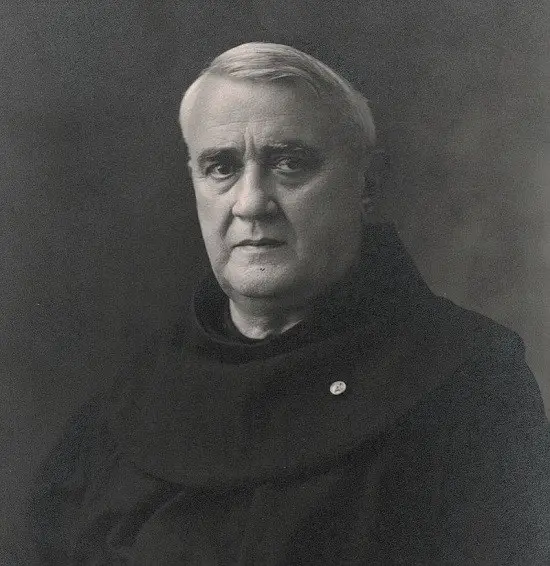
Now let us enter the genuine topic: what is my main concern? Father Gjergj Fishta, the writer anathematized throughout the communist dictatorship, was neither Greek, nor Serb, nor Cameroonian. He was Albanian, and his works were those of a fervent Albanian. On the other hand, I pose the question: is there any person who is perfect and without mistakes in life? As Christ said when it came to stoning the adulterous woman: “Let him who is without sin cast the first stone.” And inevitably, no one dared to strike the wretched woman! Therefore, like all living people, before Fishta as well as after him until the end of the world, everyone has made mistakes and committed faults, and will continue to do so.
And since Fishta supposedly had dark sides throughout his life, is that a reason to threaten that we will make them public if eminent personalities of our literature are criticized? This threat to throw a wrong stance in the face of such a personality is a stance befitting only one category of Albanians: the Piros Dimas types (formerly Pirro Dhima) and company! On the other hand, the problem, fundamentally, is not to hide or cover up facts and deeds related to anyone’s life, but the main thing is to study and analyze them in relation to the time and circumstances in which they were experienced. But by no means should they be treated as threats. This, yes, is a fault, and a serious one!
Polydimensional personalities of the stature of Father Gjergj Fishta, for certain pragmatic political purposes, were anathematized throughout the dictatorial period, without recognizing to them any merit, whether national, artistic, or even scientific. “Black” – Father Gjergj was labeled and fought as such. Not even the smallest good was acknowledged in him! And the worst evil was that to support this stance, all sorts of distortions were fabricated about him and his work! This was a tactic, a party directive.
The same was done with the figure of Mustafa Merlika Kruja. One cannot deny that he was a co-signatory of the Act of Independence in Vlorë. Without the slightest doubt, Mustafa Merlika Kruja was the most distinguished linguist among his contemporaries, but in no text published during the communist dictatorship was this fact mentioned! Whereas, for the narrow political interests of the communist regime, the figure of Mustafa Kruja was labeled only as a fascist and a quisling – accusations that are themselves highly questionable!
We continue with the physicist Selaudin Toto, whose two brothers had been executed as anti-monarchists; he himself was interned by Italian fascism, and then, when he was sentenced to death and executed by the communist dictatorship without any guilt, his name was violently forgotten even as a physicist. But he was not just a physicist and that’s it. He was a distinguished student of the great Enrico Fermi, who persistently wanted to keep him in his group of assistants, but Selaudin Toto did not accept the brilliant career that opened before him… because he wanted to come and serve his Homeland (which devoured his head).
I have brought the above examples only to clarify somewhat how harmful it is for national interests to treat the eminent figures of our nation starting from spite and passions that have political reasons at their core, and these are then supported by unprincipled people who harbor professional vices. Now let us continue with our initial argument, Father Gjergj Fishta. Why was Father Gjergj anathematized by the dictatorship? Why was it made impossible even to mention the name of that giant of the nation?! The faults he bore on his back were many: first, he was a distinguished clerical intellectual. On the other hand, he was the one who put into writing, through the verses of *The Highland Lute*, “The History of Albania” in its relations with our northern Slavic neighbor, treating a period from 1858 to 1913, with a spirit of truth and sculpting and highlighting Serbian chauvinism as it was, with all its anti-Albanian atavisms.
As a cleric, he was necessarily also an anti-communist, because he knew communist ideology well and thoroughly, as well as the extreme atheist convictions of its adherents. Father Gjergj defined the atheist views that had begun to spread in Albania after World War I up to the years when World War II began as: “The incarnations of the most refined atheism of the West and the coldest savagery of the East.” And since all of Father Gjergj’s virtues had to be turned into his faults, the poison of diabolical deception was also used, accusing him of being anti-national, as well as a fascist.
For the sake of truth, let us next take a fleeting look at the most salient points of Father Gjergj’s patriotic activity, and then we will give the genuine answers. We refer to the great Arbëresh scholar Gaetano Petrotta, who has stated: “Fishta is among the first and greatest patriots who, in the most difficult times, did their utmost to keep alive the national movement against the barbaric violence of the Turkish government and against Greek propaganda. Wherever the Albanian cause was, Father Fishta was there nearby, and through deeds and through writings, especially through his vivid poetry, he awakened the most sluggish from sleep and always kept alive the hope for the future.”
It must be said from the outset that Prof. Petrotta’s considerations about Father Gjergj were not unsupported, but it was the works as well as the activity of the great prelate that led the great Arbëresh scholar to these conclusions. Let us look at them. For Father Gjergj, patriotic devotion knew no pause: when the future of his nation was surrounded by a completely murky fog, even when Bismarck saw Albania as “a geographical expression,” adding also “the Albanians do not even have a written language of their own…”, He understood that no effort for the establishment of the Albanian state could succeed if the foundations of the written Albanian language were not laid.
Today, speaking and writing Albanian within Albanian borders seems completely normal. However, we must go back to the early years of the turn of the 19th and 20th centuries (something we cannot conceive today) and experience what the profound scholar of Albanian history and language, Mustafa Merlika Kruja, defined with a statement as laconic as it was meaningful: “… under Turkish rule, when our eyes began to open, writing and reading Albanian constituted a crime against the state.”
So, in those conditions, when the Ottoman occupier tried by all means to prevent our people from aspiring to Albania’s independence, and also from pursuing the cultivation of the Albanian language which has always kept alive the sense of nationality, Father Gjergj with all his powers fought against these evil goals of the enemy! The entire activity of Father Fishta was driven by the ideal of his whole life, which was “Albania mistress in her own home, within the borders where Albanian is spoken”!
Documentation of this devotion is the fact that, in cooperation with the distinguished patriot, the Abbot of Mirdita, Monsignor Prengë Doçi, as well as supported by other patriots such as Ndoc Nikaj, Pashk Bardhi, etc., in 1899 they founded the literary society “Bashkimi” (The Union), where Monsignor Fishta, being the right hand of the Abbot, was the most active member. Precisely the Albanian alphabet, formulated as a scientific alphabet, was the work of the literary society “Bashkimi”, and therefore Father Gjergj, who was among the creators of this alphabet, in November 1908, weighing all these factors, became one of the initiators of the Congress of Manastir (Bitola).
He clearly saw that our nation could not unite into a genuine state while the Albanian language was written with the “Cyrillics” of Cyril or with the Ottoman “scratches” that for more than 500 years had stuck in the throats of Albanians! His election as Chairman of the Albanian Alphabet Commission clearly speaks of the great persuasive influence he had among the Congress participants, and with the influence of his personality, the alphabet of the literary society “Bashkimi”, with very few changes, was then declared by the Congress of Manastir as the official alphabet of the Albanian language! Thus, Father Gjergj played the main role, becoming an important part of the crucial link that connected our National Renaissance with Albania’s Independence at that turn of the centuries!
His patriotism is also notably evident regarding religious division, which the chauvinist neighbors (together with the lack of a written language) considered sharp weapons and evident proofs of the non-existence of an Albanian nation. And precisely to oppose these insinuations that had taken hold in European chancelleries, in 1913, as a sign of revolt against the International Powers that held Shkodra occupied, Father Gjergj would raise the Albanian Flag in the Church of Gjuhadol.
And, as a sign of brotherhood and solidarity between Muslims and Catholics, he would connect the Church with the minaret of the Fushë Çela Mosque with a banner of lights. Then the “foreign governors” sent their delegation, who under frightening threats ordered the flag to be lowered, but the “brave Friar” with his courageous irony sent his message to the ruler of Shkodra, the British Admiral Sir Cecil Burney, writing among other things: “Our flag has the honor to be shot at by foreign cannons” – And indeed the admiral did not reply to Father Fishta’s letter, but… neither did he send forces to lower their flag!
Father Gjergj was the one who publicly declared: “As Christians, as Muslims, / All Albanians have Albania together, / And therefore we will all stand, / We will stand and we will fight, / We will become bundles upon bundles, / Priests, friars, hodjas. / For Albania”! Not to mention when Father Gjergj vented his extreme spite against all those who did not work to have a strong Albania. The prelate attacks them with a force that the fiercest fighters would envy, and he does not stop even before the sin of aggressiveness even against God Himself, saying:
“O God, have you not felt, / The traitors left us without a Homeland / And you sit and roar with thunder, / Idly in the mountains in vain”!
But when it comes to his mother tongue, the patriotic priest writes verses that, by their lyricism, can truly be called typical, and they conclude with a perfect, truly exemplary dramaticity:
Like the song of the summer bird, / That flutters in April’s greenery;
Like the sweetest breeze of the wind, / That enlivens the roses’ bloom;
Like the wave on the seashore, / Like the roar of the awakening thunder,
Like the rumble of an earthquake, / Just so is our Albanian tongue.
And then the Poet continues with a notable patriotic fervor and says:
“So, cursed be that Albanian son, / Who this language of God,
The inheritance left to us by the Forefather, / This inheritance does not leave to his children;
And let his mouth dry up, yes, / Who scorns this divine language;
Who in a foreign tongue, when there is no need, / Speaks, and neglects his own.”
But Father Gjergj, as extremely patriotic as he was, also knew how to write with tact. The Homer of our nation (as called by the German albanologist Maximilian Lambertz), in the verses of *The Highland Lute*, never allowed himself to display class hostilities, nor divisions, much less manifestations of fanaticism. His North Star was: “First to make Albania happen, then to beautify and adorn it”! For that “Lute” composed of 30 long songs with a total of 16,838 verses, which are permeated by impetus and a warlike spirit, filled with manliness, tenderness, and lyricism simultaneously, the Poet worked not a little but 30 years!
Now we come to the communists’ accusation that Father Gjergj was anti-national. As proof of this guilt, his verses in “Metamorphosis” of *The Ashes of Parnassus* have been presented, where the author expresses himself:
“Let Albania know / So, and the whole century,
That after today / I am no longer Albanian.”
Examining now the accusation as well as those who based their accusation on these verses, there are two possibilities: either extreme malice as a result of unprincipled hatred towards a colossus of patriotism and culture, or ignorance so boundless that even Father Gjergj himself, Father Anton Harapi or Baba Rexhepi, with all that pleiad of colossi… would pity them!
As for malice, we need not deal with it, or with its bearers; would it be a waste of time. As for the ignorance of all those who think they are capable of judging the colossus Fishta by reading his verses without any preparatory basis, I feel it my duty to explain that in “Metamorphosis”, the author evokes transformations or the opposite meaning, taking as an example the masterpiece of the great poet of ancient Rome, Ovid.
Whereas, expressed without symbolic comparisons, with those verses the Poet expresses his extreme anger and brings out the spite accumulated within his patriotic soul, against his Albanian compatriots of the time, scoundrels and wretches! And to present simply and clearly to the well-intentioned reader the idea of the master Fishta: as much as He has exalted the virtues of besa (faith) and manliness of the Albanian in the apotheosis of *The Highland Lute*, just as much He has insulted, mocked, and humiliated in *The Ashes of Parnassus* the vice and the perversion of Albanian virtues by unprincipled people!
The other accusation, propagated loudly to the four winds by the communist dictatorship, was that Fishta was a fascist because he agreed to become a member of the Italian Academy of Sciences, and thus, becoming a supporter of fascism, he approved the occupation of Albania by fascist Italy. The arguments to refute this accusation are numerous. It is enough for the objective reader of these lines to judge with impartial logic the facts that will be presented, and then if they wish to delve deeper and examine more thoroughly, they can find everything documented in archives.
The Italian fascist government, by royal decree, decorated Father Gjergj Fishta with the highest decoration it awarded. This was the Italian side’s step to silence the voice of the Franciscan friar, who with his patriotic verses filled the hearts of Albanians. And Father Gjergj’s reaction to this insult made to his personality in the patriotic aspect (as He considered it) was immediate: he refused to accept the royal decree, stating: “This decoration is not for me”!
Subsequently, the Italian Academy, whose members included the world’s most distinguished personalities, many of them Nobel laureates, commissioned Father Agostino Gemelli, Rector of the University of the Sacred Heart in Milan and a friend of Father Gjergj, to negotiate with him whether he would accept to be appointed a member of the Academy. And Father Gjergj accepted, although he returned the fascist decoration. He accepted first because a large part of the academicians were known as anti-fascists, starting with the philosopher Benedetto Croce, the famous composer Pietro Mascagni, Maestro Perosi, Agostino Gemelli himself, and others in turn.
On the other hand, He affirmed to His students and, among them, to Father Daniel Gjeçaj, who has published that: “… no one says that whoever accepts the Nobel Prize becomes a Swede… and in war no one asks what factory made your weapons, but how you used them… I today, as an academician, can serve Albania more …”! Even the Holy Father himself, Pope Pius XII (who is known not to have been a fascist), during the audience he granted to Father Gjergj in 1940, said among other things: “Your appointment as an academician of Italy is an honor for the Faith and for your Nation.”
Now we come to another meaningful fact. From December 10, 1940, the Master was experiencing the last days of his life. He is visited by the Archbishop of Shkodra, Monsignor Gaspër Thaçi, and Fishta tells him: “I do not regret that I am dying, since we all go there, but I regret deeply that all my life I have melted away to see a free and independent Albania, yet today I leave it trampled by foreign armies.”
Even when he was buried, Father Gjergj’s coffin, according to his wish, was covered with the authentic national flag of Dedë Gjo’ Luli, a flag without the embroidered Lictor fasces (which were removed when Mustafa Merlika Kruja made this one of his conditions when he agreed to form his government). I believe that with all these arguments, for which a genuine scholar without political complexes can also find supporting archival documentation, all the slanderous and malicious accusations against our National Poet, Father Gjergj Fishta, are refuted!
Before the epilogue of this writing, I cannot fail to list the statements of some of the most eminent personalities of our nation who have expressed themselves in appreciation of Father Gjergj and his work.
Professor Eqerem Çabej, without doubt among the most profound scholars of the Albanian language, stated in a postcard he sent to Lasgush Poradeci: “I read *The Highland Lute* and was amazed. I am ready to become a Catholic, for the sake of Fishta”!
Professor Kostaq Cipua told us in class: “…. In Fishta’s work, love of country and poetic mastery were fused into one”! Professor Cipua also expressed himself in writing, calling Father Gjergj Fishta the “Patriarch of Albanian letters.”
Sejfulla Malëshova stated in the press: “… for Fishta’s powerful mind, Albania owes the best epic, lyric, and dramatic poems.”
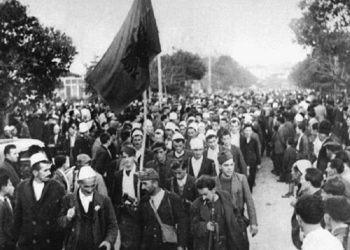
Hafëz Ali Korça, Muslim cleric and teacher of the Albanian language, expressed himself regarding Father Fishta: “…. With his persistence, our ancient language found written synthesis….! I cannot forget with how much love he embraced and congratulated me (when we met many years later with Fishta), that in the great demonstration of Korça in 1910 against the writing of the Albanian language with Arabic letters, I blessed the Latin letters of the Albanian alphabet of the Congress of Manastir and even said a prayer for them….”!
The writer Petro Marko has said: “Fishta is an elephant covered in dust during the decades of the communist regime.” The great poet Lasgush Poradeci defined Fishta as “a rock of the Albanian spirit – a Giant of the Nation.”
Now we come to the epilogue of these lines. Indoctrinated analysts may point out passages from the writings or correspondence of Father Gjergj where the Great Poet expressed himself disrespectfully toward the Tosks. I do not doubt that at all. But the scholar in question should then also conduct a “quantitative” analysis, balancing how many times Father Gjergj expressed himself against the Ghegs and how many times against the Tosks. Only then will the analyst conclude that in 90% of cases, Father Gjergj criticized, insulted, and mocked the Ghegs and their environment, and only 10% the Tosks. And the reason is evident: because the Master knew Ghegeria and the Ghegs at their roots and thoroughly!
Therefore, not without purpose, from the multitude of Albanian and foreign personalities who have expressed themselves with supreme appreciation and respect for the Person and work of Father Gjergj, I have listed only the positions of eminent figures from Toskeria of our nation.
After this analysis and confrontation with historical facts, I truly feel somewhat relieved, but still with my head bowed and disappointed, I close these lines and pose the question: why must one be threatened that if anyone tries to criticize our eminent writers who achieved brilliance with their works during the period of Socialist Realism, they will immediately confront and criticize the giant Fishta?
Why must the fear of bringing to light the shadows of the colossus Fishta serve to highlight the light that those writers may have, and to hide their shadows? No, gentlemen. Historical truth requires that the light and shadows of each person not only be brought out into the open but also compared. This is the sole criterion by which it will be seen who is a titan and who is a pygmy! / Memorie.al