

From Mërgim KORÇA
Part Two
Memorie.al – The impetus that leads us to survey the historical period encompassing the years 1939–1945 with a broad, fundamental, comprehensive, and fully scientific view requires that we illuminate and then also rely on historical facts not only left in oblivion but also deliberately distorted by the historians of the dictatorship period. Therefore, we are obliged to begin the analysis by first determining the basic, genuinely scientific criteria regarding the use of linguistic terms without deforming their meaning, without subsequently allowing erroneous interpretations (inclined by the impulse of political ideology), which in turn inevitably lead to completely wrong conclusions.
A veritable downpour of the most devilish epithets and malicious slanders was unleashed for forty-seven consecutive years upon the figure of Mustafa Kruja, starting with Enver Hoxha and then followed by the whole pleiad of historians and writers, his conformist followers. However, in the meantime, Kosovo never forgot Mustafa Kruja’s love and activity on its behalf and in its interest. Now the moment has come for a parallel concerning the same problem but… with the dictator, the forger of the anathematization of pure patriots as traitors and collaborators.
Enver Hoxha, in an appeal of his in 1942, declared: “The traitor Mustafa Kruja is trying to feed you with his lies and demagoguery, to talk to you about a Greater Albania – about a liberated Kosovo –.” Furthermore, at the Fifth Plenum of the Central Committee of the Albanian Communist Party, on February 21, 1946, Enver Hoxha said: “We have not directed our people sufficiently toward sound fraternization with Yugoslavia, which is an indispensable condition for the existence of our country.”
We continue with an extremely sad fact: In July 1946, a session of the Yugoslav Assembly was held which approved the annexation of Kosovo by Federal Yugoslavia!
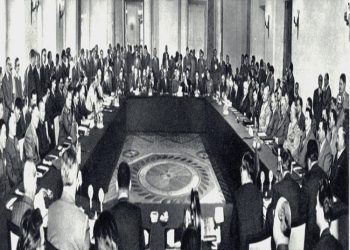
In August 1946, only one month after the annexation of Kosovo, the Peace Conference took place in Paris. There, the Albanian delegation was asked several questions regarding Albania’s stance toward that annexation. Regarding this, I invite you to find and read Enver Hoxha’s speech delivered at the Paris Peace Conference, where he explicitly says: “We have no claims against our ally Yugoslavia.”
And it did not end there; on December 15, 1946, a meeting of the Political Bureau of the Central Committee was held. According to the minutes of the meeting found in the documents of the former Archive of the Central Committee of the P.P.Sh. (Party of Labor of Albania), during his speech at that meeting, Enver Hoxha said: “Some party members want to philosophize, wondering what the people will say about what we did with Kosovo…?! We will explain to them; those who do not understand us, we will fight them.” In this atmosphere, by Enver Hoxha’s own order, a number of Albanian patriots – such as the patriot and distinguished linguist Prof. Selman Riza, the nephews of Bajram Curri, Hajro and Shaqir Curri, and others – were handed over to the Yugoslav brothers and to Yugoslav justice; they were tried and sentenced by the Yugoslavs.
Subsequently, we must necessarily expand the illumination, based on facts and existing archival documents, regarding the collaboration under completely submissive conditions implemented by the P.K.Sh. (Albanian Communist Party) and the Albanian government, first toward Federal Yugoslavia (not only leaving Kosovo to the latter but also being ready for Albania to join Yugoslavia within the framework of the Yugoslav Federation), then toward the Soviet Union, and finally toward China. It is impossible for researchers, analysts, and every attentive reader of true historical facts not to notice that in all three cases, the basis of these collaborations was primarily the self-centeredness and paranoid egoism of Enver Hoxha – an obstacle placed in the way of our partners’ interests, while completely disregarding Albania’s interests!
What makes this phenomenon even more tangible? Observing the furrow left behind during the 40 years of Enver Hoxha’s personal dictatorship (1945–1985), we come across an endless list of traitors, agents, and criminals, collaborators first of Yugoslavia, then of the Soviet Union, then of China, and finally of Anglo-American imperialism – all executed or left to rot in the prisons of the dictatorship! And behold, all this category of convicts were the closest collaborators and supporters of Enver Hoxha, who allegedly led the country for four decades… surrounded only by enemies and traitors of socialist Albania, while he himself was a pure patriot and internationalist!?
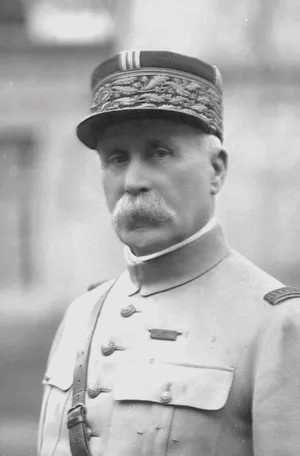
I believe that now the moment has come for a general sparking of the very concept of “collaborationism” – a very general linguistic term often used incorrectly. Therefore, as a first step, the types of collaborationism must be distinguished. The term was used for the first time by Marshal Philippe Pétain of France. Pétain, the hero of Verdun of World War I, “risked” his name after the German occupation of France (during World War II), but with his aim – which he realized – of saving ¾ of France from possible destruction by the German army. Thus, Marshal Pétain’s collaborationism was positively inclined toward French interests.
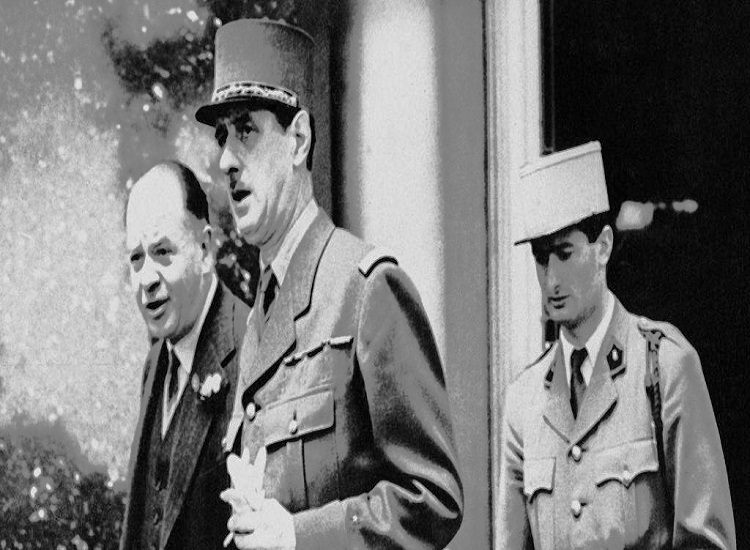
On this occasion, I will not analyze – for this is not the place – the public opinion misguided by Marshal de Gaulle, now generalized, influenced by de Gaulle’s self-centeredness, who wrote the history of that period for France and influenced the distortion of the truth that Marshal Pétain’s collaborationism was not in France’s interest. We mention de Gaulle and his stance only to highlight how his positioning was typical: POLITICAL OPPORTUNISM, because he fled France, took refuge in England, and… Ultimately sided with the victors, who always write history!
And so, self-centeredness, as well as the tendency to dismiss the deeds of each of his colleagues (he had been a student and under the command of Marshal Pétain before), found suitable ground for him, without any past patriotic glory and staying in the shadows waiting for political developments, to emerge at the head of France – to whom Marshal Pétain bequeathed his truly legendary past, knowing and being conscious that for the good of France, his great sacrifice was worthwhile!
On the other hand, diametrically opposite to Marshal Philippe Pétain’s collaborationism was that of the Norwegian Vidkun Quisling – just as an example! Yes, indeed, Quisling’s collaborationism was driven by his anti-communism, but this, on the other hand, was based simply on his egoism to be the first in his country, although he could only be Prime Minister for one week, and all his power was limited by the Germans to the right they gave him to undersign with his own hand all the documents for the deportation of Jews from Norway! See where the ego for power led Vidkun Quisling: to being an executor of death sentences, and nothing more!
What about Denmark, under the same conditions as Albania? The Danish people understood clearly that in the total balance of that war between giants, their influence in favor of the Allies would be microscopic compared to the potential losses they would suffer; therefore, they withdrew into their shell, made compromises and collaborated with the German occupying army in Denmark’s favor, …and waited for the war to end. After the war, thanks to the maturity of the leaders and the Danish people themselves, collaboration with the Germans and the compromises reached were considered actions with concrete results in the country’s favor.
The Danish left – since the Communist Party was outlawed – had no illusion of changing the country’s pro-Western direction, as a result of which the market economy continuously recorded successes in terms of increasing prosperity; and also, Denmark integrated as early as April 4, 1949, into the Western NATO alliance, and on January 1, 1973, agreed to become part of the European Common Market! (Comparisons with Albania are superfluous.)
In light of this perspective, we now examine the use of the term collaborationism by the Albanian Communist Party. During the war, with this derogatory qualifier, the leaders of the Albanian state who took leading positions were anathematized. Then, after the war, they were shot or left to rot in prisons, regardless of their extremely patriotic past, merely for being accused as collaborators of the occupier! That is the general picture. We now analyze it in the specific case of the government headed by Mustafa Merlika Kruja.
The prime minister himself, in the continuation of his patriotic activity, was a co-signatory of the independence document – a fact kept hidden by historians of the dictatorship era. After the dispersal of the government headed by Monsignor Fan Noli, Mustafa Kruja also took the path of political emigration. Since his name was unified by the historians of the dictatorship as a servant of Italian fascism, for the sake of truth, we present below some updates from archival documents:
A letter from the Italian Ministry of Foreign Affairs to the General Directorate of Police, dated August 25, 1933 (signature illegible), states: “…Mustafa Kruja complains again about the control exercised by local police authorities over his correspondence…! We consider it reasonable that this control be applied with greater care… and that Kruja not be given the impression that he is considered suspect by us.”
A letter from the Ministry of the Interior addressed to the Italian Ministry of Foreign Affairs on April 2, 1939 (signature illegible), states: “…as regards the aforementioned (Mustafa Kruja), who has come for health reasons… he is subjected to careful and very secret surveillance.”
On that same day, Mustafa Kruja had requested a meeting with Giuseppe Giro on behalf of Mussolini. During the meeting, Giro told him that he was charged with informing him that, regarding the mutual agreement, the Duce had made a couple of small changes to it. Mustafa Kruja, fiery, replied that: “Signed agreements are implemented point by point, as formulated. If Mussolini wanted to make changes… then let Zogu remain on the Albanian throne for another 100 years!”
That is just a fleeting illumination of the mutual positions – the Italian side and Mustafa Kruja.
But the other side of the medal – Mustafa Kruja? In December 1941, Mustafa Kruja took office as prime minister, and on April 23, 1942, the Albanian flag took its official form without the Lictor axes and without the Savoy knot – that is, the flag as it was before the Italian occupation! Galeazzo Ciano describes this fact in his memoirs. Mustafa Kruja had presented his aim to the Italian government: “I want Albania within its natural borders”! In the war situation at that time, Ciano had also confirmed to Mustafa Kruja the unification – besides Kosovo – of Plav and Gusinje! Thus, within this framework, the prime minister’s other desire – the unification of Chameria with the Mother Albania – remained to be realized.
Also extremely emblematic was Mustafa Kruja’s speech of November 22, 1942, when he declared publicly at the “Savoia” Theater that only by respecting Albania’s full independence would Italy find in the Albanians friends and brothers for life and death. Along this line, I cannot fail to highly appreciate also the mentality based on which Mustafa Kruja chose his closest collaborators, the members of the “Kruja” government. Minister of the Interior was appointed Dr. Mark Gjomarkaj, a jurist and son of the distinguished patriotic house of Gjomarkaj, also known as anti-Italian. Minister of Finance was entrusted to Shuk Gurakuqi, a renowned economist, distinguished as an honest man of character, also known as anti-Italian.
Minister of Public Works was appointed Iljaz Agushi, a Kosovan. A well-known patriot and anti-Italian, with political experience in Kosovo. Minister of the Fascist Party was appointed Jup Kazazi, a known anti-Italian. Minister of Justice was appointed Hasan Dosti, a distinguished jurist and known anti-Italian, about whom Naxhije Dume, one of the high officials of the P.K.Sh., in an interview regarding Hasan Dosti after the war, declared: “The Minister of Justice, Hasan Dosti, knew our anti-fascist thoughts and actions; these thoughts, as far as I could tell at the time, the minister also had his own thoughts.”
Minister of Education was Xhevat Korça. A known anti-Italian, therefore his appointment was approved by the Luogotenenza only at the very end – not a little, but three months after the Kruja Government had begun its activity and this thanks to the insistence of Prime Minister Mustafa Kruja, who would accept no other minister in his place. A fighter in the bands of Themistokli Gërmenji and of Spiro Bellkameni. Founder and first director of the Shkodra High School. When he was proposed to lead the Ministry of Education, he set two conditions: 1 – The Italian language be removed from the curricula of Albania’s elementary schools, and 2 – All teachers accused as anti-Italian be immediately released from prison or internment.
In the Central State Archive, there also exists a document signed by General Dalmazzo, commander of Italian forces in Albania, ordering all prefectures that whenever the Minister of Education Xhevat Korça went to them, he should be closely surveilled because he had communist leanings! Without extending the list too much, we stop at the distinguished figure of Albanian patriotism, Qazim Koculi, who was appointed minister without portfolio. Koculi was a known anti-Italian, who distinguished himself particularly during the Vlora War of 1920. After the delivery of the ultimatum for the withdrawal of Italian forces to General Piacentini, on which occasion he refused to withdraw his troops from the Vlora naval base, Koculi led the volunteer forces in the attack against Italian troops – a war that ended with the victory of the Albanian volunteers, throwing the Italians into the sea!
A few words now regarding the killing of Qazim Koculi (with some information that perhaps is not known, because during the communist dictatorship, the conformist historians also attributed the leadership of the volunteer forces to Selam Musai, who truly was one of the martyrs of that war, but by no means its military commander). Qazim Koculi was killed, and together with him also the unfortunate prefect of Vlora (a chance traveler), Lele Koçi. Who killed them? The perpetrator is not important, but he was instigated by a man from Dibra, one of the ordinary servants of the Italians. What was the motive?! For this, we must go deep into the years – to July 6, 1920, when the Italian forces were finally thrown into the sea and the Vlora region was liberated, rejoining Albania of 1912.
On that day, I emphasize, precisely that day, Benito Mussolini expressed himself as follows: “…I have cried more today for this defeat by the Albanians than when we suffered the defeat of Caporetto (October 25, 1917) by Austro-Hungarian and German forces (during World War I, the 12 battles along the Isonzo River – note M.K.)!” And on October 28, Mussolini wrote an article titled “AMARISSIMO” (“Extremely bitter” – note M.K.), where he explains how the defeat of the Albanian Caporetto is much, much more serious than that between the Isonzo and Piave rivers.
Precisely knowing this positioning of Mussolini, the fascist leaders of Italy, it is clearly understood why Mustafa Kruja’s government was hindered to such an extent by the Luogotenenza in the capture, trial, and punishment of the organizers and perpetrators of Qazim Koculi’s murder (for which the Duce’s revenge was discharged after two decades), to the point that Prime Minister Mustafa Merlika Kruja, feeling powerless to have the murderers of Qazim Koculi – his minister without portfolio – punished, submitted his unquestionable resignation of the Kruja government to Francesco Jacomoni!
Along this line, we cannot fail to highlight a very significant moment from the life of the anti-Italian Qazim Koculi, to whom the communist historians, supporters of communist party ideology, did not spare the qualifiers collaborator, fascist, traitor, and so on. When Qazim Koculi accepted the post of minister without portfolio in the Kruja government, his friend Sadik Shaska addressed him not without resentment, pointing out his displeasure regarding that decision. The answer he received from Koculi, the “collaborator and traitor” according to the communists, is truly symbolic: “How can you lose your mind, my friend Sadik, that I could collaborate with the rascals whom we threw into the sea in ’20? I am the same as then. To fight our enemies today, we need weapons and ammunition. If I were a high commissar of the government, I could not fill even two trusted positions, one at Trubull of Karbunar and the other at the Caves of Beun! With these we will fight the Italians, use your head, oh Sadik!”
After Qazim Koculi, we will treat very superficially two other members of the “Kruja” Government – precisely those two ministers, respectively one of the Fascist Party ministry and the other of Justice. We begin with Jup Kazazi, Minister of the Fascist Party. Prime Minister Mustafa Kruja chose him for that post precisely because of his patriotic and anti-Italian feelings, so that that ministry is kept away from Italian influence. The same for the Ministry of Justice, where the minister chosen was the patriot and one of Albania’s most renowned jurists, Hasan Dosti. When Hamit Mëzezi, Nikolla Tupe, and Ferid Xhajko were arrested in Tirana (without branching at all into the accusations that Enver Hoxha was their denouncer), the two aforementioned ministers, when those three communists were sentenced to death by the court, resigned from their ministries as a sign of protest.
Subsequently, Jup Kazazi went into illegality with the forces of ‘Balli Kombëtar’ and at the end of August 1943, led the Balli and Legaliteti forces, which comprised over 900 nationalist fighters, joined also by 25 partisans of the “Perlat Rexhepi” Battalion (the inventory of the troops was documented by Major Zenel Kazazi), and they inflicted a resounding defeat on the Italian forces in the Battle of Reç. The communist historians attribute the battle and its victory solely to the partisan forces – they alone allegedly inflicted the resounding defeat on the Italian force of 2,400 Italian soldiers! (?) So, according to these scientists – let alone not mentioning the name of the leader of that battle, Jup Kazazi – they do not even mention the nationalist forces at all! (?)
We now come to after November 29, 1944. Hasan Dosti leaves Albania and is sentenced to death in absentia as a collaborator and traitor. Jup Kazazi subsequently organized anti-communist resistance, which culminated on September 9, 1946, with the armed uprising of Postriba, of which he was part of its organizational brain. After its defeat, Jup Kazazi took refuge in the house of his uncles, Rifat and Shyqyri Kopliku, who had been imprisoned. Surrounded by the Pursuit Forces and not wanting the house to be burned, he made the women leave and then killed himself. The elder uncle, Rifat, took upon himself the sheltering of Jup Kazazi – for which he was shot! And how did the conformist historians with the ideology of the P.K.Sh. treat his figure? Even Jup Kazazi, according to them, turned out to be a “collaborator and traitor”! (?) / Memorie.al