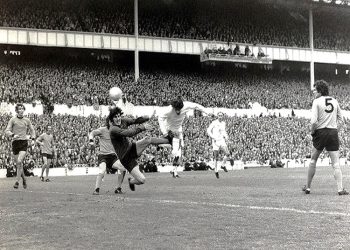
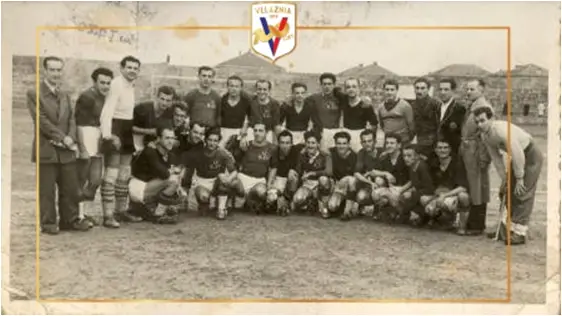

Memorie.al – A photo from 1974, capturing a film sequence from the international friendly match between “Vllaznia” and the Romanian team “ASA – Târgu Mureș” (result 1–1), played at the “Vojo Kushi” stadium in Shkodra, prompts me to return in time – no less than 12 years earlier – to when this stadium was inaugurated. Relying mostly on a history published by the well‑known journalist Besnik Dizdari about the construction of the first stadium in Albania under the communist regime, on the memoirs left by another Shkodra journalist, the late Rifat Uruçi, and on the memories I have recorded myself – even though I was no more than 12 years old, as a volunteer together with my peers from the “7 Nëntori” seven‑year school, moving cleaned stones and earth during the stadium’s construction.
In Shkodra, on this construction site that was realised solely through voluntary labor with the participation of the city’s enterprises and also the cooperative peasantry, the building of the stadium was welcomed with great enthusiasm. It was presented as a gift from the Party of Labor headed by Dictator Enver Hoxha, after eight years of persecution, executions, and internment inflicted on the population of Shkodra and all of Northern Albania.
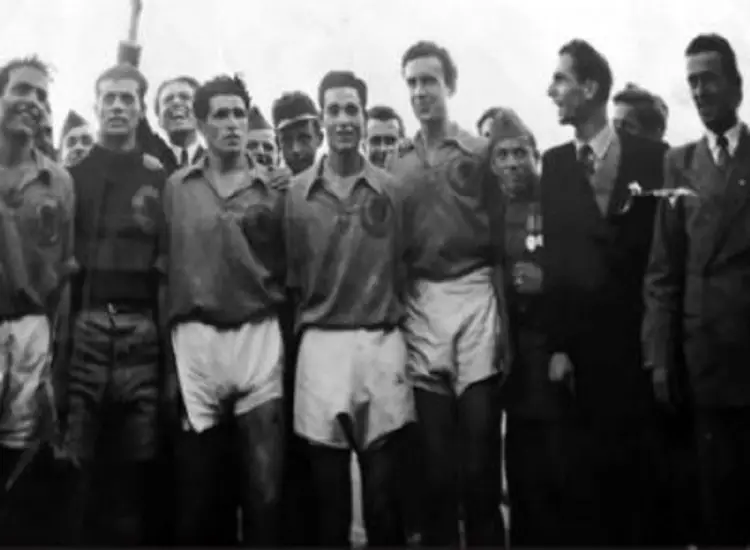
But this gift was trumpeted by the ruling Party as a privilege for the city where football was born (1905), for the city where the first international match was played between Shkodra’s “Independence” and the Austro‑Hungarian army (1913), for the city that had the privilege of hosting the first match of our National Team against Montenegro (5–0, 1946), and undoubtedly for Shkodra’s “Vllaznia”, which had been declared the first champion of Albania in the first national championship after the war.
For the construction of this stadium, much was said about the discussions that took place regarding which area of the city it would be built in. According to the memoirs of the late journalist Rifat Uruçi, the preferred first site for the representatives of the Staff set up for this purpose was the field of the former agricultural enterprise “Perlat Rexhepi”, beyond the Thive Bridge. This idea was not accepted by local power leaders and the Party Committee, as it would have required a large investment to raise embankments for the Kir River, which had several times overflowed, flooding the neighborhoods of “Qaf‑hardhi”, “Perash”, etc., and damaging many private and state economies.
The other variant that became reality was to utilise the private gardens (bahçe) of Shkodra citizens in the “Zdrale” neighborhood, the heart of the city. For this variant, the former Chairman of the Executive Committee, Shkodra native Qamil Gavoçi, had insisted – a variant that also justified opening some Muslim neighborhoods to Catholic ones. The work was done mostly by arm strength, with handcarts taken from Shkodra families in the surrounding neighborhoods, such as “Zdralej”, “Ndocaj”, “Dergut”, etc. What caused a great stir was the demolition of the cemetery of the “Zdralej” Mosque, where the gravestones were used to build the stadium’s steps.
The project was designed by engineer Irfan Tershana, who had completed his studies abroad but was afraid of his biography, because his relatives from Dibra e Madhe, such as Edip Tershana and Ibrahim Tershana, had been shot and sentenced by the communist dictatorship, accused as “enemies of the people”. Eng. Tershana personally supervised the works in implementing the project, which foresaw a football field of Olympic dimensions surrounded by five rows of stone steps. I remember as if it were yesterday that the stones, as the main building material, were obtained by lowering the enclosure walls of private houses in the neighborhoods near the stadium, whose field also touched some areas of private properties, around which fruit trees remained untouched – such as the fig trees of the Balej, Sokole, Dervishe families, etc.
The facility itself was surrounded by poplar trees that have withstood the years. Likewise, the football field was surrounded by an athletics track and its annexes, such as the jumping runways, shot put, and discus throw areas. After two years, on May 1, 1954, the construction was inaugurated, with the ribbon cut by Llazar Lipivani, Chairman of the State Committee for Physical Culture and Sports. But the inauguration was somewhat dimmed by the absence of the elite teams of the national championship for the inaugural match – “Vllaznia”, “Dinamo”, “Partizani”, and “Tirana”. On that same May 1, the Football Federation had scheduled “Vllaznia” to play in Tirana against Partizani, a match that ended 0–4.
Thus, on this holiday, the two local teams “Spartak” and “Dinamo” were privileged to enter history together with the name of the “Vojo Kushi” stadium (“Hero of the People”) – a gymnast with masterful skills. Over the years, the stadium underwent design changes. To discipline ticket entry, the steps, which had been raised to three more – that is, to eight – were enclosed with walls. The surrounding poplars increasingly formed a crown towards the heights, creating a fresh atmosphere that bold spectators used as free stands. This panorama did not change until the years when the stadium was completely reconstructed.
Four years later, when it was thought that this stadium would bring “Vllaznia” dignified representations, the unexpected happened: the team fell to the second division. This event became the cause of old rumours and stale conversations that such a fate awaited “Vllaznia” because it played on waqf land, above the centuries‑old cemetery of the “Zdralej” neighborhood mosque.
To come to the final inauguration of the “Loro Boriçi” Stadium in 2016, the stadium had undergone several design changes, increasing its steps, giving the central stand more elevation so that local and party authorities could keep distance from the fans. A design change with a vision beyond the existing reality was undertaken on the personal initiative of the former member of the Political Bureau of the Central Committee of the PPSH (Party of Labor of Albania) and First Secretary of the Party Committee in Shkodra, Muho Asllani.
It was said that the funds for the reconstruction of the stadium with a capacity of up to 30,000 seats were secured from investments in the Koman Hydropower Plant, where the raw materials – cement and steel – were unloaded from barges during sunny days at this site. It is said that Muho Asllani’s transfer from Shkodra was caused by his taking state funds without government authorisation. So true was this that the works remained suspended for a long time when, in the First Secretary’s chair, another Shkodra native, Xhemal Dymylja – although a great sports enthusiast – did not have the courage or initiative of his predecessor. Thus, the very modern project of the Shkodra engineer Reshat Koçkiqi was taken out of the archives to complete the half‑finished project.
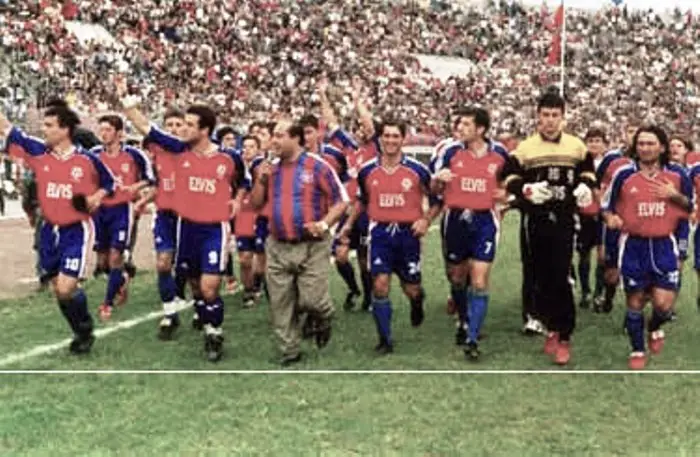
Undoubtedly, this concerns another political situation, where in the early 1990s the communist dictatorship had fallen and Democracy had triumphed. It is the golden age after the establishment of Democracy for “Vllaznia” and Shkodra, where the businessman enchanted by “Vllaznia”, the late Myftar Çela, who left as a “mortgage” the victories of “Vllaznia’s” championship title of 2001.
A full 25 years have passed without reaching the success left as a legacy by Myftar Çela, who, on the other hand, brought near that which the well‑known journalist Besnik Dizdari (who is leaving his mark also on the history of Albanian sport in general and football history in particular) cites when he says: “He who knows the environment of these stands of this stadium understands that in this match, Albania would not have surprised Europe that year 1983…! Çela – the unforgettable promoter in the development of these environments of the Albania – Russia matches 3‑1, which showed excellent organisation.”
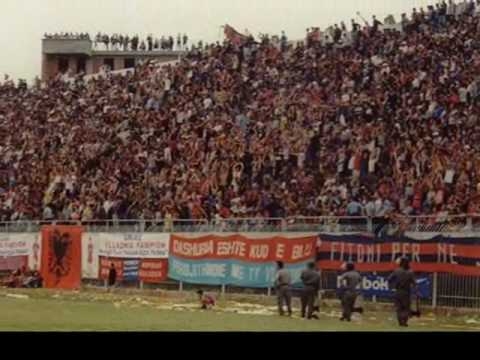
And finally, it would be the investment of the Rama Government in 2014‑2016 that gave the final hand to the intervention on this stadium – supposedly even national – but after the match of our national team with Russia, Shkodra sports lovers have been deprived of the right to follow a match of our national team in these recent years. In the past, the “Vojo Kushi” stadium (a talented former gymnast) and today the “Loro Boriçi” stadium (a former footballer and coach of international calibre over the years) have also recorded sports events such as athletics, wrestling, basketball, and volleyball, but football has an indelible history in the memory of Shkodra’s people. The team with a name in European football, in this stadium, has been surprised first by the calibre of the fans for their encouragement of “Vllaznia”, and also by the predictable results.
Split’s “Hajduk” left Shkodra having suffered a loss: 1‑2; Budapest’s “Dózsa” with 5‑6 players of the Hungarian national team, led by Ferenc Szőcz, left with a goalless draw: 0‑0. Another European team that had five footballers of the Austrian national team, who left with their heads high from the 1968 World Cup, Vienna’s “Austria”, for the Champions Cup, lost: 0‑2; the same fate for the European Cups was suffered by Tbilisi’s “Dinamo”. Or “Vllaznia’s” first victory against a national team, such as Algeria: 3‑0, in 1976. Victories against Balkan teams for the Balkan Cups are countless.
Not to be forgotten is the National Under‑21 Team with the unforgettable coach Ramazan Rragami, which, after drawing 1‑1 with West Germany and winning 3‑0 against Austria, qualified for the 1/8 finals of the European Championship. For me, even today, many chronicles and episodes recorded on the track or its annexes remain fresh, such as the presence of Czech athletes with champion Skobla in shot put, of sprinter Mandlik in the 100 m, where at the finish the tape, instead of being placed at chest height, cut him at neck height, leaving a reddish line as a memory.
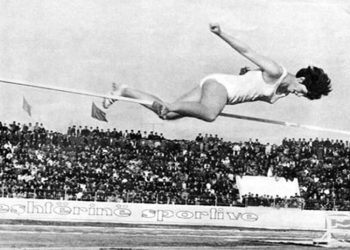
Or the presence of the world record holder, the Chinese Ni Chin‑Chin, in high jump. To encourage him in silence – as the Chinese himself required – the “Vojo Kushi” stadium recorded another spectator record, as the stands were filled an hour in advance with schoolchildren from the city. So everything in service of Ni Chin‑Chin, but the breaking of the world record of 2.29 m – one cm more than his record of 2.28 m – was not achieved. This was the history of the first stadium in Albania during the communist years, which has now reached a full 70 years of existence. / Memorie.al