From Bashkim Trenova
Part Twenty-Six
– NAZBOLSHEVISM – LITERATURE AND ARTS –
FOREWORD
Memorie.al – Historians, political philosophers, intellectuals of various schools or different positions have devoted thousands upon thousands of pages, entire volumes, studies, and articles to the comparison between Nazism and Communism. Generally, in their publications and studies, they focus on the police control of society by these dictatorships, on the role of the dictatorial state hierarchy and the head of state as suppressors of free thought, on the omnipresence of official propaganda in society, on the mass massacres and the network of concentration camps, on the activity of the police, the NKVD in the USSR (later the KGB) and the Gestapo in the Third Reich. In his book Le Passé d’une illusion (The Past of an Illusion), François Furet notes that Nazism and Communism share the same opposition to liberal democracy and to what they call “capitalist bourgeoisie.” Both ideologies claim to be socialist and use the image of socialism. Communist countries called themselves “socialist.” “Nazism” is a shortening of National Socialism.
THEATER
The figure of Lenin, the leader of October, over the years often alternates with that of Stalin. The higher the cult of Stalin rises, the more Lenin’s grandeur fades and disappears. In Vsevolod Vishnevsky’s Unforgettable 1919, Lenin appears in the prologue and yields to Stalin, saying: “We rely on you, Comrade Stalin.” This play was written by Vishnevsky on the occasion of Stalin’s seventieth birthday. It was staged in almost all theaters of the Soviet Union. The author himself was honored on this occasion with the “Stalin” Prize.
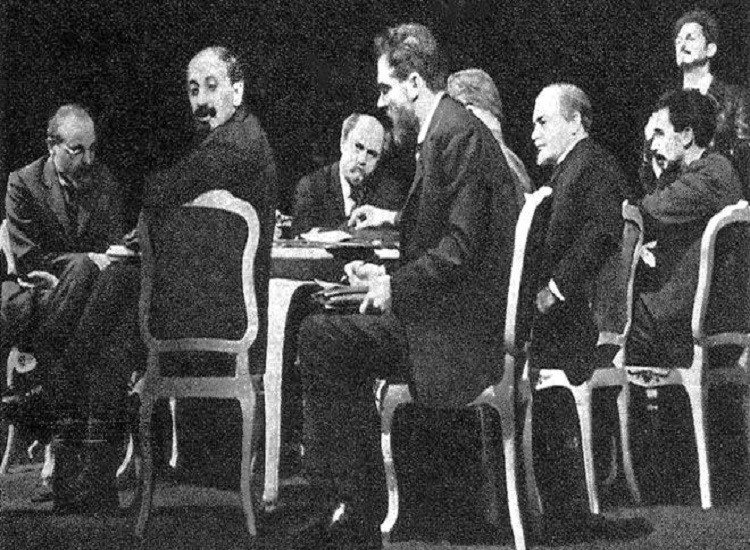
Ivan Popov’s The Family is also a play dedicated to Lenin and his youth. It ends with a scene where the future founder of the Soviet state, Lenin, rejoices in 1897 over the revolutionary activity of Stalin, who was not yet 17 years old at the time! Over the years, Russian and Soviet Theater perpetuated the cliché that it was Stalin, present every day, who overthrew the Tsarist regime. In his play The Bolsheviks, playwright Mikhail Shatrov condemns “barracks communism,” the bureaucracy that, according to him, destroyed Lenin’s legacy. He presents Stalin as the embodiment of evil. Shatrov devoted ten plays and 25 years of his life to Lenin. Shatrov’s The Bolsheviks focuses on August 30, 1918, when Fania Kaplan shot Lenin and when the Bolsheviks strengthened the Red Terror.
The Civil War occupies an important place in Soviet dramaturgy of the time and thereafter. During the years 1917-1921, the political sections of the Red Army were particularly active. In Moscow, during 1917-1919, the military theaters “Aquarium” and the Amateur Theater of the Red Army were born. In 1920-1921, the Theater of the III Guard Regiment and the Theater of the Moscow Military District were created. “October 1917”. The Petrograd Military District, during the Civil War, counted more than ten permanent theaters. The Political Directorate of the Western Front created in 1920, in Minsk, a permanent theater with three troupes: Russian, Belarusian, and Jewish. In 1920, the Red Army and Navy had 1,210 professional troupes and 911 drama circles, performing in 1,800 clubs.
During the Civil War, the first plays of Soviet playwrights were based on current events and reflected the fighting between the Whites and the Reds, i.e., between the Tsarists armed forces and the Bolsheviks. They also dealt with petty-bourgeois versus proletarian confrontations. The ending is always inevitable: the victory of the Reds and of the new communist ideas, through sacrifices and pain. In 1921, Vsevolod Vishnevsky staged, in the open air, the 8-hour spectacle The Trial of the Kronstadt Rebels, dedicated to the Kronstadt uprising. In 1929, he staged the play The First Cavalry about the events of 1920 on the Polish front, about the formation and combat activity of the legendary unit – the First Cavalry.
In 1922, V. Ivanov produced Armored Train 14-69, dedicated to the class war. The positive character, Katshalov, in the role of a peasant partisan of the Reds, clashes with the negative characters, Knipper-Tshekhova, who embody the great revanchist bourgeoisie, filled with venom. The play expresses itself decisively against tolerance, that intellectual sin!
Actors immediately ascend the stage to annihilate, mercilessly, the enemies of the revolution. In 1925, writer and playwright Vladimir Naumovich Belotserkovsky published the drama The Storm, which describes the condition of a village during the Civil War: famine, disease, disorganization, White Guard plots, and other evils, all of which are defeated by the Communists. The drama expresses distrust of intellectuals, who are presented as potentially counter-revolutionary. The ending, according to the mandatory scheme, closes with the revolutionary enthusiasm of the masses.
That same year, Boris Lavrenev published his first play Smoke, dedicated to the White uprising in Turkmenistan. It was performed at the Leningrad Academic Drama Theater. The drama is infused with the spirit of communist propaganda, hymning the power of the land of the Soviets. Boris Lavrenev is known as one of the creators of the Soviet heroic-revolutionary drama genre. In addition to the above, other authors continued to publish dramas on subjects from the October Revolution and the Civil War. In 1932, Vsevolod Vishnevsky wrote An Optimistic Tragedy. The play is dedicated to the Red Army and deals with the Civil War in 1918. A woman commissar is sent from Moscow to a battleship of the Baltic Fleet.
Power on the ship belongs to the anarchists led by Siply and Aleksei, insolent persons who try to mock the commissar by proposing she marry them. The commissar kills with a pistol shot the first person who tries to violate her honor. The anarchist leaders accept a kind of truce, hoping to turn the commissar to their side. The commissar finds allies near the ship’s commander, former Tsarist officer Bering, and the sailor Vainonen, a Bolshevik sympathizer. According to orders from Moscow, the “free anarcho-revolutionary” detachment is transformed into the First Naval Regiment. The anarchist chief, stripped of power, pretending to be kind and convincing, turns the crew against the commissar and commander, gives orders, and organizes a lynching. The crew goes to the front.
The chief asks the anarchists for support and, following his orders, the commander is arrested. Then the anarchists arrest two officers who had escaped the Germans and, on the chief’s orders, shoot them. The play also shows a confrontation between the anarchists and a small group of communists. The actions of the anarchist chief cause Aleksei and several other sailors to join the commissar. On her orders, Aleksei shoots the anarchist chief. Then the regiment is sent to the Black Sea, where it encounters German troops. As a result of betrayal by Siply, part of the regiment is captured. The commissar dies while the remaining sailors manage to escape.
The moral is clear. With anarchists, who undermine the revolution, there can be no victory. Only the Bolsheviks can secure this, by showing themselves merciless even toward the anarchists, those sworn enemies of the revolution.
World War II was also treated by Soviet playwrights. Many authors would find in their military experience themes for dramatic works, which they would write in the following years. During the most difficult time of the Nazi blockade of Leningrad, a new theater was created in that city, known as the “Leningrad Drama Theater.” The war was accompanied by a kind of softening of the Party’s vigilance on the “literary front.” National feelings were placed in the foreground. On November 7, 1941, Stalin in a speech cited Lenin’s name, but in the foreground he highlighted Prince Alexander Nevsky, a saint of the Orthodox calendar, and Dmitry Donskoy, a prince of the Russian Middle Ages, also declared a saint by the Orthodox Church. He acted similarly by exalting the memory of Tsarist marshals Kutuzov and Suvorov.
Among the dramatic works dealing with the years of World War II is also The Distant Land by Evgeni Lvovich Schwartz. The author, who participated in the defense of Leningrad, shows in this drama the fate of the children of a city orphanage, their transfer from the orphanage. He also wrote the drama One Night, about the Nazi blockade of Leningrad. Together with Mikhail Zoshchenko, Evgeni Lvovich Schwartz also wrote the anti-fascist play Under the Linden Trees of Berlin. Forever Alive is another play dedicated to World War II, written by Viktor Rozov in 1943, when the wounded author was in hospital. Based on this play, Rozov later wrote the screenplay for Mikhail Kalatozov’s film The Cranes Are Flying, which won the Palme d’Or at the Cannes Festival in 1958.
In the drama, the action begins in Moscow on July 3, 1941, with the radio message from Sovinformburo announcing that Soviet troops have become engaged in heavy fighting in World War II. Young Boris Borozdin, although exempted from military service, volunteers to go to the front. He leaves one day before his fiancée Veronika’s birthday, which he calls Belka (Squirrel). He leaves her a gift – a toy squirrel, alluding to her nickname. The toy contains a hidden note, but Veronika cannot find it. Having no news from Boris, desperate Veronika, having lost her parents and home, marries Mark, Boris’s cousin, but this marriage brings her no comfort.
While Boris’s father and his sister Irina work in a military hospital, giving their help during the war years, Mark, a poor amateur pianist, does everything to avoid being drafted. He often visits a certain Antonina Monastirskaya’s house, where individuals who profit from the war gather. Mark, in love with Monastirskaya, gives her Veronika’s squirrel toy. On this occasion, Boris’s letter is found. Veronika decides to leave Mark. Evacuated from Moscow, the Borozdins stay with Anna Kovaleva, a history teacher. Her son Vladimir returns home on leave after being wounded and, not knowing the Borozdins, one day talks about his friend Boris, who used to call his beloved “Belka.” From him, the Borozdins learn that Boris was killed in the war. Then the Borozdins return to Moscow, accompanied by Anna Kovaleva and Volodya. Mark realizes his presence in the house is unwanted. Volodya falls in love with Veronika, but she still remembers Boris and loves him. She asks Volodya to give her time. The final act ends with fireworks in honor of Soviet troops crossing the German border.
On July 3, 1941, Stalin declared: “Brothers and sisters, dedicate yourselves to victory over the enemy, do everything you can to crush the enemy, German Nazism!” From the first two words of Stalin’s appeal comes the title of the play Brothers and Sisters. This play is an adaptation of Fedor Abramov’s novel of the same title. It shows the life of a village in the far north of Russia in the Arkhangelsk region, from 1945 to the 1950s. Abramov, born in this village in 1920, first recounts the famine during the war years and shortly after. The inhabitants have no bread. They make a kind of inedible bread from moss. All the men are at the front, and only the women struggle for their families’ survival. The end of the war only worsens the cold, hunger, chaos. Only two men returned from the war. One had been a prisoner of war, and the fate of those who became prisoners of the Germans was one of Stalin’s darkest crimes.
They thought they were finally returning home, but at the border they were loaded onto trains that took them to Siberia or to camps in the far north. The same happened to civilians, women and children, especially Ukrainians, whom the Germans had sent to Germany, to camps or to war factories. The small number of former prisoners or internees who managed to return to their village, like Timofei in the drama, was persecuted by local party officials, kept aside. Abramov also shows that after the war, crop quotas, taxes (under the guise of forced “loans”), and various forms of forced labor destroyed the collective farmers.
War Does Not Have a Woman’s Face is a theatrical play based on a 1980s novel by Svetlana Alexievich. At the end of the German-Soviet pact, the Nazis attacked the Soviet Union. Many men were killed in the war; women rose up like men to take up arms and defend the homeland against the invader. According to figures, 800,000 of them served in the Soviet army. Many others joined the partisans. If initially in the war women served in infirmaries or canteens, later they truly took up arms, piloted planes, and commanded battalions. Their names in the drama are Anna, Sonia, Nina, and Olga. Each has her own story, reasons, pains, hopes, loves, deaths. Based on the many testimonies in Svetlana Alexievich’s book, the drama presents these four portraits. These women meet every May 9 to commemorate the end of Nazi Germany, the hell they lived, a hell that is unimaginable.
Despite everything, the drama, through its characters, serves the regime’s propaganda, which highlights these heroines to show the heroic strength of the Party, which created or molded the new heroic man! The task of Soviet playwrights became particularly difficult when, by commission, they had to write dramas about their fellow citizens in everyday life. Shortly after the October Revolution, the communist authorities criticized authors who placed emphasis on negative characters. They were required, besides the Revolution, the Civil War, and World War II, to write about the industrialization of the country or the “industrial” era, whose heroes are concerned only with exceeding the production plan and are corrected through criticism and self-criticism.
Personal themes, especially those of love, play only a secondary role. The Party dictates that art in general, and drama in particular, should “place at the center of attention the path toward the future.” Over the years, the Bolsheviks in power would demand that drama reflect only the conflict between “the good” and “the better,” because according to them, negative characters were no longer typical in such a developed society as the Soviet one! Almost immediately after the Bolsheviks came to power, in 1918, Vladimir Mayakovsky wrote one of the foundational works of Agitprop Theater, the play Mystery-Bouffe. The same author later wrote the plays The Bedbug in 1929, and The Bathhouse in 1930.
In Mystery-Bouff, the author applies the Marxist scheme of the development of history. The play’s axis is nothing more and nothing less than the development of the class struggle. In it act “the Clean” (bourgeois masters) and “the Unclean” (poor proletarians). Figures of Evil personify capitalism, while figures of Good personify communism. At the beginning of Act II, “the Clean” establish autocracy. Then comes the bourgeois revolution. The monarchy is followed by the Democratic Republic, but the proletarian revolution overthrows the bourgeoisie and establishes Soviet power. Acts III to VI deal with a long transitional period, meaning the road to communism is still long. Mayakovsky offers the spectator the path to a better world, the communist utopia.
Mystery-Bouffe is indeed a Marxist drama, but it conveys a Marxist revolutionary program through a prophetic, even mystical tone. If Marx purged Hegel’s dialectic of its mystical form, preferring to place dialectic on the path to transforming production relations, the Russian communists did not completely detach themselves from a certain mentality, inherited from ancient Russia, which continues to be expressed in Mystery-Bouffe within the prophecy of the “Man of the Future.” The Bedbug is a “fairy-tale comedy” in five acts and nine scenes, accompanied by a musical score by Dmitri Shostakovich. It tells of the embourgeoisement of worker Prisypkin, an old member of the Party.
Tired of the deprivations suffered during the Civil War (1917-1923), abandoning his fiancée Zoya Berezkina and his worker friends, he marries Elzevira Davidovna, owner of a hairdressing salon, thus embracing the comforts of bourgeois life. During the wedding, a brawl breaks out among the guests, and a fire breaks out in the salon. All the guests die. Only Prisypkin survives, frozen in a block of ice formed from the water thrown by firefighters to extinguish the fire. Fifty years later, the frozen Prisypkin is found. He is revived on May 12, 1979. The world at this time is run by robots who, after a discussion, voted for his revival. Prisypkin no longer recognizes this world. Society has changed; it has become communist.
What remain from the past are his petty-bourgeois attitude and an unexpected companion: an insect that had stuck to his neck. This insect had been frozen at the same time as him. While Prisypkin, nostalgic for his petty-bourgeois habits and for vodka, brings all sorts of diseases from the past, the insect likes mattresses. For this reason, the “normal insect” and the “vulgar petty-bourgeois” are found in the showcase of parasites of the zoological museum. The fate of the petty-bourgeois, who grows fat at the expense of humanity, is similar to that of the insect that grows fat on the human body. The fear of contagious diseases is also treated at the end of the play.
While the men of the future appear with a hygienist ideology that stands like a crown on their heads, they also appear more fragile and more endangered than Prisypkin by contagious diseases. On the advice of the medical team, the man of the past must be isolated to avoid any consequences in the face of the petty-bourgeois danger. The Bathhouse – this Mayakovsky drama in six acts, with circus and fireworks – was written during the spring and summer of 1929. The first performance was given on January 30, 1930, in Leningrad.
The Moscow premiere took place on March 16, 1930, directed by Meyerhold. Between 1930 and 1953, the drama was no longer performed in the USSR because of its satire on bureaucracy. What do bathhouses represent? What should they wash away? The play deals with cleansing the administrative apparatus of all those who hinder the march toward communism.
Another author, Sergei Tretyakov, in 1924, gave Russian theater the play Gas Masks. It deals with an accident in a factory. Workers try to repair a gas leak without using masks. The performance was given in a real gas factory. The aim was to attract spectators onto the stage and engage them directly in the work of the workers trying to stop the gas leak. However, because of the gas, which was really present, the public was unable to watch the scene. Gas Masks was a complete failure – an example for concretely understanding the insurmountable limit that separates art from life. Proletarian solidarity, no matter how “holy,” cannot be insane, regardless of Bolshevik agitprop. Basically, life has its own laws.
Again, in 1924, it was Vladimir Naumovich Belotserkovsky who would treat the proletariat and its role in the workplace and in history, but this time it is not the Russian proletariat that is put on stage, but the American one, in solidarity with the Russian one. This is reflected in his play Echo, dedicated to the American dockers who refuse to load certain weapons to be used against the Soviets. By the same author, years later (1934), the play Life Calls would be published, which stages the individual subjugated to personal needs and the supremacy of the collective. Belotserkovsky’s dramas generally deal with heroic communism and decadent capitalism. They played their role in theatrical life, in the formation of the mechanisms and characters of Socialist Realism. It is understandable why, during the Soviet period, his works were subject to 58 editions in 1 million copies and were translated into nine languages. / Memorie.al