Memorie.al / Standard Albanian, proclaimed as such during the regime’s time, is not a natural given of our language itself. The linguist David Luka writes that it was Marxist ideology that led to the violent imposition of this standard. The question: What is the dialectal basis of standard Albanian? is not raised in vain. It is now known by everyone that at the Congress of Spelling of the Albanian Language, and after it, for 20 consecutive years, it was stated and restated, repeated and over-repeated that “The Albanian language is a system of systems and the national literary language is a supra-dialectal system.” In the diagram presented to explain the above idea thoroughly, the following explanations were placed in the Legend, leaving no path for discussion:
– Common elements of the two dialects.
– Specific elements of the Southern dialect.
– Specific elements of the Northern dialect.
– The basis of the national literary language.
– The national literary language.
– The national language.
And these conclusions were not drawn in 1972, but 12 years later, in 1984, at the scientific conference “The Albanian National Literary Language and Our Era,” organized by the Academy of Sciences of the People’s Socialist Republic of Albania, in the paper by the originator of “standard Albanian,” Prof. Androkli Kostallari. Until 1990, the theses (respectively, the philosophical bases) of Prof. Kostallari were defended with fanaticism by all titular Albanian linguists (including those from Kosovo), pouring out, without “counting,” opinions that under no circumstances and on no issue contradicted the *sui generis* theory that A. Kostallari had put forward regarding the path of formation of the Albanian national literary language. On the contrary, they approved Kostallari’s opinions without any objection, even singing his praises.
The philosophy and practice of Prof. Kostallari, it is now known, was the Marxist-Leninist one, embodied in the so-called “language policy of the party.” The basic principle, at that time, for this problem was this: “… language itself does not have a class character, but language policy has a class character, and the class struggle within the country is also reflected in it”!
We were taught this refrain so much that we believed it a priori. Nevertheless, a supra-dialectal Albanian would have been a perfect realization, and Prof. Kostallari should be commended for it. All the more so when even renowned Balkanologists (as Kostallari himself writes) have underlined the feature of the Albanian literary language “as a model of a language that was not created *ad hoc*, but achieved unification through a complicated and long process…”.
However, in Prof. Kostallari’s text mentioned above, we learned that; “There are also particular scholars … who have overestimated the specific elements that distinguish the two dialects of Albanian and have interpreted today’s unified Albanian literary language one-sidedly, simply as a ‘literary Tosk’ elevated directly into a national literary language… Among them, the monograph by Xhenet Bajron (Janet Byron) with the title… stands out especially! In this work, which contains many contradictory assertions, the formation of the unified Albanian literary language is treated in a distorted and simplified manner”.
In note no. 4, Kostallari adds: “It should be noted that this work does not make use at all of the Acts of this Congress and the important publications after it, without which it is impossible to objectively evaluate the features of the unified Albanian literary language and the trends of its current development”. Although Xh. Bajron’s (Byron’s) work was published in 1976, none of the linguists had spoken or written about it, neither here with us nor in Kosovo.
Kostallari claims to have made a scientific analysis of the system of our literary language, upon which he bases his theory. According to Kostallari, the Albanian language has created its own system, which belongs to a higher plane than the former literary variants and dialects and functions as an independent and comprehensive system of a new type. This system does not coincide with either of the systems of this or that former literary variant, nor does it represent a mechanical fusion of literary variants, but is a new organic synthesis of the elements of the Albanian language, created historically by the development of our language.
From this presentation by Kostallari, two conclusions are drawn: First, the development of the Albanian language is a dialectical process (here in the Marxist-Leninist sense), i.e., independent of external interventions, which may have slowed down or accelerated this process, but which could in no way stop it. Second, with the creation of this new idiom (standard Albanian), the dialects undergo a dialectical contraction, because their place is increasingly taken, in a dialectical manner, by the standard language, through which the daily life communication of residents who are at all times in contact with it (school, press, television media, etc.) is carried out.
This story continued until 1991, when suddenly, one of the adherents of the Spelling Congress, Dr. Xhevat Lloshi, during a polemic with Arshi Pipa (in the article “Albanian Culture Facing New Concerns”, published in the magazine “Sot”) came out against A. Kostallari, taking Byron’s side. At the conference “The National Literary Language and the Albanian World Today”, held in Tirana in November 1992, it was openly affirmed that the dialectal basis of the Albanian literary language had been the literary Tosk!
Now we no longer had the conclusion of a single scholar, but that of an international conference. Thus, we were faced with two conclusions: one from the Spelling Congress, where the unified Albanian national literary language was formed sui generis and stood above the dialects (“supra-dialectal”); the other from the conference (also international; but not a Congress, which would have been able to annul the decisions of the Spelling Congress), which, without batting an eyelid, drew the other conclusion that the unified Albanian language was built on the basis of literary Tosk.
Now anyone with two brain cells to rub together would necessarily ask: Should we discuss this matter, or blindly accept two completely opposite conclusions on the same problem? And, as R. Ismajli writes: “If you keep issues closed in a cauldron until they ferment, there is a risk that they will burst the cauldron completely.” Now, did our esteemed linguists know that literary Tosk had been placed at the base of the unified literary language, and that “sui generis” and “inter-dialectal interaction” was just slogans, to throw dust in people’s eyes?
If they knew, why didn’t they speak then? If they didn’t know, when did they remember this? They must tell us this, because they defended this method of forming the literary language with fire. And here’s what one of them, Prof. Anastas Dodi, tells us. When a journalist from Prishtina’s “Java” asked him: “Why wasn’t it stated at the Congress that the basis of the Albanian literary language, which was being fixed there, is the Tosk dialect?”, Prof. Dodi replies: “I remember that this matter was discussed, and we made remarks to Kostallari’s paper, and told him that it should be stated that the base dialect is Tosk, which is placed at the foundation of the literary language. But it was said that this might do more harm than good.”
Now, A. Dodi, in the article “Some Problems of the Literary Language in the Work of Enver Hoxha”, has written: “As early as June 15, 1955, comrade Enver Hoxha says with great clarity that ‘today’s Albanian literary language is not Tosk…’” As you see, we are faced with two Anastases, and we don’t know which one to believe?
Why did the poet Lasgush Poradeci not sign the Resolution of the ’72 Spelling Congress?
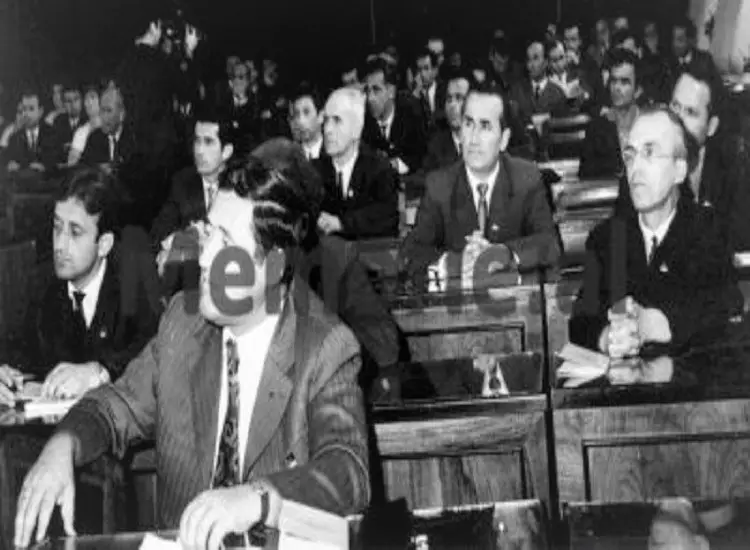
Only one participant of the Spelling Congress did not sign the Resolution. This was the poet Lasgush Poradeci. When I communicated this fact to Prof. Emil Lafe at a gathering in Shkodër, commemorating Norbert Jokl, he initially disputed it, but then remembered and told me that Lasgush had fallen ill as soon as the Congress ended. We went to the hospital to get his signature, he told me, but he was unwell, and we left. That same year, I met the poet in a confidential setting and slyly asked him about this failure to sign and about this illness, which I had learned was fabricated and done on purpose. The author looked at me for a long time, and then said: “I am afraid of history!”
After all this presentation, I would like to ask all our linguists, always ambivalent in their statements; shall we gather and decide altogether what the basis of standard Albanian is? Because we have had a full 25 years without getting to the bottom of it? Let us decide, then, once and for all and close this conversation. It would be enough, for what I said above, the question with which one of the personalities of Albanian linguistics, Shaban Demiraj, begins his own paper at the Conference on the 30th anniversary of the Spelling Congress: “… whether the decision for today’s standard Albanian was scientifically supported.”
Now, regardless of the answer, as long as this question is posed, it means that the reason to discuss this fact remains standing. Therefore, discussion is needed. Because, there are others who have expressed opposing views on these problems. Bahri Beci, for example, states clearly: “Nevertheless, the conclusion presented by A. Kostallari that during the period of building socialism in Albania the fundamental axis around which the entire system of the literary language has developed was and is inter-dialectal interaction, does not prove true”!
So, to answer the question: What is the dialectal basis of standard Albanian?, Prof. Kostallari’s theory on the formation of the unified literary language must first be put through a sieve. It must be proven, therefore, not with assertions, but with academic studies, that today’s standard Albanian is built on the basis of Tosk raised to a standard. Once an answer is given to this question, then it becomes quite clear that the dialectal basis of standard Albanian can be expanded.
Until now, I have spoken very briefly about “the path of formation of the Albanian national literary language; about the history of its spelling”, which should not be treated as a taboo. Likewise, those who think differently should not be labeled as “anti-national”. In science, the argument always holds value. The ancient Greeks said that “truth always emerges through discussion.” /Memorie.al
![“After the ’90s, when I was Chief of Personnel at the Berat Police Station, my colleague I.S. told me how they had once eavesdropped on me at the Malinati spring, where I had said about Enver [Hoxha]…”/ The testimony of the former political prisoner.](https://memorie.al/wp-content/uploads/2024/09/Ndertesa-e-DPB-se-te-Beratit-ku-ne-vitet-70-te-iu-nenshtruan-proçeseve-hetimore-Sokol-Sejko-dhe-pjestaret-e-Grupit-te-Poshnjes.-350x250.jpg)