
By Bashkim Trenova
Part Thirty-One
– NAZBOLSHEVISM – LITERATURE AND THE ARTS –
FOREWORD
Memorie.al / Historians, political philosophers, intellectuals from different schools or positions have dedicated thousands and thousands of pages, entire volumes, studies and articles to the comparison between Nazism and Communism. Generally, in their publications and studies, they focus on the police control of society by these dictatorships, on the role of the dictatorial state hierarchy, of the head of state, as suppressors of free thought, on the all-pervasive place of official propaganda in society, on mass massacres and the network of concentration camps, on the activity of the police, the NKVD in the USSR (later the KGB) and the Gestapo in the Third Reich. In his book “Le Passé d’une illusion” (The Past of an Illusion), François Furet notes that Nazism and Communism share the same opposition to liberal democracy and what they call “capitalist bourgeoisie.” Both ideologies claim to be socialist and use the image of socialism. Communist countries called themselves “socialist.” “Nazism” is a shortening of National Socialism.
Continued from the previous issue
PAINTING AND SCULPTURE
As early as 1923, Fritz von Graevenitz created ‘Denkmal für das Grenadierregiment Königin Olga’ (‘Monument for the Grenadier Regiment Queen Olga’). In 1925, he created ‘Denkmal der Gefallenen des 122. Füsilierregiments’ (‘Monument for the Fallen of the 122nd Fusilier Regiment’). Further, in 1927, Graevenitz created ‘Infanterie-Regiment Kaiser Friedrich, König von Preußen’ (‘Infantry Regiment Kaiser Friedrich, King of Prussia’). In 1932, he began work on the memorial “Mutter Heimat” (‘Mother Homeland’), which he completed several years later. Always dedicated to World War I, the role and fate of soldiers and, generally, of the German army, of Germany and the German people during this war, in 1936 Fritz von Graevenitz completed ‘Handgranatenwerfer’ (‘Hand Grenade Thrower’), in 1937 – ‘Die Wacht am Rhein’ (‘The Watch on the Rhine’), also known as the “Schneckenburger Memorial.”
We may recall that “Die Wacht is Rhein” is a German patriotic anthem. The song’s origins lie in historical Franco-German hostilities. It was particularly popular in Germany during the Franco-Prussian War and the First World War. The original lyrics of this anthem were written by Max Schneckenburger in 1840. It makes a powerful appeal to all Germans to rush and defend the German Rhine and not allow “any enemy to set foot on the banks of the Rhine.”
“Die Wacht am Rhein” calls on Germans to unite, to set aside regionalism, sectarianism and the rivalries of the various German kingdoms and principalities, to create a unified state and to protect the territorial integrity of Germany. It is the same refrain adopted and used by Nazism to justify its expansionist appetites and to spread its racist and revanchist ideology. Before coming to power, in his book “Mein Kampf,” Hitler wrote: “The purification of our civilization must extend to almost all fields.
Theater, art, literature, cinema, the press, posters, shop windows must be cleansed of manifestations of a decomposing world and placed in the service of a moral idea, of a principle of the State and of civilization.” In these lines, literature and art developed in Germany after Nazism came to power. This “straitjacket” that the Nazis put on literature and art also explains why, during their rule, no composer, writer, painter, sculptor, filmmaker, no great director emerged who would survive time. Nazi literature and art, ultimately, in their essence, if not in their entirety, can be described as dogmatic and obscurantist literature and art.
In the first years after the October Revolution, in Soviet Russia, all symbols of the past, paintings, statues, monuments of tsarism, were burned, destroyed or dismantled. This destructive, purifying activity, in the eyes of the Bolsheviks, created an empty space that needed to be filled as quickly as possible. Soviet painters and sculptors had to act by presenting a social environment transformed by the revolution, to address the masses. Hundreds and thousands of paintings and sculptures from the post-revolution period and beyond were dedicated to its heroes, peasants, soldiers, generally representatives of the proletarian mass.
A healthy, athletic, sporting body, the cult of the body, is the object of the creative activity of painters and sculptors. Sport carries irreplaceable values in the Soviet Union. Art highlights these values such as discipline, self-control, determination, will, etc. A perfect physical form is linked to results at work, to socialist construction, to the grandeur of the country of the Soviets. Soviet painters, just like their colleagues in other fields of art, have dedicated a special place to the figure of Lenin as the leader of the October Revolution, as a symbol of the proletarian revolution, thus creating a new iconography. Lenin is presented on an elevated plane, with his gaze fixed towards the horizon, towards a brilliant future. Soviet painting places on canvas a prophetic Lenin, leader of a now free people.
These images replace the traditional “idols” in state and public spaces, but also in the Russian village, where paintings of a revolutionary character and those with religious content stand side by side. The Lenin Museum in Moscow alone has 470 paintings that present him as a god. The State Historical Museum houses: ‘Владимир Ленин и манифестация’ (‘Vladimir Lenin and the Manifestation’) by Isak Brodsky, created in 1919, ‘В.И.Ленин возрасте 4-х лет’ (‘Lenin at age four’) by Ivan Parkhomenko (1920), ‘Владимир Ленин в эмиграции. 1905-1907 гг’. (‘Vladimir Ilyich in Emigration. 1905-1907’) by Emil Wiesel (1920), ‘Ленин переодетый в Смольном институте в октябре 1917 года’ (‘Lenin Disguised at the Smolny Institute in October 1917’) by Mikhail Avilov (1925).
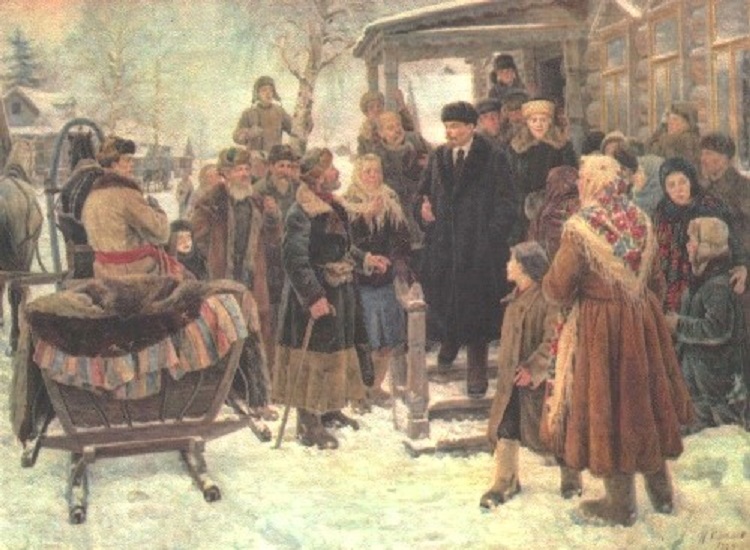
‘Владимир Ленин на Красной площади’ (‘Vladimir Lenin on Red Square’) by Isak Brodsky (1924), ‘В. И. Ленин в Смольном’ (‘Vladimir Lenin at Smolny’) also by Isak Brodsky (1925), ‘Ленин в горах Швейцарии’ (‘Lenin in the Mountains of Switzerland’) by Fyodor Lepyoshkin (1925), ‘В.И. Ленин на трибуне’ (‘Lenin at the Tribune’) by Alexander Gerasimov (1930), ‘Владимир Ленин и его жена Надежда Крупская среди крестьян деревни Горький в 1921 году’ (‘Vladimir Lenin and his wife Nadezhda Krupskaya among the peasants of Gorki village in 1921’) by Nikolai Sysoev (1949), ‘Ходоки у В. И. Ленина’ (‘Peasants Visiting Lenin’) by Vladimir Serov (1950), ‘Мы пойдём другим путём’! (‘We Will Take Another Path!’) by Pyotr Belousov (1951), Портрет Ленина (‘Portrait of Lenin’) by Ivan Kosmin (1953).
‘Ленин перед Государственным планом электрификации Советской России после Октябрьской революции’ (‘Lenin before the State Plan for the Electrification of Soviet Russia after the October Revolution’) by Leonid Shmatko (1957), ‘Портрет Владимира Ленина’ (‘Portrait of Vladimir Lenin’) by Pyotr Vasiliev (1959), ‘В. И. Ленин на революционной сходке студентов в Казанский университет’ (‘V.I. Lenin at the Revolutionary Student Gathering at Kazan University’) by Oleg Vishnyakov (1961), ‘Ленин – вождь’ (‘Lenin is the Leader’) by Viktor Ivanov (1965), ‘Ленин работает над книгой Материализм и эмпириокритицизм в Женевской библиотеке’ (‘Lenin Working on the Book ‘Materialism and Empirio-Criticism’ at the Geneva Library’) by Pyotr Belousov (1978), etc.
After Lenin’s death, Soviet painting showed particular zeal in making the gradual transition of the cult, the myth, from Lenin to Stalin. A highly significant work entitled “Под знаменем Ленина, за социалистическое строительство социализма” (‘Under the Banner of Lenin, for the Socialist Construction of Socialism’) was created by Gustav Klutsis in 1931. In this work, Stalin is still under Lenin’s shadow, but at the same time, he is also his shadow, i.e., he is presented as his heir. This work by Klutsis was widely spread throughout the country in hundreds of thousands of copies.
Beginning especially from 1933, Stalin’s image as political leader becomes even more dominant in Soviet painting. He is now alone in command of the country. Among the most famous works of this time is the piece by Efimov, depicting a ship named “СССР” (USSR). The caption reads: “The Captain of the Soviet Union leads us to victory.” Stalin, in military uniform, looks to the horizon with a determined and confident expression. This is the first work where Lenin’s spiritual son is presented alone, without him. In 1936, Klutsis returned to Stalin with the work ‘Руководители решают все’ (‘Leaders decide everything’).
Stalin occupies the entire space. In this painting, a very small, almost Lilliputian space is reserved for the joyful, admiring crowd, hypnotized by the great leader. The cult of Stalin reached its highest level especially in December 1939, during his sixtieth birthday. The image of the Kremlin chief becomes dominant and omnipresent. Paintings with Stalin at the center are distributed in all languages of the country, in Russian, Azeri, Armenian, etc. He dominates over crowds of men, women and children, always gazing at him with admiration. By the end of the 1930s, Stalin had become a living icon.
The first years of World War II are characterized by an absence of Stalin’s figure in Soviet painting. Only in 1942, at a festive ceremony dedicated to the October Revolution, posters with his image reappear. On this occasion, Stalin is shown with a determined look. The euphoric slogan of the time was: “For Stalin, the greatest of our era, Stalin the banner of our victories.” The cult of Stalin is linked to that of the Motherland. His image changes sharply. After the victory of the ‘Red Army’ at Stalingrad in 1943, Stalin is no longer presented as a simple leader, but dressed in an ornate military uniform, like those known from the time of the tsars and which the Bolsheviks had reviled and mocked.
Stalin’s current images are those of a victorious military chief, proudly displaying the honors befitting his rank. After the war, a true return to his cult would be seen. Relying on Socialist Realism, which became mandatory again, Stalin’s figure is magnified, embellished. It is presented doubled, as a human being and as an extraordinary character, always as the Messiah of happiness, of the realistically attainable socialist or communist paradise, as God. A painting by Boris Borozovsky, created in 1951, titled: ‘Под водительством великого Сталина вперед к коммунизму’! (‘Under the leadership of the great Stalin forward towards communism!’) Presents him standing, amidst a crowd, with one finger raised as if pointing to a goal to be achieved. The crowd is gigantic, incalculable. Their faces are happy. The crowd’s gaze is directed at him.
In the background of the painting, a region of southern Russia is seen with two symbols: on the right, the great works for the electrification of the country, on the left, urbanization. Stalin dominates the crowd. He is simultaneously a theoretician and a man of action, leading the people towards progress. He is described as “the great Stalin,” “the great architect of communism” on a world scale, etc. Other communist leaders such as Voroshilov, Kirov, Ordzhonikidze, etc., also occupied a less important place in Soviet painting of the time.
The art of the propaganda poster was born in Russia on the wave of the Bolshevik revolution. Gozsizdat, the state publishing house created in 1919, produced no less than 3.2 million copies of posters of this nature in 1920. And it is not the only one in this activity, to which are added another 7.5 million distributed over the next three years. The object of this art is not simply the glorification, iconization or sanctification of the Bolshevik leaders, Lenin and Stalin, and, to a lesser extent, also of others in their circle or after them. It can be said that propaganda shaped Russian art of the time, disseminating simple, utopian, unrealistic messages, deceiving, but also threatening.
It aims to mobilize the people in the service of communism, to paralyze and destroy in embryo any discontent and opposition, to pump up national pride with revolutionary ideas, to mechanize the role of the Bolshevik revolution on an international scale. Below we will give some examples. In 1920, Vladimir Lebedev presented the work ‘По Европе движется красный призрак коммунизма’ (‘The Red Ghost of Communism Moves across Europe’). It shows a worker leading a peasant. Both revolutionaries force three class enemies, three capitalists, to flee in panic. Why three? Perhaps to symbolically represent the Triple Entente, which in the Leninist view unleashed World War I and then supported the Whites against the Reds?
Lebedev reproduces here the standard caricature of the capitalist. Yuri Pimenov at the end of 1920 created the work ‘Мы строим социализм’ (‘We Are Building Socialism’). In the background, a working factory is visible, then new, generally comfortable buildings. At the center are three workers with picks and shovels, symbolizing the mobilized proletariat for the construction of a new world. Also present are two men who turn their backs on two women who are conversing. Both of these represent the “cadres” of the new regime, more precisely the forerunners of the KGB. In 1927, Yuri Pimenov presented ‘Героиня нашего и не нашего экрана’ (‘Heroine of Our Screen and Not of This Screen’). On the left side, almost as in ‘We Are Building Socialism,’ a woman is placed in an industrial landscape, conversing.
She is accompanying her daughter to school, who wears a pioneer scarf around her neck. On the right side of the work, a negative version of the Western woman is presented, with disheveled hair, inappropriate clothing, lounging idly in front of a decadent, formalist painting. Optimism is an essential component of the aesthetics of Socialist Realism also during the 1930s. In 1933, Maxim Gorky called on artists to create “joyful” paintings with “more smiles.” Figurative art is called upon to show the values of elements that, in Soviet reality, herald the brilliant future of communism. Idealized images during these years present the new Soviet man with extraordinary features, a superman, a superhero, enthusiastic and determined.
The technological advances of the Soviet Union were treated by a large number of artists, especially in the aeronautical field, presenting new heroic figures, paratroopers, aviators who master the skies, etc. This line is seen as being implemented beforehand in the functioning of Soviet museums as political instruments. In 1930 alone, numerous exhibitions in Moscow and Leningrad were dedicated to themes such as: ‘Красная Армия в советском искусстве’ (‘The Red Army in Soviet Art’), ‘Социалистическое строительство в СССР’ (‘Socialist Construction in the USSR’), ‘Женщины до и после революции’ (‘Women Before and After the Revolution’), ‘Выставка работ художников, командированных Главискусством в регионы промышленного и сельскохозяйственного строительства’ (‘Exhibition of Works by Artists Sent by Glaviskusstvo on Assignment to Regions of Industrial and Agricultural Construction’), ‘Ленинградские художники за борьбу Промфинплана’ (‘Leningrad Artists for the Struggle of the Promfinplan’).
‘Выставка работ на революционную и советскую тематику’ (‘Exhibition of Works on Revolutionary and Soviet Themes’). The latter exhibition was divided into several sections, by subject: 1 – The October Revolution. Lenin. 2 – The Civil War and the Red Army. Famine. The fight against ruin. The Party and the Soviets. 3 – Industrialization and socialist construction. Collectivization and agriculture. Housing construction. 4 – The new way of social life. Cultural Revolution. Let us stop at another case. In 1932, the exhibition ‘Художники РСФСР за 15 лет’ (‘Artists of the RSFSR after 15 Years’) opened in Leningrad. It featured 2,824 works by 357 artists. In 1933, an exhibition opened in Moscow presenting 3,500 works by Soviet painters. Here too, the tendency to present the new life and the Kremlin leaders stands out, as in the painting ‘Lenin at Smolny,’ in the format 190 x 287 cm.
It is noticeable, however, that more monumental and ideologically loyal works were exhibited in Moscow than in Leningrad. A very small space was left for formalism. The paintings presented there were created after the centralization of artistic activity in 1932 and, according to its organizers, testify that “our era is Socialist Realism.” Similar activities would be repeated in the following years. This can be seen in the exhibition. ‘Индустрия социализма’ (‘The Industry of Socialism’), opened with great pomp in Moscow in 1939. It is of gigantic proportions. It presented 1,015 works of painting, graphic art, sculpture, and works by 479 artists. The dominant subject of this exhibition is the Revolution, the role of the leader, heroic Soviet life, construction sites, Soviet industry and agriculture.
As a perfect example of Socialist Realism of the 1930s in painting, Yuri Pimenov’s painting ‘Новая Москва’ (‘New Moscow’) is taken. The author paints the Soviet capital from different perspectives, showing the massive works being carried out under Stalin’s leadership, to give it a different look, to rejuvenate it. He dedicates a painting to a Soviet woman at the wheel, a rarity for the time, but which should symbolically express the new life, optimism towards the future. Pimenov’s paintings are generally dedicated to contemporary Soviet history, its heroes, workers, peasants, soldiers.
So mobilized were Soviet artists in the service of socialist realism, i.e., of the politics and propaganda of the ruling Party, that “For example, in 1937, to celebrate the 100th anniversary of Pushkin’s death, no artist could be found for the engravings, because all the painters ‘were engaged in decorating the city for the twentieth anniversary of October and preparing the International Exhibition in Paris’.” In the Soviet Union of the 1930s and beyond, it was organs of the dictatorship such as ‘Narkompros’ (‘People’s Commissariat for Education’) that decided even the smallest details. /Memorie.al
To be continued in the next issue