
By Raimonda Moisiu-SADE
Part Two
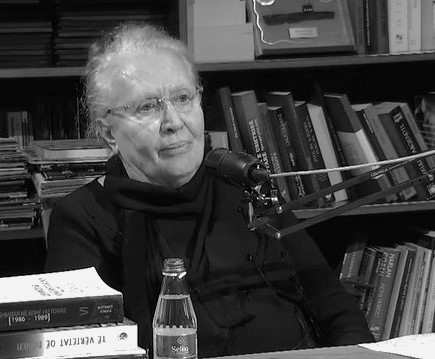
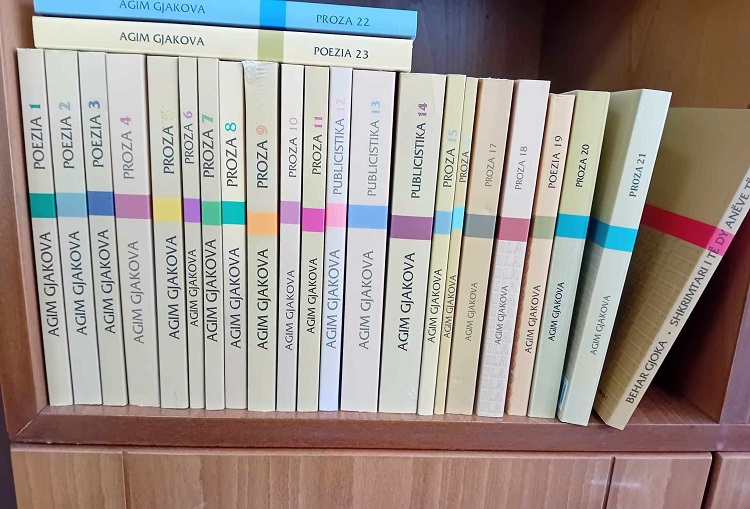
Memorie.al / In the spring of this year, I was in Tirana when I received a phone call from my brilliant and noble friend, Kozeta Mamaqi, who invited me to the promotion of a series of works – prose and poetry – by the dimensional author, her friend, Prof. Agim Gjakova! “My first encounter” with Prof. Agim Gjakova has its origins in my early youth; this happened quite by chance, like an “intimate conversation” with his remarkable poetry and prose. At that time, I was studying Foreign Languages – in the very auditorium where the esteemed Professor had years earlier completed his higher studies in English Language and Literature. Whenever I find myself in my homeland, I welcome invitations to participate in book promotions with the sensitivity of a special pleasure in the power of the book, because it not only brings together writers, poets, and lovers of art and literature, but you also feel that human connection and pure empathy, to experience and understand the creative world of knowledge and respect for the author, both mentally and spiritually – a moment of appreciation and gratitude also for those who love and write literature.
Continued from the previous issue
“Seven Kisses” – a metaphorical and lyrical title that transcends simple eroticism; they are bridges between two shores (according to Jakov Xoxa in “The Dead River” – “A kiss closes two shores and opens two hearts”) – which are not merely a human physical act, but a mystical element, representing seven meeting points between the poet’s soul and the world, reconciling Gjakova’s spirit with fate and with the people who surround him. “Seven Kisses” here are transformed into an existential blessing, in the search for love and peace after a long despair or extended social and personal turmoil. The kiss is love, and peace that comes after life’s storms; “I kiss the earth… / I kiss the foaming sea. / I kiss the forest, / I kiss the doorstep of my home, / I kiss the vineyard, / I kiss the path of childhood, / I kiss my mother’s photograph.”
“Seven Flowers” symbolize fading, beauty, but also the fragility of life and memory. Each “flower” is a poetic station that touches a particular dimension of life: love, homeland, suffering, loyalty, and resistance. The poetic cycles; “Seven Radiances” / “Seven Journeys” carry an important symbolic and philosophical weight, the wisdom and spirit of the poet; radiance implies energy, light, intellectual and philosophical awakening as a spiritual refuge to find tranquility, and they represent purity, youth, and the survival of the human spirit in the face of violence, oppression, and persecution; The verses of “Seven Radiances” are symbols of light and knowledge, radiations of free thought, and of hope that penetrates through darkness; (The Glasses)… “Set the forest ablaze, / shatter the moon, / light up the star. / (The Rainbow)… sketches a wrinkle on me, / like a dizzying discovery. / (The Lipstick)… sharpens my desire, / stirs my fevers, / …into a whirlpool of provocations. / (The Neck-scarf)… casts the gloom away from me, / spins the whole globe around me.”
While in the cycle “Seven Journeys” – the poet even accompanies it with subtitles such as – “My first habit / second / third / fourth / fifth / sixth / and seventh in the soul” – he expresses his emotional escalation that carries spiritual maturity, the dimensional secret of love and human pain. “Habit” is the unique and lyrical dialogue of feeling, the continuous spiritual journey of the poet between his travels and wanderings; “in the eternal kingdom of feelings” / but… “he does not stop travelling” – until – “and I find the likeness of love” – versifies the poet.
“Habit” begins with the first, which shows the starting point of feeling, innocence, childhood, or the first spark of consciousness; in the “second”, the encounter with love or the world that surrounds him; the “third” culminates with youthful feelings, inner fire, desires, and creative energy; the “fourth” tells us of the turning point; the “fifth” reflects: wisdom, self-examination, acceptance of life’s fate as it comes – that fate written somewhere in “the thirds of birth, of coming into this world”, until he reaches that maturity of emotional storms in the “sixth habit” beyond the real, the material, the mystical, art, and complete spiritual freedom.
In the “seventh habit” he reaches absolute peace, between the divine, the human, and the eternity of memory. The cycle “Seven Journeys” symbolizes human values, directly linked to the calvary, political and social persecution, sacrifices to be free, for the great truth, identity, memory, integrity, and national dignity. The poet travels through the wings and a healthy mind, to find the meaning of life, justice, and absolute freedom in a troubled world beyond the walls of censorship. “Seven Flights” reflect Gjakova’s ability to turn personal experiences into universal experiences, the combination of art with the philosophical, the artistic, the psychic, and the spiritual; the freedom of the unceasing wandering of the human spirit toward the unknown and the beautiful, where flight is seen as a means to overcome boundaries and isolation.
In the cycle “Seven Temptations”, Prof. Gjakova reveals human duality – between fall – temptation – and raising again, the clashes in life with one’s own weaknesses, desires, inner challenges, moral dilemmas, and existential suffering, through the historical and political trials that the author and his people have undergone, from isolation, persecution, and survival. In “Seven Discourses”, Prof. Agim Gjakova stands out for his sensitivity toward the historical and socio-political fates of his homeland, which also constitute a main pillar of his motifs and experiences. The poet communicates with historical figures and historical myths to find strength; the mountain, the eagle, and the rock serve as symbols of immovability, of identity, a return to roots, to remember history, language, and ethnic heritage; each “discourse” is an act of intellectual and civic resistance!
In “Seven Painful Ones” – the poet Gjakova constructs an inner monologue on the pain of the land, using metaphors from nature – the river that rumbles or curses, the mountains, the hail – to reflect the turmoil of the soul not only of himself, but of every compatriot. The poetic cycle of pain begins with the poem “The First Pain” (NANA) – as the poet versifies: “…my lips tremble,” / my eyes moisten, / my ears ring, / my mouth goes numb.” Similarly, Prof. Gjakova’s writing style is informal, simple, written in the first person and conversational; “I call you and you don’t answer me, / shudder, fever, icy cold, / I rush, to catch up with you, / but / ohhh… / it’s your shadow, my son.”
Poet Gjakova reveals what critics call “poetry with feet on the ground, blunt and without gloves”; he expresses pain for the fate of Kosovo and Albania, striking at social hypocrisy, the loss of human values, and the deformation of the ideals of freedom by illiterate leaders or traitors, as he says in “Pains cannot be deceived like people”. Through the intertwining of the two cycles; “Seven Discourses” / “Seven Painful Ones”, Gjakova establishes a balance with mythical elements, and the pact of the intimate, melancholic, reflective, sometimes rebellious and courageous, sometimes provocative and reformist spirit, of life’s phenomena, the wounds that a people carries, and by grounding the poetic verb, with expressive energy, with vehement intensity, he speaks with his own poetic, lyrical, and aesthetic voice; the voice and dignity that do not allow his alienation. This poetic duo remains a powerful testimony of spiritual and national survival.
In the cycle “Seven Opposites” symbolizes the philosophy of life’s great contrasts and political and social reality, between good and evil, and despite the “opposites”, the cycle conveys the message of the need for balance and spiritual awakening of the individual and the nation. The cycle “Seven Scars”, the very word “scar” implies a mark, a remaining wound, or a trace of suffering. They show that every sacrifice has left an indelible mark on the poet and on national identity, recalling prisons, persecutions, violence, and ethnic genocide. The cycle “Seven Nostalgias” represents the sensitive world, the wounded spirit, and the insult to the poet’s intelligence.
Prof. Gjakova turns longing (nostalgia) for the land, for home, for parents, for the cobblestone alleys of the Bazaar, for friends of youth, for lost freedom, and for the people who surrounded him – into patience, courage, and inspiration, to keep national identity alive. Nostalgia here is not merely a passive, lyrical, erotic, or romantic feeling, but a form of spiritual resistance, which the poet cannot see or touch, so he brings it through verses. The cycle “Seven Qualities” – presents the strong and steadfast character before the tempests and storms of life; “I rout all the inventions of evil, / with the sea of confrontation” / – the dignity of the poet’s conscience; “Can you tell me where conscience is sold, / so I can spend my last money on it, / and gift it to those two-legged creatures whose hands tremble!”
Pride alias (manliness) is an extremely powerful motif that presents the connection with roots, homeland, and identity, therefore the poet Gjakova values and defends the values, traditions, and history of his people: “to stare the devil in the eye, / to shake the earth like an earthquake, / …forgive me, people, / that I was not born of clay”! Prof. Gjakova is a master of articulating emotional, moral, and artistic integrity, creating a complete harmony between the values that the poet himself holds in real life and the values he defends through his verses. Prof. Gjakova writes with truthfulness, complete sincerity, and without compromise; he remains faithful to his unique voice, describing human feelings – joy, pain, and fear – just as they truly are, without embellishing or exaggerating them falsely.
The poetic world of Prof. Agim Gjakova consists of the spiritual, real, and virtual vision of human, reasonable existence within the genetic content of tradition and faith, space and time, in which he creates that strong bond of trust between himself and the reader, making poetry feel alive, powerful, and immortal; “no one can plow my being / …forgive me, people, / that I was not born of clay!” The poetry of Prof. Agim Gjakova functions through numerical codes and numerous metaphors – when he intertwines life-flowers, feeling-kisses, and light-radiances – the poet with artistic and philosophical mastery builds a manifesto of spiritual resistance, telling us that despite the calvary of long nights of suffering and sacrifices, man finds the strength and energy to be reborn and to awaken…
Poet Agim Gjakova speaks clearly about the boundary between art and life, where the convincing illusion of art wavers. His poetry explores the tension between the temporary nature of physical existence and the enduring quality of dreams, which can offer a sense of permanence and escape. “I find no way to wipe away their filth” – and he allows us to see something that moves between reality and imagination; “only to convey them into space, / so that some deranged planet might accept them.” The verses quoted above speak of the poet’s desire to detach him from human suffering and find peace in nature. This poetry reflects a deep melancholy about escaping from a tiresome reality. The numerical and metaphorical titles testify that man, despite spiritual fragmentation or historical fractures, always seeks a structure and a point of awakening to find the meaning of his existence.
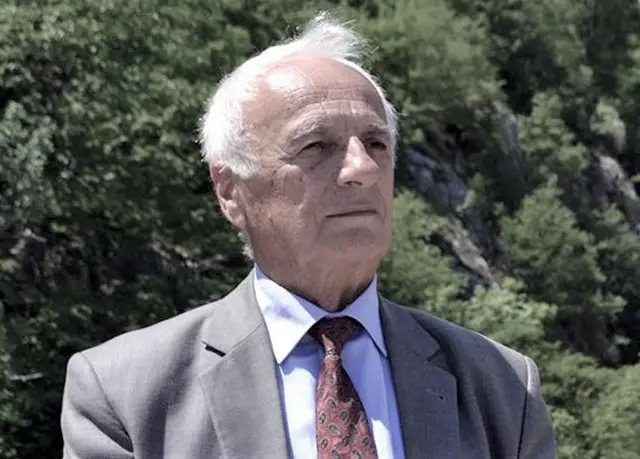
-Prof. Agim Gjakova: History and homeland – a legacy that continues even today…
The distinguished poet Agim Gjakova has devoted admirable attention to the Albanian language – extraordinarily rich, pure, direct, and well-crafted, “with feet on the ground”, yet deeply figurative. He does not use a classical rhyme structure; he prefers free verse but with an internal rhythm dictated by anaphora and structural parallelism. The division into numerical chapters gives the book the character of a literary obelisk, where each verse supports the next. His particular literary style builds a natural bridge of communication between the two main dialects of Albanian. The grammatical structure, jargon and linguistic reach, verb tenses, and spelling of words show that the author has excellent and professional knowledge of the Albanian language.
His origin and life between Kosovo and Albania – he completed his early education in his homeland, Kosovo, and after his family’s expulsion, he finished his higher studies at the University of Tirana, in English language and literature; then he worked for decades as an editor and screenwriter – which made Prof. Gjakova an excellent master of Tosk and standard language, and a fervent defender of the purity of the Albanian language, who avoided unnecessary foreign words by utilizing the internal resources of both dialects.
Both in poetry and prose, Prof. Gjakova does not abandon the strength, rhythm, and lexicon of Gheg, but he enriches it with the structure and softness of Tosk. Prof. Gjakova’s novels and poetry always open doors, and always reach the reader. What shines in his dimensional creativity is Prof. Gjakova’s eternal passion for poetry and literature. His unyielding passion proves that good literature survives every storm – a legacy that continues even today, when we look back on his creative journey, we see a rich literary monument. For many generations of readers, his name is not merely a name on a cover; he is a guide through different literary worlds.
Figures and national and historical values such as the distinguished poet and writer Prof. Agim Gjakova must be appreciated with pride and national dignity, for art and culture, for Albanian letters and future generations; he taught us that the writer is not merely an observer, but a witness to his own eras and times. Wise, measured, active, and with a great spirit, even with nine decades on his shoulders, Prof. Agim Gjakova continues to give us brilliant works from his soul, talent, and creative passion – his free and rebellious spirit, which never bowed, always in the name of the humane and human love. Prof. Agim Gjakova remains a multidimensional personality who has left an indelible mark on our culture. His work and legacy live on in full, inspiring today and always future generations and scholars of national history. / Memorie.al