
By Raimonda Moisiu-SADE
Part One
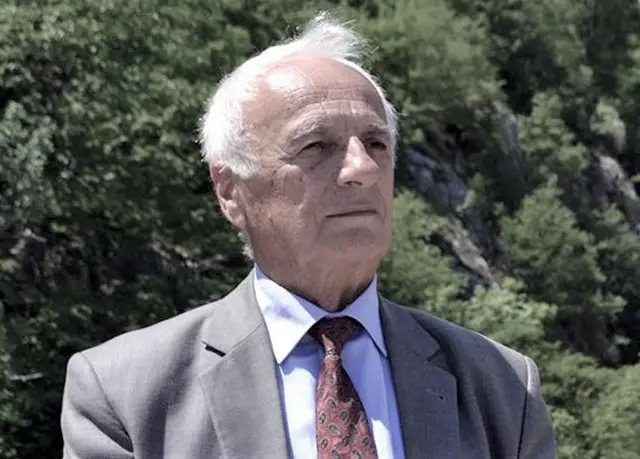
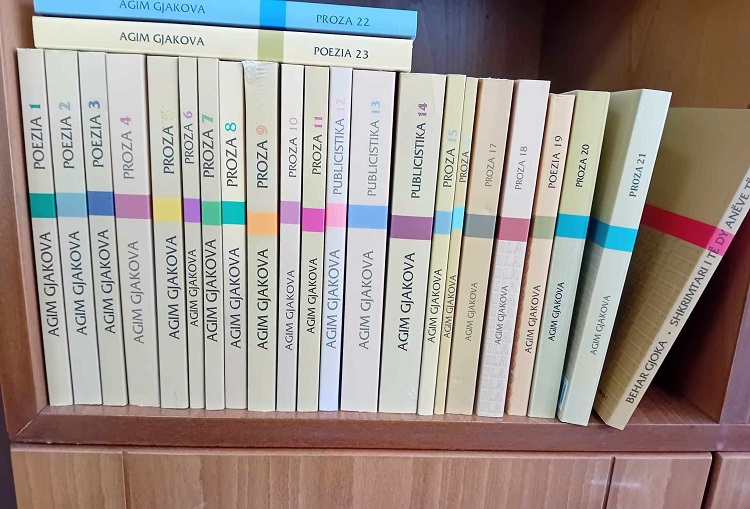
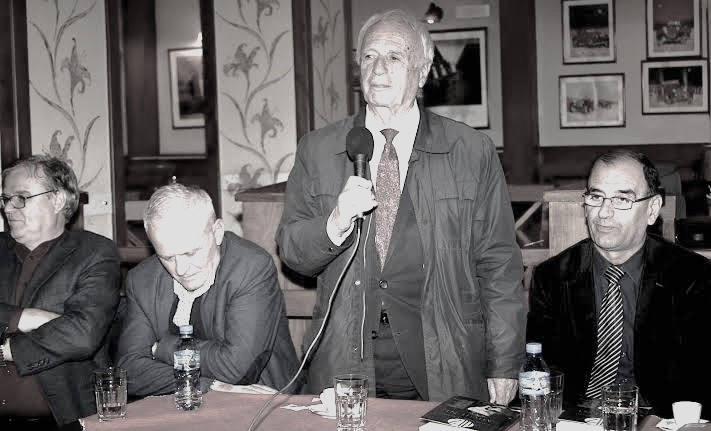
Memorie.al / In the spring of this year, I was in Tirana when a phone call came from my brilliant and noble friend, Kozeta Mamaqi, who invited me to the promotion of a series of works – prose and poetry – by the dimensional author, her friend, Prof. Agim Gjakova! “My first meeting” with Prof. Agim Gjakova has its origins in my early youth; this happened quite by chance, as an “intimate conversation” with his remarkable poetry and prose. At that time, I was studying Foreign Languages – in that very lecture hall where, years earlier, the esteemed Professor had also completed his higher studies in English Language and Literature. Whenever I find myself in my homeland, I welcome invitations to participate in book promotions with the feeling of a special delight in the power of the book, because it brings together not only writers, poets, and lovers of art and literature, but also makes you feel that human connection and pure empathy, to experience and understand the creative world of knowledge and respect for the author – mentally and spiritually – a moment of appreciation and gratitude also for those who love and write literature.
The invitation to the promotion of Prof. Agim Gjakova’s work was an opportunity for harmony, trust, and an excellent way to spend a few pleasant, productive, and cultured hours. There, numerous writers, poets, well-known publicists, old friends and colleagues, as well as younger ones, gathered, conversed, and appreciated Prof. Gjakova’s literature. Each of them expressed their own word about this noble, modest, and illuminating man, about his rich literature – not only in quantity – over dozens and dozens of published books – but also executed worthily, qualitatively, and in a completely unique manner. Indeed, it was emphasized about Professor Gjakova that: “his literature deserves much more appreciation and attention!”
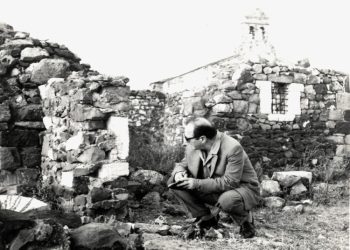
Prof. Agim Gjakova is one of the most interesting and long-lasting figures in Albanian literature; he has an extraordinary human story and creative output. To write about and bring to the attention of the reading audience and the Albanian nation the creative biography and beauty of the rich Albanian language of the prose writer, playwright, screenwriter, publicist, and poet Agim Gjakova, means to enter a world where the art of words intertwines with the depth of universal knowledge, reflecting the unyielding rebellious spirit, touching hearts, and elevating the sense of national belonging.
The creative journey of the distinguished writer Prof. Agim Gjakova begins where our curiosity for literature begins – from the school benches. He never confined himself within a single framework, but challenged himself and the Albanian word in every genre: as a poet and storyteller, touching the soul of the young and adult reader; as a novelist and writer of romances, building intricate structures and vivid characters; as an essayist and scholar, keenly analyzing society and literature; and as a talented folklorist, collecting and preserving the treasures of the popular spirit.
To date, Prof. Agim Gjakova has published over 30 books, including dozens of novels – his latest novel “The Disobedient One” (“I pabinduri”) and “The Girlfriend of Four Boys” (“E dashura e katër djemve”) – and dozens and dozens of collections of poetry, prose, journalism, and particularly documentary literature. What make his profile special is his intellectual courage and the mastery of narrative of an unyielding rebellious spirit. In every line he writes, he walks the thin line between the possible and the impossible. Like a true master of storytelling, he managed to turn the hardships of his time into enduring art.
Prof. Agim Gjakova is an erudite, prolific prose writer, and modernist poet who are not satisfied merely with momentary inspiration and personal feelings. He builds bridges between eras, connecting the classical past with the modern concerns of the time he lives in. He builds lasting bridges of communication – always “In Search of the Truth” – between poetry, prose, journalism, philosophy, history, ancient myths, and heroes. The rhythm and warmth of his creative style reflect the unyielding spirit and the special connection to Homeland and History – the compromise he has made with the many admirers of his work.
In Albanian, national, Balkan, and international letters, emblematic figures such as Prof. Agim Gjakova represent the pantheon of humanistic thought, citizenship, knowledge, and wisdom, revealing an extraordinary erudition. The synthesis of poetic lyricism and documentary literature in the works of Prof. Agim Gjakova represents a unique model in contemporary Albanian literature, harmonizing two often distant poles: deep lyricism and documentary precision. Gjakova is not content with the cold reflection of facts; he clothes them with a high human sensitivity, so that real events do not remain mere chronicles, but are transformed into spiritual experiences for the reader.
As a writer who witnessed and created through decisive historical phases, Gjakova serves as a connecting bridge between three eras: Modern History, where the basis of his style – socialist realism – is established, from which he inherits attention to social context; the post-communist era, where he gains full freedom of expression and objective analysis; and the post-communist period, where he achieves the peak of his journalistic and artistic work. His culminating publicistic and artistic achievement is identified in the field of documentary literature – a “hybrid interweaving” between artistic literature – fantasy and feeling – and documentary literature – fact and testimony – protected by a strong aura of professional integrity. Prof. Agim Gjakova proves to us that historical truth and aesthetic beauty can coexist without harming each other.
– The Metaphor of the Free and Rebellious Spirit, Which Never Bowed, in “Gjakovian Verses”
To be a poet, or the very term poetry in the essential sense of the word, implies seeing the world with the sensitivity of the beauty of an artistic soul, where every human experience or emotion springs from the impulsive sensitivity of the free spirit, talent, and artistic maturity, which exists within everything human and, in accord with the freedom of expression, transforms into a vibrant poetry that goes beyond written verses. Among the dozens of poetry volumes, I chose to analyze the one titled “Poetry 19″, by the distinguished prose writer, playwright, screenwriter, publicist, and poet of the nation, Prof. Agim Gjakova.
The structure of this poetic volume is built in sensitive cycles through metaphorical and numerical titles, carrying a weight of symbolic and philosophical grandeur. Poetic cycles that represent one of the most intimate and dramatic pillars of the poet’s lyricism; they carry a heavy biographical weight, considering that the poet lived under two dictatorships and was expelled from Kosovo to Albania, where he faced isolation and persecution. The volume contains lyrical poetry, with a civic, intellectual, patriotic tone – memories, longing, pain, and love – expressing the exhilaration and enthusiasm of a fragile community. In our case, as in the poetic volume “Poetry 19” , it represents a victory achieved in freedom, social progress, romanticism, inspiration of the muses, and the declamation of spiritual and physical beauty in classical versification.
Each poetic cycle represents a single theme related to Prof. Agim Gjakova as an individual and as a poet of a troubled and rebellious spirit, who has challenged regimes and suffered persecution. This life experience is deeply reflected in the structuring of his poetry. Life experiences and creative dedication -such as sincerity of feelings, loss, pain, loneliness, love, hope, intimacy, exhilaration, or enthusiasm – these sentiments of life, the poet feels it necessary to give voice to, casting them into verses and poetry. The poetry of Prof. Agim Gjakova is narrative – not abstract – it emerges from the actual reality of the world we live in and the simplicity of everyday life. The genius of his ambition as a poet is balanced by a cold sense of absurdity, with sparks of gentle self-mockery, muses, meditations, and speculations about life, the eternal things of human existence – life and death.
His poetic works are magnificent; without hesitation, I use the term “Gjakovian Verses,” which include lyrical poetry, erotic poetry, love poetry for the homeland – Albania and Kosovo – for the birthplace, and poetry with social, historical, and reflective themes that amplify the expressive style of beautiful pain – love! Poet Gjakova blasphemes in the name of human instinct, with the reader’s mystical conception of world-feeling, world-perception, and the achievement of a distinguished poet, placing the grandeur of real epic through the integrity of pure language, physical structure, and the profoundly poetic culture evidenced by each cycle in the context of the poems.
The book begins with a lyrical poem titled “To My Wife.” The author describes the clever, warm – but also stern – character of a physically beautiful, unique, vital, and kind-hearted woman – a wonderful woman to have by one’s side even in difficult times: “a darting of dawn through these long years / while my sky was your face through the bars / the spaces left to me were your wrinkled smiles.” Gjakova’s inspiring and explosive force is intertwined with personal memories and represents one of the most intimate and dramatic symbols of his lyricism, to express the universal – the existence of man and woman – love and inspiration!
In this cycle, the figure of the woman rises beyond a simple lyrical and romantic subject; she is transformed into a symbol of survival and fidelity. Gjakova reveals an intimate, direct, and extraordinarily sincere tone – stripped of pathos. Prof. Gjakova knows very well that people begin to grow old when they give up on love, so he begs his wife: “Smile once more for me” – with a warm but mixed language and feeling, where love serves as the only refuge against the savagery of the outside world; because “the light on the face frightens the wild darkness in a corner / and slowly tames the lion’s gaze” – to express the universal, the existence of man – love, the continuity of life.
This is also the reason why Prof. Gjakova shifts from verse to verse at every moment of the day, because the poet and the woman, the love of his life, find themselves there; “smile once more for me, / like a caravan of thorns, thoughts sting my brain, / the poison is sucked out like a bird grain by grain of wheat.” These well-placed verses in the stanza give flow to the process of visible transformation; thought follows this process – in fact, it brings it out and presents it – like a complex of metamorphoses of the image that has been shown. The logical course of this transformation is often felt as a sense of innocent guilt on the part of the poet, who, because of his political ideals and fates, has exposed even his dearest being to the storms of life, in proportion to the change itself.
In the poem “To My Wife,” the “smile” expresses optimism and the strength to survive the darkness of life; it is a powerful metaphor conveying messages of hope, intimacy, contained pain, and sadness of love. The “smile” is not merely a physical expression, but a spiritual window revealing the contrast between the poet’s inner world and reality. To challenge injustices and their fate, Gjakova hides a great spiritual wound and pain with a piercing calmness, irony, and revolt; he expresses warmth, closeness, and the magic of romantic moments; “smile once more for me, / let the colors move beyond time deeper into me, / ah what sensations, urges, and wavy explosions you evoke!”
The poem “To My Wife” contrasts “for a smile, I envy everyone” – while he finds solace in the beauty and timelessness of feeling in “the smile and eyes of his wife,” a place where “only he can enter,” because “for years, the heart has forgotten that ornament!” Prof. Gjakova suggests that memories, visions, and daydreams offer refuge from the passage of time and the transience of life, but they will never die! Each poetic cycle has as its structural axis the symbolism of the number “Seven.” The repeated use of this number is not accidental. In literature and mythology, this number represents completeness, the closed cosmic cycle (the seven days of creation), and complete transformation. Poet Gjakova, through this number, builds a closed and self-sufficient poetic universe.
Similarly, Gjakova’s writing style is an almost ritualistic structure – simple, written in the first person, and almost conversational – connected to the mythological and biblical number “seven,” which leads the reader to the discovery of his life, his struggles with the nightmare of history and the homeland, representing the culmination of the author’s existential and national upheaval. Through the cycles: “Seven Days” / “Seven Nights” – the number “seven” is the connecting bridge between the real and the mythical. Poet Gjakova plays with the duality of Day/Night, the transition from the darkness of night, where pain and nightmares dawn into the awakening of day, and the spirit is sent again to the front line of confronting difficult reality.
In the poem titled “The Seventh Night – (‘The Dreaming of the Seven’)” – Night and Dream are the spaces where the poet finds absolute freedom to hear “all the voices” suppressed by reality. Therefore, the poet uses natural elements such as “the river” to describe the inner voices of man; it murmurs, sings, curses, quarrels; “Some say the river roars, / that it gurgles, / that it chirps, / that it sings, / that it mocks, / that it gets angry, / that it speaks foolishly, / that it curses, / that it quarrels, / that it caresses, / falls asleep, / where can I find that river, / to hear all its voices.”
The “night-day” cycle shows us that Prof. Gjakova’s creativity refuses to remain static; it is in perpetual motion, just like nature itself. “Night” is connected to dreaming, meditation, the bitter memories of the past, and inner voices, while “Day” brings awakening, the confrontation with harsh reality, and the sending of the spirit and ardor toward the sky and the tangible world – an existential confrontation with truth.
The poetic cycles: “Seven Flowers” / “Seven Kisses” present the essence of the free spirit and the more lyrical, intimate, and philosophical spiritual world of Gjakova. They emerge as a dialogue with oneself, taking the form of an intimate monologue – the intertwining of deep feeling between human love; “kisses” and the spiritual beauty of nature; “flowers” that present emotional sincerity and a report on the structure of the mythical and ritual cycle of the number “seven.” Powerful metaphors that symbolize beauty, growth, hope, human connection, and the rebirth of the nature of feelings. / Memorie.al
To be continued in the next issue