Part One
Memorie.al / Today it is undeniable that the communist state led by Enver Hoxha had a highly significant and potent Intelligence and Counterintelligence system. It is equally undeniable that very little has been said about Albanian agents and intelligence networks, who operated under a mysterious veil conditioned by the very nature of this profession. Everything was done in secrecy and was masterfully camouflaged. The goal was clear: to inform the state about any possible activity directed against it. The Ministry of Internal Affairs and the Ministry of Defense, with their respective Intelligence sectors, had to work hard.
Often, the impression has been created that that regime managed to survive for so long precisely thanks to the efficient activity of its intelligence officers, most of who had been trained in Russian intelligence schools. By then, Enver Hoxha had created his communist state and needed to be extremely vigilant in protecting it from anyone who sought to undermine it. And it seems that in the early post-liberation years, the highest risk to the country was posed by the reactionary emigrants who had left during the war.
These were representatives of various currents—nationalists or Zogists, but also former supporters of Enver Hoxha who did not agree with the regime he had established and found the opportunity to leave for various European countries. But how were they behaving in the countries where they had emigrated? Was it true that they were organizing and preparing to find ways to overthrow communism? And what goals did the governments of neighboring countries have? These were all questions that required answers. But how did the Albanian state of that time manage to secure all the necessary information?
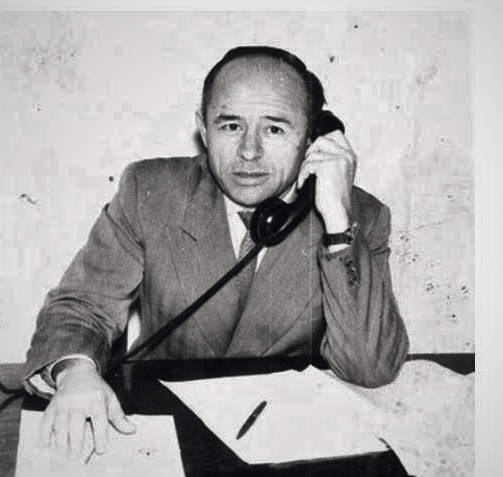
In the following account, the former director of Political Intelligence, Jonuz Mersini, reveals details about his life and mysterious missions across Europe. How was Albanian intelligence officers disguised under the cloak of diplomacy? How did they manage to convince emigrants to cooperate, thereby risking not only exposure but also their lives? Here is how an intelligence officer equipped with a diplomatic passport carried out illegal duties.
Mr. Mersini, during a part of your life, you were involved in Albanian Intelligence work in several countries. What was your task there, and how efficient was Albanian Intelligence at that time?
My tasks in different countries and at different times were varied; however, the main goal of my work in intelligence, as well as that of other intelligence officers, especially outside Albania, was the identification and selection of certain individuals who could serve Albanian intelligence.
Was your stay outside Albania considered a legal or an illegal assignment? What was the procedure followed in such cases?
It depended. There were cases where my task was solely agent work, and there were other cases, for example: at our legation in Italy, where I was transferred in 1954, in addition to directing the residency, I also carried out the legal duty of counselor at the Legation.
What was the prevailing climate in Italy, and where did you concentrate your activity?
First, I want to dwell a little on the events that preceded my transfer to Rome. It seems that around 1951-1952, at the Intelligence Directorate within the Ministry of Internal Affairs, our residency in Rome had provided the center with information that a diversionary group was being prepared to be landed in Albania from the center in Malta. The “Free Albania” committee, led by Mit’hat Frashëri and Western intelligence services, Ahmet Zogu and his followers with Abaz Kupi at the head, and Alush Leshanaku—one of the most active leaders of the emigration against us, who had infiltrated across the border from Greece several times—were involved in this activity.
This time, according to data from our residency in Rome, the diversionary group was to be larger and would include several leaders of this emigration, operating in Northern and Central Albania. The group consisted of Ndue Gjonmarku, Haki Blloshmi, Alush Leshanaku, etc., and had been prepared by Italian Intelligence and the “Independent Bloc,” of which Ismail Vërlaci was also a member. Ismail operated from Rome and was married to an Italian woman.
After the capture of Alush Leshanaku’s group, Ismail Vërlaci—the son of Shefqet Vërlaci, who had been a house friend of Leshanaku—became confused and remained passive in his actions for a certain period. At precisely this moment, I decided to take advantage of the situation to infiltrate a man whom I thought would greatly assist our Intelligence regarding diversionary groups.
And what did you decide to do?
A short time after starting my duty in Rome, I came to Albania for some work and also to take my regular leave. During a conversation with the Director of Intelligence at the time, General Zoi Themeli, I decided to tell him about Ismail Vërlaci’s situation. Apparently, Zoi discussed this fact with the Minister of Internal Affairs, Kadri Hazbiu, and after a few days, both of us were summoned to the minister’s office.
“You must go immediately to Elbasan and meet Shefqet Vërlaci’s daughter (Ismail’s sister),” the minister ordered me. She had been placed in our service after the capture and killing of Alush Leshanaku and had provided much useful information. Kadri Hazbiu and Zoi Themeli instructed me to speak to her about her brother’s worsened situation and to ask her to write him a letter, in which she would describe the strong political situation in Albania and the fact that she herself was now in the service of the State Security organs.
In the letter she was to write, she had to tell her brother that even Alushi himself, after his capture and sentencing, had contributed in favor of the State Security and that his death had been accidental, without giving further explanations about it. I had to take this letter from her, in which she would tell her brother that not only should he cease his activity against his homeland, but she would also call on him to put himself at the service of Albanian Security. And truth be told, she helped us a great deal, without any compulsion.
Did you go to meet this woman?
Not just once. In secret ways, I met with Shefqet Vërlaci’s daughter in Elbasan several times. She, although advanced in age, was well-preserved and a beautiful woman.
How did she react?
Listen, Albanian Intelligence was never aggressive. We did not prepare the ground to invade any country. On the contrary, we wanted to protect those 28,000 square kilometers that history had left us. Fortunately, there were also some of those who had fled who did not confuse the homeland with its political system. Some of them knew about the secret Tito-Venizelos treaty for the dismemberment of Albania, and they could not agree that, for the sake of overthrowing the communist system, they would accept that their homeland be divided between Greek and Yugoslav chauvinists.
At the time when the very name “Albania” would no longer exist, what value would the system have? This was the contingent we relied on in our work. In this specific case, after explaining who I was and where I served, she agreed to talk. I explained everything to her about her brother and asked her to write the letter we needed to place him in the service of the State Security organs. She agreed and wrote everything I asked. In the letter, she also wrote about some of their family matters. We parted in a very correct manner. She was intelligent and assessed the situation rightly.
How did you proceed after that? Did you meet Ismail?
I took the letter, and when I returned to Rome, the first thing I decided to do was to meet him. I knew where he lived, so I decided to wait for him in front of his house. I also took with me one of our intelligence officers in Italy, Kleanth Andoni, to have him as support in case Ismail reacted by notifying the Italian police. As soon as I saw him coming, I called him by name. At first, he didn’t want to stop. Apparently, he knew me and was aware of who I was.
“Don’t be afraid,” I told him, “I just want to give you a letter from your sister in Elbasan,” and I handed him the letter. He took it, opened the envelope, and quickly glanced through it, shaking his head in amazement at what he was reading. Taking advantage of those moments of silence, I asked him to go to a nearby café to talk.
Did he object?
No. He just told me to wait for him while he notified his wife that he would be late. He came back after about half an hour and we sat down in Piazza del Popolo, where we talked at length.
During this conversation, did you introduce yourself with your real identity?
Yes, of course. By now, my goal was for him to agree to cooperate with us. He read and reread several times the letter his sister had sent him and couldn’t believe that she and Alushi had entered the service of State Security. “They entered this service without any pressure,” I replied. I emphasized this last point several times, because I understood—although he didn’t say it bluntly—that he thought they had been forced into service.
Since the conversation dragged on, I invited him to have lunch at a restaurant, but he refused, saying his wife was expecting him at home. During the conversation, he tried to put himself on an equal footing. I understood this and told him: “I am a representative of the state at our embassy, while you are just a political emigrant acting against your homeland, and nothing more.”
“But ultimately, what do you want from me?” he asked, annoyed. I told him that it was required of him to act as his sister in Elbasan had instructed—that is, to place himself in the service of his homeland. “Whatever your political beliefs, the homeland is there, for you as much as for me. I am not asking you to blow up bridges or factories, I am not asking you to become a terrorist, but to protect your homeland from any hostile activity. Do as you wish. No one is forcing you. But I advise you to join those who care about their country.” These were my words.
And the other agent who was with you, did he remain nearby during these conversations?
Kleanthi was sitting at another café near us, observing whether there was any movement from the Questura (police headquarters) nearby. We did this because I suspected that Ismail, during the time he would go into his house, might notify the Italian Counterintelligence organs.
And how did the conversation with Ismail end?
After exchanges that were more nervous on his part and less on mine, he agreed to meet other times, but with two conditions: first, that we would not ask him anything about the situation in the Italian state and Italy’s activities against us, with the justification that he had acquired Italian citizenship and could not act against it; and second, that we would not ask him anything about the situation and activities of Albanian emigrants, when he acted under the instructions and initiative of the Italian government, because in that case it would be considered activity against his state, and he could not betray the friends with whom he had lived for years in Italy.
“With these conditions you impose, and then in what directions can you be useful to us, and about what problems can you inform us regarding activities against Albania?” He told me he could provide data on the activities of American, Greek, and Yugoslav intelligence, which operated actively from their centers in West Germany, Ioannina, and Titograd. “In all three of these centers, there is active activity against you, and I am gathering data on these activities and will inform you,” he said.
Did you accept these conditions?
I accepted for the time being, with the goal that he would gradually become more involved in our service and later provide me with data on the active emigration against us as well.
Did you manage to receive information from him?
During the time I was working at the Albanian Legation in Rome, I met him several times, going near his house. He gave me some information regarding the activity developed by Yugoslav Intelligence from their center in Titograd and Greek Intelligence from Ioannina. In the last meeting, Ismail also handed me a list of Albanians who had been gathered and were training at one of the American Intelligence centers in Munich, West Germany.
I sent this list to the Intelligence Directorate in the early months of 1955, before I was transferred as a counselor at Albania’s Mission to the United Nations in New York. After my departure from Italy, I did not learn what happened further with Ismail, because it was not permitted to ask about agent matters with which one was no longer connected…”
How did our agent seduce the Italian diplomat in bed…?!
Let’s call him Xhani (John). That was the pseudonym of the foreign diplomat who became part of the Albanian agent network. In fact, his origin was from the Albanians of Calabria, and this career diplomat, who spoke Albanian very well, often expressed sympathy for the land of his ancestors. Skënder Konica, who had directed the Albanian residency in Xhani’s place of residence, had managed to establish a friendship with him and, treating him as a friend, was able to use him to obtain important data and information. His successor, Jonuz Mersini, maintained the same attitude toward this diplomat.
Coincidentally or not, after many years, he would come on duty to his country’s embassy in Tirana. This was the right moment to make him a full collaborator with Albanian Intelligence. Now back in Tirana at that time, Jonuz Mersini decided to study Xhani’s character carefully. Being unmarried, he could not fail to be fond of women. This is precisely where the Albanian agent would come into play. A beautiful, single woman who, above all, very much enjoyed intimate relationships with foreigners. Her task was clearly defined: to seduce him and take him to bed.
Apparently, trained in this role, it took her very little to accomplish the mission. And not only that. The agent ensured that their intimate moments were photographed. She was not afraid of photographic exposure. Through another Albanian intelligence agent, who was disguised as an employee of the Ministry of Foreign Affairs, the photos in which he and the Albanian agent appeared in the most intimate moments reached Xhani’s hands. Now he had nowhere to turn. He was forced to further strengthen his cooperation with Albanian intelligence. / Memorie.al