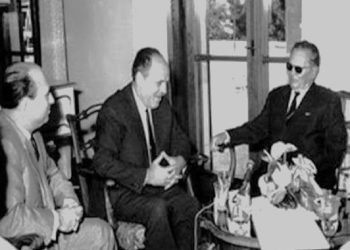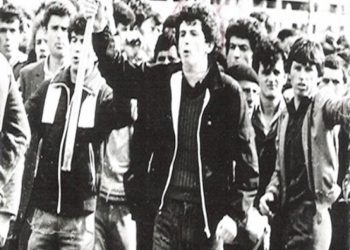
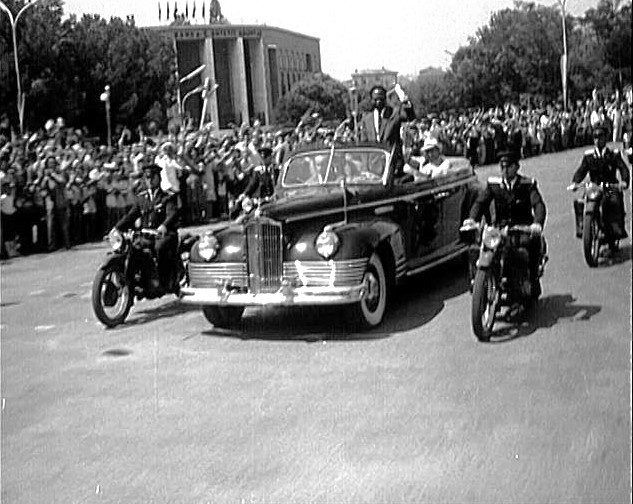

Memorie.al / In Albania, the latest waves of emigration from Africa have raised questions about notions of hospitality and racism in the country. Encounters between Albanians and Africans in Western Europe highlight the ethno-racial distinction between “diasporic” communities as they struggle for recognition and resources. But how did communist ideology in the past mediate relations between Albanians and Africans? Socialist Albania was a vocal supporter of anti-colonial battles in Africa and established relations with several newly independent states. Symbols of independence movements such as Kwame Nkrumah of Ghana and Haile Selassie of Ethiopia visited Albania.
Albanian ties to anti-colonial figures
The end of colonial rule in the early 1960s coincided with the deterioration of Sino-Soviet relations and the rupture of Albanian‑Soviet relations. Albania strengthened its ties with China in an effort to create a front against Western capitalism and Soviet “revisionist” influence in Africa. Through diplomats in Accra, the Party of Labour of Albania established links with members of the Union of the Peoples of Cameroon (UPC), Abel Kingue and Ndeh Ntumazah.
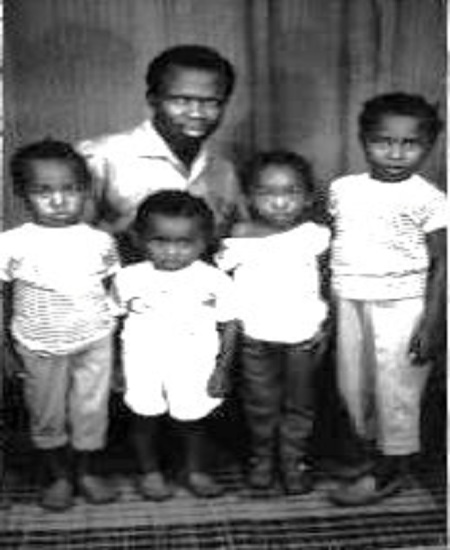
To support their struggle against the neo-colonial regime in Cameroon, the Albanians welcomed Ntumazah’s children and wife in 1964. Three years later, in 1967, Albania became the permanent residence of the children of Elise Osendé, who was most likely the wife of Osendé Afana. Afana, also from the UPC, was killed in combat in 1966.
The Albanian embassy in Algiers served as a point of contact with Congolese activists. After a Cuban colleague told him about Che Guevara’s exploits in the Congo, the Albanian ambassador in Algiers recommended that the government in Tirana host three Congolese students who had been expelled from Belgium for political reasons, as well as the wife and child of one of them. The students were advised to go to Albania by Jacques Grippa, the head of the Communist Party of Belgium, who planned to go to the country on vacation.
Several Congolese students and activists travelled to Albania in the mid‑1960s. In 1966, a year after the coup that brought Mobutu to power, 15 Congolese children and one child born in Uganda arrived in Albania. Among them was the child of revolutionary activist Willem‑Emmanuel Kabasu Babo.
Kabasu Babo travelled to Tirana in 1967 with Constantin‑Marie Kibwe and Thomas Mukwid. In the Albanian capital, they reached an agreement to form a Marxist‑Leninist party that was established in the Congo as the Communist Party of the Congo. Babo returned to Albania in 1970, inquiring about the conditions of the Congolese children and asked the Albanian government for financial and logistical support in exchange for diamonds, gold, uranium, mercury and cocaine.
The government rejected the request after Babo was expelled from his party due to alleged pro‑Soviet tendencies.
Growing up in 1970s Albania
The Congolese and Cameroonian children were between 2 and 15 years old when they arrived in Albania. They were raised without their parents, some of whom were killed in combat. Until the mid‑1970s, the Albanian authorities paid them little attention, but interest grew when most of them reached adolescence and some began to display divisive tendencies.
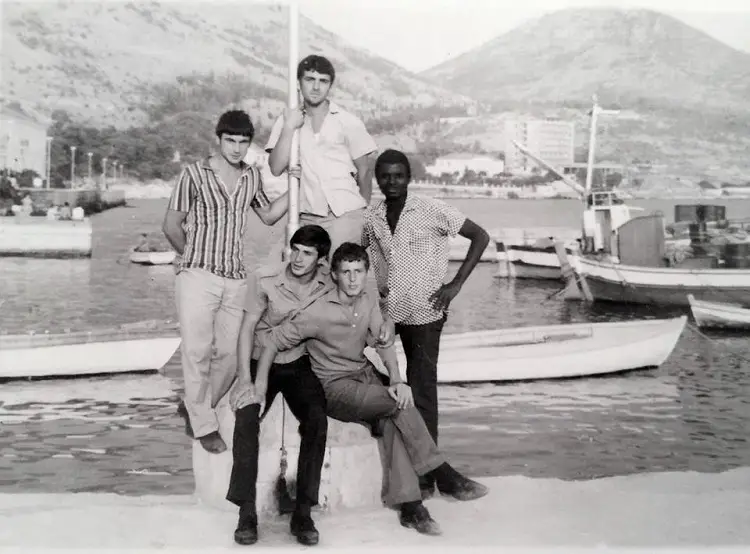
In 1974–75, local communist party leaders in Vlorë, on the Adriatic coast, complained about the “unpleasant behaviour” of the “Congolese” young men José (“Zhose” or “Zhozef” in Albanian archives) Makanga and Vitali Pakasa, aged 15 and 16 respectively. The pair was accused of dropping out of school, associating with “degenerate elements” among “our youth”, and being violent and abusive. They were also said to be following Western fashion and music.
Archival documents contain traces of an ongoing policy of marginalisation. In one letter, the racist term “zezak” (lit. “blackie”) is used when referring to Pakasa and Makanga. According to the communist leaders of Vlorë, the two youths should either be put to work like all other emigrants or expelled from the country. The pair rejected the accusations; Makanga protested their treatment and both asked the local authorities either to send them back to the Congo or to imprison them.
Makanga’s emotional state deteriorated to the point that he cut his wrists with a piece of glass. He wrote to communist leader Enver Hoxha to denounce his treatment by the Albanian authorities, but the letter is missing from the archives. In 1978, a report by the Ministry of Culture acknowledged that the local authorities had marginalised the Congolese children, stating that they had come to Albania at a very young age but were treated as foreigners and felt this.
African teenagers in Elbasan had a similar experience. In April 1975, local communist authorities complained about inappropriate behaviour from Joseph (“Zhozef” in the archives) Osendé, the son of Elise Osendé, and Jean Mate (“Zhan Mate/Mat” in the archives). Both had praised the Soviet Union. Osendé, who had once lived there, claimed that young people had more opportunities for entertainment. Osendé dropped out of school and spent his time reading novels, playing table tennis and listening to music on the radio. The local authorities recommended that the “African” students be removed because they were “undesirable”.
Moneng Charles (“Mon Eng Sharl” in the archives), an older student, drew the attention of the Albanian authorities in 1976. According to the Ministry of the Interior, Charles spread revisionist literature and propagated decadent Western music and lifestyles. He had committed “immoral” acts with many Albanian and foreign girls and had relations with personnel from the Polish and Bulgarian embassies, the ministry claimed.
Charles was expelled from Albania on 27 January 1977, when he still needed two and a half months to graduate from medical school. Before boarding the plane, Charles gave the agents accompanying him a cassette tape with a message for Hoxha. Speaking as if on behalf of all the Congolese students, Charles rejected the accusations against him but said he would remain grateful to Albania. He also mentioned that he often felt lonely in the country and asked the party to take care of the other Congolese because they might achieve more than he had.
Limited impact on international relations
The spread of communist movements and the end of colonial regimes created forms of solidarity that challenged the racist ideology characterising relations between Europeans and Africans.
However, the effects of the communist movements were limited at the level of foreign and international relations.
They did not touch the intimate structures of socialist society where foreigners and some minority groups continued to be marginalised because of their ethnic and racial background. This demonstrates the limits of state‑driven inclusion policies and sheds light on past and present forms of solidarity between Albanian and African citizens that go beyond institutionalised spaces and relationships. /Memorie.al